
Learning Russian in Miami: What Adult Beginners Should Know Before Choosing a Class
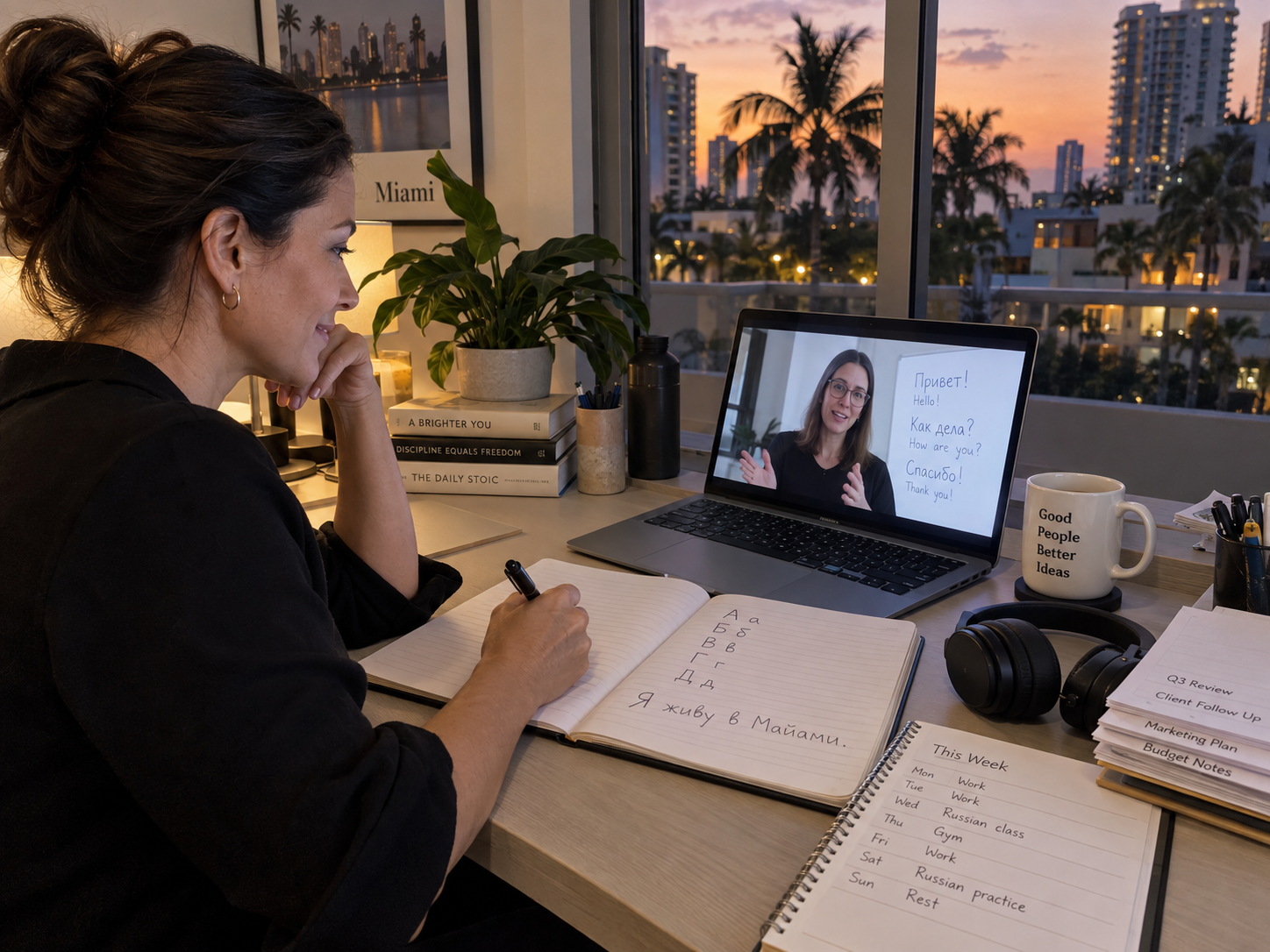
The first Russian class can feel harder to choose than the language itself.
Search for Russian classes in Miami and the results quickly become messy. Some language schools do not actually offer Russian. University courses may be designed primarily for enrolled students. Private tutors vary enormously in teaching style. Online programs range from serious live instruction to prerecorded videos that leave learners essentially teaching themselves.
Meanwhile, Miami presents an unusual contradiction: formal adult Russian classes are not nearly as ubiquitous as Spanish classes, yet Russian is very much present in South Florida, particularly as you move north toward Sunny Isles Beach and Aventura.
For a complete beginner, this means the most convenient class is not automatically the right class—and the closest one may not even be the most practical.
Before paying for a course, it helps to understand what a good beginner Russian class should actually do, what questions to ask, and which apparent advantages matter much less than they seem.
“Beginner Russian” can mean several completely different things
This is the first problem with class listings.
A true complete beginner may know nothing beyond da, nyet, and perhaps spasibo.
Another person calling herself a beginner may have studied Russian in college fifteen years ago and forgotten most of it.
Someone else may have a Russian-speaking spouse and understand a surprising amount of everyday conversation without knowing how to read Cyrillic.
A heritage learner might speak naturally with grandparents but have never formally studied grammar.
And an app user may recognize several hundred Russian words while being unable to answer:
Как вас зовут?
Kak vas zovut?
“What is your name?”
without several seconds of mental assembly.
These learners should not necessarily be in the same class.
One of the first questions to ask a school, therefore, is not simply:
“Do you offer beginner Russian?”
Ask what students are expected to know before the first lesson.
A genuine complete-beginner course should not assume that students already read Cyrillic or understand Russian grammar.
If the course description casually mentions practicing cases and expanding conversational vocabulary, it may be a continuing beginner course rather than a course for someone starting at zero.
Do not choose a Russian class because Cyrillic looks intimidating
The alphabet frightens a disproportionate number of prospective Russian students.
It is also one of the least sensible reasons not to start.
At first, Russian appears visually impenetrable:
Здравствуйте.
Then there are the letters that seem to be playing tricks:
В sounds like V.
Н sounds like N.
Р sounds like R.
С sounds like S.
У sounds roughly like “oo.”
English-speaking eyes spend years learning what those shapes mean in the Latin alphabet, so initially they keep trying to interpret them the English way.
But the Cyrillic alphabet is a finite system. With regular practice, adults generally get through the “this looks impossible” stage much faster than they expect.
A beginner class should teach Cyrillic from the beginning and start using it quickly.
Be cautious of a course that keeps students dependent on English transliteration for months:
privet, menya zovut, ya zhivu…
Transliteration is helpful for the first few encounters with Russian. Eventually it becomes training wheels that are surprisingly difficult to remove.
Russian makes much more sense when:
Я живу в Майами.
stops looking like code and simply reads as:
Ya zhivu v Mayami.
“I live in Miami.”
The teacher matters more than whether the teacher is a native speaker
Many adult learners automatically search for a “native Russian teacher.”
Native ability is useful. It gives an instructor natural pronunciation, idiomatic language, and cultural knowledge.
It does not automatically make someone good at teaching beginners.
Knowing Russian and knowing how to explain Russian to an English-speaking adult are very different skills.
A teacher needs to understand why an American learner finds certain things confusing.
Why does:
Я люблю Москва
not work?
Why does Moskva suddenly become:
Я живу в Москве.
Ya zhivu v Moskve.
“I live in Moscow.”
Why does:
мой друг
my male friend
become:
с моим другом
with my male friend?
A good teacher does not merely say, “That's the instrumental case.”
The teacher gradually makes the pattern comprehensible and then gets students to use it often enough that grammar begins moving from analysis into speech.
When considering a Russian course, look for evidence of actual teaching experience with non-native adult learners, not simply native fluency.
Ask how much you will actually speak
This question matters more than almost anything on a school's website.
A course can advertise itself as “conversational” while giving each student five minutes of speaking time in a 90-minute lesson.
Class size matters here.
Imagine a teacher asks students to practice:
Что вы делали вчера?
Shto vy delali vchera?
“What did you do yesterday?”
In a class of four, everyone can answer, make mistakes, hear corrections, ask follow-up questions, and try again.
In a class of twenty, most people are listening.
Listening is valuable. It is not the same skill as speaking.
Russian makes this particularly important because learners have to manipulate endings while talking. Knowing that a noun should change is one thing. Changing it correctly while simultaneously choosing vocabulary and following a conversation is another.
A beginner should be speaking from the first weeks—even if those first conversations are extremely simple.
Grammar should neither dominate the class nor disappear from it
Russian teaching tends to go wrong in two opposite directions.
The traditional version can become a parade of tables:
Nominative.
Accusative.
Genitive.
Prepositional.
Dative.
Instrumental.
Memorize the endings. Complete thirty exercises.
The reaction against this approach sometimes goes too far in the other direction: “Don't worry about grammar; just speak.”
That sounds appealing until every sentence requires grammar.
Russian needs explicit explanation.
What it does not need is grammar detached from language.
A useful beginner course might introduce:
Я живу в Майами.
Ya zhivu v Mayami.
“I live in Miami.”
Я работаю в банке.
Ya rabotayu v banke.
“I work in a bank.”
Я учусь в университете.
Ya uchus' v universitete.
“I study at a university.”
Students start noticing that locations often appear after в with a changed ending. Only then does the grammatical label become useful.
The best question is not whether a course “teaches grammar.”
It should.
The question is whether grammar is repeatedly brought back into real sentences.
Pronunciation deserves attention earlier than most beginners expect
Russian spelling is relatively systematic once Cyrillic becomes familiar.
Russian pronunciation is less straightforward.
Consider:
молоко — moloko — milk
There are three written о vowels, but they are not normally pronounced identically because unstressed vowels are reduced.
Word stress is crucial in Russian, yet normal Russian writing does not usually mark it.
Students therefore need to learn not simply:
молоко
but effectively:
молокó
with an awareness of where the stress falls.
Then there are hard and soft consonants, unfamiliar consonant combinations, and ы, the vowel that has inspired generations of English speakers to make deeply strange facial expressions in Russian classrooms.
A beginner class does not need to turn pronunciation into phonetics graduate school.
But the instructor should be correcting stress and basic pronunciation from the beginning.
Incorrect habits become more stubborn after hundreds of repetitions.
Miami makes the online-versus-in-person decision unusually practical
Some people unquestionably prefer a physical classroom.
There is value in leaving the house, sitting across from other learners, putting the phone away, and having one location associated with Russian.
But Miami geography has a way of turning apparently modest distances into meaningful weekly commitments.
A learner in Brickell, Coral Gables, Kendall, Miami Beach, Aventura, and Sunny Isles Beach may all be searching for “Russian classes in Miami” while having completely different definitions of nearby.
The relevant calculation is not mileage.
It is:
How much of my Tuesday evening does this class actually consume?
If a 75-minute lesson requires getting ready, driving across Miami, parking, taking the class, and driving home, it may become a three-hour commitment.
That can still be worthwhile.
But compare it honestly with a live online class that begins when the laptop opens and ends when it closes.
The mistake is treating online instruction and recorded courses as the same thing.
A live online class still has an instructor. Students answer questions, speak to classmates, receive corrections, and attend at a scheduled time.
For an adult learner, the question is less “Is online as good as in person?” than:
In which format will I consistently attend and actively participate?
If you choose an online class from Miami, check the time zone before paying
This sounds embarrassingly obvious.
It causes problems anyway.
Many online language schools advertise nationally, but class schedules remain tied to the school's home time zone.
Miami is on Eastern Time. A 6:00 p.m. Pacific class is therefore a 9:00 p.m. class in Miami.
That may be perfect for someone who has children, finishes dinner, and finally has quiet time at nine.
It may be terrible for someone who starts work at 6:30 the next morning.
Do the conversion before becoming attached to the course.
And check whether the class remains at the same local relationship when daylight-saving changes occur. U.S.-based schools usually shift together, but international instructors and programs may not.
Adult language learning contains enough grammatical complications. There is no need to add accidental scheduling ones.
Miami's Russian-speaking community is useful—but it is not a substitute for instruction
One advantage Miami learners have is that Russian does not exist only inside the classroom.
The language has a visible presence farther north in Miami-Dade, particularly around Sunny Isles Beach and neighboring communities.
The Sunny Isles Beach Branch of the Miami-Dade Public Library System, for example, hosted adult Russian Social Clubevents in 2026 in which presentations were conducted in Russian.
Chabad Russian Center in Sunny Isles Beach also serves a longstanding Russian-speaking community and offers community and adult programming. Its own site says the organization has operated in Sunny Isles Beach since 2003.
For a learner, these resources matter because they provide something textbooks cannot: evidence that Russian is being used around you by actual communities.
But complete beginners should have realistic expectations.
Walking into a Russian-language cultural event after three lessons will not magically create immersion. You may understand almost nothing.
That is fine.
At first, recognizing спасибо, a number, someone's name, or a phrase you learned last week can be surprisingly motivating.
Later, these environments become much more useful.
Language exchanges are practice, not classes
Miami also has social opportunities for language practice.
INT'L CAFÉ Miami has been running multilingual language-exchange events in 2026, normally on the fourth Saturday of the month, and Russian is among the languages the organizers say are generally represented. The events are intentionally social and can be noisy and crowded rather than resembling structured instruction.
There is also a Russian-speaking Meetup group in Miami, although its page currently shows no upcoming events.
These can become useful additions once you have enough Russian to sustain a few minutes of interaction.
They are much less effective as substitutes for a beginner course.
A language exchange partner is not necessarily going to explain why you used the wrong case.
They may not even know the grammatical terminology for the correct answer.
Native speakers routinely use grammar perfectly without having any idea how to teach it—which is entirely normal. Most English speakers would struggle to explain every grammatical reason behind the sentences they produce automatically.
Use conversation events for conversation.
Use classes for structured learning.
Do not mistake a large amount of material for a good curriculum
Some courses advertise enormous libraries:
200 videos.
5,000 vocabulary words.
Lifetime access.
Six workbooks.
Forty hours of recordings.
This can sound impressive.
For a complete beginner, it may simply create forty hours of decisions.
A curriculum is not a warehouse.
A good beginner Russian course answers a more important question:
What should I learn next?
Students should move through material in an order where each new concept has something to attach to.
The alphabet leads into reading.
Basic nouns lead into gender.
Simple verbs introduce conjugation.
Location expressions start making the prepositional case meaningful.
Direct objects begin introducing accusative forms.
Possession and absence eventually make the genitive more intuitive.
The structure gradually becomes visible.
A beginner should not have to design this sequence alone.
That is one of the things the class is supposed to provide.
Ask about homework—but ask the right question
“How much homework is there?” is useful.
“How necessary is the homework?” is better.
Some classes technically assign thirty minutes of homework but teach in such a way that students who skip it can still function.
Others move quickly enough that missing assignments for two weeks leaves the student completely lost.
Busy adults should know which kind they are joining.
There is no universally correct amount.
A learner who enjoys studying may want several hours of structured work each week.
Someone with a demanding career and family responsibilities may need a course designed around one weekly class plus brief review.
The dangerous choice is enrolling in the course you wish you had time for rather than the course that fits your actual life.
Language programs lose adults this way all the time.
The problem is rarely motivation on the first day.
The question is what happens in week five.
Six questions to ask before registering
A surprisingly useful test of a Russian course is whether the school can answer these clearly:
Is this a complete beginner course, and does it assume any previous Cyrillic?
How many students are normally in the class?
How much of each lesson involves students actually speaking Russian?
Who teaches the course, and do they have experience teaching Russian to adult non-native speakers?
What happens if I miss one lesson?
Does this level continue into another course, or do I have to find a new program after the introductory term?
The last question is easy to overlook.
A four-week introduction to Russian can be enjoyable. But if the goal is serious learning, find out whether there is somewhere to go afterward.
Restarting at “Beginner Russian” with a different school every few months is an excellent way to learn how to introduce yourself fifteen times and never reach anything interesting.
What should you be able to do after a first beginner course?
Not “speak Russian.”
That standard is so vague that it is almost useless.
A short first course should produce smaller, more concrete changes.
Cyrillic should no longer feel alien.
You should be able to read simple unfamiliar words slowly rather than merely recognizing memorized ones.
You should be able to introduce yourself, ask and answer basic questions, say where you live, talk briefly about family or work, and use several common verbs.
You should understand that Russian words change form for grammatical reasons—even if you cannot yet produce every ending correctly.
And perhaps most importantly, you should be able to build something new from what you learned.
There is an enormous difference between memorizing:
Я люблю кофе.
Ya lyublyu kofe.
“I like coffee.”
and realizing that you can also say:
Я люблю музыку.
“I like music.”
Я люблю Майами.
“I like Miami.”
Я люблю русскую литературу.
“I like Russian literature.”
That small act of recombination is the beginning of actually possessing the language.
Apps are useful—but test whether you can produce the answer without seeing it
Apps fit Miami life rather well.
Vocabulary while waiting somewhere.
Cyrillic practice over coffee.
A few listening exercises before work.
There is nothing wrong with this.
The problem arrives when recognition begins masquerading as speaking.
Seeing:
Как дела?
and tapping “How are you?” is one skill.
Hearing someone unexpectedly say Как дела? and responding naturally is another.
After app practice, close the screen and see what survives.
Can you say five sentences about yourself without prompts?
Can you ask three questions?
Can you describe what you did yesterday?
Even badly?
If not, the class you choose should contain more active retrieval and speaking.
Private Russian lessons make sense for certain Miami adults
Private instruction costs more per hour, but the comparison is not always as simple as “private expensive, group affordable.”
A private lesson can make sense when:
your work schedule changes constantly;
you travel frequently;
your skills are uneven;
you are a heritage speaker;
you need Russian for a specific professional or family situation;
or the local group schedule simply does not fit.
The teacher can spend twenty minutes on the exact pronunciation problem that is holding you back rather than continuing because the syllabus says today's topic is transportation.
For a standard complete beginner with a predictable schedule, however, a good small group has advantages of its own.
You hear other learners.
You discover that everyone forgets endings.
You practice understanding Russian spoken by people whose accents are not perfect.
And, importantly, there is something socially reassuring about realizing that ы is making everyone else miserable too.
Heritage learners should be especially suspicious of class labels
Miami's Russian-speaking community means some adults looking for classes have grown up with Russian around them.
These learners are frequently placed badly.
A heritage learner might understand:
Поставь это на стол и позвони бабушке.
“Put this on the table and call Grandma.”
without consciously analyzing anything.
Then ask the same person to explain a work project in Russian and the vocabulary disappears.
Reading may be slow.
Spelling may be uncertain.
Grammar may be intuitive but inconsistent.
Pronunciation, meanwhile, may sound completely natural.
That is not a conventional beginner profile.
If you grew up hearing Russian, look for a school willing to evaluate speaking, listening, reading, and grammar separately rather than deciding your level from how fluent your accent sounds.
The Miami-specific advantage comes after class
One of the strongest arguments for learning Russian in Miami is not actually the classroom market.
It is what can happen outside class.
South Florida gives learners access to Russian-speaking communities, cultural organizations, library programming, social groups, and language exchanges that many American learners do not have nearby.
A structured class can provide the grammar and progression.
Miami can provide reminders that the language exists beyond the textbook.
Once you know enough Russian, that combination becomes powerful.
You hear something while shopping and recognize it.
You attend a social event and manage a short conversation.
You notice Cyrillic and read it without consciously “decoding” anything.
Someone answers faster than your teacher normally speaks, and somehow you still understand the point.
Those tiny encounters matter because they gradually change Russian from a school subject into something the brain expects to encounter in ordinary life.
Where Polyglottist fits for Miami learners
Polyglottist Language Academy offers live online Russian classes for adults, including complete beginner and continuing levels depending on the current schedule. Classes are taught live rather than through prerecorded lessons, and the academy emphasizes small groups, structured progression, and opportunities to actually speak. (Polyglottist Language Academy)
For a Miami learner, the obvious tradeoff is that Polyglottist's physical classroom is in Berkeley, California; the relevant option is online. Miami students should also check the listed class time carefully because schedules may be published in Pacific Time.
A complete beginner does not need to arrive already knowing Cyrillic. The beginner program starts with the alphabet, pronunciation, basic vocabulary, and elementary sentence structure before progressing into more substantial grammar and conversation. (Polyglottist Language Academy)
That sort of regular instruction can pair particularly well with Miami's local Russian-language environment: learn the structure in class, then begin noticing and using pieces of it elsewhere.
Choose the class you can still imagine attending in November
Adults often choose courses based on the first week.
The first week is easy.
The notebook is new. Motivation is high. Learning to read Москва feels gratifying.
A better test is to imagine an ordinary week two months later.
Work ran late.
Traffic is bad.
You forgot half the vocabulary.
Dinner still needs to happen.
Would you still go to this class?
If the answer is yes, you may have found the right format.
Russian is a long project. There will eventually be cases, aspect, verbs of motion, participles, stress patterns, and sentences whose endings appear to be conspiring against you.
None of those is a particularly good reason to quit.
An inconvenient class is.
For adults learning Russian in Miami, the strongest choice is therefore rarely the program with the largest curriculum, the fanciest promise, or even the shortest distance from home.
It is the class with the right level, enough speaking, competent instruction, manageable expectations, and a schedule that can survive real adult life.
Once those pieces are in place, Cyrillic is the easy part.
Frequently Asked Questions
Where can adults learn Russian in Miami?
Dedicated local group options are more limited than for languages such as Spanish, so Miami adults often combine private tutors, live online classes, independent study, and local conversation or cultural resources. Polyglottist Language Academy offers live online Russian classes for adults, while Miami-area Russian-language community activity is especially visible around Sunny Isles Beach. (Polyglottist Language Academy)
Do I need to learn Cyrillic before starting Russian classes?
No. A genuine complete-beginner class should teach the alphabet from the beginning. Learning a little Cyrillic beforehand may make the first lessons easier, but it should not be an entrance requirement.
Is Russian difficult for English speakers?
Russian has several features that require sustained practice, especially cases, verb aspect, word stress, and verbs of motion. The Cyrillic alphabet is usually much less difficult than beginners expect. A structured course makes the grammar considerably more manageable than attempting to learn disconnected rules.
Are online Russian classes useful for beginners?
They can work very well when they are live and interactive. Look for small classes in which students speak regularly and receive correction rather than courses built mainly around prerecorded videos.
Can I practice Russian in Miami outside class?
Yes. Miami has Russian-speaking community life, particularly around Sunny Isles Beach and nearby parts of northern Miami-Dade. In 2026, local opportunities have included Russian-language library programming and multilingual language-exchange events.
How much should a beginner study between Russian lessons?
Short, regular review is generally more sustainable than occasional marathon sessions. A weekly class combined with several brief periods of vocabulary, listening, reading, and speaking practice can create steady progress without requiring Russian to take over the week.