
How to Learn Japanese in Atherton and the Mid-Peninsula: A Guide for Busy Adults
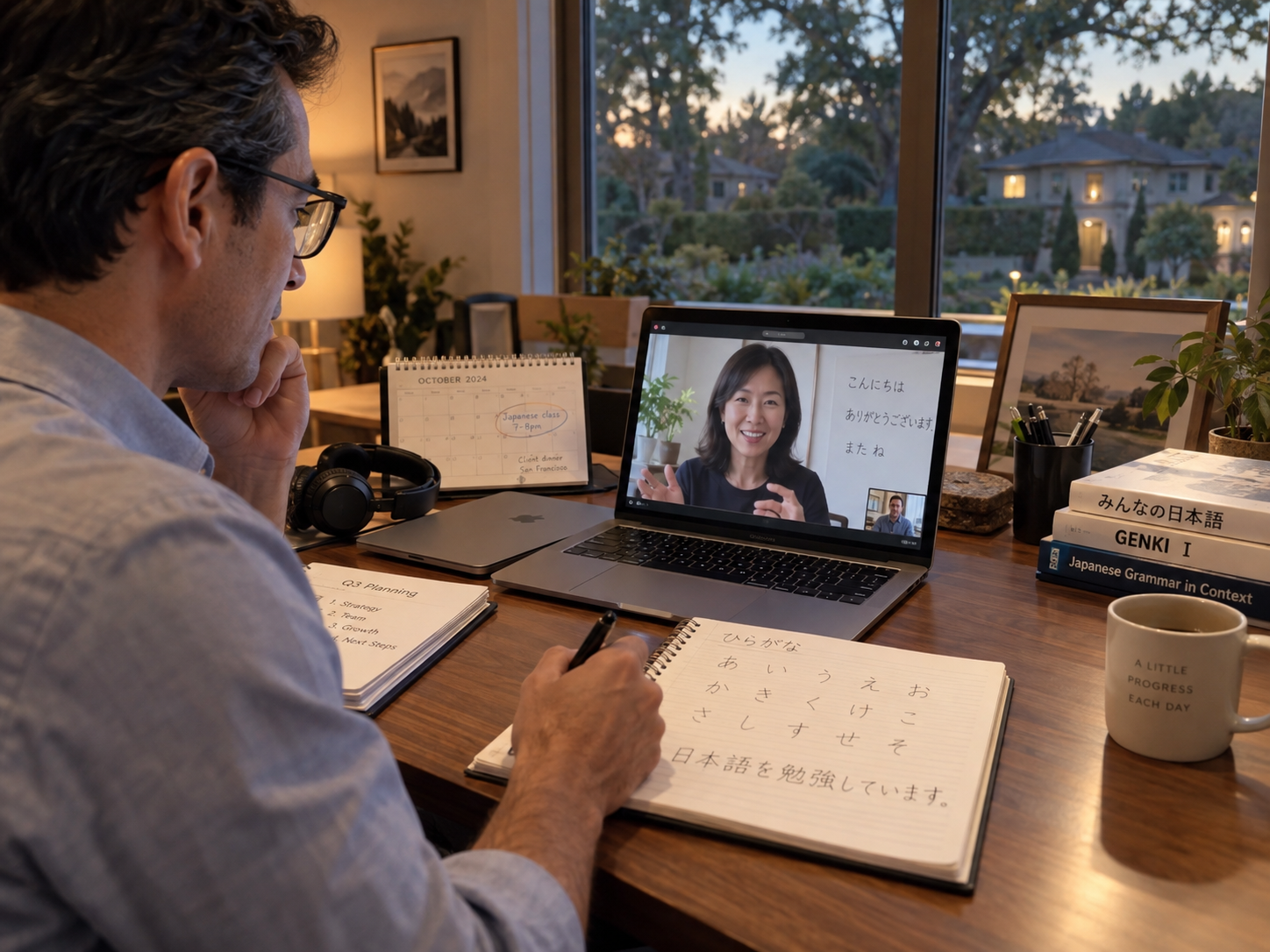
Atherton is a slightly awkward place to begin looking for a Japanese class.
Not because the area lacks Japanese learners. The Mid-Peninsula has an unusually international population, close ties to technology and business in Japan, and plenty of adults learning Japanese for travel, family, work, literature, anime, food, or simple intellectual curiosity.
The problem is geography.
There is no obvious “Japanese language school of Atherton” where an adult can walk in after work, take Beginner Japanese on Tuesday evenings, and progress neatly through five levels. The useful options are scattered around the Peninsula: Palo Alto, Los Altos and Foothill College to the south; Redwood City and San Mateo to the north; plus an increasingly good selection of live online classes.
For a busy adult, this matters more than it may seem.
Japanese already asks for a certain amount of consistency. Add a 35-minute drive, parking, an inflexible college schedule, or two hours of homework after a long workday, and a perfectly good course can become a course you stop attending.
So the real question for an adult in Atherton is not simply “Where can I learn Japanese?”
It is:
What form of Japanese study can I realistically keep doing six months from now?
That is a much better place to start.
The best Japanese course is often the one with the least weekly friction
Adults sometimes choose language classes as though they were choosing universities: Which program is the most rigorous? Which teacher has the strongest credentials? Which curriculum covers the most material?
Those things matter. But adult language learning has another variable that is much less glamorous and often more important: friction.
Suppose one course is academically excellent but requires driving across the Peninsula at rush hour twice a week. Another meets online for an hour on Thursday evening and asks for twenty minutes of review on most days.
The first course may be “better” on paper.
The second may be the one you are still taking next year.
Atherton makes this especially relevant because its own Caltrain station has been closed since 2020; Caltrain shifted service to nearby stations including Menlo Park and Redwood City. That does not make local travel difficult, exactly, but it does mean that “I’ll just take the train to class” is not as effortless as it might be elsewhere on the Peninsula.
If a Japanese course requires substantial travel, calculate the door-to-door commitment, not merely the advertised class time.
A two-hour class can easily become a three-hour evening.
For someone with a flexible schedule, that may be perfectly reasonable. For someone finishing work at 6:00, it may be the difference between sustained study and a very expensive three-week experiment.
First decide what kind of Japanese learner you actually are
Before comparing schools, it helps to be a little ruthless about the goal.
Someone planning a first trip to Japan in eight months does not need the same course as someone who wants to read contemporary Japanese fiction. A person learning because a spouse's family speaks Japanese needs something different again.
If your main goal is travel
Speaking and listening should dominate the early months.
You need to be comfortable with things such as:
すみません — sumimasen — excuse me
お願いします — onegaishimasu — please / I'd like this, please
これは何ですか。— Kore wa nan desu ka? — What is this?
駅はどこですか。— Eki wa doko desu ka? — Where is the station?
You should still learn hiragana. It makes Japanese far less opaque surprisingly quickly. But there is little reason to spend your first three months obsessively memorizing hundreds of kanji if the immediate goal is ordering dinner, using trains, checking into hotels, and having small interactions with people.
If you want serious long-term proficiency
Look for a sequential program.
Japanese is one of those languages in which disconnected study can create peculiar gaps. A learner may recognize 400 kanji but struggle to make a simple request politely. Another may understand a surprising amount of anime dialogue but barely read hiragana.
A structured curriculum helps keep speaking, grammar, listening, and literacy moving roughly together.
If your schedule changes constantly
Private instruction or a genuinely flexible online program may be worth the additional cost.
One thing busy professionals sometimes underestimate is the value of simply being able to say: “Tuesday is impossible this week. Can we meet Friday?”
For the right learner, flexibility is not a luxury. It is what makes lessons possible at all.
Foothill College: the serious academic route
For adults on the southern side of the Mid-Peninsula who want substantial, college-level Japanese, Foothill College is one of the most obvious programs to investigate.
Its Japanese sequence runs from elementary through intermediate study, with additional conversation courses. The first elementary course includes basic communicative Japanese, hiragana, katakana, and roughly 80 kanji. It is a five-unit class with a stated workload of five lecture hours per week.
That last number deserves attention.
Five hours a week is not a casual evening hobby.
Foothill can be an excellent choice for an adult who genuinely wants an academic language program and is willing to organize life around it. The curriculum progresses far beyond a six-week introductory class, and the college also offers intermediate and advanced conversation options.
There is another advantage for busy Peninsula learners: some sections are fully online. For Fall 2026, for example, Foothill listed fully asynchronous sections of Elementary Japanese I, along with other online Japanese offerings.
But asynchronous does not mean effortless.
College Japanese still comes with deadlines, assignments, reading, writing, and a pace designed around an academic quarter. Foothill's own course materials describe textbook and workbook assignments, online listening, writing work, and preparation outside class.
For someone who wants Japanese to become a serious long-term project, that can be exactly the point.
For someone hoping for one pleasant hour of Japanese after work, it may be more Japanese than intended.
The Japan Society in San Mateo: worth watching for live adult classes
Going north from Atherton, the Japan Society of Northern California is particularly relevant because it offers adult Japanese instruction not only online and in San Francisco, but also in San Mateo.
Its group courses typically run for 12 weeks, meeting once a week for two hours. Current published tuition is $400 for in-person group classes and $375 for online group classes for members, excluding textbooks.
The important thing is to check the actual level available each term.
For Fall 2026, the San Mateo schedule includes continuing and more advanced courses rather than an in-person absolute-beginner class, while Beginning 1 classes appear in the online schedule. Several were already full or closed when the schedule was checked.
That illustrates something useful about Japanese study on the Peninsula: a nearby organization may offer Japanese without offering your level at the moment you need it.
Do not assume that because a school “has Japanese,” it has a complete beginner class beginning next Tuesday.
Check:
the exact level;
whether the course is starting or already midway through a sequence;
how long each class meets;
whether missing a week is manageable;
and when the next new-beginner cycle begins.
For adults who like a traditional classroom experience and can make San Mateo work geographically, the Japan Society is certainly worth monitoring.
Palo Alto Adult School: flexible, but understand the format
Palo Alto Adult School is another nearby place people naturally look for language instruction.
Its Fall 2026 world-language offerings include a Conversational Japanese course described as preparation for travel and basic conversation. The current version is an online recorded course offering six weeks of access and 24 course hours, priced at $130.
That is a very different learning experience from sitting in a room with an instructor.
For a busy adult, recorded instruction has an obvious advantage: Tuesday at 7:00 does not have to be free.
The disadvantage is equally obvious: nobody is waiting for your answer.
Japanese can become deceptively passive when studied alone. It is easy to watch an explanation, understand it, recognize the examples, and conclude that you “know” the material. Then someone asks:
週末は何をしましたか。
Shūmatsu wa nani o shimashita ka?
“What did you do over the weekend?”
—and the brain suddenly produces nothing.
Recorded courses can work well for highly independent learners, especially those preparing for travel. But if speaking Japanese is a priority, add some form of live conversation.
Do not confuse recognizing Japanese with being able to use it
This is perhaps the biggest trap for busy adults because apps fit so beautifully into fragmented schedules.
Ten minutes with an app while drinking coffee. Five minutes of kana on the phone. A Japanese podcast in the car. Vocabulary cards before bed.
All useful.
But recognition is a seductive skill.
Seeing:
水
and thinking “water” feels like progress because it is progress.
Recognizing:
日本に行きたいです。
also feels good.
But understanding “I want to go to Japan” when it appears on a screen is considerably easier than producing the sentence while another human waits for you to speak.
A good adult Japanese routine therefore needs at least some retrieval.
Close the book.
Say the sentence.
Answer a question without seeing the model first.
Describe what you ate yesterday.
Ask where something is.
Language becomes usable when the brain has to retrieve it rather than merely approve the correct answer.
Japanese rewards short, frequent study more than heroic weekends
Busy adults often imagine two possible schedules:
“I should study Japanese for an hour every day.”
That collapses by Wednesday.
Or:
“I'll catch up for three hours Sunday.”
That often becomes unpleasant.
Japanese responds particularly well to something less dramatic.
A realistic week might contain one live class, three or four 15-minute review sessions, a few minutes of kana practice on otherwise wasted time, and one slightly longer session on the weekend.
That is enough to create continuity.
The writing system is the clearest example.
Learn hiragana early
Hiragana looks formidable when all 46 basic characters are presented at once.
In practice, it becomes familiar surprisingly quickly if encountered every day.
Learn a handful. Review them tomorrow. Add another handful. Begin reading simple words before the whole chart feels perfect.
Waiting until hiragana is “finished” before using it is unnecessary.
Add katakana before it becomes an emergency
Katakana is often neglected because beginner textbooks naturally spend more time on hiragana.
Then the learner arrives in Japan and discovers katakana everywhere.
ホテル — hotel
コーヒー — coffee
レストラン — restaurant
タクシー — taxi
The irony is that many katakana words represent familiar foreign vocabulary. The difficult part is simply learning to read the script quickly enough to recognize what is already known.
Do not make kanji the entire language
Kanji matters. A lot.
But adult beginners sometimes become so fascinated—or intimidated—by kanji that Japanese turns into a character-memorization project.
Learn kanji in words and sentences.
Seeing 食 as an abstract symbol is less useful than meeting it through:
食べる — taberu — to eat
食事 — shokuji — meal
食堂 — shokudō — dining hall / cafeteria
The character then begins to function as part of a language rather than as an isolated piece of trivia.
One hour of speaking may be more valuable than another five hours of passive study
This is particularly relevant for Peninsula professionals, who are often very good at studying.
They know how to read explanations. They can analyze grammar. They can memorize systems.
Japanese happily rewards all of that—and then reveals that conversation is a separate skill.
Real speech is messy. Someone speaks faster than expected. A familiar verb arrives in a form you did not anticipate. You understand the beginning of the sentence and lose the end.
That discomfort is not evidence that your studying failed.
It is the skill being trained.
Adults who want practical Japanese should therefore choose a course that requires them to answer questions, make sentences, and interact—not merely watch an instructor speak.
Online Japanese makes unusual sense in Atherton
A decade ago, recommending an online language class over a nearby physical classroom often felt like a compromise.
That is less true now.
For Atherton and the Mid-Peninsula, live online learning solves a genuine geographic problem: good adult Japanese programs exist, but they are dispersed.
Driving to Berkeley for a one-hour class from Atherton every week would be difficult to justify for most people. Driving to San Mateo is much more reasonable, but the appropriate level may not be running when needed. A college course may provide excellent instruction but demand more time than a working adult can give.
A small live online class can occupy a useful middle ground: real instructor, real classmates, real conversation, but no commute.
Near the beginning level, that tradeoff is often favorable.
Polyglottist Language Academy, for example, offers live Japanese classes specifically for adults, including small online groups as well as selected in-person classes in Berkeley. Its online complete-beginner courses are taught live rather than as recordings, and group sizes are typically limited to three to six students.
The academy also offers individual online Japanese instruction for learners who need a customized schedule or pace.
For an Atherton learner, the attraction is not that online study is somehow inherently superior to an in-person classroom. It is that a one-hour class can genuinely remain a one-hour commitment.
That matters.
What should a complete beginner learn first?
The first stage of Japanese should feel more practical than many beginners expect.
A good foundation includes:
Pronunciation. Japanese sounds are fairly approachable for English speakers, but vowel length and doubled consonants matter.
Hiragana. Begin immediately rather than relying on romanization for months.
Basic polite sentence patterns. Japanese grammar feels unfamiliar at first, but a small number of structures produce a surprising amount of useful language.
Particles such as は, の, を, に, and で. Do not expect perfect understanding immediately. Their meaning becomes clearer through repeated examples.
Everyday verbs. Eat, drink, go, come, see, do, buy, speak.
Questions. Learning to ask something is more useful than memorizing another list of nouns.
Listening and speaking. From week one.
Kanji should begin too, but gradually.
There is no prize for becoming exhausted fastest.
What if you studied Japanese years ago?
This is extremely common.
Someone studied Japanese for a semester in college, learned hiragana twelve years ago, watched a hundred hours of Japanese television, or completed half of Genki before life intervened.
Now they have too much knowledge for “absolute beginner” but not enough confidence for an intermediate class.
Do not choose a level based on the number of years you once studied.
Test what you can actually do.
Can you introduce yourself without notes?
Can you read hiragana comfortably?
Can you form a past-tense sentence?
Can you ask and answer ordinary questions about work, family, hobbies, or last weekend?
Do basic particles feel familiar?
If not, a low-beginner course may be more productive than jumping into an intermediate class and spending six weeks trying to disguise the gaps.
Repeating some material is not wasted time if it turns passive knowledge into usable Japanese.
For a busy Mid-Peninsula adult, consistency beats intensity
Japanese has a reputation for requiring enormous commitment.
Eventually, reaching a very high level does require a lot of time. There is no clever hack around thousands of words, kanji, listening hours, and actual conversations.
But that is a poor reason not to begin.
A working adult does not need to study Japanese like a university major.
A year of modest but consistent study can produce much more than people expect: comfortable hiragana and katakana, useful everyday grammar, basic conversation, travel competence, and the satisfying moment when pieces of Japanese heard in the wild stop sounding like an uninterrupted stream of syllables.
The right class creates structure around that process.
For learners in Atherton, Menlo Park, Redwood City, Palo Alto, San Carlos, and the surrounding Mid-Peninsula, the useful question is therefore not which Japanese program is theoretically the most comprehensive.
It is which program fits into Tuesday when Tuesday is already full.
That may be an academic course at Foothill. It may be an in-person Japan Society class in San Mateo. It may be a flexible recorded course. It may be private tutoring. Or it may be a small live online class where closing the laptop at the end of class means the commute home takes approximately three seconds.
The language will still require effort.
There is no reason the logistics need to make it harder.
At Polyglottist Language Academy, our Japanese classes are designed around the reality that most adult students have jobs, families, travel, and lives that do not revolve around homework. We offer live online Japanese instruction as well as selected in-person classes in Berkeley, with an emphasis on small groups, practical communication, and understanding how Japanese is actually used rather than simply memorizing translations.
For Mid-Peninsula learners, the online option can provide the useful middle ground between completely independent study and committing to a substantial weekly commute.
Frequently Asked Questions
Are there Japanese classes in Atherton itself?
Dedicated adult Japanese programs in Atherton are limited. Most practical options are found elsewhere on the Mid-Peninsula—including Palo Alto, the Foothill College area, and San Mateo—or through live online classes.
Where can adults take Japanese classes near Atherton?
Current options worth investigating include Foothill College's Japanese program, the Japan Society of Northern California's San Mateo and online classes, Palo Alto Adult School's online conversational course, private instruction, and live online adult language schools. Course levels and schedules change from term to term.
Is an online Japanese class as good as an in-person class?
It can be, particularly when the online class is live and small enough for students to speak regularly. Recorded courses offer more schedule flexibility, while live classes provide immediate interaction and correction. The best format depends largely on how independently you study and how much conversation practice you need.
How much Japanese should a busy adult study each week?
A sustainable beginning might be one class each week plus several short practice sessions. Fifteen or twenty focused minutes on most days is often more useful than waiting for a large block of free time once a week.
Should I learn hiragana before taking Japanese classes?
Not necessarily. A true complete-beginner course should teach it. However, spending a little time becoming familiar with hiragana before the first class can make the opening weeks easier.
Is Japanese realistic for someone with a demanding job?
Yes, provided the learning plan is designed around the actual schedule rather than an imaginary one. Progress may be slower than for a full-time student, but regular study over a long period matters much more than occasional periods of intense work.