
The Best Russian Novels for English Speakers (Ranked by Approachability)
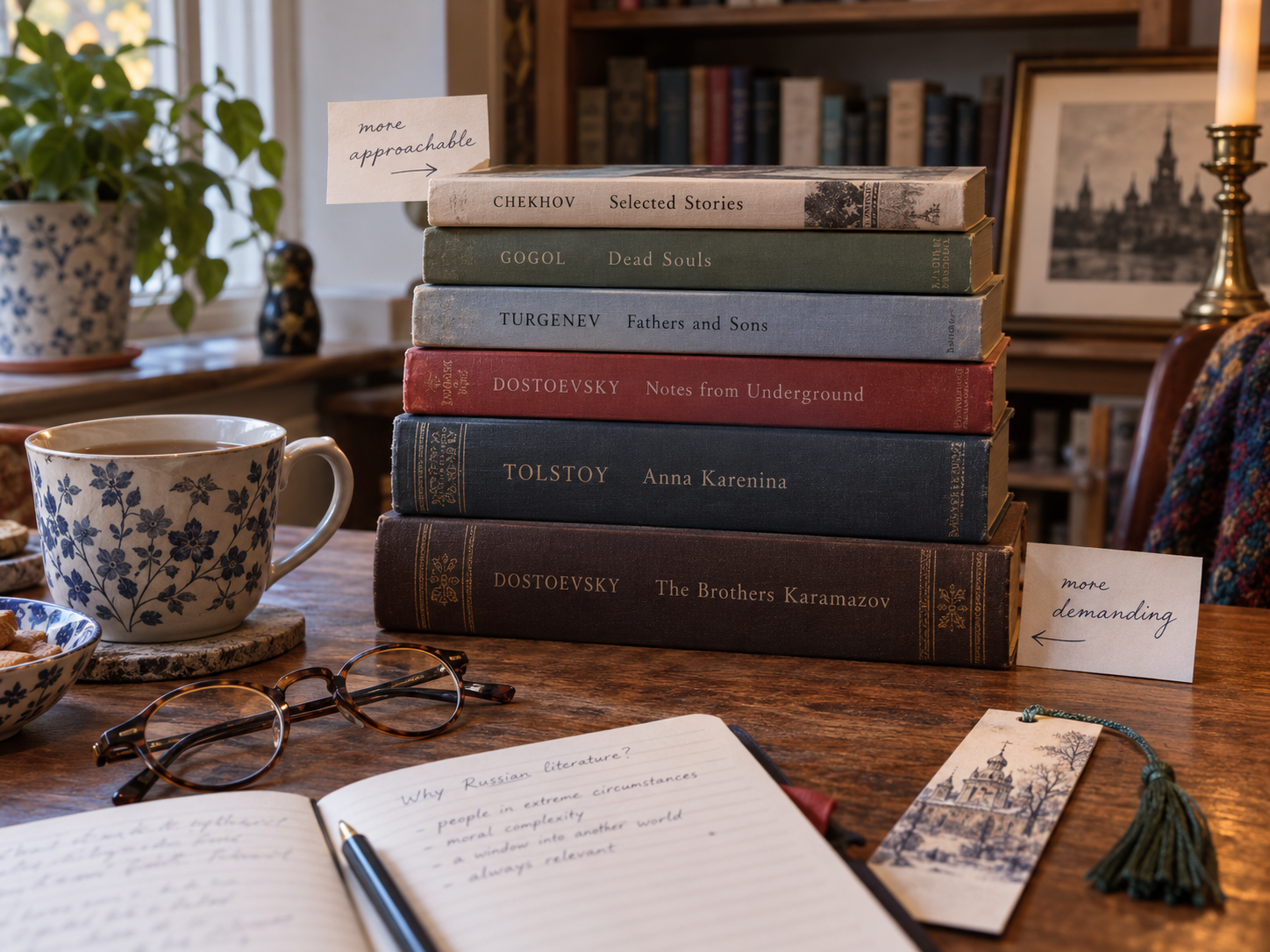
The worst way to begin Russian literature is often the way people are told to begin it: pick the biggest famous novel, prepare to suffer, and assume confusion is part of the experience.
Russian literature does not require that initiation. Some major works are short, funny, plot-driven, or structurally simple. Others are masterpieces that become much more rewarding after you have learned how Russian names work and developed patience for long philosophical digressions.
This ranking is therefore about approachability in English, not literary importance.
1. The Death of Ivan Ilyich — Leo Tolstoy
Technically a novella rather than a full-length novel, The Death of Ivan Ilyich is one of the best entry points into Russian literature because it is short, focused, psychologically direct, and devastating without requiring a map of nineteenth-century politics.
The story follows a respectable official who confronts illness, death, and the possibility that he has lived incorrectly. Readers encounter Tolstoy’s moral seriousness without committing to War and Peace.
Difficulty: very approachable.
2. One Day in the Life of Ivan Denisovich — Aleksandr Solzhenitsyn
This novel is brief and tightly contained: one day in a Soviet labor camp. The setting requires historical context, but the narrative structure is easy to follow.
The details of food, cold, work, hierarchy, and survival are concrete. The book gives readers a way into Soviet history without the sprawling cast of many earlier Russian novels.
Difficulty: approachable, emotionally serious.
3. A Hero of Our Time — Mikhail Lermontov
Lermontov’s novel is relatively short and divided into episodes. Its central character, Pechorin, became one of the defining “superfluous men” of Russian literature.
The chronology is not completely straightforward, but the sections move quickly and include travel, romance, dueling, and psychological self-examination.
Difficulty: approachable with a little historical context.
4. Fathers and Sons — Ivan Turgenev
Compared with Dostoevsky and Tolstoy, Turgenev can feel remarkably clean. Fathers and Sons centers on generational conflict and the figure of Bazarov, a young nihilist whose ideas disturb the older generation.
The philosophical material matters, but it stays attached to relationships and character tension.
Difficulty: moderate and very manageable.
5. The Master and Margarita — Mikhail Bulgakov
This is often the book that convinces people Russian literature is not what they expected. The novel mixes Soviet Moscow, satire, the supernatural, romance, Pontius Pilate, a giant talking cat, and bureaucratic absurdity.
Its structure is more complex than the books above, but the energy carries readers through confusion. It helps to know something about Soviet censorship and anti-religious culture, though the book can be enjoyed before every reference is understood.
Difficulty: moderate, strange in a good way.
6. Crime and Punishment — Fyodor Dostoevsky
This is the first truly large classic on the list. The plot is famous and compelling: Raskolnikov commits murder and then lives inside the moral and psychological consequences.
What makes the novel challenging is not only length. Russian names shift between first names, patronymics, surnames, and diminutives. Characters deliver long arguments. Emotional intensity stays high for hundreds of pages.
Yet the central story gives readers something to hold onto.
Difficulty: moderate to challenging.
7. Doctor Zhivago — Boris Pasternak
Pasternak’s novel moves through revolution, civil war, love, separation, poetry, and historical upheaval. It is beautiful, but structurally less direct than a reader might expect from the famous romance at its center.
The historical background matters. Readers who know the broad sequence of late-imperial Russia, the 1917 revolutions, and civil war will have an easier time.
Difficulty: challenging.
8. Anna Karenina — Leo Tolstoy
Anna Karenina is long but highly readable in a good translation. The challenge is not obscurity; it is scale. The novel follows multiple families and social worlds, and the agricultural and philosophical sections can surprise readers who arrive expecting only a tragic romance.
Tolstoy’s psychological observation is extraordinarily accessible once you settle into the cast.
Difficulty: challenging mainly because of length.
9. The Brothers Karamazov — Fyodor Dostoevsky
This novel contains a murder mystery, a family catastrophe, theological debate, courtroom drama, and some of Dostoevsky’s most famous philosophical writing.
It also asks the reader to stay with long arguments about God, suffering, freedom, morality, and responsibility.
Difficulty: very challenging but rewarding.
10. War and Peace — Leo Tolstoy
War and Peace is not impossible; it is simply enormous. Hundreds of characters, family networks, military campaigns, philosophical essays, French dialogue, and historical context all compete for attention.
Readers who begin with shorter Russian works often discover that the novel becomes less intimidating because they already understand naming patterns, social ranks, and the narrative patience Russian classics sometimes require.
Difficulty: most demanding on this list because of scale, not because every page is difficult.
A note on translation
The translator changes the experience more than many beginners realize. Different English versions make different choices about tone, names, repetition, slang, and sentence structure. If the first few pages feel wooden, compare another translation before deciding the novel is not for you.
Russian names also become easier quickly. Keep a character list at first. After several books, Dmitri Fyodorovich, Mitya, and Karamazov will stop feeling like three unrelated people.
For Russian learners, reading even a few paragraphs in the original beside a translation can reveal patterns that disappear in English. Polyglottist Language Academy’s Russian classes can help build the grammar and vocabulary needed to move gradually from translated literature toward selected original passages.
You do not have to earn Russian literature by suffering through the longest book first. Start with a work that gives something back quickly. The canon will still be there when you are ready for the larger mountains.