
Where Can Adults Practice Russian in Philadelphia? Classes, Conversation, and Cultural Resources
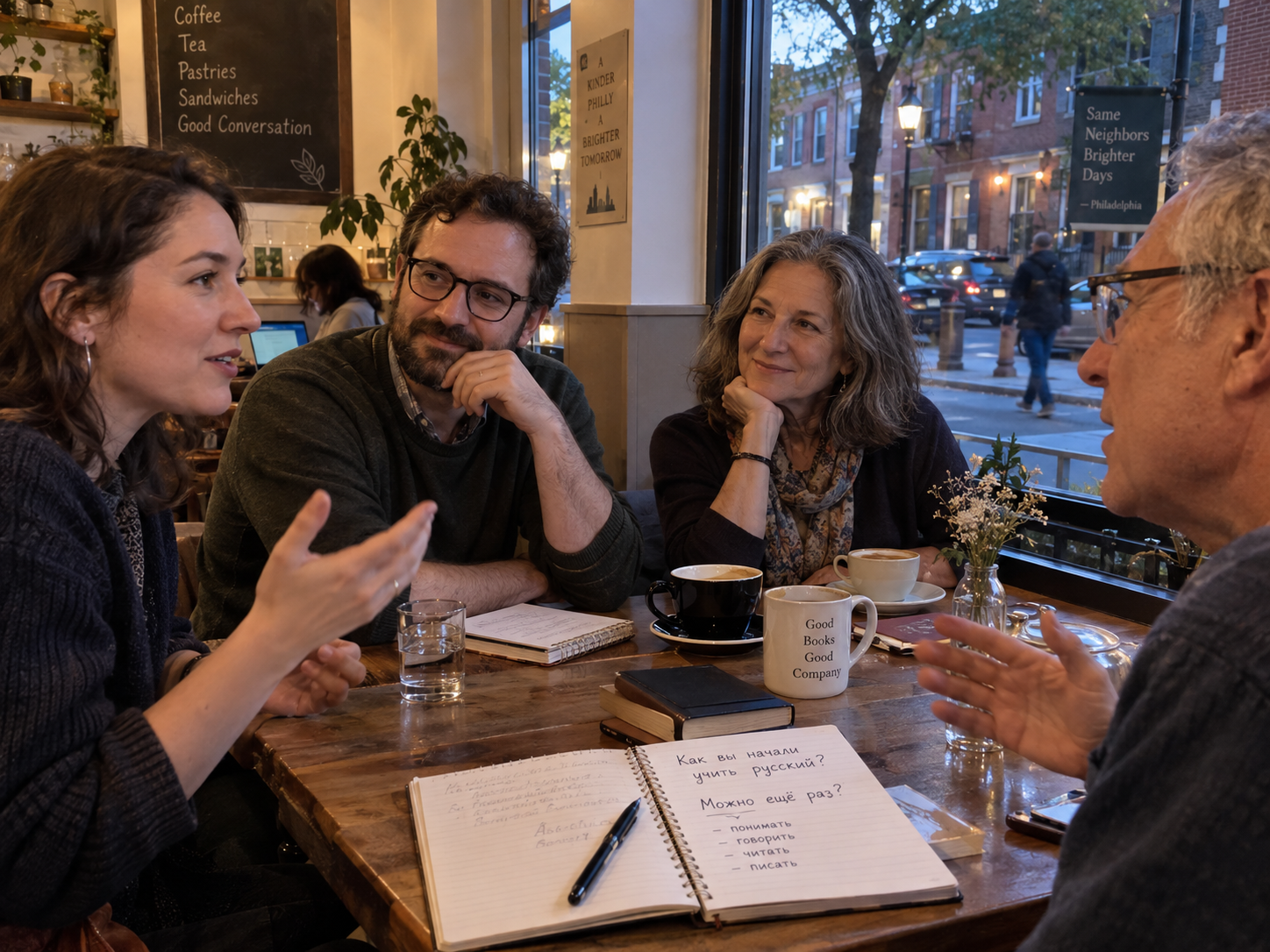
There is a moment in learning Russian when another grammar worksheet is no longer what you need.
You know that в ресторане means “in the restaurant.” You understand why Москва becomes Москве after certain prepositions. You may even have survived your first encounter with verbs of motion.
Then someone actually speaks Russian to you.
They ask an ordinary question you were not expecting, use a word you have never heard, shorten something your textbook always presented in its full form, and wait for an answer.
This is where Russian starts becoming a language rather than a subject.
Philadelphia is surprisingly good for that stage of learning. The city does not have dozens of obvious walk-in Russian conversation schools, and formal adult classes are more limited than Spanish or French. But Philadelphia has something arguably more useful once a learner has some foundation: universities with serious Russian programs, an active if somewhat irregular conversation scene, cultural events, Russian-language books, and a substantial Russian-speaking presence in Northeast Philadelphia.
The trick is knowing which resources actually teach Russian, which let you practice it, and which simply put you in an environment where the language is around you.
Those are three different things.
Start with a class if you cannot yet hold a conversation
A conversation meetup sounds appealing when you are beginning Russian. Unfortunately, ten memorized phrases do not create much conversation.
If your active Russian currently consists of:
Здравствуйте. — Zdravstvuyte. — Hello.
Меня зовут… — Menya zovut… — My name is…
Я немного говорю по-русски. — Ya nemnogo govoryu po-russki. — I speak a little Russian.
then a social gathering may give you some useful listening practice, but it cannot replace systematic instruction.
Russian has too much structure for most adults to reconstruct efficiently through exposure alone. Cases, verb conjugation, aspect, gender, agreement, and verbs of motion gradually need to be organized into something coherent.
Philadelphia has several academically serious options.
At UPenn Department of Russian and East European Studies, Russian is taught from elementary through advanced levels. For Fall 2026, Penn lists two sections of Elementary Russian I as well as Intermediate Russian and higher-level coursework. The introductory course develops speaking, listening, reading, and writing and specifically emphasizes real-life communication and spontaneous interaction.
Penn has also offered Russian through its Liberal and Professional Studies summer program. In Summer 2026, for example, Russian I ran online four evenings per week from late May through July. That particular course has already ended, but it illustrates why adults interested in Penn should check LPS and nontraditional enrollment routes rather than assuming every Russian course is only for full-time undergraduates.
Bryn Mawr is another serious option, especially for adults west of the city. Its Continuing Education program allows qualified community members to take up to two undergraduate courses per semester for credit or audit, subject to space and other requirements. Fall 2026 Russian offerings include Elementary Russian Intensive, Intermediate Russian, Advanced Russian, Russian Through Art, and Russian for Pre-Professionals.
The word intensive should be taken seriously. Bryn Mawr's elementary course meets Monday through Friday and includes additional conversation work. That may be excellent for an adult who wants Russian to become a major intellectual project. It is not necessarily realistic for someone looking for a pleasant Wednesday-evening hobby.
For many working adults, a smaller once-a-week live course or private instruction will be easier to sustain.
Philadelphia's Russian conversation scene exists—but check the calendar
Once you can produce basic sentences without building each one from scratch, conversation groups become much more valuable.
The Russian Language Club Philadelphia on Meetup is one of the clearest examples. The group describes itself as a place for native speakers and learners to meet in cafés and bars and speak Russian. Recent gatherings have included coffee conversations, dinners, and informal Russian-speaking meetups.
There is one practical complication: these groups are not necessarily weekly institutions.
As of September 2026, the club has around 60 members and has held several recent events—including a Russian conversation gathering in August—but its current Meetup calendar shows no upcoming event.
That does not make it useless. It simply means a Philadelphia learner should treat Meetup as something to watch, not as a guaranteed Tuesday-night class.
Join the group. Turn on notifications. Go when an event appears.
Language practice tends to be opportunistic.
What should you actually do at a Russian meetup?
Many intermediate learners arrive at their first conversation group with one plan:
“Speak Russian.”
That is not quite enough.
Real conversation becomes easier when you arrive with a few subjects already mentally prepared. You do not need to memorize speeches, but it helps to know how you would talk about:
what you do for work;
where you live;
why you started Russian;
a recent trip;
what you watched or read recently;
plans for the weekend.
One particularly useful question is:
Как вы начали учить русский?
Kak vy nachali uchit' russkiy?
“How did you start learning Russian?”
At a language meetup, that question can carry a conversation surprisingly far.
If the other person is a Russian speaker learning English, ask what they find difficult about English. If they grew up speaking Russian in Philadelphia, ask what languages they use at home and at work.
And when you do not understand something, resist the instinct to smile vaguely and hope the topic changes.
Try:
Что это значит?
Shto eto znachit?
“What does that mean?”
or:
Можно ещё раз, пожалуйста?
Mozhno eshchyo raz, pozhaluysta?
“Could you say that again, please?”
Being able to repair a conversation is itself a major language skill.
Penn's Russian Tea shows what good conversation practice looks like
Penn's Russian program also runs Russian Tea, described by the department as a weekly conversation hour for students of Russian at all levels. The format is deliberately informal: Russian conversation, fellow learners and faculty, tea, and something to eat. Penn's Spring 2026 calendar showed Russian Tea meetings throughout March and April.
This is primarily a Penn student activity rather than something the general public should assume they can simply attend. But it is worth knowing about if you are taking a Penn course or otherwise connected to the university.
More importantly, it illustrates a useful principle.
Good conversation practice does not have to mean sitting across from somebody and declaring, “Now we shall practice the instrumental case.”
It works better when Russian is attached to something else: tea, a board game, a film, an argument about a book, or a discussion of what happened that week.
Grammar becomes considerably more memorable when you need it because you are trying to say something.
Do not overlook Northeast Philadelphia
If you learn Russian only through Zoom lessons and textbooks, it can begin to feel like a language that exists mainly on your laptop.
Northeast Philadelphia offers a useful corrective.
The area has long had communities from Russia, Ukraine, Belarus, Central Asia and other parts of the former Soviet Union, and Russian continues to function as a shared language for many people from quite different national and cultural backgrounds.
That last distinction matters.
Hearing someone speak Russian tells you what language they speak. It does not tell you that they are Russian.
For learners, Northeast Philadelphia offers opportunities for exposure that are much more ordinary than a cultural festival—and, in some ways, more useful.
At Bell’s Market on Bustleton Avenue, for example, shoppers encounter foods and products from across Eastern Europe and the former Soviet region. The market remains active in 2026 and is located in an area with substantial Eastern European communities.
Farther north on Bustleton Avenue, NetCost Market is another large Eastern European grocery store and is currently operating in Philadelphia.
A grocery store may sound like an odd language-learning recommendation.
It is actually useful.
Read labels.
Try to identify words before looking at the English.
Notice the difference between:
молоко — milk
сметана — sour cream
гречка — buckwheat
творог — farmer's cheese / curd cheese
солёный — salted
копчёный — smoked
Packaging provides repeated, contextual vocabulary in a way flashcards often do not.
There is also an etiquette point here. Employees in a store are working; they have not volunteered to become someone's free Russian tutor. If a natural interaction happens in Russian, excellent. But learners should not force extended practice on someone who is trying to ring up groceries.
The point is exposure, not turning every Russian-speaking stranger into a lesson.
Russian-speaking cultural life is another kind of immersion
KleinLife in Northeast Philadelphia is an important community center with longstanding connections to Russian-speaking Jewish residents. It hosts social and cultural programming and has served as a gathering place for Russian-speaking members of the community.
It is not a beginner Russian language school.
That is precisely why it becomes interesting later.
Philadelphia's Russian-language cultural calendar includes comedy, theater, music, lectures, and touring performers, and KleinLife frequently serves as a venue. Current listings for fall 2026 include several Russian-language or Russian-speaking performers appearing there in October, November, and December.
An intermediate learner may understand only 40 percent of a comedy performance.
That can still be valuable.
In fact, learning to continue listening when you do not understand every word is an important transition. Beginners often believe comprehension works like a light switch: either you understood the sentence or you did not.
Real listening is messier.
You catch the topic.
Then a verb.
Then a joke goes completely past you.
Then you suddenly understand an entire sentence.
That is normal.
Use the Free Library as a Russian-language resource
Philadelphia learners also have a resource that costs nothing: the Free Library.
Its digital collection currently includes more than 600 Russian-language titles through OverDrive.
For learners in Northeast Philadelphia, Northeast Regional Library is one of the system's largest branches, second only to Parkway Central in its resources and staffing. Even when a particular Russian title is not sitting on the shelf, the library system's catalog and hold system make it worth checking before buying yet another textbook.
The important thing is to choose material at the right difficulty.
Tolstoy is not a moral obligation.
A learner who has studied Russian for eight months will probably learn more from two pages of something manageable than from spending an evening translating every fourth word of Anna Karenina.
Children's books can help. So can graded readers, short articles, recipes, comics, interviews, or books you already know in English.
The goal is not literary prestige.
The goal is reading Russian.
Culture helps when it gives the language somewhere to attach itself
There is sometimes a strange separation in language learning between “studying the language” and “learning the culture.”
In reality, the two become increasingly difficult to separate.
Consider something as simple as:
Давайте.
A dictionary may give “let's” or “come on.”
But in actual Russian conversation, davayte can do much more. Depending on context and intonation, it can suggest doing something together, encourage someone to proceed, agree to a proposal, or help close a conversation.
Similarly:
Ничего.
literally contains the idea of “nothing,” yet in actual speech it can mean something closer to “It's okay,” “Not bad,” “Don't worry about it,” or other context-dependent responses.
These are not difficult because dictionaries are bad.
They are difficult because languages live inside social situations.
Films, performances, conversations, cafés, shops, podcasts, and books give learners repeated examples of what people actually do with words.
Heritage speakers need a different kind of practice
Philadelphia's Russian-speaking population also means that some adults looking for Russian practice are heritage speakers rather than conventional second-language learners.
A heritage speaker may understand almost everything a parent says but answer in English.
Another may speak fluently at home but read slowly.
Someone else may have excellent pronunciation and an intuitive sense of grammar while lacking vocabulary outside family life.
Those learners often do not need Elementary Russian I.
But they may still need structured practice.
A heritage speaker might benefit much more from reading a news article aloud, discussing a film, writing short texts, or deliberately expanding vocabulary into professional and abstract subjects.
Family Russian can be remarkably specialized.
A person may know exactly how to argue with a grandmother about eating more soup and have absolutely no idea how to describe their job.
Placement should reflect what someone can actually do—not simply whether Russian was spoken at home.
Build a Philadelphia Russian routine, not just a list of resources
The most effective approach is usually to combine several kinds of exposure.
A realistic month for an adult learner might look something like this:
One structured Russian lesson each week.
One conversation meetup whenever a Philadelphia event appears.
A Russian-language film, podcast, or performance every week or two.
A visit to Northeast Philadelphia occasionally to browse products, books, or cultural events.
Ten or fifteen minutes of reading on most days.
And, crucially, regular speaking.
The mix matters because each activity exposes a different weakness.
A class shows you what you do not understand grammatically.
Reading exposes vocabulary gaps.
Conversation reveals what you cannot retrieve quickly enough.
Listening reveals what you know on paper but fail to recognize at normal speed.
Together, those weaknesses gradually become abilities.
If local practice is irregular, keep the instruction regular
Philadelphia's Russian ecosystem has one limitation: many of its best practice opportunities are episodic.
A conversation group may meet this month and not next month. A Russian-language performer may visit once. A university conversation hour may only be available to students. Cultural programming changes from season to season.
That is normal for a language with fewer adult learners than Spanish or French.
It also means that the structured part of your Russian learning should probably be the predictable part.
Polyglottist Language Academy offers live online Russian classes for adults at several levels, with small groups and a progression from beginner study into more independent communication. Philadelphia students can use a regular online class as the backbone of their study and then use the city's conversation and cultural resources for the part no textbook can supply: unpredictable real Russian. (Polyglottist Language Academy)
That combination makes more sense than treating online and local learning as competitors.
One teaches the system.
The other makes you use it.
The goal is eventually to stop “practicing Russian”
At first, every interaction feels educational.
You notice that you correctly used the genitive plural. You mentally celebrate recognizing a verb. You replay the sentence you just said and wonder whether the adjective ending was wrong.
Eventually something changes.
You are talking about Philadelphia traffic.
Or someone's vacation.
Or whether a movie was terrible.
Five minutes later, you realize you were speaking Russian and had temporarily forgotten that speaking Russian was the activity.
That is the point.
Philadelphia gives adult learners several ways to get there: university courses, live classes, Meetup conversations, Russian-language cultural events, libraries, and a part of the city where Russian is still used in ordinary life.
None of these resources does everything.
Together, they can turn Russian from something you study into something you actually use.
Frequently Asked Questions
Are there Russian conversation groups in Philadelphia?
Yes. Russian Language Club Philadelphia organizes informal conversation events through Meetup, although meetings are irregular and there may not always be an upcoming event posted.
Where can adults take Russian classes in Philadelphia?
Penn has a substantial Russian program, while adults can also investigate university nondegree options, private tutors, and live online adult classes. Bryn Mawr's Continuing Education program is another option for people willing to travel outside Philadelphia proper.
Is Northeast Philadelphia a good place to practice Russian?
It is particularly useful for exposure to Russian and other languages spoken by communities from the former Soviet Union. Russian can be encountered in shops, cultural settings, and community life, especially around Bustleton and nearby neighborhoods.
Can beginners attend Russian conversation groups?
They can, but conversation groups become much more useful after learners can ask and answer basic questions spontaneously. Complete beginners usually progress faster with structured lessons first.
Where can I find Russian books in Philadelphia?
The Free Library's digital collection includes hundreds of Russian-language titles, and its physical catalog is also worth searching.
How often should I speak Russian?
Regular short conversations are more useful than waiting until you feel “ready.” Even one meaningful speaking session each week can reveal gaps that are almost invisible during passive study.