
10 Beautiful Japanese Words That Have No English Translation
There is a particular kind of internet list that makes Japanese sound almost supernatural. Japanese, we are told, has words for emotions English speakers have never imagined, fleeting natural phenomena we have somehow failed to notice, and philosophical concepts that require entire paragraphs to explain.
The reality is less mystical—and more interesting.
There are very few words that are truly untranslatable. If a Japanese speaker can understand an idea, an English speaker can usually understand it too. The difference is that Japanese sometimes packages an experience into a single word where English needs a phrase, an explanation, or a completely different sentence.
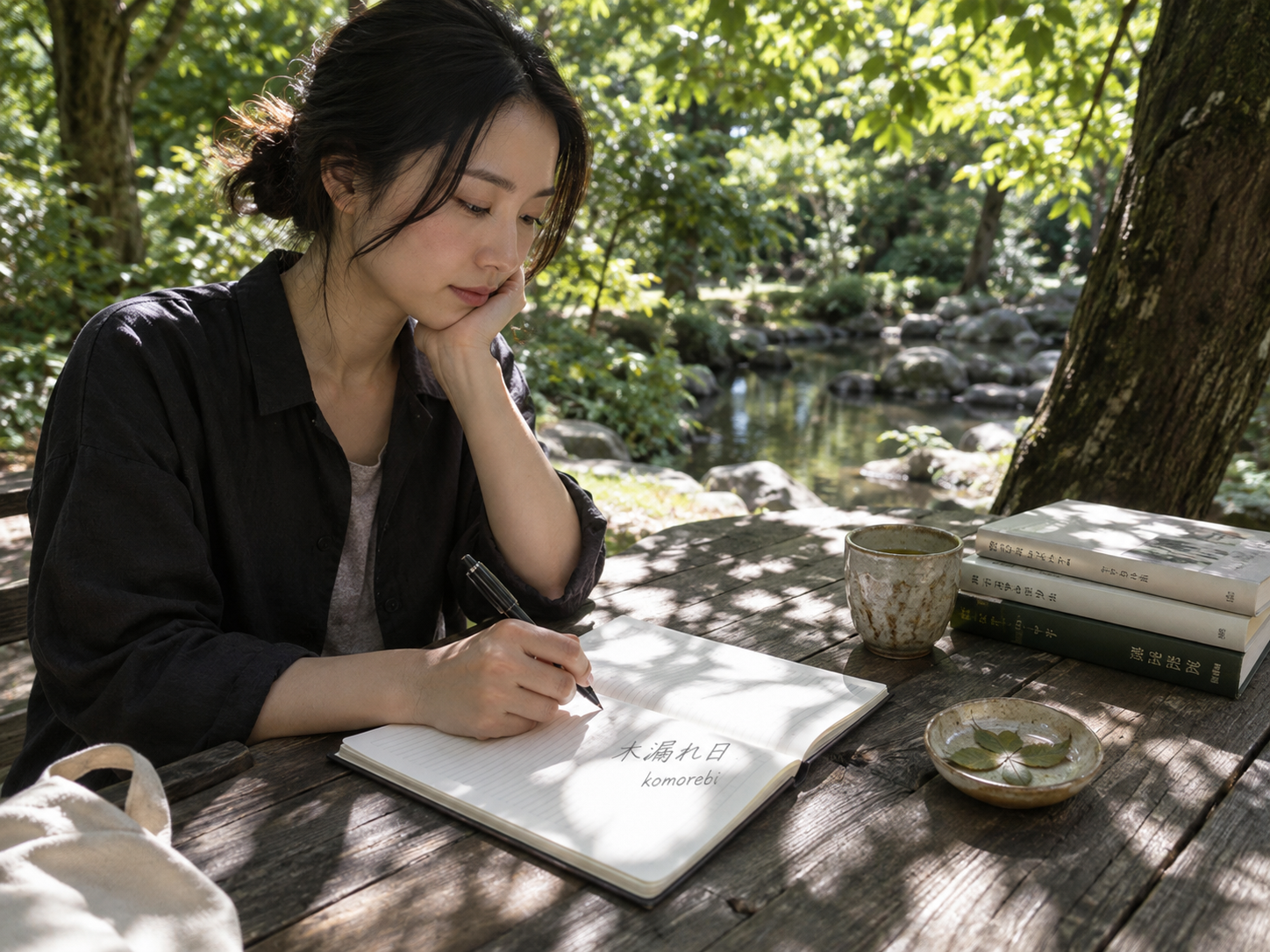
Take 木漏れ日 (komorebi). English speakers certainly notice sunlight coming through leaves. We simply never agreed on one everyday word for it.
Or consider 口寂しい (kuchisabishii), literally suggesting that one's “mouth is lonely.” It describes wanting something to eat or put in one's mouth despite not really being hungry. English speakers experience this constantly. We just tend to call it “snacking because I'm bored.”
That is what makes these Japanese words worth learning. They do not reveal ten emotions available only in Japan. They show how languages divide ordinary human experience differently.
Here are ten particularly good examples.
1. 木漏れ日 — Komorebi
木漏れ日 — komorebi — sunlight filtering through the leaves of trees
Anyone who has walked beneath trees on a bright afternoon knows exactly what komorebi looks like: patches of sunlight appearing and disappearing across the ground as leaves move above.
Japanese simply gives the phenomenon a compact name.
The word is built from 木 (ki), tree; the idea of light 漏れる (moreru), leaking or filtering through; and 日 (hi), sun or sunlight. Japanese dictionaries define 木漏れ日 quite straightforwardly as sunlight entering through gaps between the branches and leaves of trees. (コトバンク)
A perfectly ordinary sentence might be:
木漏れ日がきれいですね。
Komorebi ga kirei desu ne.
“The sunlight through the trees is beautiful, isn't it?”
What is lovely about komorebi is its specificity. It isn't simply “sunshine,” and it isn't exactly “dappled light,” because the trees are part of the idea.
English has no trouble describing it. Japanese just gets there faster.
2. 懐かしい — Natsukashii
懐かしい — natsukashii — bringing back fond memories; nostalgically familiar
Someone plays a song you hadn't heard since high school.
You open a box and find something that used to sit in your childhood bedroom.
You return to a neighborhood you knew twenty years ago.
A Japanese speaker might simply say:
懐かしい!
Natsukashii!
“Nostalgic” is the obvious translation, but it often feels slightly off. In English, nostalgia can sound reflective, wistful or even melancholy. Natsukashii is frequently much more immediate: something from the past has appeared in front of you, and suddenly the past feels close again.
Japanese dictionary definitions emphasize the pleasant feeling that arises when encountering people or things one knew long ago. (コトバンク)
For example:
この曲、懐かしい。
Kono kyoku, natsukashii.
“This song takes me back.”
That last translation is not literal, but it may actually capture the feeling better than “This song is nostalgic.”
And this is one of the first useful lessons in translation: sometimes the best equivalent of a word is not another word.
3. もったいない — Mottainai
もったいない — mottainai — what a waste; too good to waste; a shame not to use
A perfectly edible meal gets thrown away.
Someone replaces a usable object because a newer model appeared.
A talented person never does anything with an opportunity.
All of these situations can provoke:
もったいない!
Mottainai!
“What a waste!” works much of the time, but mottainai can stretch further. It expresses regret that something with value is not being properly used, appreciated, or allowed to fulfill its potential. Japanese explanations of the term similarly emphasize the regret involved when the value of something is not being fully realized. (mottainai-vp.jp)
Consider:
まだ食べられるのに、捨てるのはもったいない。
Mada taberareru noni, suteru no wa mottainai.
“It would be such a waste to throw it away when it's still good to eat.”
The interesting part is that mottainai is not limited to garbage.
Wasting time can be mottainai. Passing up a good opportunity can be mottainai. Using an expensive ingredient carelessly can be mottainai.
English translations change with the situation because English has no single everyday expression covering quite the same territory.
4. 口寂しい — Kuchisabishii
口寂しい — kuchisabishii — wanting something in your mouth even though you aren't hungry
This may be one of the most useful words on the list.
口 (kuchi) means “mouth.”
寂しい (sabishii) means “lonely.”
So, rather wonderfully, your mouth can be lonely.
Japanese dictionaries describe 口寂しい as the feeling of wanting something to eat, drink, smoke, or otherwise have in one's mouth when there is nothing there. (コトバンク)
It is the packet of crackers opened during a movie despite having eaten dinner.
The handful of nuts picked up while working.
The unnecessary trip to the refrigerator while thinking.
口寂しいから、何か食べたい。
Kuchisabishii kara, nanika tabetai.
“I feel like nibbling on something.”
The literal translation—“because my mouth is lonely”—sounds charmingly strange in English. But the sensation itself is extremely familiar.
This is a good example of why “untranslatable” can be misleading. Nothing about kuchisabishii is difficult to understand. English simply never lexicalized the experience as neatly.
5. 積ん読 — Tsundoku
積ん読 — tsundoku — buying books and leaving them unread in piles
Some words become more painfully relevant after you learn them.
Tsundoku refers to acquiring books but leaving them stacked up without reading them. The word contains a joke: it plays on 積んでおく (tsunde oku), roughly “to pile something up and leave it,” and 読 (doku), reading. The dictionary definition is brutally simple: buying books, stacking them up, and not reading them. (コトバンク)
Anyone with an optimistic relationship to bookstores may recognize the problem.
積ん読が増えてきた。
Tsundoku ga fuete kita.
“My pile of unread books is getting bigger.”
English now sometimes borrows tsundoku directly, perhaps because alternatives such as “the accumulation of books one intends to read eventually” are rather less efficient.
There is also something pleasingly nonjudgmental about the word. The books are not necessarily abandoned. They are waiting.
Possibly for years.
6. 一期一会 — Ichigo ichie
一期一会 — ichigo ichie — treating an encounter as something that may never happen in exactly the same way again
Ichigo ichie is often rendered as “once in a lifetime,” but that can give the wrong impression.
It does not necessarily mean meeting someone whom you will literally never see again.
The expression developed in connection with the Japanese tea ceremony and the idea that each gathering should be approached sincerely because this particular meeting—these people, at this moment, under these circumstances—will never occur in precisely the same form again. Japanese dictionary sources trace it to the tea tradition before its meaning broadened to important encounters more generally. (コトバンク)
That makes ichigo ichie subtler than the English phrase “once-in-a-lifetime experience.”
You could have coffee with the same friend every Saturday. Yet today's conversation still happens only once.
A dinner ends. A class finishes. Travelers who happened to meet on a train go in different directions.
Ichigo ichie is not really about chasing spectacular experiences. It is about noticing the irreproducibility of ordinary ones.
7. もののあわれ — Mono no aware
もののあわれ — mono no aware — a deep emotional awareness of the fleeting nature of things
This is where “untranslatable Japanese words” lists often become excessively romantic.
Mono no aware is certainly an important idea in Japanese literary and aesthetic history, but reducing it to “the beauty of impermanence” makes it sound tidier than it really is.
The expression has long associations with classical Japanese literature and was later famously developed as a literary concept by the Edo-period scholar Motoori Norinaga, particularly in relation to The Tale of Genji. Japanese reference works describe it more broadly as the deep feeling or emotion stirred by encountering the world and human affairs. (コトバンク)
Impermanence matters because things affect us partly because they do not remain unchanged.
Cherry blossoms are the cliché, but they are useful here. A plastic flower can remain perfect on a table for years. A cherry blossom appears, reaches its peak, and falls.
The falling is not an unfortunate defect in the experience. It is partly what gives the experience emotional weight.
But mono no aware need not involve flowers. Children growing older, a house being emptied before a move, the final evening of a trip, an old photograph—the same feeling can emerge from quite ordinary things.
English can express all of this.
It just takes a while.
8. 幽玄 — Yūgen
幽玄 — yūgen — subtle, profound beauty that cannot be completely expressed
Some beauty announces itself.
Other beauty seems powerful precisely because part of it remains hidden.
That second territory is where 幽玄 (yūgen) lives.
Japanese dictionaries describe yūgen as something profound, subtle, elegant and difficult to fully grasp, and the term became important in medieval Japanese literary and performing arts. (コトバンク)
“Mysterious beauty” is one possible translation, but “mysterious” sounds a little too much like a detective novel.
Imagine instead a mountain partly hidden by mist. A moon seen through clouds. A story that leaves something unsaid rather than explaining every emotion.
What is missing becomes part of what is experienced.
This is also why yūgen is interesting for language learners. English-speaking learners sometimes want every Japanese expression to map cleanly onto an English definition. But advanced language learning increasingly involves becoming comfortable with areas where meanings overlap rather than line up perfectly.
A language is not a code in which every word has an identical replacement on the other side.
9. 侘び寂び — Wabi-sabi
侘び寂び — wabi-sabi — beauty associated with simplicity, age, imperfection and restraint
Few Japanese aesthetic terms have been exported more enthusiastically than wabi-sabi.
Unfortunately, it is often reduced to something like “Japanese people think broken things are beautiful.”
That is much too simple.
Even 侘び (wabi) and 寂び (sabi) were historically distinct ideas before becoming commonly paired. Modern explanations often associate wabi with discovering richness or satisfaction in simplicity and insufficiency, while sabideveloped associations with subdued beauty, age and patina. (日本文化を旅するwebマガジン-日本を再発見する愉しさを。|タビノト。)
A handmade ceramic cup with a slightly irregular surface might fit comfortably into a wabi-sabi aesthetic.
So might aged wood whose surface has changed over decades.
But merely damaging something does not magically make it wabi-sabi.
The important distinction is between imperfection with character and simple deterioration.
English now often uses wabi-sabi itself. That is one way languages solve translation problems: eventually they stop translating and steal the useful word.
English did the same thing with karaoke, emoji, tsunami and haiku.
10. 森林浴 — Shinrin-yoku
森林浴 — shinrin-yoku — spending time immersed in the atmosphere of a forest
Translated literally, 森林浴 (shinrin-yoku) means something close to “forest bathing.”
There is no bathtub involved.
The idea is to spend time in a forest and experience it through the senses: walking, breathing, listening, looking and simply being among trees.
What surprises many people is that this poetic-sounding expression is not an ancient term passed down from samurai and monks. Japan's Forestry Agency says it introduced the term in 1982 as a way of encouraging people to enjoy and spend time in forests. (Rinya)
It subsequently traveled internationally as shinrin-yoku and “forest bathing.”
This is worth remembering because discussions of beautiful Japanese vocabulary sometimes treat every evocative term as evidence of an ancient and unchanging national philosophy.
Languages are more interesting than that.
They invent things.
They make jokes.
They create compounds for new ideas.
And occasionally a government agency coins something that, forty years later, people on the other side of the world assume must be centuries old.
So are these Japanese words really impossible to translate?
No.
And that does not make them less interesting.
Komorebi can become “sunlight filtering through the leaves.”
Kuchisabishii can become “wanting to snack even though you aren't hungry.”
Ichigo ichie can be explained as appreciating the unrepeatable nature of a particular encounter.
Translation succeeds.
What disappears is the compactness.
That distinction matters for language learners. One of the pleasures of reaching beyond beginner Japanese is discovering that vocabulary does not simply provide new labels for things already neatly divided by English. Sometimes another language draws its boundaries elsewhere.
Japanese can compress an experience that English leaves scattered across several words.
English, of course, does exactly the same thing in the opposite direction. There are English words whose most natural Japanese translation changes considerably depending on context.
Neither language sees more of the world.
They simply organize it differently.
And once a learner begins noticing that, vocabulary study becomes much more interesting than memorizing two columns of supposedly equivalent words.
At Polyglottist Language Academy, this is one reason we like teaching vocabulary in context rather than as isolated translations. Polyglottist offers live language classes for adults, including online classes and selected in-person classes in Berkeley, California, with an emphasis on practical communication and understanding how a language is actually used.
Explore Japanese Classes at Polyglottist Language Academy
Words such as natsukashii or mottainai are useful not because they prove Japanese is impossibly exotic. They are useful because they reveal something learners eventually discover about every language: meaning rarely fits perfectly into dictionary boxes.
Sometimes learning one new word gives you one new noun or adjective.
And sometimes it gives you a slightly different way of noticing something you had been experiencing all along.
Frequently Asked Questions
What does “untranslatable Japanese word” actually mean?
Usually, it means there is no single English word with exactly the same range of meaning. The concept itself can still be translated or explained in English.
What is the most famous untranslatable Japanese word?
Wabi-sabi, ikigai, komorebi, mottainai, and tsundoku are among the best-known examples in English-language discussions of Japanese vocabulary. Some have effectively become English loanwords.
Is komorebi really a Japanese word?
Yes. 木漏れ日 (komorebi) is an ordinary Japanese noun referring to sunlight filtering through the branches and leaves of trees. (コトバンク)
What is the Japanese word for nostalgia?
懐かしい (natsukashii) is often translated as “nostalgic,” although it frequently expresses the warmer and more immediate feeling of encountering something familiar from one's past. (コトバンク)
Is wabi-sabi the same thing as imperfection?
Not exactly. Imperfection can be part of the aesthetic, but wabi-sabi also carries associations with simplicity, restraint, age, quietness and finding richness in things that are modest or incomplete. (日本文化を旅するwebマガジン-日本を再発見する愉しさを。|タビノト。)
Is shinrin-yoku an ancient Japanese tradition?
The practice of spending time in forests is obviously much older, but the specific term 森林浴 (shinrin-yoku) was introduced by Japan's Forestry Agency in 1982. (Rinya)