
When foreigners begin learning Russian, they often expect the hardest part to be the alphabet, the grammar, or the pronunciation of words like здравствуйте, but the truth is that some of the most confusing moments happen not in textbooks or grammar exercises, but in ordinary human situations: entering someone’s home, greeting a new acquaintance, bringing flowers to a dinner, sitting at a table, making a toast, offering help, smiling at strangers, or figuring out whether a simple “thank you” is enough.
Russian etiquette is not impossible to understand. In fact, many Russian manners are built around values that are quite easy to appreciate: respect for elders, seriousness in public, loyalty to close friends, generosity toward guests, and a strong sense that home is a private, intimate space. But for foreigners, especially those from cultures where friendliness is shown through constant smiling, casual first-name greetings, quick visits, and informal conversation, Russian social rules can sometimes feel mysterious.
A foreigner may think they are being polite by smiling broadly at everyone, helping clear plates without asking, giving an even number of flowers, shaking hands in a doorway, or saying “how are you?” as a casual greeting. But in Russia, these actions may be interpreted differently. They may seem strange, awkward, too casual, too formal, too distant, too intrusive, or simply culturally “off.”
The good news is that Russian etiquette is learnable. Even better, learning it can make your Russian feel much more natural. You do not need to become Russian to communicate well in Russian, but you do need to understand the social logic behind the language. Russian is not just a system of cases, verbs, and vocabulary. It is also a way of entering relationships, showing respect, creating warmth, and avoiding accidental awkwardness.
In this article, we will explore the Russian etiquette rules that foreigners often get wrong, why these rules matter, and how understanding them can help you feel more confident in Russian-speaking environments.
1. Smiling Too Much at Strangers
One of the most famous cultural differences foreigners notice in Russia is the role of smiling.
In many English-speaking cultures, especially in the United States, smiling at strangers is often considered polite. A cashier smiles. A passerby may smile. A receptionist smiles. A person on the street might smile simply to show friendliness or harmlessness.
In Russia, smiling has a different social meaning.
A smile is usually more personal. It often signals genuine warmth, amusement, affection, or emotional connection. Russians do smile, of course, but they may not smile automatically in public situations. A neutral expression is not necessarily coldness. It may simply be normal public behavior.
This can confuse foreigners. They may interpret a serious face as rudeness, anger, or disapproval. Meanwhile, Russians may interpret constant smiling as artificial, insincere, nervous, or strange.
This does not mean you should avoid smiling in Russia. A natural smile is always welcome in the right context. But it helps to understand that Russian public etiquette often values sincerity over automatic friendliness.
Instead of smiling constantly to show that you are polite, focus on being respectful, calm, and attentive. When warmth develops naturally, the smile will mean more.
Useful Russian phrases:
Здравствуйте.
Hello.
Спасибо.
Thank you.
Очень приятно.
Nice to meet you.
Извините.
Excuse me / Sorry.
Sometimes, a polite tone matters more than a big smile.
2. Treating “How Are You?” Like a Meaningless Greeting
In English, especially American English, “How are you?” often functions as a greeting. Many people do not expect a detailed answer. The expected response is usually something like “Good, thanks. How are you?”
In Russian, the equivalent phrase Как дела? can be more personal.
Of course, Russians also use Как дела? casually, especially among friends, classmates, and colleagues. But it is still more likely to be heard as a real question than the English “How are you?” If you ask someone Как дела?, they may actually tell you how things are going.
This is one reason foreigners sometimes feel surprised by Russian conversations. A simple question may lead to a real answer. Someone may say they are tired, busy, stressed, dealing with family issues, or frustrated with work. This is not necessarily oversharing. It may simply reflect a cultural preference for emotional honesty in closer conversations.
If you are a beginner, you can keep your answer simple:
Хорошо, спасибо.
Good, thank you.
Нормально.
Fine / okay.
Неплохо.
Not bad.
Так себе.
So-so.
Устал / устала.
I’m tired.
A small but important point: Russian has masculine and feminine forms in some expressions. A man says Я устал. A woman says Я устала.
The main etiquette lesson is this: do not ask Как дела? too mechanically. Use it when you are prepared to hear a real answer.
3. Using First Names Too Quickly or Too Casually
Russian names come with their own etiquette system, and foreigners often underestimate how important this is.
In English, it is common to move quickly to first names, even in professional settings. A student may call a teacher by first name. A customer may call a service worker by first name. Coworkers may use first names immediately.
Russian can be more formal, especially with older people, teachers, doctors, officials, and people you do not know well.
Traditionally, polite address often uses a person’s first name plus patronymic. For example:
Анна Сергеевна
Anna Sergeyevna
Иван Петрович
Ivan Petrovich
The patronymic comes from the father’s name and is a normal part of respectful address. You may hear this in schools, universities, offices, medical settings, and formal situations.
Foreigners often feel intimidated by patronymics because they seem long and difficult. But you do not always need to use them perfectly as a beginner. What matters is understanding that Russian has stronger distinctions between formal and informal address.
Russian also has two forms of “you”:
ты — informal “you”
вы — formal or plural “you”
Using ты too quickly can sound overly familiar, especially with someone older, a teacher, a client, or a stranger. When in doubt, use вы.
Examples:
Как вас зовут?
What is your name? Formal.
Как тебя зовут?
What is your name? Informal.
Вы говорите по-английски?
Do you speak English? Formal or polite.
Ты говоришь по-английски?
Do you speak English? Informal.
A safe rule for beginners: use вы unless the other person invites you to use ты.
4. Shaking Hands Across a Doorway
This is one of the classic Russian etiquette rules foreigners often hear about only after they have already made the mistake.
In Russian tradition, it is considered bad luck or improper to shake hands, kiss, hug, or pass important items across a threshold. The doorway is symbolically a boundary between outside and inside, public and private, departure and arrival.
So if you arrive at someone’s home and they open the door, do not stretch your hand across the doorway for a handshake. Step inside first, or wait until the other person comes out.
Is every Russian strict about this? No. Younger people may care less. Some people may treat it playfully rather than seriously. But many still know the rule, and it can create an awkward little moment if you ignore it.
The etiquette lesson is simple: cross the threshold first, then greet properly.
Useful phrase:
Можно войти?
May I come in?
Проходите, пожалуйста.
Please come in.
5. Forgetting to Take Off Your Shoes Indoors
If you visit a Russian home, expect to take off your outdoor shoes.
This is not optional in many households. Russian homes usually separate outdoor dirt from indoor living space, especially in winter, when streets may be muddy, snowy, icy, or treated with salt. Wearing outdoor shoes inside can feel extremely rude or unhygienic.
Many hosts will offer you slippers, called тапочки.
A foreigner may feel awkward removing shoes, especially if this is not common in their culture. But in a Russian home, taking off your shoes is usually one of the first signs that you understand basic household etiquette.
What should you do?
When you enter, pause near the door and look for where other shoes are placed. If you are unsure, ask:
Где можно снять обувь?
Where can I take off my shoes?
Or simply:
Мне снять обувь?
Should I take off my shoes?
The host will usually guide you.
Also, do not refuse slippers too dramatically. If the host offers тапочки, accepting them is often polite. You do not have to make a big speech about it. Just smile naturally and say:
Спасибо.
Thank you.
6. Bringing the Wrong Flowers
Flowers are a beautiful and important part of Russian social etiquette, but there is one rule foreigners must know: bring an odd number of flowers for happy occasions.
An even number of flowers is traditionally associated with funerals or mourning.
So if you are bringing flowers for a birthday, dinner invitation, date, celebration, teacher, host, or friend, choose an odd number: 3, 5, 7, 9, 11, and so on.
This is one of those details that may seem small, but it can matter a lot. A foreigner who brings an even number of flowers may not intend anything negative, but the symbolism can feel uncomfortable.
Also, the type of flower can matter depending on the situation. Red roses may feel romantic. Simple seasonal flowers may be better for a host. Very extravagant bouquets may feel too intense unless the occasion calls for it.
If you are invited to a Russian home, flowers for the hostess or host are often appreciated. You might also bring chocolates, cake, wine, fruit, or something small from your own country.
Useful phrase:
Это вам.
This is for you.
Спасибо за приглашение.
Thank you for the invitation.
7. Arriving Empty-Handed to Someone’s Home
Russian hospitality is generous, and guests are often treated with great care. But guests are also expected to show appreciation.
If you are invited to someone’s home, especially for dinner, it is usually polite to bring something: flowers, sweets, cake, wine, tea, fruit, or a small gift.
You do not need to bring something expensive. In fact, a very expensive gift may create discomfort. The point is not to impress people with money. The point is to show attention and respect.
Arriving completely empty-handed may seem too casual, especially if the host has prepared food.
A safe choice is:
flowers, always an odd number
chocolates
cake or pastries
good tea
fruit
a small souvenir from your country
something for children, if the family has children
When giving the gift, you can say:
Это небольшой подарок.
This is a small gift.
Я принёс торт.
I brought a cake. Said by a man.
Я принесла торт.
I brought a cake. Said by a woman.
Again, Russian grammar often reflects the speaker’s gender in past-tense verbs.
8. Underestimating Russian Hospitality
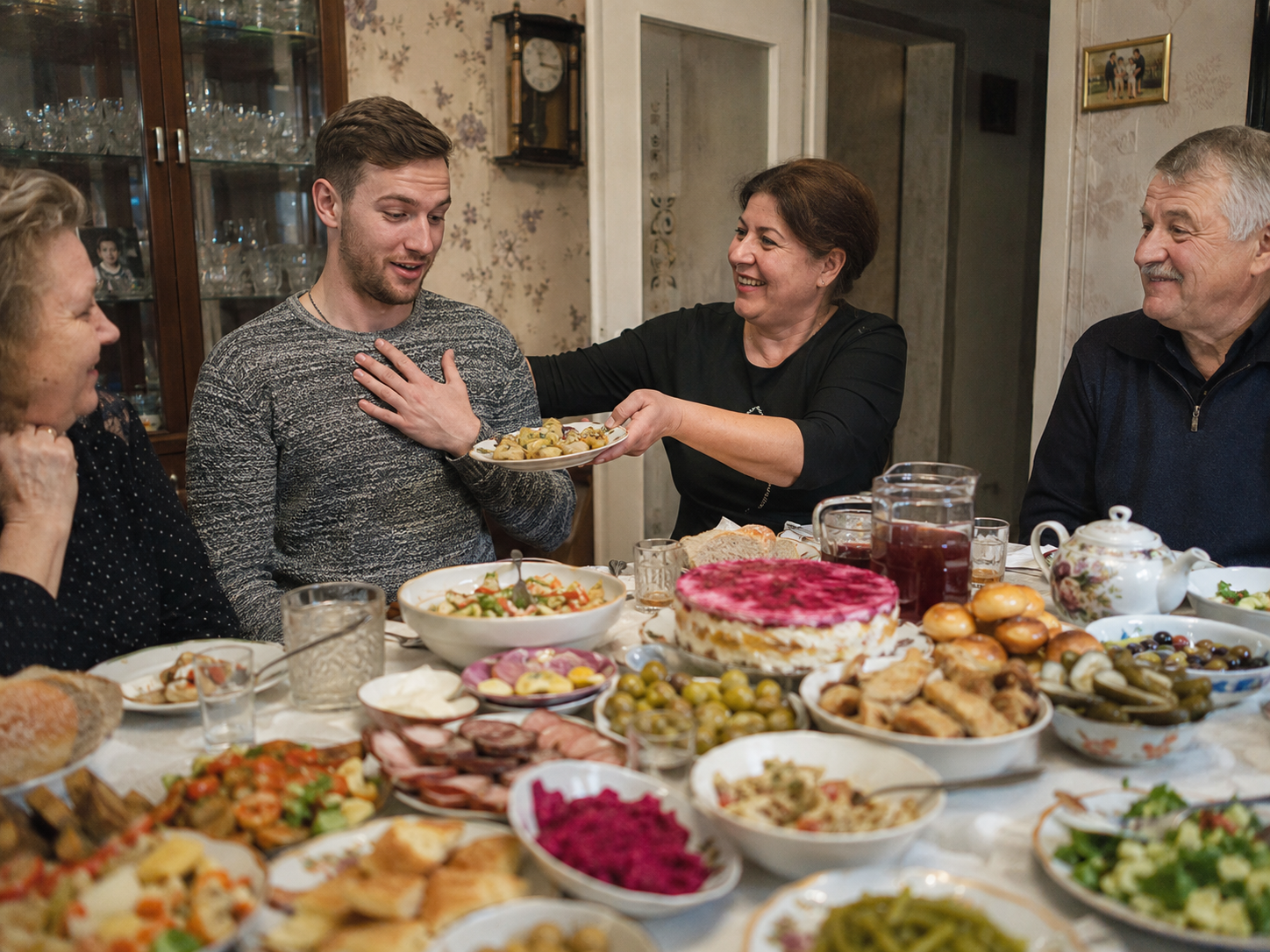
Foreigners often say they are shocked by how much food appears on the table when they visit a Russian home.
A “small dinner” may include salads, bread, pickles, fish, meat, potatoes, soup, tea, sweets, cake, fruit, and more. Even if the host says, “We just made something simple,” the table may look like a holiday feast.
Russian hospitality can be intense. Hosts may encourage you to eat more. They may refill your plate. They may worry that you are hungry. They may say:
Ешьте, ешьте!
Eat, eat!
Попробуйте это.
Try this.
Вам понравилось?
Did you like it?
For foreigners, this can be both wonderful and overwhelming. You may feel pressured to eat more than you want. You may not know how to refuse politely.
The key is to show appreciation. Do not simply say “No” sharply. Instead, compliment the food and explain gently.
Useful phrases:
Очень вкусно!
Very delicious!
Спасибо, я уже наелся.
Thank you, I’m already full. Said by a man.
Спасибо, я уже наелась.
Thank you, I’m already full. Said by a woman.
Можно чуть-чуть?
Can I have just a little?
Я попробую.
I’ll try it.
Even if you cannot eat much, appreciation matters.
9. Not Understanding Toasts
Russian toasts are not just quick “cheers” moments. In many social situations, especially dinners, celebrations, birthdays, weddings, and family gatherings, toasts can be meaningful and emotional.
A toast may include wishes for health, happiness, success, friendship, family, love, or memory. People may speak sincerely. Sometimes they may speak at length.
Foreigners often make two mistakes.
The first mistake is drinking too early, before the toast is finished.
The second mistake is treating the toast as a casual, meaningless ritual.
If someone is making a toast, listen. Wait until they finish. Then drink with the group.
Common phrases:
За здоровье!
To health!
За дружбу!
To friendship!
За любовь!
To love!
За встречу!
To our meeting!
Поздравляю!
Congratulations!
Also, be careful with the famous phrase На здоровье. Many English speakers think this means “cheers” in Russian. It is not the standard Russian toast. Russians may say На здоровье in response to thanks, especially when giving food, meaning something like “you’re welcome” or “enjoy it,” but for toasting, За здоровье is more appropriate.
10. Misreading Russian Directness
Russian communication can be more direct than what many English speakers are used to.
A Russian person may say:
Вы плохо выглядите.
You look bad.
Ты похудел?
Have you lost weight?
Ты поправился?
Have you gained weight?
Это неправильно.
That is wrong.
Мне это не нравится.
I don’t like this.
To foreigners, this can sound rude or harsh. But Russian directness does not always mean aggression. In many contexts, especially among friends or family, direct comments may be understood as honesty, concern, or practical feedback.
This does not mean Russians are always direct or that politeness does not exist. Russian has many subtle forms of politeness. But the cultural balance between honesty and social comfort can be different.
Foreigners sometimes soften everything so much that their Russian sounds vague or unnatural. At the same time, beginners should be careful not to imitate directness too aggressively, because they may lack the tone and relationship context that makes it acceptable.
The best approach is to learn polite directness.
Examples:
Мне кажется, это не очень удобно.
It seems to me this is not very convenient.
Я не совсем понимаю.
I don’t completely understand.
Можно по-другому?
Is it possible another way?
Извините, но я не согласен.
Sorry, but I disagree. Said by a man.
Извините, но я не согласна.
Sorry, but I disagree. Said by a woman.
Russian politeness often comes not from avoiding the truth, but from expressing it with the right level of respect.
11. Speaking Too Loudly in Public
In some cultures, speaking energetically in public is normal. In Russia, especially in public transportation, cafés, museums, theaters, waiting rooms, and apartment buildings, loud public behavior may be frowned upon.
Foreigners may not realize how loudly they are speaking, especially in groups. English speakers in particular are sometimes perceived as loud abroad, even when they are not trying to be.
In Russia, public space often has a more reserved emotional style. People may talk quietly on the metro. They may avoid drawing attention to themselves. Big emotional displays in public can be seen as inappropriate depending on the setting.
This does not mean Russians are quiet in all situations. Russian homes, celebrations, and close gatherings can be lively and loud. But public behavior is often more controlled.
A useful rule: match the volume of the people around you.
If everyone is speaking softly, lower your voice. If you are in a private dinner and everyone is laughing loudly, relax.
Useful phrase:
Извините.
Excuse me / Sorry.
A simple apology works well if you accidentally disturb someone.
12. Ignoring Respect for Elders
Respect for older people remains important in Russian etiquette.
On public transportation, younger people are often expected to offer seats to elderly passengers, pregnant women, people with small children, or people who clearly need help. This expectation may be stronger than in some Western cities.
Foreigners may not notice the social pressure immediately, but others might.
If you are sitting on a bus or metro and an older person enters, it is polite to offer your seat.
You can say:
Садитесь, пожалуйста.
Please sit down.
This is a small phrase, but it can communicate a lot of cultural awareness.
Respect for elders may also appear in greetings, table behavior, and conversation. Older relatives or guests may be served first. Their opinions may be given special attention. Interrupting them may seem especially rude.
Of course, Russian society is diverse, and younger generations may behave differently. But as a learner, showing respect will almost never hurt you.
13. Being Too Casual With Invitations
In Russian social life, an invitation to someone’s home can mean more than “come over for a quick visit.”
Home is often a private and intimate space. Being invited into a Russian home may be a sign of trust, friendship, or serious hospitality. It is not always casual.
If someone invites you, take it seriously. Arrive on time or only slightly late, depending on the situation. Bring something. Compliment the home or the food. Do not leave too quickly unless you have explained in advance.
Also, do not assume that “drop by anytime” always literally means anytime. Russian hospitality is generous, but people still appreciate respect for their time and household.
If you are invited, you might say:
Спасибо за приглашение.
Thank you for the invitation.
Во сколько мне прийти?
What time should I come?
Что мне принести?
What should I bring?
That last question is very useful. Even if the host says, “Nothing,” you should probably still bring something small.
14. Refusing Food Too Strongly
Because food is connected to hospitality, refusing it can be delicate.
Foreigners who are dieting, vegetarian, allergic, or simply full may feel uncomfortable at a Russian table. The host may keep offering food, and the guest may keep saying no. This can become awkward.
The solution is not to force yourself to eat everything. The solution is to refuse warmly and appreciatively.
Instead of saying:
Нет.
No.
Say:
Спасибо, всё очень вкусно, но я уже наелся.
Thank you, everything is very delicious, but I am already full. Said by a man.
Спасибо, всё очень вкусно, но я уже наелась.
Thank you, everything is very delicious, but I am already full. Said by a woman.
If you have a dietary restriction:
Я не ем мясо.
I don’t eat meat.
У меня аллергия.
I have an allergy.
Мне нельзя.
I can’t have it / I’m not allowed to have it.
The phrase Мне нельзя is very useful because it sounds less like personal rejection and more like a restriction.
15. Misunderstanding Personal Space and Emotional Distance
Russian social behavior often has a strong contrast between public distance and private closeness.
In public, people may seem reserved. They may not smile much. They may not make small talk. They may avoid unnecessary interaction.
But in private relationships, Russians can be extremely warm, loyal, generous, emotional, and deeply engaged. Friendship may involve long conversations, practical help, emotional honesty, and a strong sense of responsibility.
Foreigners sometimes misunderstand this contrast. They think Russians are cold because public interactions are reserved. Or they assume a warm private conversation means instant casual friendship.
The truth is more nuanced. Russian social life often has a thicker boundary between strangers and insiders. Once you cross that boundary, the relationship may become much deeper than expected.
This is one reason learning Russian etiquette matters. You are not just learning how to avoid mistakes. You are learning how to enter relationships in a culturally appropriate way.
16. Expecting Constant Small Talk
In many English-speaking cultures, small talk is a social lubricant. People talk about the weather, weekend plans, traffic, sports, pets, or work as a way of creating comfort.
In Russia, small talk exists, but it may not be as automatic or as central in all situations. Conversations may become serious faster. People may discuss literature, politics, family, health, money problems, work stress, or philosophical questions more openly than some foreigners expect.
This can be refreshing, but also surprising.
A foreigner may think, “Why are we talking about life and death after ten minutes?” A Russian speaker may think, “Why are we talking about nothing for so long?”
As a beginner, you do not need to discuss Dostoevsky at your first coffee meeting. But you should be prepared for conversations that feel less superficial.
Useful beginner-friendly questions:
Откуда вы?
Where are you from?
Где вы живёте?
Where do you live?
Что вы любите делать?
What do you like to do?
Вы любите путешествовать?
Do you like to travel?
Почему вы учите русский?
Why are you learning Russian?
That last question is one you may hear often.
17. Forgetting Important Polite Words
Russian has a reputation for sounding serious or direct, but polite words are very important.
Beginners should master these early:
Пожалуйста.
Please / You’re welcome.
Спасибо.
Thank you.
Большое спасибо.
Thank you very much.
Извините.
Excuse me / Sorry.
Простите.
Forgive me / Sorry.
Будьте добры.
Would you be so kind.
Можно?
May I? / Is it possible?
Скажите, пожалуйста…
Tell me, please…
The phrase Скажите, пожалуйста is extremely useful. It softens questions and makes you sound more polite.
For example:
Скажите, пожалуйста, где метро?
Could you tell me where the metro is?
Скажите, пожалуйста, сколько это стоит?
Could you tell me how much this costs?
Beginners sometimes learn vocabulary but forget etiquette phrases. That is a mistake. In real life, politeness words help you survive many situations even with limited grammar.
18. Not Knowing How to Apologize Properly
Foreigners sometimes overuse or underuse apologies in Russian.
The most common words are:
Извините — excuse me / sorry, formal or polite
Извини — sorry, informal
Простите — forgive me / sorry, formal or stronger
Прости — forgive me, informal
Use извините when asking a stranger for help, getting someone’s attention, bumping into someone, or making a small mistake.
Examples:
Извините, где метро?
Excuse me, where is the metro?
Извините, я не понимаю.
Sorry, I don’t understand.
Извините, можно спросить?
Excuse me, may I ask?
For beginners, извините is one of the safest and most useful Russian words you can learn.
19. Thinking Russian Etiquette Is Only About Rules
It is tempting to see etiquette as a list of rules:
Do not shake hands across a threshold.
Take off your shoes.
Bring odd-numbered flowers.
Offer your seat to elders.
Do not smile too much at strangers.
Wait for the toast.
These rules are useful. But etiquette is not only about memorizing rules. It is about understanding the values behind them.
Russian etiquette often reflects:
respect for private space
seriousness in public
sincerity in emotion
generosity toward guests
loyalty in friendship
respect for age and experience
attention to ritual and symbolism
warmth inside trusted relationships
When you understand the values, the rules become easier to remember.
For example, taking off shoes is not just a rule. It reflects respect for the home.
Bringing food or flowers is not just a rule. It reflects gratitude for hospitality.
Waiting during a toast is not just a rule. It reflects respect for the speaker and the occasion.
Using вы is not just grammar. It reflects social distance, politeness, and respect.
This is where language and culture become inseparable.
20. Being Afraid to Make Mistakes
Finally, one of the biggest mistakes foreigners make is becoming so afraid of etiquette mistakes that they stop trying.
Russian culture has many customs, but Russians do not expect foreigners to know everything. If you are sincere, respectful, and willing to learn, most people will appreciate your effort.
You may use the wrong form of “you.” You may forget a patronymic. You may mispronounce здравствуйте. You may bring the wrong kind of cake. You may answer Как дела? too briefly or too honestly. You may not understand when a toast is finished.
That is normal.
The goal is not perfection. The goal is awareness.
A beginner who says three simple Russian sentences politely often makes a better impression than an advanced learner who ignores the culture completely.
Start with these essentials:
Здравствуйте.
Hello.
Спасибо.
Thank you.
Пожалуйста.
Please / You’re welcome.
Извините.
Excuse me / Sorry.
Очень приятно.
Nice to meet you.
Можно?
May I?
Скажите, пожалуйста…
Could you tell me, please…
With these phrases, a respectful attitude, and a basic understanding of etiquette, you can avoid many common mistakes and create much warmer interactions.
FAQs About Russian Etiquette
Do Russians really not smile at strangers?
Russians do smile, but smiling is usually more connected to genuine emotion or personal warmth than automatic public politeness. A neutral expression does not necessarily mean someone is angry or rude.
Should I use ты or вы in Russian?
Use вы in formal situations, with strangers, older people, teachers, officials, and anyone you do not know well. Use тыwith friends, family, children, or when someone invites you to be informal.
Is it rude to wear shoes inside a Russian home?
In many Russian homes, yes. Guests are usually expected to remove outdoor shoes near the entrance. Hosts may offer slippers, called тапочки.
What should I bring when visiting a Russian home?
Good options include flowers, chocolates, cake, fruit, tea, wine, or a small gift. If bringing flowers for a happy occasion, choose an odd number.
Why should I not bring an even number of flowers?
An even number of flowers is traditionally associated with funerals or mourning. For birthdays, visits, dates, celebrations, or dinner invitations, bring an odd number.
Is Russian directness rude?
Not necessarily. Russian communication can be more direct than English-speaking communication, but directness may reflect honesty, concern, or practicality. Tone and relationship matter greatly.
What is the most useful polite Russian phrase for beginners?
Скажите, пожалуйста… is extremely useful. It means “Could you tell me, please…” and can be used before many questions.
Is “На здоровье” the right way to say cheers?
Not usually. For toasts, Russians more commonly say За здоровье!, meaning “To health!” На здоровье is often used more like “you’re welcome” or “enjoy it” in response to thanks.
Should I offer my seat to older people in Russia?
Yes, it is usually polite to offer your seat to elderly passengers, pregnant women, people with small children, or anyone who appears to need it.
What is the biggest etiquette mistake foreigners make in Russian?
The biggest mistake is assuming that Russian etiquette works exactly like etiquette in their own culture. Russian manners may look reserved on the surface, but they often reflect deep values around sincerity, hospitality, respect, and trust.
Learn Russian Beyond the Textbook
Russian etiquette is one of the best reminders that language is never only about words. You can memorize vocabulary lists, study grammar charts, and practice pronunciation, but if you do not understand how people greet each other, visit each other’s homes, show respect, make toasts, refuse food, or use formal and informal speech, you will miss a huge part of real communication.
At Polyglottist Language Academy, we help students learn Russian in a way that is practical, cultural, and human. Our Russian classes are designed for adults who want to understand not only how Russian grammar works, but how Russian is actually used in real conversations. Whether you are a complete beginner or continuing from a previous level, our small-group classes give you the chance to practice speaking, ask questions, build confidence, and learn the cultural details that textbooks often skip.
If you want to speak Russian with more confidence, understand Russian culture more deeply, and avoid the common mistakes that beginners often make, we invite you to sign up for Russian classes with Polyglottist Language Academy.
Russian may seem intimidating at first, but with the right guidance, it becomes much more approachable — and much more rewarding.
Read More on Our Blog
You may also enjoy these related articles: