
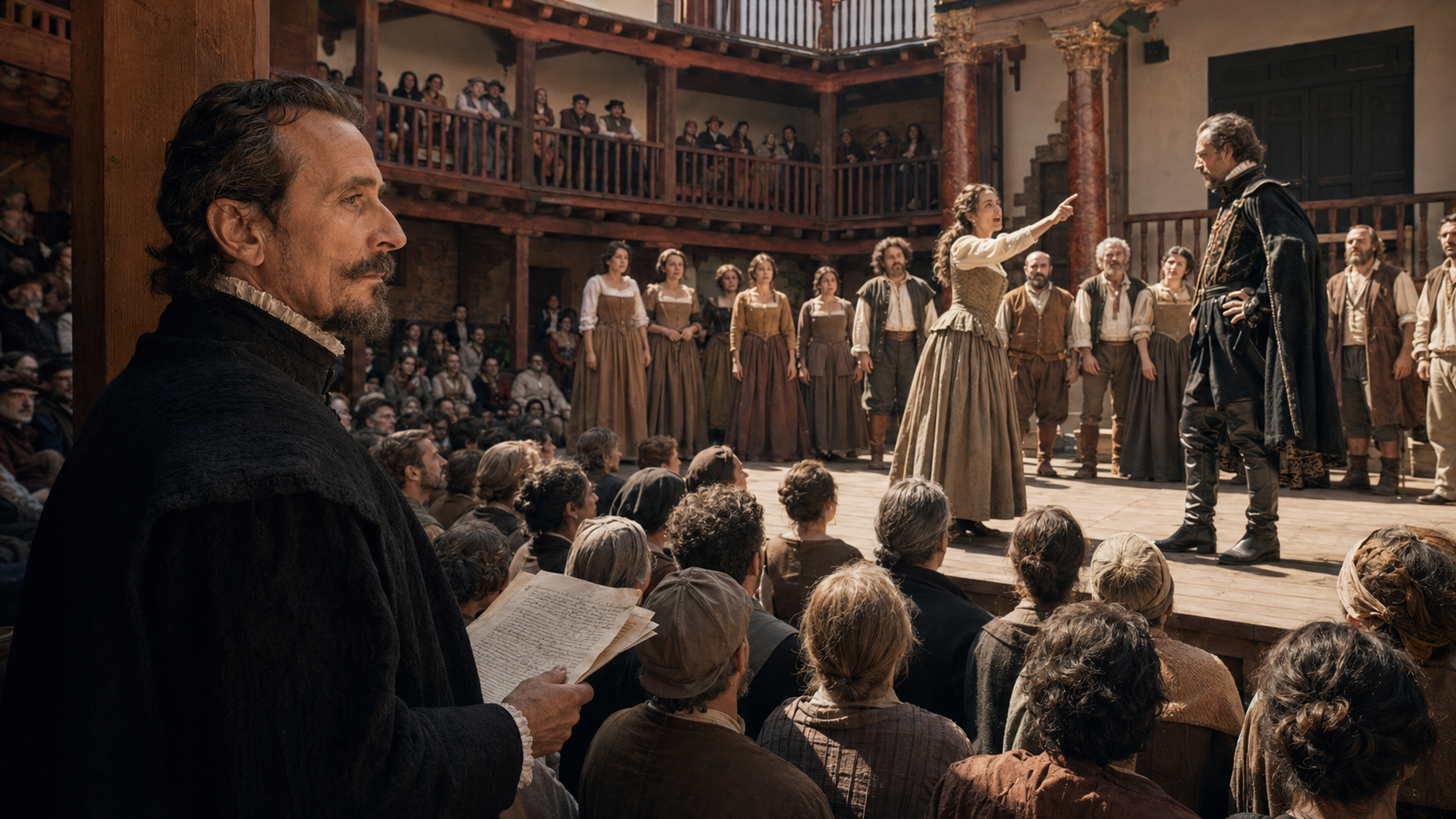
Imagine stepping into a crowded courtyard theater in Madrid around the year 1600.
People are talking, laughing, buying refreshments, watching one another, and waiting impatiently for the performance to begin. The audience is not sitting in reverent silence. The theater is noisy, social, commercial, and alive. A successful play must capture everyone’s attention quickly—and hold it.
Then the actors appear. Within minutes, there is a forbidden romance, a threat to someone’s honor, a jealous noblewoman, a clever servant, a disguise, an abuse of power, and the possibility of public scandal.
The playwright behind many of these stories is Lope de Vega.
Today, his name can sound intimidatingly literary. He belongs to Spain’s Golden Age, wrote largely in verse, and lived more than four centuries ago. Yet his plays often feel less like remote monuments of “great literature” and more like expertly constructed popular entertainment. They move quickly, shift between comedy and danger, follow several characters at once, and place private emotions inside larger conflicts involving class, gender, reputation, and authority.
Lope understood something that modern television writers understand very well: an audience will return for complicated people, emotional tension, social conflict, and a story that refuses to stand still.
A playwright with several lives
Lope de Vega’s full name was Félix Lope de Vega Carpio. He was born in Madrid in late 1562 and died there in 1635. During his lifetime, he became the most celebrated dramatist of Spain’s Golden Age and one of the most prolific authors in European literary history. He was praised as the Fénix de los ingenios, the “Phoenix of Wits,” and Cervantes famously described him as a monstruo de naturaleza—a “monster of nature,” in the sense of an astonishing natural phenomenon.
Even without his plays, Lope’s biography would sound like the plot of a historical drama.
He was educated by Jesuits and studied at Alcalá de Henares, although he did not complete a university degree. He became involved in Madrid’s literary and theatrical world while still young. He served in the military, married more than once, had numerous romantic relationships and fathered several children. An early relationship with the actress Elena Osorio ended in scandal when Lope wrote insulting verses about her and her family, resulting in his exile from the royal court.
Later, after years of emotional upheaval and personal loss, he entered the priesthood in 1614. Becoming a priest, however, did not transform him into a simple model of religious withdrawal. His attachments, passions, literary ambitions, and appetite for public recognition continued.
That contradiction is essential to understanding him.
Lope was religious and sensual, penitential and theatrical, morally serious and frequently scandalous. He wrote sacred poetry filled with guilt and devotion, but he also wrote some of the liveliest stories about attraction, jealousy, rivalry, desire, and deception in Spanish literature. His life repeatedly moved between discipline and impulse, public reputation and private emotion—the same tensions that animate many of his plays.
This may be one reason he remains so compelling. Lope did not write about human inconsistency from a safe distance. He lived it.
Madrid was watching
Lope’s success cannot be separated from the world of public theater that developed around him.
In late sixteenth- and early seventeenth-century Spain, theater was not an obscure pastime for a small educated elite. It was a major form of urban entertainment. Performances were held in corrales de comedias, courtyard theaters where audiences from different social backgrounds occupied different sections.
The patio was the central courtyard. Women watched from a designated gallery known as the cazuela. Wealthier or more powerful spectators might sit in boxes or more prestigious areas. People came not only to follow the play but also to socialize, observe one another, argue, flirt, and take part in the public life of the city.
Madrid’s best-known theaters included the Corral de la Cruz and the Corral del Príncipe. The site of the latter is associated with today’s Teatro Español.
A performance had to compete with all the distractions of this lively environment. The playwright could not assume that the audience would patiently wait through a slow first act while the intellectual meaning gradually revealed itself.
Lope wrote accordingly.
His plots usually begin moving quickly. Lovers are separated by class. A woman wants a man she believes she should not want. A powerful official threatens an ordinary family. A secret is overheard. A disguise changes a person’s apparent identity. A servant sees through the foolishness of the aristocrats. Comic misunderstandings develop beside the possibility of violence.
This theater was created for a mixed, demanding public, and Lope treated that public with respect. He did not assume popular entertainment had to be intellectually empty. Instead, he used suspense, humor, romance, and spectacle to lead audiences into difficult questions about justice, reputation, power, and responsibility.
The man who changed the rules
Lope de Vega did not invent Spanish theater. Drama existed in Spain before him, shaped by religious performance, court entertainment, classical models, Renaissance theory, and the work of earlier playwrights.
What Lope did was transform those traditions into a flexible, highly successful form designed for the commercial stage.
Classical dramatic theory often emphasized formal rules, including separation between tragedy and comedy and adherence to the unities of time, place, and action. Lope recognized that these rules did not always correspond to what audiences enjoyed.
In his theatrical manifesto, Arte nuevo de hacer comedias en este tiempo—“The New Art of Writing Plays in Our Time”—he joked that when he began writing a comedy, he locked the established precepts away “with six keys.”
His point was not that artistic structure did not matter. Lope’s plays are carefully structured. Rather, he believed that dramatic rules should serve the performance, not suffocate it.
He helped establish a three-act form and freely mixed serious and comic material. Noble characters might appear alongside peasants, servants, soldiers, rulers, and outsiders. A romantic comedy could contain genuine danger. A story about political violence could include humor. Suspense might be produced through disguise, delayed recognition, mistaken identity, competing love stories, or a secret revealed at exactly the wrong moment.
Lope even defended the mixture of tones directly:
“The tragic and the comic mixed together
will make one part serious, another ridiculous.”
That combination still feels familiar. Modern audiences routinely watch stories that shift from humor to grief, romance to political conflict, or domestic drama to public catastrophe. Lope understood that emotional variety does not necessarily weaken a story. It can make the story feel more like life.
Honor was not simply pride
One of the hardest ideas for modern readers to understand in Golden Age drama is honra.
In contemporary English, “honor” may suggest personal integrity, ethical behavior, or an internal sense of dignity. In Lope’s world, honra was also intensely public. It depended on how a person and family were perceived by others.
A rumor could damage it. A woman’s sexual reputation could affect an entire household. A man might feel obligated to respond to an insult because failing to respond would appear cowardly. Social identity was not imagined as something purely private. It existed under the gaze of the community.
This makes Lope’s theater a world of constant observation.
Who saw the meeting? Who heard the conversation? Who entered through the garden? Who believes the accusation? Who controls the story that other people will repeat?
Adult language learners sometimes notice that a single word can open a door into an entire cultural system. Honra is one of those words. It cannot be understood only through a dictionary definition. To understand it, we must see the relationships around it: family, gender, class, gossip, reputation, and authority.
Lope’s plays repeatedly ask what happens when desire conflicts with that public system. A person may love someone socially inappropriate. A powerful man may assume that his rank allows him to violate another household. A woman may have to protect her reputation while also pursuing what she wants. A peasant may demand recognition of a dignity that society supposedly reserves for the nobility.
The result is not one simple political message. Lope often criticizes abuses of power while preserving the larger social order. His plays can question authority and restore it in the same ending. That tension is not necessarily a contradiction that needs to be solved. It is often where the drama becomes most interesting.
Fuenteovejuna: when a village answers as one
Lope’s most internationally recognizable play is probably Fuenteovejuna.
The story is based on a historical episode from 1476. The people of Fuente Obejuna rebelled against Fernán Gómez de Guzmán, a commander of the Order of Calatrava whose rule had become associated with violence and abuse.
In Lope’s version, the Commander terrorizes the village and attempts to exercise power over its women. Laurencia, one of the play’s central figures, becomes a target of his predatory authority. Frondoso, the man she loves, attempts to protect her, but the conflict is larger than one couple.
After sustained abuse, the villagers kill the Commander.
When investigators demand the name of the person responsible, the inhabitants repeatedly give the same answer:
“Fuenteovejuna lo hizo.”
“Fuenteovejuna did it.”
The sentence is simple enough for a beginner to understand, but its meaning is enormous. The village refuses to isolate one individual. It becomes a collective moral actor.
Is this a story of popular revolution? In part.
Is it a defense of monarchy? Also in part.
The Catholic Monarchs eventually pardon the villagers and absorb the crisis into royal justice. The play therefore condemns local tyranny while presenting the crown as the final source of order. This is why Fuenteovejuna cannot be reduced to a simple modern slogan. It celebrates collective resistance, but it does not completely reject hierarchy.
Laurencia’s role makes the play even more powerful. After suffering violence, she confronts the men of the village for failing to act. Her speech transforms private injury into a public accusation. She does not wait quietly for male characters to decide what justice means.
Modern audiences may read Laurencia as a feminist figure, but it is more accurate to recognize both her extraordinary force and her historical setting. She speaks from within a society organized by honor, family, and gendered expectations, yet she turns those expectations against the men who have failed to defend the community.
The play remains urgent because it asks questions that have not disappeared:
When authority becomes abusive, who is responsible for resisting it?
What happens when official systems fail?
Can a community share responsibility without erasing individual guilt?
Why do people remain silent until one voice makes silence impossible?
Directors have staged Fuenteovejuna in many political contexts because its central image—the community speaking as one—can be adapted to struggles against dictatorship, occupation, gendered violence, workplace abuse, and institutional intimidation. The historical situation changes, but the moral pressure remains recognizable.
Desire, intelligence, and women who refuse to remain still
A modern reader approaching Lope for the first time may expect his women to be passive figures waiting to be married.
That is not usually what happens.
Lope’s female characters live within a restrictive social world, but many of them are verbally skilled, emotionally complex, and strategically active. They disguise themselves, manipulate appearances, test lovers, defend their reputations, expose hypocrisy, and find ways to influence decisions formally controlled by men.
In El perro del hortelano, Diana, the Countess of Belflor, desires her secretary Teodoro but is trapped by class expectations. She does not simply surrender to love. She hesitates, intervenes, becomes jealous, changes direction, and tries to control both the relationship and the social meaning of the relationship.
The title refers to the expression about the dog in the manger: someone who will neither enjoy something nor allow another person to enjoy it. Diana does not initially accept Teodoro, yet she cannot tolerate the idea that he might love someone else.
The comedy is elegant and entertaining, but underneath it lies a serious question: what happens when emotion challenges a social hierarchy that everyone is expected to treat as natural?
La dama boba, meanwhile, plays with assumptions about intelligence, education, desire, and transformation. Its treatment of women reflects its period, but the play also enjoys overturning appearances. The supposedly foolish woman does not remain easily defined by the judgment others have placed upon her.
In Peribáñez y el comendador de Ocaña, an abuse of aristocratic power threatens the dignity of a peasant marriage. In El castigo sin venganza, private desire collides with dynastic obligation and produces one of Lope’s darkest tragedies. El caballero de Olmedo begins with love and courtship but moves toward violence and fatality.
These works differ greatly in tone, but they share Lope’s fascination with people forced to negotiate between what they feel and what their society permits.
Lope de Vega was not simply “the Spanish Shakespeare”
The comparison between Lope de Vega and William Shakespeare is understandable.
They lived during roughly the same period. Both wrote for commercial theaters, appealed to broad audiences, mixed tragic and comic tones, and created stories involving rulers, lovers, servants, women resisting restrictions, political conflict, and mistaken identities.
Yet calling Lope “the Spanish Shakespeare” can make him seem like a secondary version of an English original.
He was not.
Lope developed within Spain’s own theatrical institutions, political structures, religious culture, poetic traditions, and ideas about honor. The comedia nueva was not an imitation of English Renaissance drama. It was a distinctive dramatic system that influenced generations of Spanish playwrights, including Tirso de Molina and Pedro Calderón de la Barca.
Shakespeare became more familiar in the English-speaking world partly because of the global dominance of English and the central place Shakespeare received in Anglophone education. Lope’s lesser visibility outside the Spanish-speaking world does not reflect lesser importance within his own literary tradition.
For students of Spanish, reading Lope can be a useful reminder that literary fame is shaped by language and cultural power. A writer may be foundational in one tradition and nearly invisible in another.
The complicated relationship with Cervantes
Miguel de Cervantes and Lope de Vega are sometimes presented as straightforward enemies. The reality appears more complicated.
Cervantes could admire Lope’s astonishing talent and success while also criticizing the theatrical system Lope represented. Lope dominated the commercial stage in a way Cervantes never did. That imbalance naturally created tension.
The description monstruo de naturaleza captures both admiration and unease. Lope’s productivity seemed almost inhuman.
Traditional accounts credit him with approximately 1,500 to 1,800 plays, though exact totals are uncertain. Many works have been lost, and attribution can be difficult because early modern theater was commercial, collaborative, and not always carefully documented. It is therefore safer to describe him as extraordinarily prolific than to repeat one precise number as settled fact.
Stories claiming he could write a complete play in a single day are probably exaggerated. Still, the exaggeration points toward something real. Lope wrote at an astonishing pace because professional theater demanded a constant supply of new material.
In modern terms, he was not only an inspired artist. He was also a working writer operating under commercial pressure, responding to audiences, competitors, actors, theatrical companies, and deadlines.
That makes his career surprisingly contemporary.
A quieter Lope appears in his poetry
The public energy of Lope’s theater can make it easy to forget that he also wrote poetry, prose, religious verse, epic works, and La Dorotea, a prose dialogue shaped by memory and emotional conflict.
His Rimas and Rimas sacras reveal a more introspective voice. The same man who could fill a stage with rapid action also wrote about guilt, grief, devotion, love, contradiction, and spiritual exhaustion.
One of his best-known sonnets begins with a cascade of emotional states:
“Desmayarse, atreverse, estar furioso…”
“To faint, to dare, to be furious…”
The poem attempts to define love through opposites and emotional extremes. Love is not presented as calm agreement. It is confusion, courage, fear, anger, tenderness, absence, and self-division.
That emotional instability is deeply Lopean. His characters often want two incompatible things at once. They desire freedom but fear disgrace. They reject a lover but cannot endure losing that lover. They demand justice while depending on the very hierarchy that has failed them.
Lope understood that people rarely experience emotion in orderly categories.
Spanish words that unlock Lope’s world
Reading even a short scene by Lope can introduce students to vocabulary that carries historical and cultural meaning.
Honra
Public honor or reputation. It is closely connected to how a person or family is viewed by society.
Honor
Often overlaps with honra, although it may refer more broadly to dignity, status, or moral worth. In Golden Age drama, the distinction varies according to context.
Comendador
A commander associated with a military or religious order. In Fuenteovejuna, the Commander is the abusive authority figure at the center of the conflict.
Galán
The leading young man or romantic hero in a traditional play. A galán is usually involved in courtship, rivalry, or questions of honor.
Dama
A lady or female romantic lead. Lope’s damas are often more active and strategically intelligent than the label may suggest.
Gracioso
The comic servant or companion. The gracioso may provide humor, but also practical insight and social commentary.
Corral de comedias
A courtyard theater used for public performances in Golden Age Spain.
Capa y espada
Literally “cloak and sword.” A comedia de capa y espada typically involves urban romance, honor, disguise, rivalry, and mistaken identity.
“Fuenteovejuna lo hizo”
“Fuenteovejuna did it.” The phrase has come to represent collective responsibility and solidarity.
For students, vocabulary like this is easier to remember when it belongs to a dramatic situation. Comendador becomes more vivid when attached to a villain. Honra becomes clearer when a character risks losing it. Language gains emotional weight when it is heard in conflict rather than memorized from an isolated list.
Is Lope too difficult for a Spanish learner?
The original language can be challenging.
Lope wrote largely in verse, using Golden Age vocabulary, flexible word order, literary references, poetic compression, and forms that are unfamiliar to many modern readers. Even native speakers may prefer annotated or modernized editions.
That does not mean students must wait until they are nearly fluent.
Intermediate learners can begin with selected scenes, bilingual editions, modern adaptations, or filmed performances. Reading a short passage aloud can reveal rhythm and emotion even when every grammatical detail is not immediately clear.
A good starting method is:
Read a brief plot summary.
Watch a scene in performance.
Read the same scene in Spanish.
Mark repeated words and emotional expressions.
Read the scene aloud with another person.
Drama is especially useful for language study because it was written to be spoken. A play allows students to hear formality, accusation, persuasion, flirtation, command, mockery, and affection. These social tones are often harder to understand from grammar exercises alone.
Following Lope through Madrid
Travelers interested in literature can still find Lope’s world in Madrid.
The Casa-Museo Lope de Vega is located in the Barrio de las Letras, the neighborhood associated with many writers of Spain’s Golden Age. The house gives visitors a more intimate view of the playwright’s domestic and literary environment.
The surrounding area connects Lope to Cervantes, Quevedo, and other major figures of the period. Nearby streets preserve the memory of Madrid’s theatrical culture, including the area associated with the Corral del Príncipe.
For a language learner, visiting such places changes the scale of literary history. A name from a textbook becomes a person who walked through a particular street, wrote in a particular room, worried about money, competed with other writers, worked with actors, and tried to satisfy a demanding public.
Madrid does not preserve Lope only as a statue or a historical label. His presence is woven into the city’s idea of itself as a literary capital.
Why his stories still feel modern
Lope de Vega’s world was not our world. Its assumptions about monarchy, religion, gender, class, and family cannot simply be translated into contemporary values.
Yet his dramatic conflicts remain recognizable.
A powerful man believes his position protects him from consequences.
A woman must manage desire in a society that judges her differently from a man.
A family fears public humiliation.
An employee or social inferior becomes romantically involved with someone above them.
A community knows that abuse is occurring but hesitates to intervene.
An institution fails, forcing ordinary people to decide whether they will remain silent.
A public figure tries to control the story others tell about them.
These are not relics of seventeenth-century Spain.
Lope’s particular gift was to turn such conflicts into theater that moved. He did not place ideas onstage as static arguments. He embodied them in lovers, servants, rulers, jealous rivals, frightened families, outspoken women, compromised authorities, and communities under pressure.
At Polyglottist Language Academy, we believe literature becomes most useful when it helps students see how language, history, and daily human behavior connect. Studying Spanish is not only a matter of mastering verb forms. It is also a way of understanding why words such as honra, pueblo, justicia, and poder carry cultural histories that cannot always be captured by a single English equivalent.
Readers interested in exploring these connections can learn more about our online Spanish classes and discover how literature, conversation, and cultural context can make the language feel more alive.
Frequently asked questions about Lope de Vega
Why is Lope de Vega important in Spanish literature?
Lope transformed Spanish commercial theater by developing a flexible dramatic form that mixed comedy and tragedy, used rapid three-act plots, and appealed to a broad public. His model of the comedia nueva influenced later writers, including Tirso de Molina and Calderón de la Barca.
What is Lope de Vega’s most famous play?
Fuenteovejuna is probably his most internationally famous play. It tells the story of a village that collectively resists an abusive commander and refuses to identify a single person as responsible for his death.
Did Lope de Vega really write 1,800 plays?
The number is traditional rather than certain. Lope was extraordinarily prolific, but modern scholars are cautious because many texts were lost, some works have uncertain attribution, and early modern theatrical authorship was not always clearly documented.
Was Lope de Vega a priest?
Yes. He was ordained in 1614. However, his religious life did not erase the romantic attachments, emotional contradictions, and concern with worldly fame that characterized much of his biography.
What did Cervantes think of Lope de Vega?
Cervantes appears to have both admired and criticized him. He recognized Lope’s extraordinary talent and popularity while expressing reservations about the commercial theatrical style Lope helped establish. Their relationship was more complicated than a simple personal feud.
Is Lope de Vega difficult to read in Spanish?
The original texts can be difficult because they use Golden Age vocabulary, poetic word order, verse forms, and cultural references. Intermediate learners can begin with modernized editions, bilingual texts, selected scenes, or filmed productions.
Related reading
European Spanish Vs. Mexican Spanish: Which One Should You Learn?
Why Spanish Is Spoken In So Many Countries (And How It Spread)
Latin America Vs. Spain: Historical Roots Of Language And Culture Differences
Learning Spanish In Oakland: Connecting With The City Through Language
Small-Group Spanish Classes In Berkeley Vs Apps: What Produces Real Results?
Lope de Vega wrote for people crowded into a noisy courtyard, people who wanted to laugh, worry, recognize themselves, and discover what would happen next.
Four centuries later, the courtyard has changed. The questions have not.
Who controls the story? Who is allowed to love? What does a community owe its most vulnerable members? When does silence become complicity? And what happens when ordinary people finally answer with one voice?
Opening a play by Lope is therefore more than opening an old book. It is like hearing a stage come alive in another language—and realizing that the people speaking from it are not as distant from us as we expected.