
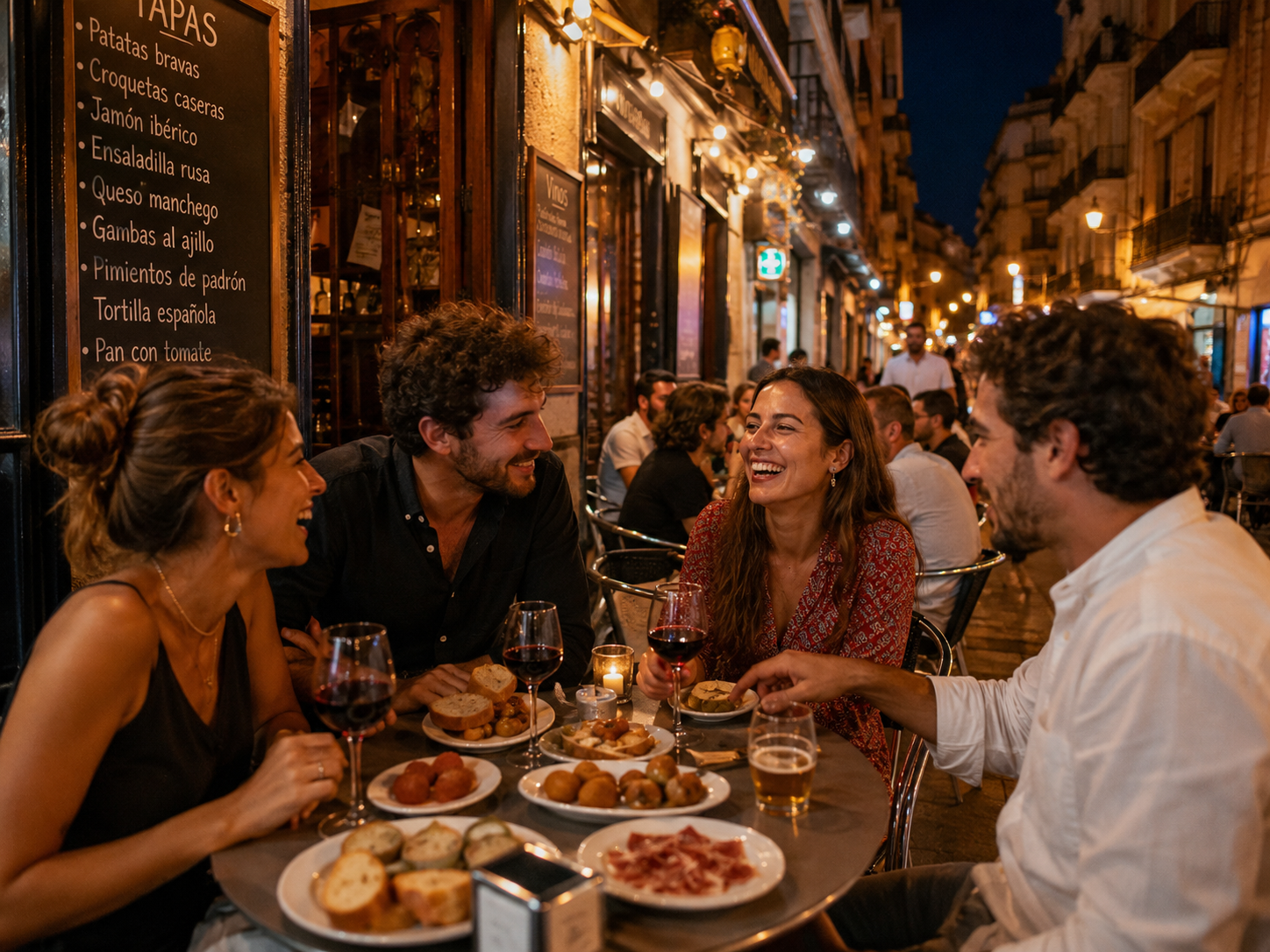
If you want to understand Spain, you cannot understand it only by looking at monuments, beaches, flamenco dresses, football stadiums, or famous paintings in museums; you have to pay attention to the quiet choreography of ordinary life—the morning coffee taken quickly at a neighborhood bar, the noisy market conversations over tomatoes and olives, the long lunch that refuses to be rushed, the evening stroll through a plaza, the children playing late while grandparents sit on benches, and the small daily rituals that reveal how Spaniards think about time, food, family, friendship, work, rest, and pleasure.
Spain is a country where daily life has a rhythm that can surprise foreigners. Meals happen later. Coffee breaks matter. Social life spills into the street. A simple walk can become a cultural event. Lunch may feel like the emotional center of the day. Dinner often starts when people in other countries are already thinking about bed. And although modern Spain is fast-paced, urban, diverse, and globally connected, many traditional customs still shape the way people organize their day.
Of course, there is no single “Spanish day.” Spain is not one uniform culture. Life in Madrid is different from life in a village in Galicia. A workday in Barcelona may look different from one in Seville, Valencia, Bilbao, or Granada. Traditions vary by region, age, job, family structure, season, and personal preference. Not every Spaniard takes a long lunch. Not everyone has a siesta. Not everyone goes out for tapas every night. Modern life has changed many old routines.
But there are still patterns that visitors and language learners notice again and again. Spain has a strong culture of social connection. Food is rarely just food. Time is often experienced more communally than individually. The street, café, market, plaza, and dining table are extensions of daily life. Even simple interactions—ordering coffee, greeting a neighbor, buying bread, meeting friends—can teach you something about Spanish values.
For language learners, understanding these customs is especially important. If you are learning Spanish, you are not only learning grammar and vocabulary. You are learning how people live through the language. Words like desayuno, comida, sobremesa, paseo, tapas, merienda, and cena are not just dictionary entries. They describe habits, expectations, and cultural rhythms. When you understand the day, the language becomes more alive.
So let’s step into a day in the life of a Spaniard—not as a rigid schedule, but as a cultural journey from morning to night.
Morning in Spain: A Slow Beginning, Even on a Busy Day
A typical Spanish morning often begins later than in some northern European or American routines, though this depends greatly on work schedules. Many people wake up early for school or work, especially in cities, but the emotional tone of the morning can feel different. Breakfast is usually not the biggest meal of the day. In fact, compared with countries where breakfast might include eggs, meat, pancakes, oatmeal, or a large buffet-style meal, Spanish breakfast is often light and simple.
A common breakfast might include coffee and toast, perhaps with olive oil and tomato. This is the famous pan con tomate or tostada con tomate, especially popular in many regions. Some people prefer toast with butter and jam. Others have a small pastry, such as a croissant or magdalena. Coffee is essential for many people, and the morning bar or café plays an important role in daily life.
In Spain, coffee culture is not always about sitting for hours with a laptop. A person may stop at a local bar, drink a quick café con leche, exchange a few words with the waiter, and continue with the day. The bar is not only a place for alcohol; it is a social institution. It may serve breakfast in the morning, lunch later, tapas in the evening, and coffee all day.
This is one of the first cultural surprises for visitors: Spanish bars are part of everyday life. They are not necessarily nightlife places. They are neighborhood meeting points.
If you are learning Spanish, morning café culture gives you useful everyday phrases:
Un café con leche, por favor.
A coffee with milk, please.
Una tostada con tomate.
Toast with tomato.
Para tomar aquí.
To have here.
Para llevar.
To go.
La cuenta, por favor.
The bill, please.
These phrases may seem simple, but they connect directly to daily life. Language becomes easier to remember when it belongs to a real situation.
Greetings and Morning Politeness
Spanish greetings are warm but not overly formal in everyday situations. In the morning, you will hear buenos días everywhere: in cafés, shops, offices, apartment buildings, and markets. It is polite to greet people when entering a small shop or local business. In some places, especially smaller towns or neighborhoods, people may greet neighbors and acquaintances naturally as they pass.
Spanish culture often values friendliness in public interaction, but not in the same way everywhere. A person may not have a long conversation with every stranger, but basic greetings are important. Walking into a small bakery without saying hello can feel abrupt.
Common morning expressions include:
Buenos días.
Good morning.
¿Qué tal?
How are things?
¿Cómo estás?
How are you?
Muy bien, gracias. ¿Y tú?
Very well, thank you. And you?
In Spain, ¿Qué tal? is extremely useful. It is informal, natural, and common. It can mean “How are you?” or “How’s it going?” depending on context.
For language learners, this is a reminder that real Spanish is not only about complete textbook sentences. Everyday speech is full of short, flexible expressions that make conversations feel natural.
Mid-Morning: The Second Breakfast or Coffee Break
One of the most charming features of Spanish daily life is the mid-morning break. Because breakfast is often light, many people have another small snack later in the morning. This might be around 10:30 or 11:00, depending on the workday.
This break may include another coffee, a small sandwich, a pastry, or something savory. In offices, schools, and workplaces, this moment can be important socially. It is a chance to pause, talk, and reset before continuing the day.
In Spain, the day is often not organized around constant productivity in the same way as in some cultures. That does not mean Spaniards do not work hard—they absolutely do. But there is often a stronger cultural acceptance of breaks as part of life. Coffee is not only fuel; it is also a small ritual.
If you are visiting Spain, you may notice cafés becoming lively in the late morning. People stand at the bar, chat briefly, read the news, or meet colleagues. The pace is energetic but social.
This is also a good moment to observe Spanish body language. Conversations may feel animated. People may speak with expressive gestures. The tone may sound louder than what some foreigners expect, but loudness does not necessarily mean anger. In many Spanish contexts, lively conversation is normal and friendly.
Shopping at the Market: Food as Daily Culture
In many Spanish towns and cities, food shopping is not only practical—it is cultural. Supermarkets are common, of course, and many modern Spaniards shop the way people do anywhere else. But traditional markets still have an important place in Spanish life.
A market in Spain is a feast for the senses. You may see bright red tomatoes, peppers, oranges, lemons, eggplants, fish, seafood, cheeses, olives, cured meats, fresh bread, and seasonal produce. Vendors may know regular customers by name. People ask what is freshest, what is good today, how to cook something, or which fruit is ready to eat.
Food in Spain is deeply regional. What people buy and cook depends on where they live. In coastal regions, fish and seafood may dominate. In the interior, you may see more meats, legumes, stews, and cured products. Olive oil is central almost everywhere. Bread is essential. Seasonal ingredients matter.
If you want to understand Spanish customs, watch how people shop for food. There is often a relationship between buyer and seller. There may be conversation, advice, humor, and habit. A market is a classroom for language learners because it teaches real vocabulary:
tomates — tomatoes
aceitunas — olives
pan — bread
queso — cheese
jamón — ham
pescado — fish
marisco — seafood
fruta — fruit
verduras — vegetables
Useful phrases include:
¿Cuánto cuesta?
How much does it cost?
Quería medio kilo de tomates.
I would like half a kilo of tomatoes.
¿Está maduro?
Is it ripe?
¿Qué me recomienda?
What do you recommend?
These are not abstract phrases. They belong to real life. And that is exactly why cultural learning and language learning should go together.
Lunch: The Heart of the Spanish Day
In many cultures, dinner is the main meal. In Spain, traditionally, lunch—la comida—has often been the most important meal of the day.
Spanish lunch usually happens later than many foreigners expect, often around 2:00 or 3:00 in the afternoon. This can be one of the biggest adjustments for visitors. If you are used to eating lunch at noon, you may find yourself hungry while restaurants are not yet serving their main lunch menu.
A traditional Spanish lunch may include several courses. There may be a starter, a main dish, bread, dessert or fruit, and coffee. During the workweek, many restaurants offer a menú del día, a fixed-price lunch menu that usually includes a few choices for each course. This tradition became especially popular as a practical way for workers to have an affordable full meal.
Lunch is not only about eating. It is about pausing. It is about gathering. On weekends, lunch with family or friends can last for hours. The table becomes a social space where people talk, argue, laugh, tell stories, and remain long after the plates are cleared.
This leads us to one of the most beautiful Spanish words: sobremesa.
Sobremesa: The Conversation After the Meal
Sobremesa literally refers to the time spent at the table after eating. It is not dessert, exactly. It is not a formal activity. It is the lingering conversation after lunch or dinner, when nobody rushes to leave.
For many foreigners, sobremesa is a revelation. In some cultures, once the food is finished, the meal is over. In Spain, the most meaningful part may begin after the eating slows down.
People talk about family, politics, memories, gossip, plans, work, football, travel, or nothing important at all. The point is not efficiency. The point is presence.
Sobremesa reveals something essential about Spanish social life: relationships are often nourished through time. You cannot always schedule connection in a 20-minute window. Sometimes you need to sit, remain, listen, and let conversation wander.
For language learners, sobremesa is both beautiful and intimidating. It is where real conversation happens. People interrupt each other, joke, speak quickly, and use colloquial expressions. But it is also one of the best places to understand the soul of the language.
Spanish is not just spoken; it is shared.
What About the Siesta?
No article about Spanish daily life can avoid the famous siesta. But it is important to be accurate.
Many foreigners imagine that everyone in Spain sleeps for hours every afternoon. This is not true. Modern work schedules, commuting, school routines, and urban life mean that many Spaniards do not take a daily siesta. In big cities, many people work through the afternoon or have schedules that do not allow a long rest.
However, the idea of the siesta still reflects something real about the traditional rhythm of the day, especially in hotter regions. Historically, taking a rest after the midday meal made sense, particularly in places where the early afternoon heat was intense. Some shops and businesses may still close for part of the afternoon, especially in smaller towns, though this varies greatly.
Even when people do not sleep, the early afternoon can feel quieter. Streets may empty a little. Some businesses close. The energy shifts. The day seems to inhale before beginning again.
The siesta is not laziness. It is a historical adaptation to climate, meal timing, and daily rhythm. It also reflects a broader cultural idea: rest has a place in life.
That said, Spain today is modern, busy, and diverse. Many Spaniards laugh at the stereotype that they are always sleeping in the afternoon. The reality is more complex.
Late Afternoon: Work, School, Errands, and Merienda
After lunch and the quieter early afternoon period, life picks up again. Children return from school or activities. Adults continue work or run errands. Shops may reopen if they closed earlier. Streets become busy again.
In the late afternoon, some people have merienda, a small snack between lunch and dinner. This is especially common for children, but adults may also have something light. It might be a sandwich, fruit, pastry, yogurt, or coffee.
Merienda makes sense because dinner in Spain is often late. If lunch is at 2:30 and dinner is at 9:30 or 10:00, a snack in between helps.
Again, the Spanish day is structured differently from what many visitors expect. Instead of three meals at early hours, the day stretches later. Social energy often increases in the evening rather than disappearing.
For a traveler or language learner, this is important. If you try to eat dinner at 6:00 p.m. in Spain, you may find restaurants empty or not yet open for dinner service. At 6:00 or 7:00, many Spaniards are not thinking about dinner yet. They may be shopping, walking, meeting friends, taking children to activities, or having a drink and a small snack.
The Evening Paseo: Walking as a Social Ritual
One of the most beautiful Spanish customs is the paseo, the evening walk.
The paseo is not simply exercise. It is a social ritual. In towns and cities across Spain, especially when the weather is pleasant, people go out in the evening to walk, see others, meet friends, enjoy the air, and participate in public life.
You may see older couples walking slowly arm in arm. Parents pushing strollers. Teenagers gathering in groups. Children playing in plazas. Friends stopping to talk. Grandparents sitting on benches. Dogs being walked. Cafés filling with conversation.
The paseo reveals how important public space is in Spanish culture. Life does not happen only inside the home. It happens in streets, squares, terraces, and neighborhood meeting points.
In many countries, the evening is private: people return home, close the door, and stay inside. In Spain, especially in good weather, the evening often belongs to the community.
For language learners, the paseo is a reminder that conversation is not always formal. Spanish is used in motion, in greetings, in small encounters, in spontaneous meetings.
Useful phrases include:
Vamos a dar un paseo.
Let’s go for a walk.
¿Te apetece dar una vuelta?
Do you feel like going for a stroll?
Nos vemos en la plaza.
We’ll meet in the square.
Hace muy buena tarde.
It’s a beautiful evening.
These expressions capture more than vocabulary. They capture a way of living.
Tapas Culture: More Than Small Plates
Tapas are one of the most famous Spanish traditions, but they are often misunderstood. For many visitors, tapas simply mean small plates of food. But tapas culture is also about social movement, sharing, and informality.
Going for tapas may mean meeting friends for drinks and small bites before dinner. It may mean moving from one bar to another. It may mean standing, talking, tasting, and continuing. In some regions, a small tapa may come free with a drink. In others, tapas are ordered separately. The style varies from place to place.
Common tapas include:
patatas bravas
fried potatoes with spicy sauce
tortilla española
Spanish omelette with potatoes and eggs
croquetas
creamy fried croquettes
jamón ibérico
Iberian cured ham
gambas al ajillo
garlic shrimp
pimientos de padrón
small green peppers
pan con tomate
bread with tomato and olive oil
aceitunas
olives
But tapas are not only about food. They are about the way food creates conversation. People share plates, reach across the table, order more, comment on flavors, laugh, and spend time together.
Spanish eating culture often values sharing. Instead of each person having a separate plate and focusing only on their own meal, many dishes are placed in the center. This creates interaction. You ask, offer, pass, recommend, and taste.
Language learners can practice phrases like:
¿Quieres probar?
Do you want to try?
Está buenísimo.
It’s delicious.
Pedimos otra ración.
Let’s order another portion.
¿Compartimos?
Shall we share?
These phrases are practical, warm, and very Spanish in spirit.
Dinner: Late, Light, and Social
Spanish dinner, la cena, usually happens later than in many countries. It may be around 9:00, 9:30, or even later, especially in summer or on weekends.
Dinner is often lighter than lunch, though this depends on the person and occasion. A simple dinner at home might include soup, salad, eggs, fish, leftovers, cheese, bread, or something easy. A dinner out with friends may be more elaborate and last late into the night.
The late dinner schedule can surprise visitors, but it makes sense within the larger rhythm of the Spanish day. Lunch is late and substantial. The afternoon extends. People go out in the evening. Dinner comes after that.
In summer, when temperatures are high, late evenings are especially important. People may avoid the hottest part of the day and become more active after sunset. Outdoor terraces fill. Families walk. Children stay up later than many foreigners expect. Streets remain lively.
This does not mean every Spaniard lives like this every day. Work schedules can be demanding, and many people would prefer more sleep. But the cultural rhythm still leans later than in many other countries.
Family, Friends, and the Importance of Togetherness
One of the strongest themes in Spanish daily life is togetherness. Family ties are often close, and friendships are actively maintained. People may meet frequently, talk often, and include others in everyday plans.
Family lunch on Sundays, meals with grandparents, meeting cousins, or gathering for festivals and birthdays can be very important. In many families, grandparents play a major role in childcare and family life. Young adults may remain closely connected to their parents even after moving out.
Friendship also has a public dimension. People meet in cafés, bars, parks, and plazas. Social life is not always centered around private homes. This can make Spain feel open and lively to visitors.
The Spanish phrase hacer vida social means to have a social life, but literally it suggests “making social life.” That is exactly what daily customs do: they create repeated opportunities for connection.
Coffee, lunch, paseo, tapas, dinner—these are not isolated events. They are social structures.
Regional Differences: Spain Is Not One Routine
It is important to remember that Spain is regionally diverse. Customs vary across the country.
In Andalusia, the rhythm may feel especially shaped by heat, outdoor life, and late evenings. In Catalonia, meal traditions and language use may differ. In the Basque Country, food culture has its own extraordinary identity, especially with pintxos. In Galicia, seafood and local traditions shape daily life. In Valencia, rice dishes and Mediterranean routines are central. Madrid has the energy of a capital city, with fast workdays but also intense nightlife and social life.
Spain also has multiple languages and regional identities. Spanish, or Castilian, is the national language, but Catalan, Galician, and Basque are also important in their regions. A day in the life of a Spaniard may therefore include different languages, different foods, and different customs depending on where you are.
This diversity is one of Spain’s great cultural strengths. The country is united by certain broad rhythms, but it is also deeply local.
Time in Spain: Why the Day Feels Different
Many foreigners describe Spain as having a different relationship with time. The day feels shifted later. Meals stretch. Evenings expand. Social life continues into the night.
This can be delightful, but it can also require adjustment. If you are used to early dinners and early bedtimes, Spain may feel disorienting at first. You may need to plan meals differently. You may need to accept that a quick lunch is not always the cultural ideal. You may need to slow down.
At the same time, modern Spain is not outside the pressures of contemporary life. People work long hours. Commutes can be tiring. Many Spaniards discuss work-life balance and the challenges of late schedules. The traditional rhythm can be beautiful, but it is not always easy.
Still, for visitors and learners, Spain offers an important lesson: time is not only something to manage. It is something to share.
Language Lessons Hidden in Daily Customs
If you are learning Spanish, daily customs give you a map for what to learn first. Instead of memorizing random vocabulary, organize your learning around real life.
Learn how to:
Order coffee.
Greet people politely.
Buy food at a market.
Ask prices.
Talk about meals.
Invite someone for a walk.
Order tapas.
Say whether you like something.
Make simple plans.
Thank people naturally.
Join basic conversation.
This is how language becomes practical. You are not learning Spanish as an abstract school subject. You are learning Spanish as a living tool for connection.
For example, if you learn the verb querer only as a grammar item, it may feel dry. But if you learn:
Quiero un café.
I want a coffee.
Quería una mesa para dos.
I would like a table for two.
¿Quieres probar esto?
Do you want to try this?
Suddenly the verb belongs to real Spanish life.
The same is true for ir, tomar, comer, poder, gustar, and hacer. These verbs appear constantly in daily routines.
Spanish culture can therefore guide your language learning. If you understand the day, you understand what people actually say.
A Sample Day in the Life of a Spaniard
To bring all of this together, imagine a typical day—not universal, but culturally recognizable.
In the morning, a woman stops at her neighborhood café before work. She orders un café con leche and una tostada con tomate. She greets the waiter, who recognizes her. The breakfast is simple, quick, and familiar.
Later in the morning, she takes a short coffee break with a colleague. They talk about work, weekend plans, and the weather.
At lunchtime, she meets her family or coworkers for la comida. The meal is not rushed. There is bread on the table, olive oil, perhaps fish, meat, vegetables, or rice, depending on the region. After eating, they remain for a while in conversation. This is sobremesa.
In the late afternoon, she returns to errands or work. Maybe she stops at the market or bakery. Maybe she has a small merienda.
As the sun begins to soften, people appear in the streets. Families, friends, older couples, children, and dogs fill the plaza. She goes for a paseo, perhaps meeting a friend along the way.
Later, she meets friends for tapas. They share plates, order drinks, laugh, talk loudly, and move slowly through the evening. Dinner may come late, or tapas may become dinner. The day ends not in isolation, but in conversation.
This is the beauty of Spanish daily life: ordinary moments become cultural rituals.
FAQs About Spanish Customs and Daily Life
What time do Spaniards usually eat breakfast?
Breakfast in Spain is often light and usually eaten in the morning before work or school. Many people have coffee with toast, a pastry, or something simple. Some also have a second small breakfast or coffee break later in the morning.
What is the biggest meal of the day in Spain?
Traditionally, lunch, or la comida, is the biggest meal of the day. It often happens around 2:00 or 3:00 p.m. and may include several courses, especially on weekends or during family gatherings.
Do Spaniards really take a siesta every day?
Not everyone takes a siesta. The siesta is a famous tradition, but modern work schedules mean many Spaniards do not sleep in the afternoon. However, in some places, especially smaller towns or hotter regions, the early afternoon may still be quieter.
Why do Spaniards eat dinner so late?
Spanish dinner is late partly because lunch is also late and often substantial. The afternoon and evening schedule stretches later, especially in warm weather. Many people socialize, walk, or have tapas before dinner.
What is sobremesa?
Sobremesa is the time spent talking at the table after a meal. It is an important Spanish custom because it shows the value placed on conversation, family, friendship, and not rushing away immediately after eating.
What is the paseo?
The paseo is an evening walk, often through a town center, plaza, or neighborhood. It is both a walk and a social ritual. People use it to enjoy the evening, see others, talk, and participate in public life.
Are tapas eaten every day in Spain?
Not necessarily. Tapas are common and culturally important, but people do not always eat tapas every day. Tapas culture varies by region and personal lifestyle. For many people, tapas are especially common when meeting friends or going out.
Is Spanish daily life the same everywhere in Spain?
No. Spain is very diverse. Daily customs vary by region, city, climate, age, job, and family situation. Life in Madrid, Seville, Barcelona, Bilbao, Valencia, or a small village can look quite different.
What Spanish phrases are useful for daily life in Spain?
Some useful phrases include buenos días for good morning, un café con leche, por favor for ordering coffee, ¿cuánto cuesta? for asking the price, ¿quieres probar? for offering food, and vamos a dar un paseo for suggesting a walk.
Learn Spanish with Polyglottist Language Academy
If reading about Spanish daily life makes you want to understand the language behind the culture, Polyglottist Language Academy can help you take the next step.
Spanish is not only a language of grammar rules and vocabulary lists. It is a language of cafés, markets, family tables, plazas, music, travel, friendship, literature, and everyday conversation. When you learn Spanish, you gain access not only to Spain, but to a vast and diverse Spanish-speaking world across Europe, Latin America, and beyond.
At Polyglottist Language Academy, we offer language classes for adults who want to make real progress in a supportive, structured environment. Our classes are small, practical, and designed to help students speak, understand, and use the language with confidence. Whether you are a complete beginner, returning to Spanish after years away, or hoping to improve your conversational skills, a class can give you the consistency and guidance that self-study often lacks.
If you dream of ordering coffee in Madrid, joining a conversation in a plaza, traveling through Spain with more confidence, or simply understanding Spanish-speaking culture more deeply, we invite you to explore our current Spanish classes and sign up.
The best way to understand Spanish customs is not only to read about them—it is to learn the language that carries them.
Check Out Our Other Blog Articles
If you enjoyed this article, you may also like these related posts from our language and culture blog: