
The Role of the Italian Nonna: More Than Just Grandma
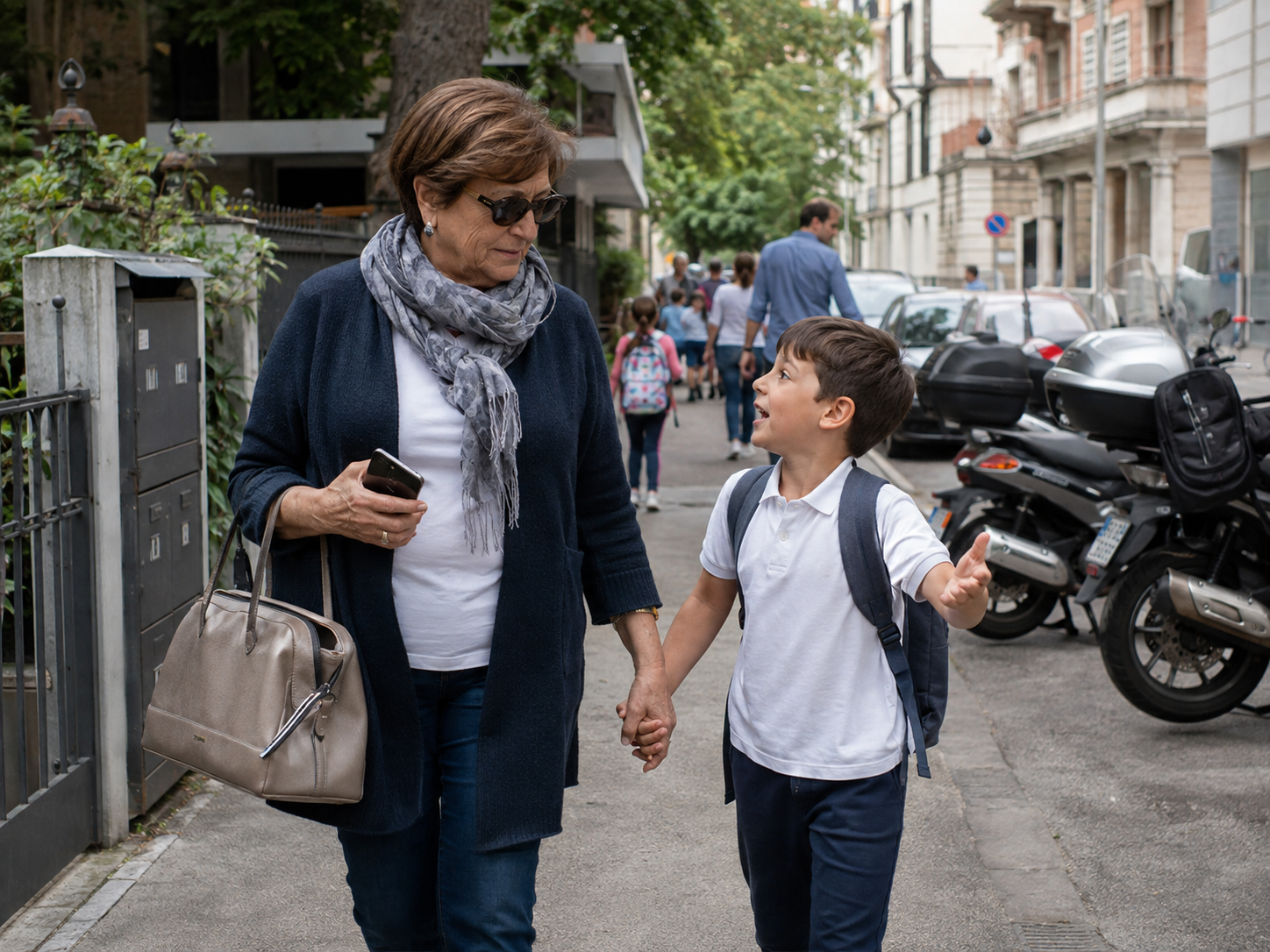
A grandmother picks up her grandson from school because his parents are still at work. On the way home, she asks what he had for lunch, notices that his jacket is open, hears a detailed account of an argument with a classmate, and reminds him that he has homework. Later, she sends his mother a message saying that he seemed tired and did not eat much of his snack, although he insists that he ate plenty. Nothing particularly dramatic has happened, yet in the space of an afternoon she has been a caregiver, observer, family messenger, source of reassurance, and occasional source of irritation.
That everyday scene is closer to the reality of an Italian nonna than the familiar image of an elderly woman permanently stationed beside a pot of sauce. The stereotype exists for a reason. Food, family gatherings, and grandmothers really are connected in many Italian families, but the more interesting story begins once we move beyond that image. A nonna may be the person who knows the family history nobody else remembers, the relative who provides crucial childcare, the person from whom a grandchild picks up regional expressions, or the one everyone calls when something goes wrong. She may also be fiercely independent, still working, traveling, living far from her grandchildren, or completely unwilling to become the family’s automatic babysitter.
There is no single Italian nonna. What makes the role culturally interesting is how many different kinds of family relationships can fit inside one ordinary word.
What Does Nonna Actually Mean?
Nonna is simply the Italian word for “grandmother.” Nonno means “grandfather,” and nonni is commonly used for “grandparents.” You might say Mia nonna vive a Bologna, meaning “My grandmother lives in Bologna,” or I miei nonni abitano ancora nello stesso paese, meaning “My grandparents still live in the same town.”
These are basic vocabulary items, but family words rarely remain emotionally neutral for long. For someone who grew up spending every afternoon at a grandmother’s house, nonna may immediately evoke a particular kitchen, voice, perfume, neighborhood, dialect, or way of asking questions. For someone whose grandmother lived far away, the associations may instead involve summer visits, phone calls, or occasional family gatherings. The word itself is ordinary; the emotional weight comes from the relationship behind it.
Another useful family word is nipote, which often surprises English speakers because it can mean “grandchild,” “niece,” or “nephew.” Context tells you which relationship is meant. Mio nipote ha dieci anni can mean that your grandson, granddaughter, nephew, or niece is ten years old. Italian family vocabulary is full of these small reminders that dictionary equivalents only take you so far.
Why Grandparents Can Be So Present in Everyday Family Life
In some Italian families, grandparents play a very practical role in making everyday life possible. They may pick children up from school, prepare lunch, watch them in the afternoon, help during school holidays, take them to activities, or step in when a child is sick and the parents cannot easily miss work. When generations live near one another and the relationship is good, this kind of arrangement can become part of the weekly rhythm. A grandmother may know the child’s teachers, friends, favorite foods, and after-school schedule almost as well as the parents do.
That closeness can be enormously helpful, but it also changes the family dynamic. A grandmother who is caring for a child several afternoons a week is not simply an occasional visitor. She is participating in daily life, and that often means she develops opinions about how things should be done. Parents may be grateful for the help while also finding themselves saying some version of, “Mamma, please don’t give him chocolate before dinner.” The grandmother, meanwhile, may reasonably think that if she is doing the school pickup, making lunch, helping with homework, and staying home when the child is ill, she is entitled to a little judgment of her own.
This mixture of help, affection, gratitude, and negotiation is much more recognizable than the simple idea that grandmothers “spoil” their grandchildren.
The Nonna as a Bridge Between Generations
A grandmother can also hold parts of family history that younger relatives never experienced firsthand. An adult grandchild may know that the family came from a particular town but not why anyone left. They may have heard that two relatives stopped speaking decades ago without knowing what started the disagreement. There may be photographs in a drawer filled with people nobody younger can identify.
The grandmother may know what the neighborhood looked like before it changed, how her parents earned a living, which relatives emigrated, who lived in which apartment, what happened to a family business, or why a particular tradition mattered so much to an earlier generation. This does not mean older people exist primarily as archives of the past. A woman can remember family life in the 1960s and still spend her morning arranging travel plans on her phone and her afternoon at a Pilates class. What she possesses is simply a longer stretch of firsthand family experience.
That becomes especially noticeable when grandchildren become interested in their own origins. The questions often arrive much later than the stories were originally offered. A teenager may have rolled her eyes at an old family story for years and suddenly want every detail when she is thirty.
Language Changes When You Speak to Your Grandmother
For Italian learners, this is one of the most interesting parts of the relationship. Italy has enormous regional linguistic diversity, and family conversations can preserve vocabulary, pronunciation, sayings, and local forms that learners will never encounter in a standard beginner textbook. Someone may speak standard Italian at university or at work and shift naturally toward regional speech when answering a grandmother’s call. The change may be subtle: pronunciation shifts, a local word appears, or a phrase comes out that belongs specifically to the family’s region.
Some people also use regional languages or what are commonly called dialects extensively with older relatives. These varieties are not simply “incorrect Italian.” They have their own histories and structures, and their use varies greatly around the country. For heritage learners, this can create interesting discoveries. A student may recognize a word because a grandparent used it constantly at home, only to learn later that the expression is regional rather than standard Italian. Another student may know an impressive range of family and food vocabulary while still feeling uncertain about basic formal grammar because the Italian they encountered growing up came through family conversation rather than school.
That is one reason family language is so fascinating. It is not simply vocabulary. It can tell you where people come from, who they grew up around, and whom they are speaking to.
Food Matters, but Not Because Every Nonna Makes Pasta
It would be strange to write about Italian grandmothers and avoid food entirely. In many families, food really is one of the ways care and continuity are expressed. A particular dish may belong to one grandmother because she always made it. A recipe may come from a specific town or region. Grandchildren may learn it not from written instructions but by standing nearby and watching someone who measures ingredients by habit.
This is where family knowledge can become wonderfully imprecise. Ask for the amount of flour and the answer may effectively be “enough.” Ask how long something cooks and the response may be “until it’s ready.” For a learner accustomed to precise written recipes, that can be both charming and maddening.
But there is no requirement that an Italian grandmother cook beautifully. Some love cooking. Some do it because somebody has to. Some order food. Some have adult children who are far better cooks than they are. Some families maintain elaborate Sunday lunches, while others do nothing of the kind. What food can provide is a routine around which family relationships develop. It gives people a reason to sit at the same table and repeat certain habits long enough for them to become memories.
Questions about food can also carry other kinds of concern. A grandmother asking whether a grandchild has eaten may genuinely want to know about lunch, but the question can also contain broader worries: Are you taking care of yourself? Are you too busy? Are you stressed? Are you sleeping enough? In some families, practical concern is one of the ways affection is expressed. People may not constantly articulate their feelings in psychological language, but they notice whether you look tired, whether you have eaten, whether you brought a coat, and whether you arrived home safely.
Childcare Creates Closeness, but Also Boundaries
Frequent childcare can produce particularly close relationships between grandparents and grandchildren. It can also produce disagreements about authority. Bedtimes, sweets, screen time, manners, homework, clothing, religion, and discipline are all areas where generations may have different ideas.
A parent may think the grandmother is undermining a rule. The grandmother may think the parent is being unnecessarily strict. Or the disagreement may run in the opposite direction, with the grandmother insisting on rules the parents do not care about. Nobody has to be the villain.
The situation becomes more complicated when grandparents provide a great deal of practical help. Parents may want final authority over how their children are raised, while grandparents may feel that daily responsibility naturally gives them some influence. These negotiations occur in families everywhere, but they are worth acknowledging because closeness does not mean the absence of conflict. Often the conflict exists precisely because people are so involved in one another’s lives.
The Relationship Does Not Disappear When Grandchildren Grow Up
The image of a nonna usually centers on small children, but grandmothers often remain important long after the grandchildren have become adults. For some people, a grandmother becomes a confidante. She may be easier to talk to than a parent because she occupies a different position in the family. She knows the parents well enough to understand the context but is not responsible for enforcing their rules. She may also be the keeper of every embarrassing childhood story.
Adult grandchildren sometimes discover that the questions become more personal rather than less personal as they get older. Relationships, jobs, marriage, housing, and children may all become acceptable subjects for family investigation. Allora, quando ti sposi? means “So, when are you getting married?” A grandchild may adore the person asking and still have absolutely no desire to answer.
This is one reason sentimental descriptions of grandparents can feel incomplete. Affection does not prevent irritation, and family intimacy often gives people permission to ask questions that strangers would never attempt.
The Family Diplomat, or Occasionally the Source of the Dispute
An older relative can become an important link between different branches of a family. She may remember birthdays, organize lunches, relay news, encourage siblings to call one another, and quietly keep relatives in contact who might otherwise drift apart. She may also take sides.
Grandmothers are human beings, not professionally neutral mediators. A nonna may keep the peace in one disagreement and maintain a grievance from 1987 in another. She may urge reconciliation while simultaneously remembering exactly what someone said at a wedding thirty years ago. Family gossip can travel efficiently through older relatives who remain in regular contact with several generations.
That role can be affectionate and useful, but it can also be exhausting. Cultural importance does not require sainthood.
Her Opinion May Still Matter When Everyone Is an Adult
New partners, marriage, divorce, cohabitation, career decisions, moves, and decisions about having children can all bring older generations into conversations that younger adults might prefer to consider entirely their own. Yet attitudes cannot simply be predicted by age. One grandmother may be very traditional about marriage and completely relaxed about career choices. Another may surprise the family by being more accepting of an unconventional relationship than the parents are. Someone who appears conservative in one part of life may be remarkably flexible in another.
This is particularly important when talking about modern Italy because “older Italian woman” is not a worldview. What often remains, however, is influence. An adult grandchild may make an independent decision while still caring intensely about what the grandmother thinks of it. “It is my life” and “I hope Nonna approves” can exist quite comfortably in the same person.
Becoming a Grandmother Does Not End a Woman’s Own Life
The traditional image of the nonna sometimes makes it seem as though womanhood ends and grandmotherhood begins. Real life is obviously much more complicated. A woman may become a grandmother while she is still working. She may have spent decades in a profession, have a large circle of friends, travel regularly, care for an older partner or parent, volunteer, exercise, date after a divorce or widowhood, or simply value having time that belongs to her.
Not every grandmother wants to become the default childcare provider. One may happily collect the grandchildren from school every Wednesday but refuse Saturdays because Saturdays are hers. Another may enjoy having grandchildren for a weekend and be delighted when their parents pick them up again. This does not make her less loving.
Modern grandmotherhood has to coexist with identities and routines that do not revolve exclusively around children and grandchildren. That makes the role more varied, not less meaningful.
There Is No Single Type of Italian Nonna
One nonna may live upstairs from her daughter and see the grandchildren every day. Another may live several hundred kilometers away. One may cook a large family lunch every Sunday, while another dislikes cooking and suggests a restaurant. One may speak a regional language constantly; another may use almost entirely standard Italian. One may consider caring for grandchildren one of the great pleasures of her life, while another may tell her adult children, with complete justification, that she already raised her children and has plans.
The word identifies a family relationship, not a personality type. Once that becomes clear, the cultural role becomes much more interesting because we can stop asking whether someone resembles “an Italian grandmother” and start looking at what she actually does within her particular family.
Geography and Distance Change the Relationship
Italian family life is not identical across the country. Living arrangements, employment, housing costs, migration, local traditions, and individual circumstances all affect how often generations see one another and what grandparents are able to do. A grandmother in a small town who lives five minutes away from her grandchildren can participate in everyday life differently from one whose adult children moved to Milan, Rome, another European country, or across the Atlantic.
Even within the same family, siblings may have completely different experiences. One set of grandchildren may grow up seeing the grandparents several times a week, while their cousins see them mainly during holidays. It is tempting to reduce these differences to north versus south, but that often hides more than it explains. City versus small town, local housing, employment, transportation, and whether adult children have moved away can matter just as much.
Geographic distance does not necessarily mean emotional distance either. Family group chats, video calls, photographs, and voice messages allow grandparents to participate in daily life even when they cannot be physically present. A grandmother may see photographs of a school performance within minutes, hear about a lost tooth on a video call, or receive a message from an adult grandchild who wants advice from another country.
Sometimes she travels to help after a baby is born. Sometimes the grandchildren spend part of the summer with her. Sometimes the relationship is maintained through frequent short digital contact rather than long stretches of shared daily life. The relationship adapts to mobility rather than disappearing simply because several generations no longer live in the same neighborhood.
The Italian-American Nonna Belongs to a Related but Different Story
For readers from Italian-American families, the word nonna can carry another layer of meaning. Diaspora families often preserve traditions connected to the particular regions and towns from which earlier generations emigrated. Food, dialect expressions, religious practices, family celebrations, and ideas about family roles may develop differently abroad than they do in contemporary Italy.
That does not make those traditions less authentic. They are part of a different historical experience. A custom maintained for generations in New Jersey, Boston, Chicago, San Francisco, Toronto, Melbourne, Buenos Aires, or elsewhere may no longer look exactly like the version practiced today in the Italian town the family originally left. The two traditions have been evolving separately.
Heritage language reflects this too. Someone may grow up using words learned from grandparents that sound old-fashioned, highly regional, or unfamiliar to contemporary speakers elsewhere in Italy. Those words are still part of that family’s linguistic history. For heritage learners, discovering where those expressions came from can be one of the most rewarding parts of studying Italian more formally.
When a Nonna Dies, Families Sometimes Discover How Much She Knew
There is a particular moment that occurs in many families after an older relative is gone. Someone finds a photograph and nobody knows who is in it. Then another question appears. Why did the family leave that village? Who originally owned this piece of jewelry? Was that story about the uncle actually true? Where did the recipe come from? What was the name of the relative everyone called by a nickname? What exactly was that expression she used in dialect?
For years, one person carried the answers so casually that nobody thought of the information as something that needed preserving. Then suddenly it cannot be recovered.
That is one reason conversations with grandparents can matter beyond nostalgia. Asking about family history while someone is still able and willing to talk about it can preserve information that otherwise disappears almost accidentally. The questions do not have to be grand. Sometimes asking who is standing in an old photograph is enough to begin a story no one else in the family knows.
A Little Italian Family Vocabulary
Several words are especially useful when talking about family:
ItalianEnglishnonnagrandmothernonnograndfathernonnigrandparentsnipotegrandchild, niece, or nephewfigliosonfigliadaughtergeneroson-in-lawnuoradaughter-in-lawbisnonnagreat-grandmotherbisnonnogreat-grandfather
You might also hear Sono molto legata a mia nonna, meaning “I’m very close to my grandmother,” from a female speaker, or Sono molto legato a mia nonna from a male speaker. These are simple sentences grammatically, but family vocabulary becomes much richer once learners begin listening to how relatives actually speak to one another.
What Family Language Can Teach Italian Learners
Textbooks have to simplify conversation. People speak one at a time, pronunciation is clear, and everybody seems remarkably willing to finish complete sentences. Family conversation rarely behaves so politely. People interrupt, overlap, use nicknames, shorten phrases, tease one another, change topics, and rely on shared knowledge that would make no sense to an outsider. Regional expressions may appear without explanation. A grandmother may give an instruction that sounds quite direct on paper but affectionate in the tone in which she says it.
For language learners, this is a useful reminder that relationships shape speech. The Italian used with a professor, hotel receptionist, childhood friend, parent, and grandmother does not sound identical even when the grammar is all recognizably Italian. For heritage learners, studying standard Italian can sometimes organize language they have heard for years without fully understanding where it fits. A familiar household expression suddenly has a grammatical structure. A strange-sounding word turns out to come from a particular region. A family pronunciation begins to make historical sense.
For learners without Italian ancestry, family vocabulary offers a different kind of window into the language. It shows how much meaning can sit inside ordinary words once relationships, age, region, and history enter the conversation.
For students interested in developing that kind of understanding, Polyglottist Language Academy offers Italian classes for adults that combine grammar and conversation with the cultural context behind everyday Italian, including family vocabulary, regional differences, and formal and informal speech. EXPLORE ITALIAN CLASSES AT POLYGLOTTIST LANGUAGE ACADEMY