
On a school website, a teacher is listed as Елена Сергеевна Волкова (Elena Sergeyevna Volkova). In the hallway, a student says, Здравствуйте, Елена Сергеевна! Later, a friend calls her Лена (Lena). If you learned Russian from a class roster, you might wonder where half the teacher’s name went. If you learned it from her friends, you might wonder where all those extra syllables came from.
Сергеевна is a Russian patronymic, or о́тчество (otchestvo). It usually comes from the father’s given name. In this example, that name is Сергей (Sergey). The patronymic occupies the slot an English speaker might think of as the middle name. Its other job is the one learners tend to miss. Say Елена Сергеевна aloud and you’ve chosen a way to address Elena, one that can sound respectful, affectionate, businesslike, or several of those at once. Cornell University’s guide to Russian naming customs
That student in the hallway may have known her teacher for years. The two names together can sound as ordinary as “Good morning.”
What a Russian patronymic tells you
In Елена Сергеевна Волкова, Елена is the given name, Сергеевна is the patronymic, and Волкова is the surname. Russian documents and lists often put the surname first, so the same person may appear as Волкова Елена Сергеевна. On a form, ФИО stands for фамилия, имя, отчество, in that order. Gramota.ru on names in Russian documents
The difference from a typical American middle name becomes clear if Elena has a brother. Say his full name is Антон Сергеевич Волков (Anton Sergeyevich Volkov). He and Elena have different patronymics, Сергеевич and Сергеевна, built from the same given name. You can read the relationship between the forms even before you know anything about the family. Two strangers can also be Сергеевич and Сергеевна, of course. Sergey is a name many fathers share.
The pattern starts afresh in the next generation. In a family following this convention, a daughter of Антон Сергеевичcould be Мария Антоновна. Her patronymic comes from Антон, her father’s given name. Сергеевич points one generation further back. That makes a patronymic a useful clue when reading family records, especially when the same few given names keep turning up.
How Russian patronymics are formed
The endings worth recognizing first are -ович and -евич for men, and -овна and -евна for women. Many names ending in a hard consonant take the -ович / -овна pair. Names such as Игорь and Андрей take -евич / -евна, with a spelling adjustment to the original name. Here are a few examples you’re likely to encounter. Gramota.ru’s dictionary guide to patronymics
Father’s given name Son’s patronymic Daughter’s patronymic
Иван (Ivan) Иванович (Ivanovich)Ивановна (Ivanovna)
Александр (Aleksandr) Александрович (Aleksandrovich)Александровна (Aleksandrovna)
Сергей (Sergey) Сергеевич (Sergeyevich)Сергеевна (Sergeyevna)
Андрей (Andrey) Андреевич (Andreyevich)Андреевна (Andreyevna)
Игорь (Igor) Игоревич (Igorevich)Игоревна (Igorevna)Пётр (Pyotr)Петрович (Petrovich)Петровна (Petrovna)
Павел (Pavel) Павлович (Pavlovich)Павловна (Pavlovna)
Илья (Ilya) Ильич (Ilyich)Ильинична (Ilyinichna)
Никита (Nikita) Никитич (Nikitich)Никитична (Nikitichna)
Some forms are easier to learn as pairs. Павел becomes Павлович or Павловна, and Илья gives Ильич or Ильинична. Notice also that the patronymic comes from the given name Александр even if everyone at home calls the father Саша. If you’re writing to a real person, copy the form they give you. A table can help you recognize a patronymic on sight. Their email signature gives you the spelling they actually use. Gramota.ru on the forms derived from Никита
When to say Елена Сергеевна
A teacher or professor who introduces herself as Елена Сергеевна has already given you a good opening for your next conversation or email. Здравствуйте, Елена Сергеевна! (Zdravstvuyte, Elena Sergeyevna!) is a simple “Hello, Elena Sergeyevna.” The same pattern can fit an appointment with a doctor or a conversation with a senior colleague in a workplace where people use patronymics. In many everyday situations, здравствуйте by itself is plenty. Someone asking a station employee which platform to use can get straight to the question. University of Texas Russian course material on forms of address
An English-speaking learner may hear the patronymic as the equivalent of “Ms. Volkova.” That analogy helps with the level of politeness, but it misses something. Russian keeps the given name in the greeting. A former student who still says Елена Сергеевна can sound genuinely fond of her old teacher. The form belongs to the history of that relationship as much as it belongs to classroom etiquette.
The reverse can happen too. A colleague might say Елена, вы уже видели письмо? (“Elena, have you seen the email yet?”). The colleague uses the first name and keeps вы, the polite form of “you.” An invitation to просто Елена (“just Elena”) tells you which name to use. Вы can stay right where it is. Learners who treat Russian formality as one switch often find this combination surprising. The name and the pronoun give speakers two separate choices. Tatiana Larina on Russian forms of address · Master Russian on first names with вы
A group can also use different forms for the same person. If Elena’s longtime colleague calls her Лена while everyone is getting coffee, a new student can still call her Елена Сергеевна ten minutes later. Listen to how people in a role like yours address her, and give the most weight to how she asks to be addressed. If the cues are mixed, Как к вам лучше обращаться? (Kak k vam luchshe obrashchat’sya?) means “How should I address you?” It’s a useful question for a first meeting, especially when the name on the door gives you all three parts and the person in front of you gives you one. Samara State Institute of Culture’s handbook for international students
Why the patronymic can be hard to hear
On paper, Александрович looks as though it ought to take up quite a bit of time. In casual speech, it can come out as Александрыч. Алексеевна can become Алексевна. The first time you hear a reduction like that, you may be sure the speaker used a different name. It helps to hear the first name and patronymic together at conversational speed, then look at the written form and listen again. When you practice a name for a first meeting, mark the stressed syllable in each word. In Еле́на Серге́евна, those are ле́ and ге́. Then try the two names as one greeting instead of pausing to assemble them. Gramota.ru on spoken patronymic forms
Sometimes the patronymic stands on its own. Михайлыч, a colloquial form of Михайлович, may carry warmth or respect among people who know one another well. A learner may recognize the word and still miss the tone. Imagine a coworker calling across a familiar workshop and then imagine a visitor trying the same thing on arrival. The sound is identical. The history between the speakers is doing much of the work. Gramota.ru on patronymics used on their own
A name can change when the sentence changes
Russian grammar can make two versions of a name look like two different people. Compare «Здравствуйте, Елена Сергеевна!» (“Hello, Elena Sergeyevna!”) with «Я написала Елене Сергеевне» (“I wrote to Elena Sergeyevna,” said by a woman). In the second sentence, both parts of the name take the dative case because Elena is the recipient. If Елене Сергеевне is the first version you see, look for Елена Сергеевна on a roster.
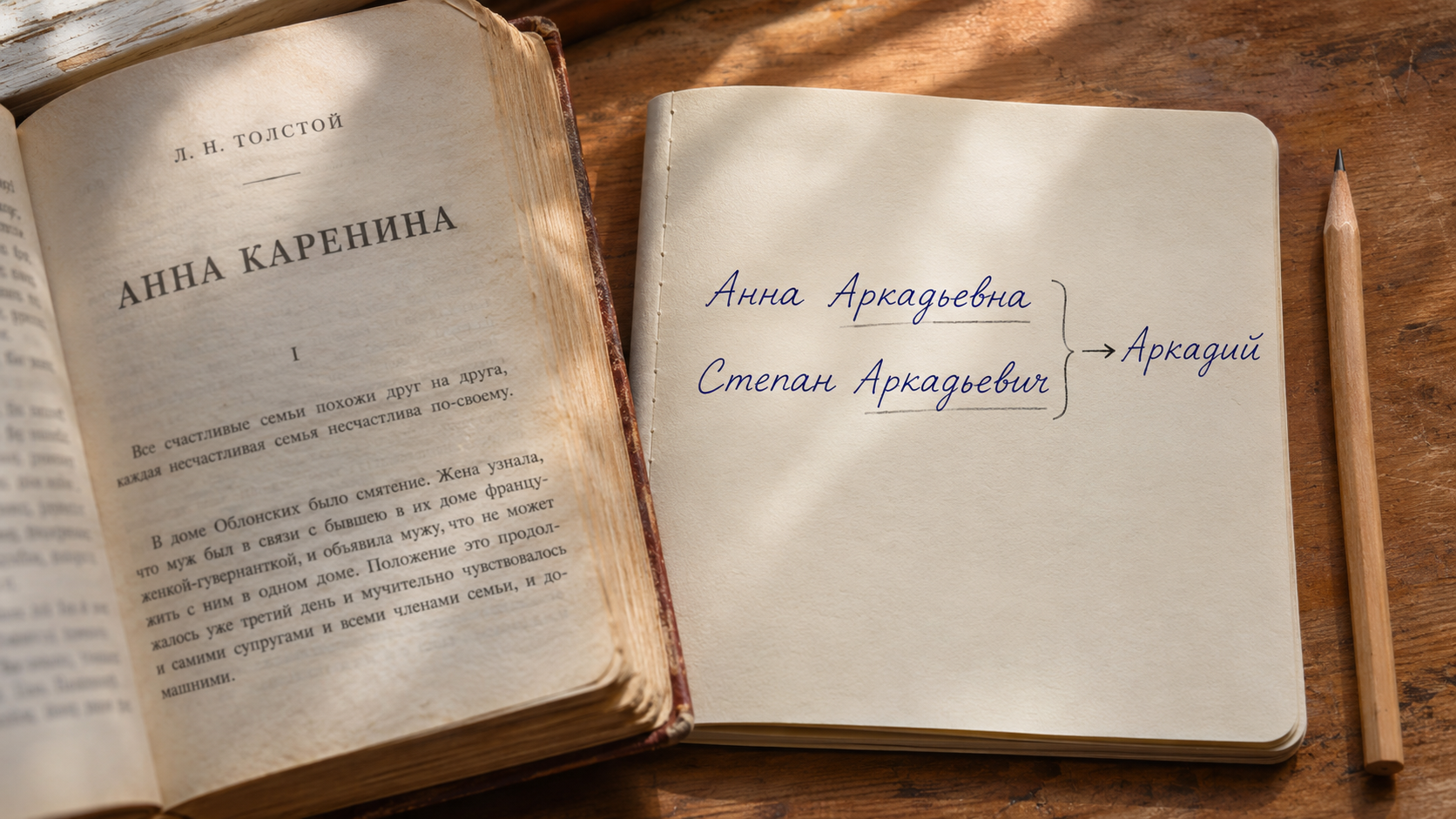
This is where Russian novels can feel particularly crowded. In Tolstoy’s Anna Karenina, Анна Аркадьевна Каренинаand her brother Степан Аркадьевич Облонский carry the same clue to their father’s name, Аркадий (Arkady). Their surnames differ, and Stepan also goes by Стива (Stiva). If you keep a character list, give each person one line and put the different forms beside it. The next time someone calls him Stiva, you can pay attention to who said it and what that familiarity tells you. Character guide to Anna Karenina
A few questions that come up in practice
Does everyone who speaks Russian have a patronymic?
People bring different naming traditions to Russian. Even in Russia, the law that sets out the usual father-based convention allows for exceptions based on regional law or cultural custom. In conversation and correspondence, use the name the person provides. Russian Family Code, Article 58
Do I need a patronymic to introduce myself in Russian?
For an ordinary introduction, Меня зовут Алекс (Menya zovut Aleks), “My name is Alex,” is enough. Use the name you ordinarily go by.
Do children have patronymics too?
A child can have a patronymic in their full name. In everyday conversation, adults generally address children by their given name or a familiar form of it. Calling a child by their first name and patronymic can sound playfully ceremonious. Cornell University’s guide to Russian naming customs
Which spelling should I use in English?
Use the spelling the person uses in English. You might see Sergeyevna or Sergeevna for Сергеевна, depending on the transliteration system or the person’s own spelling. An English spelling is a useful reading aid. For pronunciation, listen to the person say the name.
Listen again to the student in the hallway. She may say Елена Сергеевна as easily as Elena’s friend says Лена. For a learner, those extra syllables take practice. For the student, they’re part of a name she’s said so often that she can call it out halfway down the stairs.
Polyglottist Language Academy offers live Russian classes for adults online and in person in Berkeley, California. The classes make room for everyday conversation and for choices like these, where the grammar can be right and the greeting can still feel a little off. Explore Russian classes