
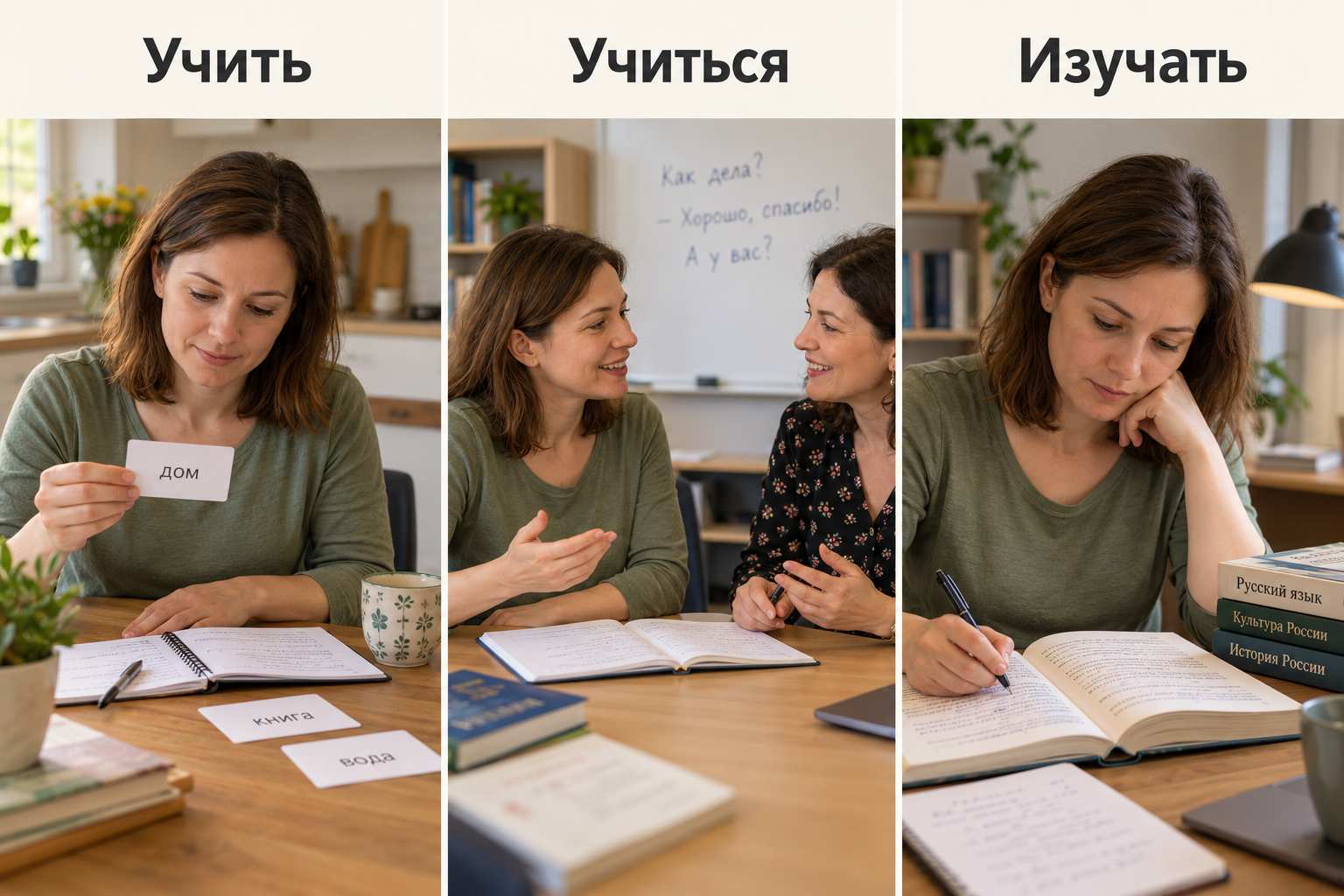
“I’m learning Russian” ought to be a fairly safe sentence. It is, after all, one of the first things a Russian learner needs to say.
Then the dictionaries get involved.
Учить can mean “to learn,” but also “to teach.” Учиться means “to learn” or “to study,” yet Я учусь русский is not the normal way to say “I’m learning Russian.” Изучать also means “to study,” which raises the reasonable question of why the first two verbs were necessary.
The problem is partly the way vocabulary gets presented: three Russian infinitives lined up beside three overlapping English translations. The distinctions become much clearer in complete sentences.
Start with these:
Russian English What the sentence tells us
Я учу русский. I’m learning Russian. The language is what I’m learning.
Я учусь в университете. I study at a university. The university is where I’m a student.
Я изучаю русский язык. I’m studying Russian. Russian is the subject of my study.
All three can describe the same person. Choosing a verb often means choosing which part of the situation to express.
Учить: learning something—or teaching someone
For an everyday introduction, this is a useful sentence to keep ready:
Я учу русский.
Ya uchú rússkiy.
I’m learning Russian.
The longer version, Я учу русский язык, is also correct. Leaving out язык (“language”) is entirely ordinary when the meaning is clear.
Here, учить takes a direct object: the thing being learned. Other useful combinations include учить слова (“learn vocabulary words”), учить правило (“learn a rule”), and учить стихотворение (“learn a poem”).
With material such as a poem or a list of words, учить often involves committing something to memory. With a language, its meaning is broader. Я учу русский does not imply that the speaker spends every evening memorizing lists while refusing to have a conversation.
This is where a common shortcut becomes misleading. “Учить means memorize; изучать means study” can help explain certain examples, but it does not cover the ordinary expression учить русский. Memorization is one use of учить, rather than its entire meaning. Поиск по Грамоте
How can the same verb mean “teach”?
Look at what follows it:
Я учу новые слова.
I’m learning new words.
Я учу детей.
I teach children.
The children are the people receiving instruction. They are not material the speaker is trying to memorize.
To name both the learners and the subject, Russian uses this pattern:
учить кого? чему? — teach whom? what?
Она учит детей русскому языку.
She teaches children Russian.
The people being taught are in the accusative case; the subject taught is in the dative. That is why русский язык changes to русскому языку.
Compare the two constructions carefully:
LearningTeachingОна учит русский язык.Она учит детей русскому языку.She is learning Russian.She teaches children Russian.
The verb has not changed. The sentence around it has.
A teacher can also say Я преподаю русский язык (“I teach Russian”). Преподавать is a useful verb for teaching a subject, particularly as a professional activity. For someone simply explaining that they are learning Russian, Я учу русский is already a natural choice.
Учиться: being a learner, studying somewhere, learning to do something
Учиться puts the person in the role of learner. It works particularly well for explaining where someone studies, what they are learning to do, or how their studies are going.
Я учусь в университете.
I study at a university.
Она учится онлайн.
She studies online.
Мы учимся говорить по-русски.
We’re learning to speak Russian.
That last sentence is especially helpful. When “learning” is followed by an action—learning to drive, cook, swim, or speak—учиться plus an infinitive is a dependable pattern:
RussianEnglishЯ учусь водить машину.I’m learning to drive.Он учится готовить.He’s learning to cook.Она учится плавать.She’s learning to swim.
No equivalent of the English word “to” is inserted between the verbs. The second verb is simply in its infinitive form: водить, готовить, плавать.
There is also a difference worth hearing between these two sentences:
Я учу русский.
I’m learning Russian.
Я учусь говорить по-русски.
I’m learning to speak Russian.
The first names the language. The second names an ability being developed. Both may fit an adult beginner, but they do not say exactly the same thing.
Учиться does not mean studying without a teacher
The ending -ся causes some understandable confusion. Learners encounter reflexive verbs such as мыться (“wash oneself”) and try applying the same logic everywhere: if учить means teach, perhaps учиться means teach oneself.
That is not a reliable interpretation.
Someone can учиться with a teacher, at a school, in a university, or independently. The verb itself does not specify whether a teacher is involved. The reflexive ending is part of the word’s meaning and grammatical behavior; it does not always translate as “oneself.” Поиск по Грамоте
To make independent study explicit, add самостоятельно:
Я учу русский самостоятельно.
I’m learning Russian independently.
Can учиться be followed by a subject?
Yes, but the construction differs from учить русский.
Учиться can take a dative complement naming what is being learned: учиться музыке (“study music”), for example. Учиться русскому языку is grammatically possible too. For a simple everyday statement that Russian is the language being studied, however, Я учу русский or Я изучаю русский язык is a more straightforward default.
The practical correction is therefore:
Я учусь русский. → Я учу русский.
The problem is not that учиться can never name a subject. The problem is attaching an accusative object to it as though it behaved just like учить.
Изучать: studying a subject, examining a question
Изучать directs attention toward the subject being studied:
Я изучаю русский язык.
Ya izucháyu rússkiy yazýk.
I’m studying Russian.
Она изучает историю.
She studies history.
Мы изучаем русскую грамматику.
We’re studying Russian grammar.
Like учить in its learning sense, изучать takes a direct object in the accusative case. The ending in русскую грамматику makes that case visible; русский язык looks the same in the nominative and accusative because it is masculine and inanimate.
Изучать is a natural choice for academic subjects, but it is not reserved for universities or advanced learners. A complete beginner can truthfully say Я изучаю русский язык. The verb does not certify expertise.
Nor does it require a teacher. Я изучаю русский самостоятельно is perfectly compatible with independent learning.
Where изучать goes beyond learning
An especially useful distinction appears outside the classroom:
Учёные изучают поведение животных.
Scientists study animal behavior.
Она внимательно изучает карту.
She is examining the map carefully.
In these sentences, изучать means investigate, examine, or study closely. The scientists are researching behavior, and the traveler is trying to understand a map. Neither situation is principally about memorizing assigned material. Russian dictionaries recognize these research and examination senses alongside studying a subject. Поиск по Грамоте
This explains why there is no universal rule for replacing учить with изучать. Their meanings overlap when a language or school subject is involved. In other contexts, the substitution changes the meaning or produces something odd.
Учить стихотворение suggests learning a poem, often by heart. Изучать стихотворение suggests studying it as a text: its language, imagery, structure, or meaning. Both activities involve a poem, but they make very different homework assignments.
“Я учу русский” or “Я изучаю русский”—which sounds better?
Both are correct.
Я учу русский is a comfortable everyday way to say “I’m learning Russian.” Я изучаю русский язык can sound a little more formal or more focused on the language as a subject. These are tendencies, rather than a rule that divides casual speakers from serious students.
A friend might ask:
— Ты учишь русский?
— Да, недавно начал. Пока говорю медленно.— Are you learning Russian?
— Yes, I started recently. I still speak slowly.
Начал is the masculine past form; a woman would say начала.
In a description of a university program, another speaker might say:
Я изучаю русский язык и историю России.
I study Russian and Russian history.
Neither speaker’s verb choice establishes how many hours they work or how well they speak. A beginner should not feel obliged to choose the grander-sounding word to prove commitment.
There is a useful distinction here between sounding appropriate and sounding impressive. In a short introduction, the simpler sentence often does its job perfectly.
The question often tells you which verb you need
Instead of translating “study” from English, listen for the missing information in the conversation.
Что ты изучаешь? — What are you studying?
Я изучаю историю. — I’m studying history.
The question asks for a subject.
Где ты учишься? — Where do you study?
Я учусь в университете. — I study at a university.
The question asks for a place of education.
Чему ты учишься? — What are you learning?
Я учусь готовить. — I’m learning to cook.
The answer supplies a skill.
These patterns are more helpful than trying to give each verb one exclusive English translation. English “study” might describe a degree program, tonight’s exam preparation, an academic subject, or careful examination. Russian does not divide those meanings at precisely the same boundaries.
This is also why Я учусь and Я занимаюсь are worth keeping separate. Я учусь can describe being a student. Я занимаюсь русским can describe working on Russian or having Russian lessons. For “I’m studying right now,” Я сейчас занимаюсь is often useful. An English word shared by several situations does not guarantee that one Russian verb will cover them all.
The present-tense forms worth learning together
The infinitives are учи́ть, учи́ться, and изуча́ть. In a rough transliteration: uchít’, uchít’sya, and izuchát’. Transliteration cannot fully represent Russian softened consonants, but it can help identify the words.
The stress marks in this table are learning aids; they are normally omitted in everyday writing.
Person Учить. Учиться. Изучать яучу́учу́сьизуча́ютыу́чишьу́чишьсяизуча́ешьон / онау́читу́читсяизуча́етмыу́чиму́чимсяизуча́емвыу́читеу́читесьизуча́етеониу́чату́чатсяизуча́ют
Notice the stress shift in учить and учиться: учу́, but у́чишь; учу́сь, but у́чишься. Learning only the infinitive leaves out something the spoken sentence needs.
For a first conversation, three forms will carry a surprising amount of weight: Я учу русский, Вы учите русский?, and Где вы учитесь? Learn those aloud before trying to recite the entire table at speed.
What changes when the learning has a result?
All three verbs in the title are imperfective. They can describe an activity, an ongoing process, or a repeated situation without presenting a completed result.
Related perfective verbs become useful when a speaker wants to express an outcome:
ProcessResultЯ учу новые слова. — I’m learning new words.Я выучил новые слова. — I learned the new words.Я учусь плавать. — I’m learning to swim.Я научился плавать. — I learned to swim.Я изучаю эту тему. — I’m studying this topic.Я изучил эту тему. — I have studied this topic.
The result examples use masculine past forms. The feminine equivalents are выучила, научилась, and изучила.
The prefixes are not interchangeable decorations. Выучить is useful for material learned; научиться for an ability acquired; изучить for something studied or examined as a completed task in the relevant context. These examples are a practical starting point, rather than an exhaustive map of every meaning.
In particular, “I learned” can be misleading in English. “I learned to swim” describes acquiring an ability, so научиться fits. “I learned that the lesson was canceled” describes finding out information and normally calls for узнать: Я узнал, что урок отменили.
That distinction matters more than forcing every English occurrence of “learn” into the same Russian family.
Give each verb a sentence from your own life
A useful personal set might look like this:
Я учу русский, потому что мой муж говорит по-русски.
I’m learning Russian because my husband speaks Russian.
Я учусь говорить без подготовки.
I’m learning to speak without preparing in advance.
Сейчас мы изучаем прошедшее время.
We’re studying the past tense at the moment.
Each sentence has a reason to exist. The first explains a motivation, the second names a developing ability, and the third identifies a lesson topic. The verbs become easier to remember because they belong to something a person actually wants to say.
That approach also makes corrections more useful. Instead of asking only “Was my verb wrong?”, ask “What does this sentence suggest—and what would I say for my intended meaning?” Sometimes the answer is a case ending. Sometimes both versions work, with a slight change in emphasis.
Polyglottist Language Academy offers live language classes for adults, including online classes and selected in-person classes in Berkeley, California, with an emphasis on practical communication and understanding how Russian is actually used. Readers who would like to work on choices like these in conversation can explore the current Russian classes.
There is something reassuring about being able to explain that learning is still in progress. Я учу русский is already a complete, natural sentence. It leaves room for imperfect endings, slow answers, and the next thing worth learning.