
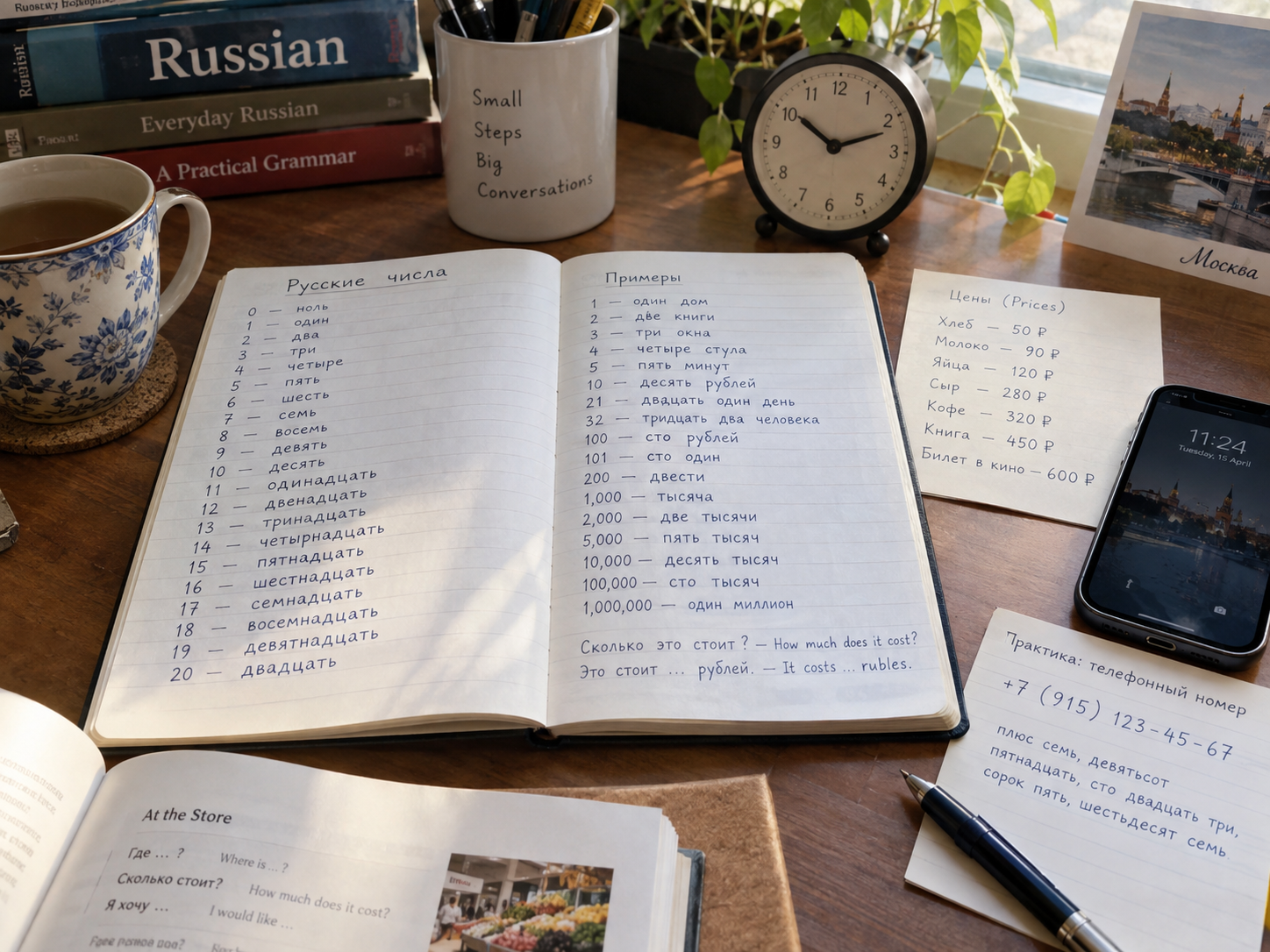
Russian numbers become much easier once you stop imagining that you have to memorize one thousand separate words. The system is mostly built from a small set of blocks. The difficult part is not forming 347. It is what happens when a number touches a noun.
A beginner can learn to count to 100 surprisingly quickly, then discover that “one ticket,” “two tickets,” and “five tickets” require different noun forms. That is where Russian numbers stop being arithmetic and start becoming grammar.
Start with 1–10
один — one
два — two
три — three
четыре — four
пять — five
шесть — six
семь — seven
восемь — eight
девять — nine
десять — ten
The pronunciation deserves attention from the beginning. Один is stressed on the second syllable: оди́н. Четыре is четы́ре. Russian spelling remains useful, but stress should be learned with the word.
Eleven through nineteen follow a pattern
оди́ннадцать — 11
двена́дцать — 12
трина́дцать — 13
четы́рнадцать — 14
пятна́дцать — 15
шестна́дцать — 16
семна́дцать — 17
восемна́дцать — 18
девятна́дцать — 19
два́дцать — 20
These forms look long at first, but repetition makes them predictable. Students sometimes try to construct them in real time every time they speak. It is better to learn 11–19 as high-frequency whole words.
Tens let you build most numbers to 100
30 — три́дцать
40 — со́рок
50 — пятьдеся́т
60 — шестьдеся́т
70 — семьдеся́т
80 — во́семьдесят
90 — девяно́сто
100 — сто
To form 21, 36, or 58, Russian simply combines the tens and units:
двадцать один — 21
тридцать шесть — 36
пятьдесят восемь — 58
девяносто четыре — 94
There is no equivalent of English “and” in ordinary number formation. 125 is сто двадцать пять, not “one hundred and twenty-five.”
Hundreds are worth learning as a set
100 — сто
200 — две́сти
300 — три́ста
400 — четы́реста
500 — пятьсо́т
600 — шестьсо́т
700 — семьсо́т
800 — восемьсо́т
900 — девятьсо́т
1000 — ты́сяча
Once you know these, a number such as 642 is simply шестьсот сорок два.
1,000 is тысяча. It behaves like a feminine noun, which matters later when cases and larger numbers enter the picture, but a beginner does not need the full declension before using basic quantities.
Один and два change with gender
English “one” never changes. Russian один does.
один билет — one ticket, masculine
одна книга — one book, feminine
одно окно — one window, neuter
Two also changes in the feminine:
два билета — two tickets
две книги — two books
This is one reason learners should practice numbers with nouns rather than as an isolated counting exercise.
The famous 1–2–5 pattern
Russian nouns change after numbers.
1 рубль — one ruble
2 рубля — two rubles
3 рубля — three rubles
4 рубля — four rubles
5 рублей — five rubles
6 рублей — six rubles
The same pattern returns constantly.
21 рубль
22 рубля
25 рублей
Why does 21 behave like 1? Because for ordinary counting, the final part of the number controls the pattern, with important exceptions around 11–14.
11 рублей
12 рублей
13 рублей
14 рублей
So 111 рублей, 112 рублей, 113 рублей, 114 рублей also take the plural genitive-type form.
Beginners do not need to master every grammatical explanation immediately. They do need to notice that quantities are spoken as chunks: два билета, пять билетов, двадцать один билет.
Prices: the first place numbers become useful
At a shop or café you may hear:
Сколько стоит? — How much does it cost?
Сто пятьдесят рублей. — 150 rubles.
Двести рублей. — 200 rubles.
Prices are excellent practice because the number has a real communicative purpose. You are not simply reciting 1–100; you are listening for information you need.
Saying your age
Russian does not say “I am 30 years old” with the verb “to be.” It uses a dative construction:
Мне тридцать лет. — I am 30.
Ему двадцать один год. — He is 21.
Ей сорок два года. — She is 42.
Notice another number pattern:
1 год
2, 3, 4 года
5+ лет
Again, compound numbers follow the ending pattern except when the final two digits are 11–14.
Telling time without making it harder than necessary
Beginners can start with the simplest useful structure:
Который час? — What time is it?
Сейчас три часа. — It is three o’clock.
Сейчас пять часов. — It is five o’clock.
For schedules, Russian often uses a 24-hour clock in written contexts, especially transportation and formal timetables. In conversation, people also use ordinary hour expressions and context.
A beginner does not need every traditional half-hour and quarter-hour construction on the first day. First become comfortable understanding and saying exact hours and digital times. More idiomatic forms such as половина шестого (“half past five,” literally “half of the sixth”) can come next.
Phone numbers: listen for grouping
Russian phone numbers can be read digit by digit or in groups, and speakers may group them differently depending on the number and context. That is why listening practice matters more than memorizing one “correct” format.
If you need clarity, you can ask:
Повторите, пожалуйста. — Please repeat.
Медленнее, пожалуйста. — More slowly, please.
По цифрам, пожалуйста. — Digit by digit, please.
When giving your own number to a learner, reading the digits individually is the safest practice method at first.
A better way to practice numbers
Counting from 1 to 100 is useful once. After that, switch to random retrieval.
Say the price of things around you. Read apartment numbers. Practice years. Generate fake phone numbers. Look at a clock and say the time. Ask yourself how many books are on the table and use the correct noun form.
Teachers often notice that students who can count perfectly in sequence still freeze when asked for “47” without starting at 40. Random practice fixes that problem.
If you want structured Russian instruction with speaking practice, Polyglottist Language Academy offers live classes for adult beginners and continuing learners.
Russian numbers are not difficult because 742 is complicated. Семьсот сорок два is quite manageable. The real skill is being able to use that number naturally in a price, an age, a phone number, or a sentence without having to rebuild the grammar from the beginning every time.