
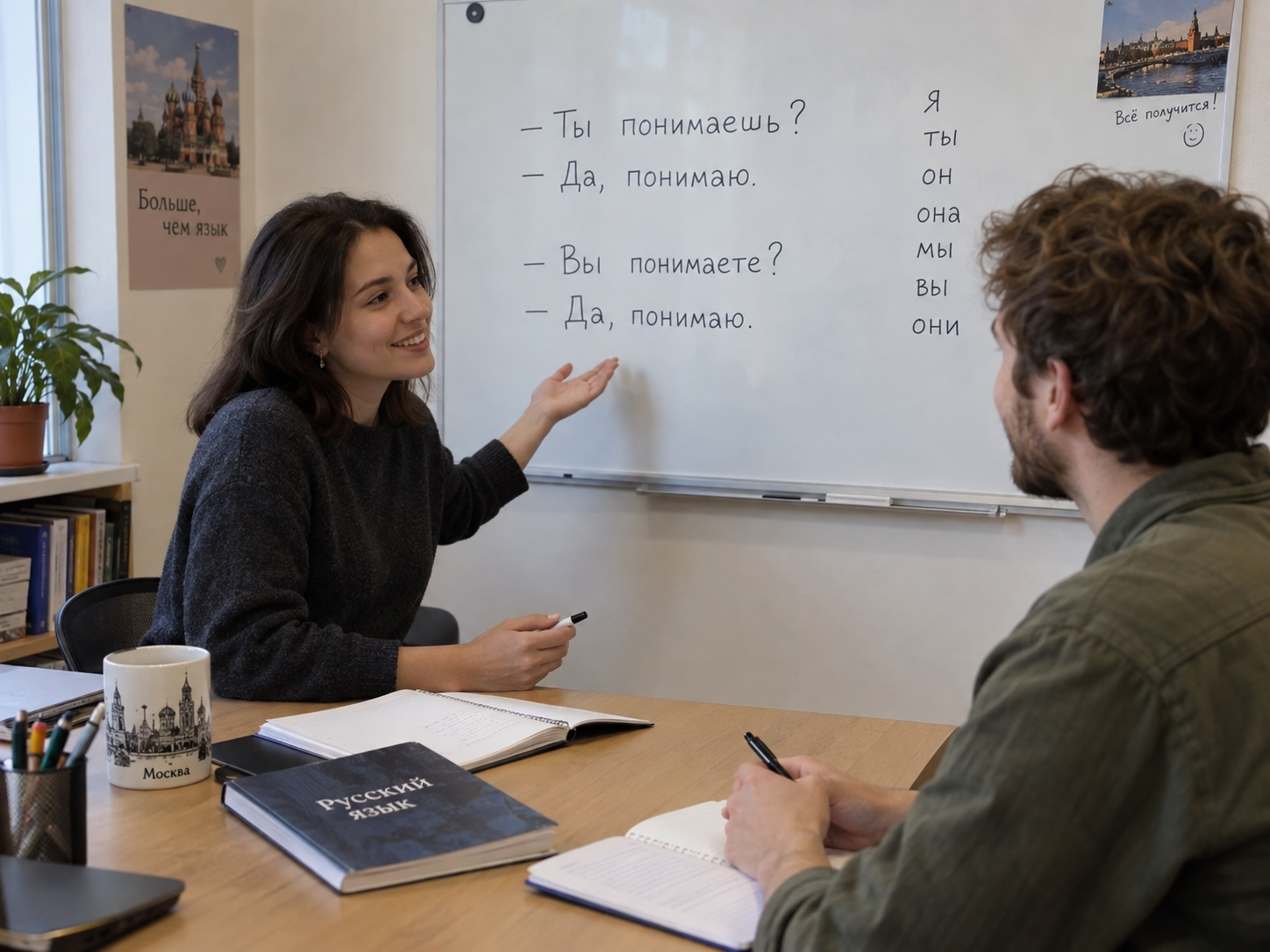
Russian beginners usually memorize я, ты, он, она, мы, вы, они within the first few lessons. The list itself is easy. The trouble begins the moment those pronouns enter real sentences.
“Do you understand?” can be Ты понимаешь? or Вы понимаете? “I see him” uses его rather than он. “She called me” requires мне or меня depending on the verb and structure. A form that looked like a simple vocabulary item suddenly behaves like a small grammatical system.
Russian pronouns are not difficult because there are too many of them. They are difficult because they carry both grammar and social information.
The basic subject pronouns
The standard personal pronouns are:
я — I
ты — you, singular and informal
он — he / it for a masculine noun
она — she / it for a feminine noun
оно — it for a neuter noun
мы — we
вы — you plural, or you formal/polite
они — they
At the nominative level, this is straightforward. The first important difference from English appears with “you.” Russian has two forms, ты and вы, and choosing between them is part of normal social interaction.
Ты and вы are about relationship, not simply politeness
Textbooks often teach ты as “informal you” and вы as “formal you.” That is useful, but incomplete.
Ты is normally used with children, close friends, family members, romantic partners, and people who have explicitly established an informal relationship. Вы is used with strangers, many professional contacts, older people you do not know personally, service interactions, and anyone you are addressing as a group.
A Russian speaker meeting an adult for the first time will often begin with вы unless the context strongly suggests otherwise. Moving from вы to ты can mark growing familiarity. The phrase Давайте на ты roughly means “Let’s use ты with each other.”
English speakers sometimes worry excessively about this choice and become afraid to speak. In most ordinary situations, starting with вы is the safe option. If the relationship becomes informal, native speakers can make that transition naturally.
The reverse mistake can sound more noticeable. Using ты immediately with an unfamiliar adult can feel overly familiar, dismissive, or simply socially odd depending on context.
Why Вы is sometimes capitalized
You may see Вы with a capital letter in letters, emails, forms, or highly polite written communication addressed to one person. The capital letter can signal respect.
In ordinary modern writing, especially messages and less formal email, lowercase вы is also common. When вы refers to more than one person, it is normally lowercase.
Learners should understand the convention without treating capitalization as a rigid universal rule.
Pronouns change with cases
Russian personal pronouns decline. That means the form changes depending on what role the pronoun plays in the sentence.
The forms learners encounter most often include:
Я: меня, мне, мной / мною
Ты: тебя, тебе, тобой / тобою
Он: его, ему, им
Она: её, ей, ею / ей
Оно: его, ему, им
Мы: нас, нам, нами
Вы: вас, вам, вами
Они: их, им, ими
You do not need to memorize every form before speaking. It is more effective to learn them inside common sentence patterns.
Меня зовут Анна. — My name is Anna.
Он видит меня. — He sees me.
Мне нравится Москва. — I like Moscow, literally “Moscow is pleasing to me.”
Она говорит со мной. — She is speaking with me.
The same English word “me” becomes меня, мне, or мной because Russian is marking the grammatical relationship explicitly.
A common trap: его, её, and их
The forms его, её, and их can function as personal pronouns in cases, but they are also used as possessive forms meaning “his,” “her,” and “their.”
Я вижу его. — I see him.
Это его книга. — This is his book.
Я знаю её. — I know her.
Это её машина. — This is her car.
Learners often expect possessive forms to behave like ordinary adjectives and change with the noun. These three do not. Его книга, его дом, его окно and его друзья all keep его unchanged.
After prepositions, он, она, and они often gain н-
This is one of the most visible pronoun patterns in Russian.
Without a preposition:
Я вижу его. — I see him.
Я позвонил ей. — I called her.
After many prepositions:
Я говорю о нём. — I am talking about him.
Я иду к ней. — I am going to her.
Я работаю с ними. — I work with them.
The forms него, неё, них, нему, ней, ними and related variants are not separate pronouns to learn randomly. The initial н- is connected to their use after prepositions.
Russian often uses pronouns differently from English
English requires explicit subject pronouns in most complete sentences: “I know,” “she understands,” “we are leaving.” Russian often uses them too, but context can make them unnecessary.
Знаю. — I know.
Понимаю. — I understand.
Идём? — Shall we go? / Are we going?
Because the verb ending already carries information about person and number, Russian can omit the pronoun when the subject is obvious.
English-speaking beginners often overuse я because they translate sentence by sentence. Я думаю, я хочу, я знаю, я понимаю is grammatically possible, but natural speech may omit some of those pronouns when the subject has already been established.
Себя: the pronoun that means “oneself”
Russian has a reflexive pronoun себя. It refers back to the subject and has no nominative form.
Я вижу себя в зеркале. — I see myself in the mirror.
Она говорит о себе. — She talks about herself.
Они купили себе кофе. — They bought themselves coffee.
English changes myself, yourself, himself, herself, ourselves, themselves according to person. Russian uses forms of себя for all of them.
This is actually simpler once learners stop looking for a separate Russian equivalent for every English reflexive pronoun.
Pronouns reveal what cases are doing
Pronouns are a useful way to understand Russian cases because the changes are so visible. Compare:
Я люблю тебя. — I love you.
Я звоню тебе. — I call you.
Я говорю с тобой. — I speak with you.
Я думаю о тебе. — I think about you.
The English “you” stays the same. Russian shows the changing relationship through тебя, тебе, тобой, тебе.
This is why memorizing isolated charts has limited value. A learner who can recite тебя, тебе, тобой but cannot connect each form to a natural sentence does not yet control the system.
A practical way to learn Russian pronouns
Instead of studying one giant declension table, build a small group of high-frequency sentence frames:
Меня зовут… — My name is…
Мне нравится… — I like…
У меня есть… — I have…
Я говорю с ним / с ней. — I speak with him / her.
Я думаю о них. — I think about them.
Я иду к вам. — I am coming to you.
When these patterns become automatic, the pronoun forms stop feeling like abstract endings and start behaving like pieces of language you can actually retrieve.
If you want to practice Russian grammar in conversation rather than only memorize forms, Polyglottist Language Academy offers live Russian classes for adults at different levels.
The most important pronoun choice in a first conversation is often not a case ending at all. It is the social decision between ты and вы. Once that feels natural, the rest of the pronoun system becomes much easier to organize around real relationships and real sentences.