
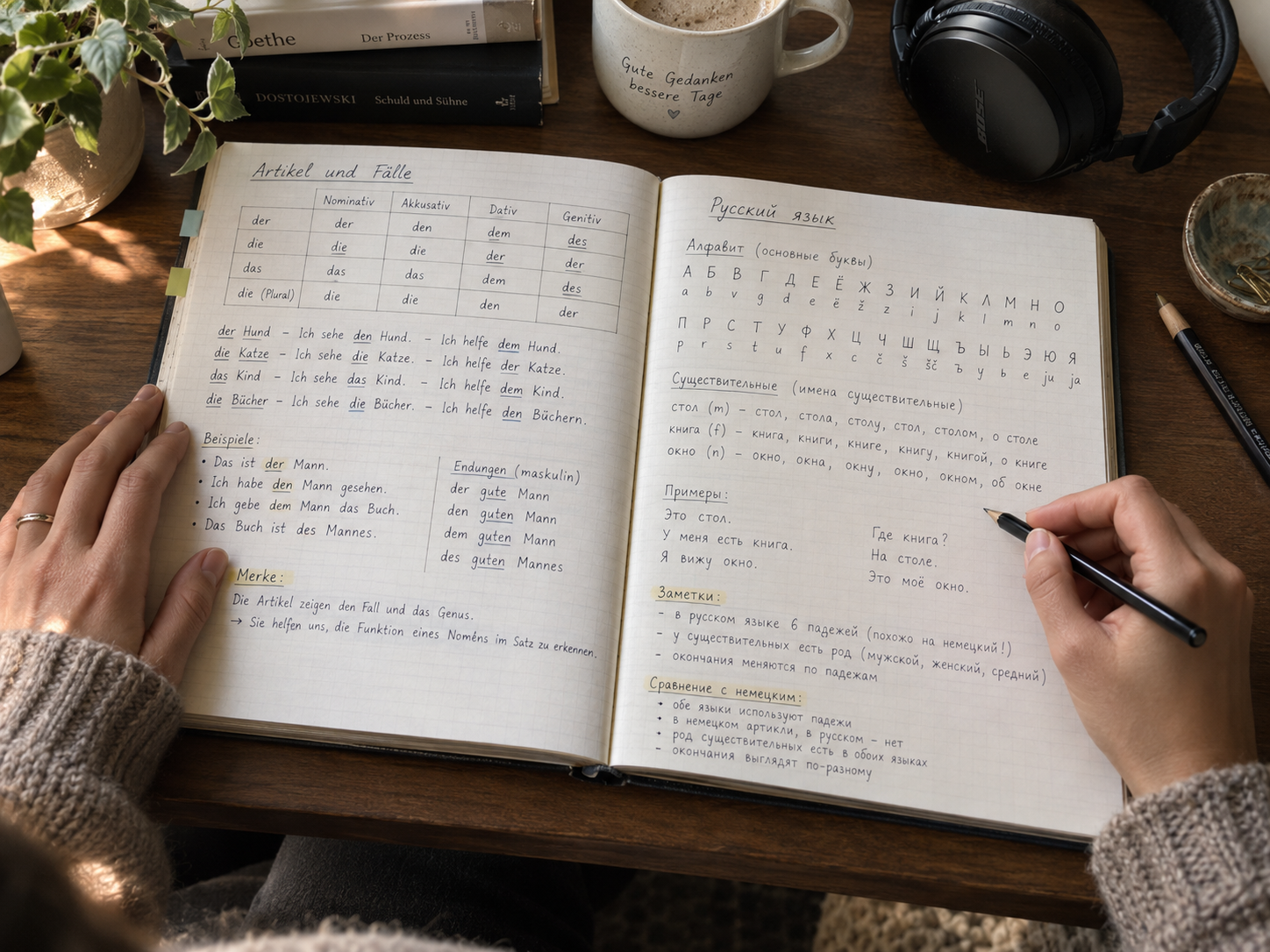
English-speaking students often ask which is harder, Russian or German, as though the answer should be obvious once the grammar charts are placed next to each other. In practice, the comparison is less tidy. German gives English speakers a comforting amount of familiar vocabulary and an alphabet they can already read, then introduces a grammatical system that becomes surprisingly demanding. Russian looks more intimidating at the beginning because of Cyrillic and unfamiliar word forms, yet some parts of the language are more systematic than beginners expect.
The better question is not simply which language is harder. It is which kinds of difficulty you are more willing to deal with.
The first week feels easier in German
For an English speaker, German initially looks recognizable. Words such as Haus, Wasser, Name, Hand, Winter, Mutter, and Freund may not all be identical to their English counterparts, but many are close enough to guess. Even unfamiliar words are written in the Latin alphabet, so a complete beginner can start reading aloud immediately.
Russian creates a more dramatic first impression. Дом, вода, имя, рука, зима, мать, and друг give an English speaker very few visual clues at first. Before vocabulary study even begins, the learner has to become comfortable with Cyrillic.
That difference is real, but it is also easy to exaggerate. Cyrillic is not a months-long obstacle. Most adults can learn the letters well enough to decode basic Russian within a few focused study sessions. The more stubborn problems in Russian appear later: stress, cases, verb aspect, motion verbs, and the way word endings change across a sentence.
German therefore wins the first-week contest. That does not necessarily mean it stays easier.
Both languages use cases, but the systems feel different
German has four grammatical cases: nominative, accusative, dative, and genitive. Russian normally teaches six: nominative, accusative, genitive, dative, instrumental, and prepositional.
On paper, six looks clearly worse than four. Yet the learner experience is more complicated because German packs a great deal of grammatical information into articles and adjective endings.
A German learner has to pay attention to forms such as der, die, das, den, dem, and des, then coordinate them with noun gender and adjective endings. Russian has no definite or indefinite articles at all. Instead, case is shown largely through the endings of nouns, adjectives, pronouns, and numbers.
Compare the idea “with my good friend.” German gives you mit meinem guten Freund. Russian gives you с моим хорошим другом. Both languages are signaling relationships through endings. Neither system is trivial; they simply distribute the work differently.
Teachers often notice that English speakers understand the basic idea of German cases sooner because the articles make the changes visible. Russian students may take longer to recognize what an ending is doing, but once the major noun patterns become familiar, the system begins to feel less chaotic.
German gender is easier to see, not necessarily easier to predict
German has three grammatical genders: masculine, feminine, and neuter. Russian does too.
Russian, however, often gives you a clue from the noun ending. Many nouns ending in a consonant are masculine, many ending in -а or -я are feminine, and many ending in -о or -е are neuter. There are exceptions, but beginners can classify a large number of common nouns from their form.
German is less generous. A learner often has to memorize the article together with the noun: der Tisch, die Stadt, das Buch. There are patterns and suffixes that help, but guessing from appearance is much less reliable.
This is one of the places where Russian can actually feel more predictable.
German pronunciation is easier to approach; Russian stress is harder to ignore
Neither German nor Russian has a sound system that is impossible for English speakers, but they create different problems.
German pronunciation contains unfamiliar sounds, especially ch and the front rounded vowels written ö and ü. Still, spelling is comparatively informative, and stress is often easier to anticipate than in Russian.
Russian has several sounds that need deliberate practice, including ы, х, and the contrast between hard and soft consonants. The bigger long-term problem, however, is stress. Russian stress is mobile and often unpredictable. It can change between related forms, and unstressed vowels are reduced in pronunciation.
The word хорошо, for example, is written with three о letters but is not pronounced as three identical “o” sounds. A learner who reads every vowel exactly as written will sound noticeably non-native and may sometimes make listening harder for themselves as well.
German learners certainly have pronunciation work to do, but Russian requires earlier acceptance that learning a word means learning its stress too.
Russian word order is freer; German word order is more rule-bound
German sentence structure can feel surprisingly strict. In a main clause, the finite verb usually occupies the second position. In many subordinate clauses, the conjugated verb moves to the end. Separable-prefix verbs create another layer of movement.
A sentence such as Ich weiß, dass er morgen nach Berlin fährt demonstrates a structure that English speakers cannot simply imitate from English word order.
Russian word order is more flexible because grammatical endings show relationships that English often expresses through position. Я люблю тебя and Тебя я люблю can both mean “I love you,” although the emphasis changes.
That flexibility is useful, but it does not mean “anything goes.” Natural Russian word order depends on context, emphasis, and what information is already known. Beginners sometimes hear that Russian word order is free and then produce sentences that are technically interpretable but pragmatically strange.
German requires more visible word-order discipline. Russian requires more sensitivity to emphasis.
Vocabulary gives German a major advantage
English and German are both Germanic languages. That shared history gives English speakers a large number of cognates and near-cognates, even when the relationship is not obvious at first glance.
Russian belongs to the Slavic family, so basic vocabulary offers fewer shortcuts. A beginning Russian student cannot look at стол, работать, покупать, or сегодня and recover the meanings from English.
Russian does contain many international words: телефон, университет, ресторан, музыка, проблема. These help, but the core everyday vocabulary still requires more memorization than German typically does for an English speaker.
If your main criterion is how quickly vocabulary begins to feel familiar, German has the advantage.
Russian verbs and German verbs are difficult in different ways
German verbs bring separable prefixes, irregular past forms, participles, auxiliaries, and word-order consequences. Russian verbs introduce aspect: most actions are learned through an imperfective/perfective relationship that tells you not simply when an action happens but how the speaker views its completion, repetition, or process.
The Russian pair читать / прочитать both relate to “to read,” but they do not function as interchangeable translations of the English verb. That distinction becomes central very quickly.
Later, Russian motion verbs add another layer: идти, ходить, ехать, ездить and their prefixed forms are famous for making otherwise confident learners slow down.
German verbs may look more familiar at first, but Russian asks the learner to build categories that English largely does not mark in the same way.
So which language is actually harder?
For most English speakers, Russian is probably the more difficult language overall, largely because it offers fewer vocabulary shortcuts and combines case endings with unpredictable stress, verbal aspect, and a less familiar sound system. German, however, is often underestimated. Its articles, adjective endings, gender, case system, and sentence structure can become technically demanding long after the vocabulary has begun to feel familiar.
A learner who hates memorizing vocabulary may find Russian exhausting. A learner who dislikes rigid word-order rules and article declensions may find German more frustrating than expected.
The most useful decision is therefore not “Which language has the scarier grammar chart?” It is which language you have enough reason to keep hearing, reading, and using after the novelty wears off. A motivated Russian learner will usually outpace an unmotivated German learner, even if German is easier on paper.
If you want structured practice rather than comparing grammar systems in isolation, Polyglottist Language Academy offers small-group Russian and German classes for adults, with live instruction and level-based progression.
The early experience of the two languages is almost reversed: German looks friendly and becomes more complicated; Russian looks foreign and becomes more legible. Neither one stays exactly as difficult as it first appears.