
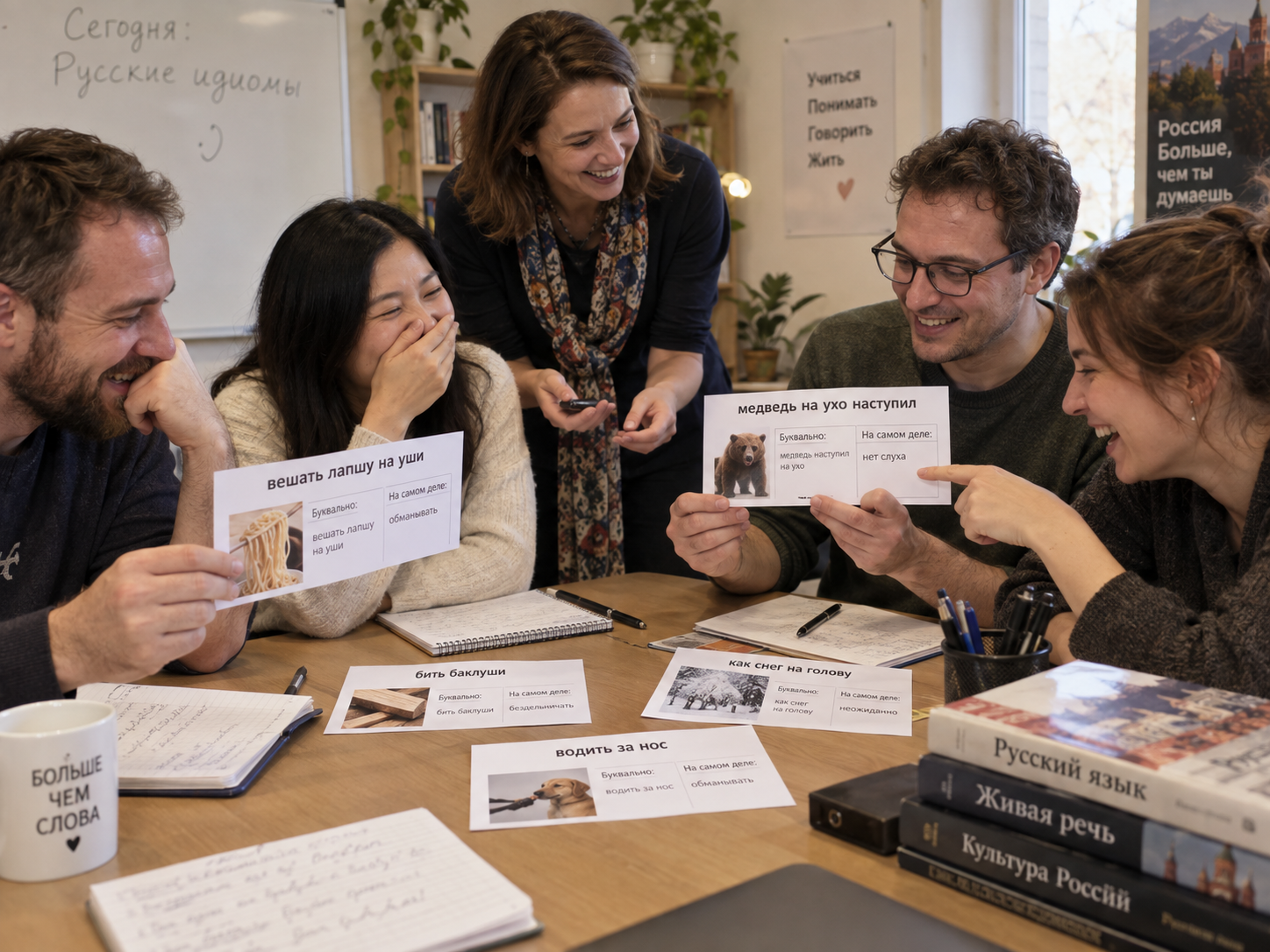
If a Russian speaker tells you that someone is "hanging noodles on your ears," no pasta is involved. If your "hands don't reach" a task, nobody is commenting on your arm length. And when someone wishes you "neither fluff nor feather," they are actually wishing you luck.
Idioms are where literal translation stops being useful and cultural familiarity begins.
The expressions below are widely recognizable in Russian and useful for learners because they appear in real conversation, media, and writing. They are not a scientific ranking of the ten statistically most frequent idioms; Russian has too many contexts and registers for that kind of list to be very meaningful. They are simply ten expressions worth knowing.
Вешать лапшу на уши
Literal: to hang noodles on someone's ears
Actual meaning: to deceive someone, tell them nonsense, or feed them a story
Он тебе лапшу на уши вешает.
He's feeding you a line / He's lying to you.
The image is ridiculous enough that the phrase is memorable. It is conversational and can be playful or accusatory depending on tone.
Руки не доходят
Literal: the hands do not reach
Actual meaning: you have not gotten around to doing something
У меня всё руки не доходят разобрать эти бумаги.
I still haven't gotten around to sorting these papers.
This is one of those expressions learners quickly want because English speakers need it constantly. It usually suggests lack of time, competing priorities, or procrastination rather than physical inability.
Дело в шляпе
Literal: the matter is in the hat
Actual meaning: it's settled; it's practically done; success is assured
Мы всё подписали — дело в шляпе.
We signed everything; it's a done deal.
The expression is informal and upbeat. You use it when the difficult or uncertain part appears to be over.
Как снег на голову
Literal: like snow onto the head
Actual meaning: suddenly and unexpectedly, often inconveniently
Гости приехали как снег на голову.
The guests arrived completely out of the blue.
The phrase often carries the feeling that the surprise created a problem. A pleasant surprise can still be unexpected, but this idiom frequently has a "now what do we do?" flavor.
После дождичка в четверг
Literal: after a little rain on Thursday
Actual meaning: probably never; at some indefinite impossible time
Когда он вернёт деньги? После дождичка в четверг.
When will he pay the money back? When pigs fly.
English has its own impossible-time idioms, but the Russian image is different. The phrase is humorous and dismissive rather than a literal scheduling suggestion.
Семь пятниц на неделе
Literal: seven Fridays in one week
Actual meaning: someone keeps changing plans, promises, or decisions
У него семь пятниц на неделе.
He changes his mind all the time / You can never rely on his plan.
This is especially useful when a person repeatedly agrees to one thing and then replaces it with another.
Как рыба в воде
Literal: like a fish in water
Actual meaning: completely comfortable and in one's element
Она в новой компании как рыба в воде.
She's completely at ease in the new company.
This idiom transfers quite easily into English because we have nearly the same metaphor. That makes it a nice reminder that idioms are not always culturally exotic; languages often build metaphors from the same human observations.
Медведь на ухо наступил
Literal: a bear stepped on someone's ear
Actual meaning: someone has a poor ear for music or cannot sing well
Я не пою — мне медведь на ухо наступил.
I don't sing; I'm completely tone-deaf.
The phrase is usually humorous and self-deprecating rather than a clinical claim about hearing.
Зарубить на носу
Literal: to notch it on the nose
Actual meaning: remember this very well; get it through your head
Заруби себе на носу: я больше ждать не буду.
Remember this: I'm not waiting anymore.
Beginners sometimes imagine actual violence because modern нос means "nose." The expression's history is more complicated than that literal image suggests, but in modern usage the phrase simply means to remember something firmly. Depending on tone, it can sound emphatic or scolding.
Ни пуха ни пера — К чёрту!
Literal: neither fur/down nor feather — to the devil!
Actual meaning: good luck — thanks / may it work out
This is a traditional exchange used before exams, performances, competitions, or other situations where someone needs luck.
One person says:
Ни пуха ни пера!
The conventional response is:
К чёрту!
The logic comes from an old superstition around not directly wishing a hunter success, but modern speakers use it far beyond hunting.
A learner who replies with спасибо will still be understood. Knowing к чёрту simply lets you recognize and participate in the traditional formula.
Why idioms are hard even when you know every word
Suppose you know that руки means hands and доходят is related to reaching or getting somewhere. That vocabulary does not automatically give you руки не доходят as "I haven't gotten around to it."
Idioms live as units.
This is why advanced learners sometimes know more individual Russian words than a native-speaking child and still miss an easy joke or everyday phrase. The missing knowledge is not vocabulary size; it is how words habitually travel together.
Learn the whole phrase, then learn its social temperature
Do not memorize only "дело в шляпе = done." Save a sentence. Notice who says it. Ask whether it sounds neutral, playful, old-fashioned, emphatic, or rude.
A phrase can be perfectly correct and still sound strange if used in the wrong setting.
For example, заруби себе на носу is much stronger than simply запомни — remember. If you use it with a colleague over a minor scheduling detail, you may sound as if you are scolding them.
This is where structured conversation practice helps. Idioms become useful when you learn not only what they mean, but when a native speaker would actually choose them instead of a neutral phrase.
The goal is not to force an idiom into every conversation. It is to reach the point where "noodles on the ears" no longer creates a mental picture of dinner and simply registers, immediately, as someone telling you a story you probably should not believe.