There is a particular mistake visitors to Japan make every spring.
They look at late April and early May and think they have found the perfect travel window.
The weather is pleasant. Spring is well underway. The rainy season has not yet arrived in most of the country. Cherry blossoms may still be lingering in northern regions. Parks are green, mountains are opening up, and walking around a city all day is far more comfortable than it will be in August.
Then they try to book a train to Kyoto.
Or a hotel in Hakone.
Or a domestic flight to Okinawa.
Suddenly Japan appears to have had exactly the same vacation idea.
This is Golden Week, the cluster of Japanese national holidays that falls between the end of April and the beginning of May. It is one of Japan's busiest domestic travel periods, alongside New Year and the summer Obon period. The Japan National Tourism Organization specifically warns travelers to expect crowded trains, packed tourist destinations, and heavily booked hotels during this period.
Golden Week is not one enormous national holiday. It is several holidays packed closely enough together that, with weekends and a day or two of leave, many people can create a substantial break from work or school.
That distinction explains almost everything about it.
When is Golden Week?
Golden Week falls from late April into early May.
The core national holidays are:
April 29: Shōwa Day
May 3: Constitution Memorial Day
May 4: Greenery Day
May 5: Children's Day
Together with weekends and occasional substitute holidays, these dates can produce several consecutive days off. JNTO broadly describes the Golden Week travel period as April 29 through May 5 plus adjacent weekends.
The exact shape changes each year because the days of the week change.
That is important if you are planning a trip.
One year may produce an exceptionally convenient run of holidays. Another may have ordinary workdays interrupting the sequence unless employees take paid leave.
So “Golden Week” is best understood as a seasonal holiday period rather than a fixed seven-day vacation beginning on one precise date.
Why is it called Golden Week?
The name sounds older and more ceremonial than it actually is.
“Golden Week” is a modern nickname rather than the official name of a traditional Japanese festival.
It became popular in the postwar period, when the group of holidays at the end of April and beginning of May created particularly strong attendance for leisure activities, including cinema.
The English phrase stuck.
Today, Golden Week is so widely used in Japan that it barely feels foreign.
In Japanese, it is commonly written:
ゴールデンウィーク
Gōruden Wīku
You may also see the abbreviation:
GW
in advertisements, business notices, travel information, and social media.
A store might announce special GW hours. A hotel advertises a GW plan. Someone asks:
ゴールデンウィークは何する?
Gōruden Wīku wa nani suru?
“What are you doing for Golden Week?”
There is nothing particularly ancient about the expression. It belongs to modern Japanese life.
April 29: Shōwa Day
The first holiday in the Golden Week period is:
昭和の日
Shōwa no Hi
Shōwa Day
April 29 was the birthday of Emperor Hirohito, known after his death as Emperor Shōwa, who reigned from 1926 until 1989.
That period included some of the most consequential and difficult events in modern Japanese history: militarization, the Second World War, defeat and occupation, and then Japan's extraordinary postwar economic transformation.
Shōwa Day therefore has more historical weight than the phrase “former emperor's birthday” might suggest.
The holiday is officially associated with reflecting on the Shōwa period and Japan's recovery and development during those decades.
For younger Japanese people, however, April 29 may function in daily life primarily as the beginning of Golden Week.
This is a useful distinction when reading about Japanese holidays.
An official holiday can have historical symbolism while most people's immediate experience of it is much more ordinary:
No work.
No school.
A trip somewhere.
Lunch with family.
Traffic.
Why did Greenery Day used to be on April 29?
The history gets slightly complicated.
After Emperor Shōwa died in 1989, his birthday continued as a holiday but was renamed Greenery Day, partly in recognition of his interest in nature.
In 2007, April 29 became Shōwa Day.
Greenery Day moved to May 4.
This explains why older references to Golden Week may place Greenery Day on a different date.
It also demonstrates something worth remembering about Japanese public holidays: their names and meanings can change even when the date itself remains important.
May 3: Constitution Memorial Day
May 3 is:
憲法記念日
Kenpō Kinenbi
Constitution Memorial Day
Japan's current Constitution came into effect on May 3, 1947.
The document established the structure of postwar Japanese government and contains some of the country's most important political principles, including popular sovereignty, fundamental rights, and the famous Article 9 concerning war and military force.
For most travelers, Constitution Memorial Day is not especially visible on the street.
There are no Constitution Memorial Day costumes to wear and no particular food everyone is required to eat.
That can seem odd if one expects every holiday to produce a festival.
Many Japanese national holidays do not.
Their greatest practical effect may simply be that offices, schools, and businesses operate differently while millions of people suddenly have time to travel.
May 4: Greenery Day
May 4 is:
みどりの日
Midori no Hi
Greenery Day
The holiday is associated with nature and appreciation of the environment.
Its modern placement on May 4 dates from 2007.
For travelers, Greenery Day arrives at an almost suspiciously appropriate moment. Much of Japan is intensely green by early May.
The pale new leaves of spring have appeared. Temperatures are comfortable in many parts of the country. Gardens are active, hiking becomes increasingly appealing, and the humid summer still feels safely distant.
This helps explain why Golden Week is such an attractive domestic vacation period even without the holidays themselves.
The calendar happens to give people time off during some of the year's most comfortable weather.
May 5: Children's Day
May 5 is the most visually recognizable Golden Week holiday:
こどもの日
Kodomo no Hi
Children's Day
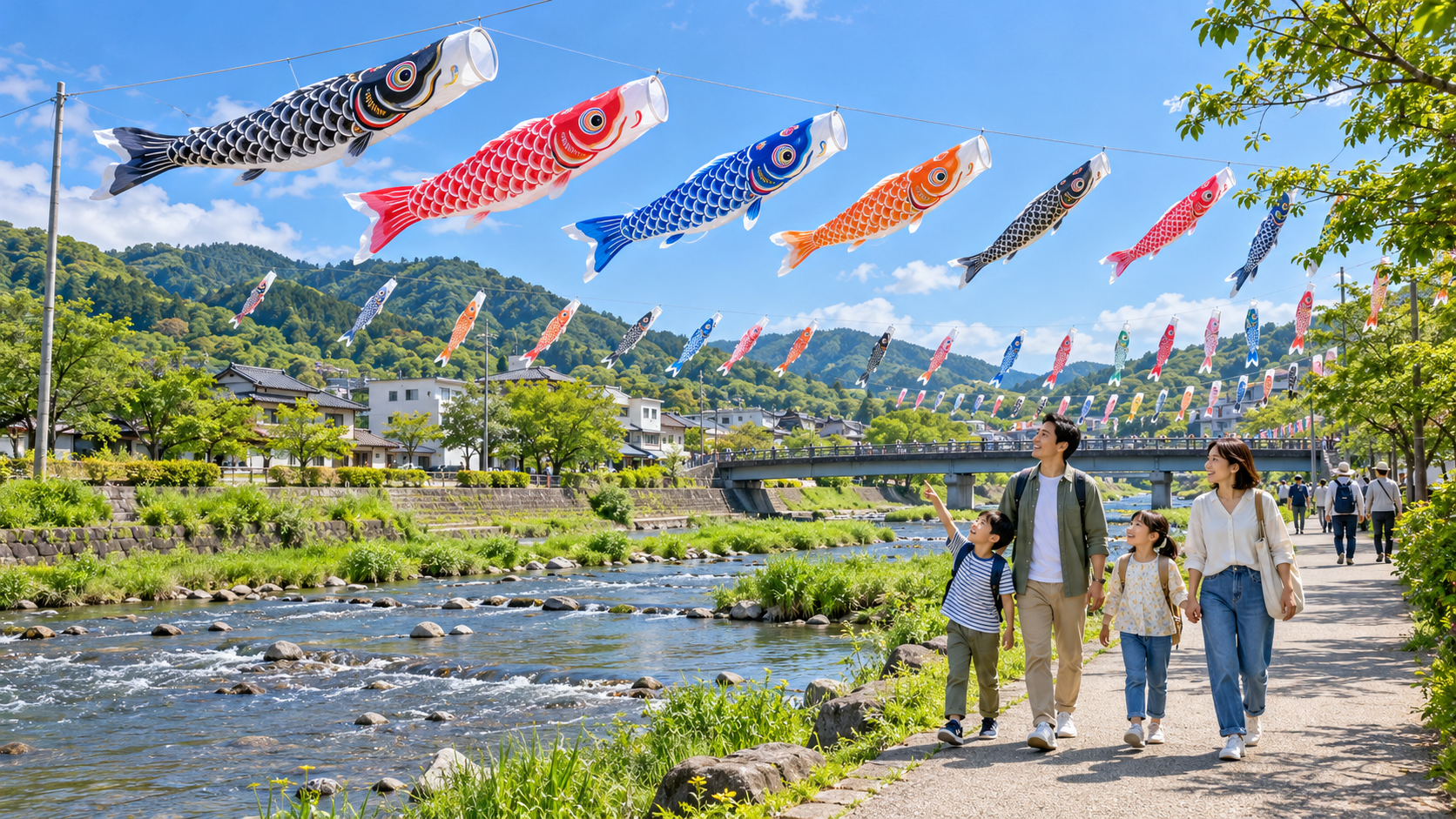
Around this time, visitors begin seeing long, colorful carp-shaped streamers called:
鯉のぼり
koinobori
They are flown outside homes, over rivers, at parks, and across public spaces.
The carp has traditionally symbolized strength and perseverance.
A common display includes several carp streamers representing members of the family, though practices vary.
Large public displays can be spectacular, with dozens or even hundreds of koinobori stretched across a river or valley.
Children's Day developed from Tango no Sekku, one of Japan's traditional seasonal festivals. Historically, the occasion was particularly associated with boys, while March 3's Hinamatsuri, or Doll Festival, was associated with girls.
Modern Children's Day officially celebrates children more broadly and expresses hopes for their health and happiness.
JNTO notes that the koinobori seen around Japan in May are traditional Children's Day decorations.
Why four holidays can create such enormous disruption
Four national holidays do not initially sound sufficient to transform an entire country's travel patterns.
The answer is the calendar.
Imagine May 3, 4, and 5 falling near a weekend.
Suddenly employees may have five consecutive days off.
If April 29 is also conveniently placed and someone uses one or two paid vacation days in between, the break becomes much longer.
Japanese workers have historically been stereotyped as reluctant to take extended vacations. Like most stereotypes, that needs qualification, but there is a real practical effect when national holidays create time off that does not require personally requesting a long absence.
Millions of people become free at roughly the same time.
And Japan has approximately the same number of famous destinations it had the week before.
That produces Golden Week.
What happens during Golden Week?
There is no single Golden Week tradition.
People do many of the same things Americans might do during a long holiday weekend.
They travel.
They visit family.
They take children somewhere.
They go shopping.
They visit theme parks.
They hike.
They stay home and enjoy not commuting.
Domestic tourism becomes especially intense.
Major cities can behave strangely during the holiday.
Business districts may feel quieter because offices are closed, while stations serving tourist destinations become exceptionally busy.
Tokyo itself does not simply “shut down.” In fact, many entertainment districts, shopping areas, attractions, and restaurants become crowded precisely because people are free.
The crowds move rather than disappear.
Golden Week is not Japanese Christmas
Foreign explanations sometimes describe unfamiliar holidays by forcing them into a familiar Western equivalent.
Golden Week is occasionally presented as though it were Japan's Christmas vacation.
That comparison does not work very well.
There is no single Golden Week family meal.
There is no equivalent of Christmas morning.
There is no one religious event underlying the period.
There is no universal tradition of returning to one's hometown in the same way associated with New Year or, to some extent, Obon.
Golden Week is fundamentally a cluster of public holidays that creates leisure time.
That makes it culturally important in a different way.
The shared experience is often not a ritual.
It is having the same days off as everyone else.
Is Golden Week a good time to visit Japan?
This depends on what kind of trip you want.
Weather-wise, it can be excellent.
From a transportation and accommodation perspective, it can be one of the least convenient times of the spring.
JNTO lists Golden Week among Japan's major peak travel seasons and advises visitors to expect crowded transportation, busy tourist destinations, higher demand for lodging, and the need to book early.
For a first visit centered on Tokyo, Kyoto, Osaka, Hiroshima, Hakone, and other major tourist destinations, voluntarily placing the entire itinerary inside Golden Week usually offers little advantage.
The same temples will still exist a week later.
The trains will simply contain fewer people.
If possible, travel just before or after it
For many international visitors, this is the simplest strategy.
Late April before the holiday rush can be excellent.
So can the second half of May.
JNTO specifically notes that the latter half of May is calmer and provides a good travel window before the rainy season arrives in June.
Moving a trip by even several days can make a substantial difference in:
hotel availability
room prices
train reservations
domestic flights
theme park crowds
highway traffic
popular sightseeing areas
This is one of those cases where knowing the Japanese calendar can save considerably more money than knowing a secret booking website.
What if you are already traveling during Golden Week?
Then the situation is not catastrophic.
Japan does not stop functioning.
You simply need to plan more carefully.
Reserve long-distance trains
If your itinerary depends on a particular Shinkansen or limited express train, do not assume you can arrive at the station and improvise.
Reserve seats when possible.
Unreserved travel during peak periods can be uncomfortable, especially with luggage.
Book hotels early
Popular leisure destinations can fill quickly.
This matters especially for places such as Kyoto, Hakone, resort areas, and destinations where accommodation supply is limited.
Expect popular attractions to be busy
Theme parks, aquariums, museums, shopping areas, and family attractions can become crowded.
A place already famous for crowds will not suddenly become a hidden gem because you arrived at 11:30 on May 4.
Consider less obvious destinations
Golden Week can be a good excuse to explore places that are not on every first-time visitor's itinerary.
JNTO itself recommends considering lower-key destinations during the peak period.
The difference between a famous Kyoto temple and a regional town with few international tourists can be enormous.
Tokyo during Golden Week is more complicated than “avoid it”
Tokyo is so large that describing it as simply crowded or quiet is almost meaningless.
Some commuter traffic falls because offices are closed.
Meanwhile, entertainment areas, parks, shopping districts, exhibitions, and family attractions become busier.
Neighborhood restaurants may close for a few days.
Others operate normally or extend activity because of holiday demand.
This creates an odd effect.
A visitor can walk through one part of Tokyo and think:
“Where is everyone?”
Then arrive at a major attraction and discover where everyone went.
Kyoto is another matter
Kyoto already struggles with concentrated tourism at famous sites.
Golden Week adds large numbers of domestic travelers to the usual international visitors.
Places such as Kiyomizu-dera, Fushimi Inari, Arashiyama, and Kyoto Station can become particularly busy.
If you are in Kyoto during Golden Week, early mornings become valuable.
This does not mean arriving somewhere at 9:30 and describing it as early.
For the most famous outdoor sites, genuinely early can mean sunrise or shortly afterward.
That strategy is useful outside Golden Week too.
During Golden Week, it becomes more useful.
Roads can be worse than trains
International travelers often worry primarily about crowded rail travel.
Japanese families traveling domestically may be using cars.
That means major expressways can develop severe congestion as people leave metropolitan areas and then return.
Rental-car itineraries therefore need just as much planning as train travel.
A road that normally takes three hours is not guaranteed to take three hours on a peak holiday afternoon.
This matters particularly if your itinerary involves catching a flight or other fixed connection.
Build in margin.
Airports become part of the holiday rush
Domestic flights to destinations such as Hokkaido, Kyushu, and Okinawa can be heavily booked.
Japan's domestic air network is extensive, so flying is a normal part of domestic tourism rather than an unusual luxury.
During Golden Week, that means airports participate in the same migration as the rail network.
International visitors arriving in Japan may not notice much at immigration and then discover that the flight they wanted from Tokyo to Fukuoka is extremely expensive or unavailable.
Book the domestic portion too.
Does everything close during Golden Week?
No.
This is another common misunderstanding.
Government offices, schools, banks, and many ordinary businesses close according to the holiday calendar.
Some privately owned shops and restaurants may also take time off.
But tourist attractions, shopping centers, chain restaurants, theme parks, hotels, and leisure businesses often remain open because Golden Week is an important period for customers.
Some places are busier precisely because everything else is closed.
If you need something specific, however, check.
A small restaurant may decide to take several days off.
A clinic may have holiday hours.
A local museum may operate on a special schedule.
The phrase:
ゴールデンウィーク休業
Gōruden Wīku kyūgyō
means roughly:
“Closed for the Golden Week holiday.”
It is useful to recognize.
Golden Week and Japanese work culture
Golden Week is interesting partly because it exposes the relationship between work and leisure in Japan.
Japanese employment culture has long been associated with long working hours and limited vacation-taking.
That picture has changed, varies greatly by employer, and should not be treated as a universal description of Japanese workers.
Still, nationally scheduled holidays have particular importance in a culture where some employees may feel uncomfortable taking a long block of individual leave.
Golden Week solves the social problem.
Everyone is off.
Or at least, enough people are off that taking time away requires less explanation.
This helps explain why travel demand becomes so concentrated.
Not everyone gets Golden Week off
The phrase “the whole country goes on vacation” makes for good travel copy but is obviously not literally true.
Tourism workers are working.
Hotel employees are working.
Restaurant staff are working.
Train crews, airline staff, retail employees, convenience-store workers, emergency services, and many others continue working.
For people in hospitality and retail, Golden Week may be one of the busiest periods of the year.
Some workers take their vacation later instead.
This is worth remembering whenever a national holiday is described as though every citizen experiences it identically.
They do not.
What Japanese people actually call the holidays
Knowing the holiday names makes signs and conversations much easier to understand.
Shōwa Day
昭和の日
Shōwa no Hi
April 29.
Constitution Memorial Day
憲法記念日
Kenpō Kinenbi
May 3.
Greenery Day
みどりの日
Midori no Hi
May 4.
Children's Day
こどもの日
Kodomo no Hi
May 5.
And the overall period:
ゴールデンウィーク
Gōruden Wīku
Golden Week.
The abbreviation:
GW
is also extremely common.
Useful Japanese for talking about Golden Week
A few expressions are especially practical.
What are you doing for Golden Week?
ゴールデンウィークは何をしますか。
Gōruden Wīku wa nani o shimasu ka?
“What are you doing for Golden Week?”
More casually:
GW、何する?
Gōruden Wīku, nani suru?
“What are you doing for Golden Week?”
I'm going on a trip
旅行に行きます。
Ryokō ni ikimasu.
“I'm going on a trip.”
I'm going back to my hometown
実家に帰ります。
Jikka ni kaerimasu.
“I'm going back to my parents' home / family home.”
I'm not doing anything special
特に何もしません。
Toku ni nani mo shimasen.
“I'm not doing anything in particular.”
A perfectly respectable Golden Week plan.
Why Children's Day is often the part visitors remember
The national holidays themselves are mostly invisible.
Koinobori are not.
The carp streamers associated with Children's Day give the Golden Week season a visual identity that the other holidays largely lack.
Large displays appear across parks, rivers, and festival venues.
Some families display traditional warrior helmets called:
兜
kabuto
or decorative samurai armor associated historically with wishes for boys' strength and healthy development.
Traditional seasonal foods can include:
柏餅
kashiwa-mochi
mochi sweets wrapped in oak leaves.
Another is:
ちまき
chimaki
a wrapped rice preparation whose style varies.
These customs make Children's Day feel much more like a recognizable seasonal festival than Constitution Memorial Day.
Golden Week is also a useful lesson in how Japan organizes seasons
Japanese culture has a strong habit of marking time through seasonal events.
Cherry blossom season.
Golden Week.
The rainy season.
Obon.
Autumn foliage.
New Year.
Convenience stores, restaurants, advertisements, television, travel campaigns, and everyday conversation all reflect this calendar.
Learning Japanese therefore involves more than memorizing words for January through December.
Certain expressions carry an entire social season with them.
Mention Golden Week in April and Japanese speakers already know the practical context:
Where are you going?
Did you manage to get reservations?
How bad will the traffic be?
Do you have to work?
That shared knowledge is part of the meaning.
Should travelers avoid Golden Week completely?
Not necessarily.
If Golden Week is when you can travel, go.
Japan does not become unvisitable.
The weather can be excellent, seasonal events are taking place, and the holiday atmosphere itself can be interesting.
But go knowingly.
Book important transportation.
Reserve accommodation early.
Do not schedule seven famous attractions per day and become surprised when other human beings are present.
Consider smaller cities, regional festivals, parks, neighborhoods, and destinations outside the standard first-trip circuit.
And if your travel dates are completely flexible, compare the same itinerary one or two weeks later.
The calmer version of Japan may be considerably more enjoyable.
Golden Week makes more sense once you stop looking for one celebration
Visitors sometimes ask:
“So what do Japanese people actually do for Golden Week?”
The question assumes there should be one answer.
There isn't.
Golden Week is not one festival.
It is four national holidays, weekends, vacation days, travel plans, family outings, traffic jams, koinobori, theme parks, airport queues, quiet office districts, and millions of individual decisions about what to do with several precious days off.
That is precisely why it matters.
At Polyglottist Language Academy, our Japanese classes for adults connect language with the cultural contexts in which people actually use it, including holidays, travel, everyday conversation, and seasonal traditions. Polyglottist offers live online Japanese classes and selected in-person classes in Berkeley, California.
A learner who knows the translation of Gōruden Wīku knows the vocabulary.
A learner who hears the phrase in April and immediately thinks, “I should probably book that train now,” has understood something more useful.
Frequently asked questions about Golden Week in Japan
What dates are Golden Week in Japan?
Golden Week centers on four national holidays: Shōwa Day on April 29, Constitution Memorial Day on May 3, Greenery Day on May 4, and Children's Day on May 5. Weekends and substitute holidays can extend the practical vacation period.
Why is it called Golden Week?
“Golden Week” is a modern nickname for the cluster of holidays from late April into early May. The English-derived expression became widely established in postwar Japan and is now commonly used in Japanese as ゴールデンウィーク.
Is Golden Week a bad time to visit Japan?
Not necessarily, but it is one of Japan's busiest domestic travel periods. Transportation and tourist destinations can be crowded, and hotels may fill or become more expensive. Advance booking is strongly recommended.
Does Japan shut down during Golden Week?
No. Government offices, schools, and many ordinary businesses close for national holidays, but hotels, transportation, shopping centers, restaurants, and attractions often continue operating and may be especially busy.
What is Children's Day in Japan?
Children's Day is celebrated on May 5. It is associated with wishes for children's health and happiness and is recognizable by koinobori, colorful carp-shaped streamers displayed around Japan.
Do Japanese people travel during Golden Week?
Yes. Golden Week is one of Japan's peak domestic travel periods, and trains, roads, airports, hotels, and major destinations can become exceptionally busy.
Is late May a better time to visit Japan?
For travelers with flexible schedules, often yes. JNTO notes that the second half of May is generally calmer than Golden Week while still offering pleasant spring conditions before the rainy season in much of the country.