
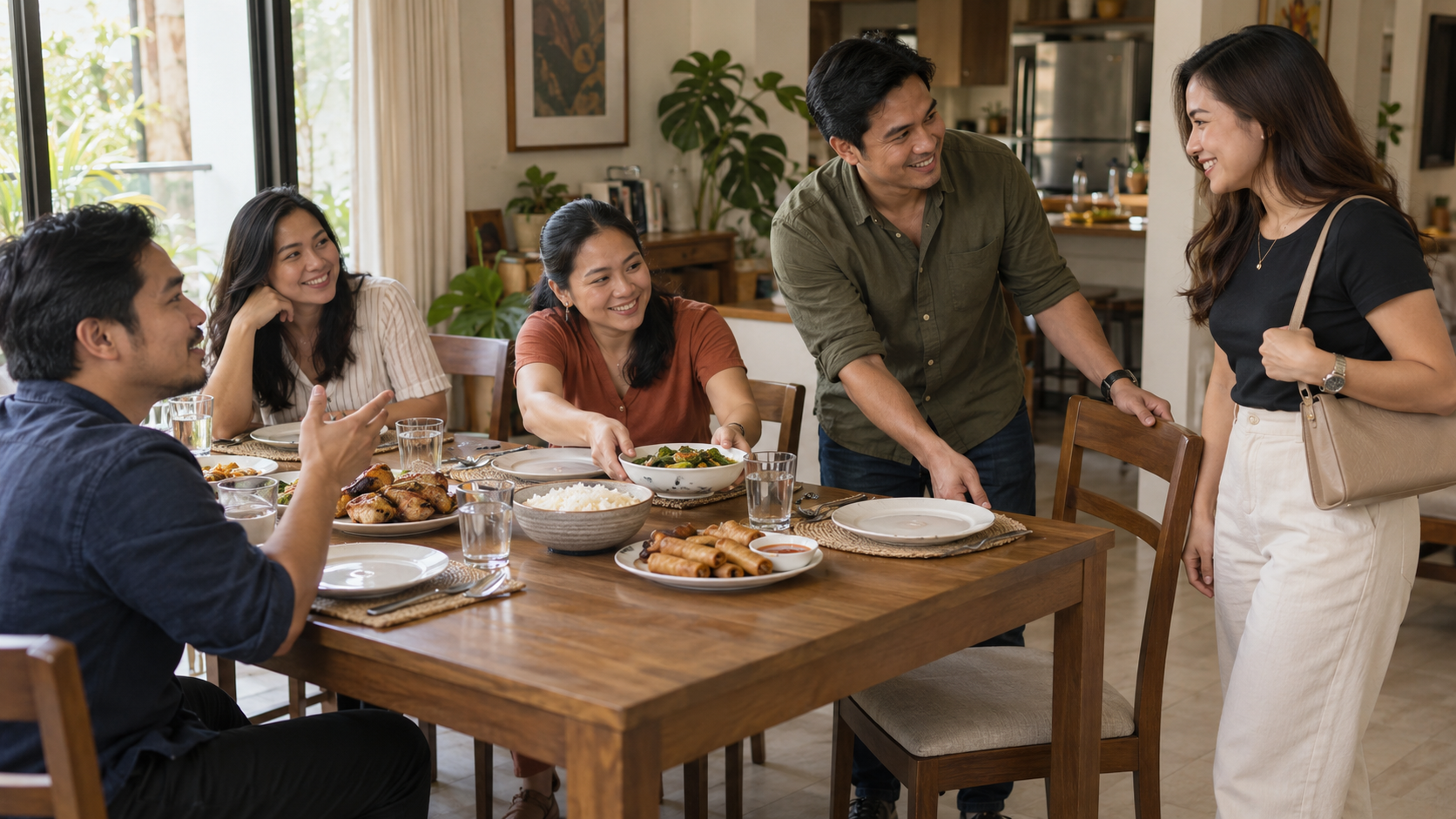
A Filipino coworker agrees to join a group dinner even though they are tired.
A relative avoids openly criticizing a family decision in front of everyone.
A friend goes along with the group's plan rather than insisting on their own preference.
An American observer might describe all three as being agreeable, conflict-avoidant, or overly accommodating.
Sometimes that is accurate.
But there is another idea worth knowing: pakikisama.
Pakikisama is one of the most frequently discussed Filipino cultural concepts and one of the easiest to oversimplify. It is often translated as “getting along with others,” “smooth interpersonal relations,” or “group harmony.”
Those translations are useful, but incomplete.
Pakikisama is not simply being nice. It is the social skill of maintaining workable, respectful relationships within a group. It can involve flexibility, cooperation, tact, reciprocity, and a willingness not to make oneself unnecessarily difficult.
It can also create pressure to conform.
That tension is what makes the concept interesting.
What does pakikisama mean?
The word comes from the root sama, which can mean “to accompany” or “to be with.”
The form pakikisama carries the idea of joining with others, going along with the group, or maintaining companionship and social harmony.
In everyday terms, it often means making an effort to preserve good relationships.
Someone with good pakikisama may be seen as:
cooperative
easy to work with
considerate
willing to adjust
socially aware
able to maintain harmony
Someone perceived as lacking pakikisama may seem difficult, aloof, selfish, or unwilling to cooperate with the group.
That does not mean every disagreement is bad.
The problem is more often disagreement expressed in a way that damages relationships unnecessarily.
Pakikisama is not exactly conformity
This is the first misconception worth correcting.
It is tempting to define pakikisama as “Filipinos conform to the group.”
That is too crude.
A person can disagree internally and still practice pakikisama externally.
They may soften the way they express disagreement.
They may wait for a private moment.
They may compromise on something minor to preserve the larger relationship.
They may participate in a group activity not because it is their first choice, but because belonging to the group matters.
This is not necessarily submission.
Sometimes it is social judgment.
Every culture has situations where people decide that insisting on their preference is not worth the friction. Pakikisama gives that instinct more cultural visibility.
Why group relationships matter so much
Filipino social life is often highly relational.
Family, friends, coworkers, neighbors, classmates, church communities, and extended social networks can overlap.
A person's actions may affect not only how others see them individually, but also the quality of relationships within the group.
That means social smoothness can have practical value.
If people expect to keep interacting with one another, preserving goodwill matters.
Pakikisama helps maintain that goodwill.
This is one reason blunt confrontation can sometimes feel harsher in Filipino settings than it might in an American one.
The disagreement itself is not necessarily the problem.
The public disruption of the relationship may be.
How pakikisama differs from hiya
Pakikisama and hiya are often mentioned together, and they do overlap.
But they are not the same concept.
Hiya is connected to shame, embarrassment, propriety, and sensitivity to how one's behavior reflects on oneself and others.
Pakikisama is more directly about maintaining smooth relationships and getting along with the group.
Consider a workplace example.
An employee may avoid publicly contradicting a manager because doing so could create hiya for the manager.
They may also choose a tactful, private way to raise the issue because they want to preserve pakikisama within the team.
The same action can involve both concepts for different reasons.
This is why Filipino social values are better understood as overlapping tendencies rather than separate boxes.
Pakikisama at work
The workplace is one of the clearest places to see pakikisama in action.
Imagine a team deciding where to have lunch.
One person strongly prefers Japanese food.
Everyone else wants Filipino food.
In a highly individualistic framework, the person may simply say:
“I really don't want Filipino food. I'm going somewhere else.”
That is a valid choice.
In a Filipino setting, the person may be more likely to go with the group unless the preference is important enough to justify separating.
The decision is not just about lunch.
It is also about participating in the group.
This does not mean Filipino workplaces lack independent thinkers.
It means social participation itself can carry more weight.
Why after-work activities can matter
Pakikisama can extend beyond formal working hours.
Joining coworkers for meals, celebrations, birthdays, karaoke, or informal gatherings may be understood as part of maintaining the relationship.
An employee who consistently refuses every invitation may be seen not simply as private, but as distant.
This can be difficult for people from cultures where work and personal life are kept more separate.
An American employee might think:
“My work is good. Why should it matter whether I go to dinner?”
A Filipino coworker may think:
“We spend every day together. Why don't you want to be part of the group?”
Neither perspective is irrational.
They are based on different assumptions about what professional relationships include.
Pakikisama in families
Family life is another major setting where pakikisama matters.
Filipino families often involve extended networks rather than only parents and children.
Decisions may include grandparents, aunts, uncles, cousins, siblings, godparents, and family friends.
In that environment, maintaining good relations requires constant adjustment.
A person may attend a gathering they would rather skip.
They may avoid challenging an elder publicly.
They may agree to help with an event.
They may make room for relatives in plans that would otherwise be simpler.
From the outside, this can look inefficient.
From inside the relationship, the social cost of refusing may be more important than the inconvenience.
The American instinct to “set boundaries” can collide with pakikisama
Modern American social language places enormous emphasis on boundaries.
That language can be useful.
People should be able to protect their time, health, money, and emotional well-being.
But boundary language can sound very different in a culture where relationships carry strong mutual obligations.
An American might say:
“I don't owe anyone an explanation. I'm just saying no.”
A Filipino relative may hear:
“I do not care how this affects the family.”
Again, this does not mean a person should never say no.
It means the way a refusal is delivered can matter as much as the refusal itself.
Pakikisama often values a response that preserves the relationship even when the answer is negative.
Refusal may be softened rather than stated bluntly
Suppose someone is invited to a gathering they do not want to attend.
A direct response might be:
“No, I don't want to go.”
That is clear.
It can also sound unnecessarily harsh.
A softer response might be:
Tingnan ko.
“I'll see.”
or:
Baka hindi ako makapunta.
“I might not be able to come.”
or:
May gagawin kasi ako.
“I have something I need to do.”
The practical meaning may still be no.
The difference is that the refusal is less confrontational.
For language learners, this matters because Filipino communication can sometimes sound less definite in English translation than it feels in context.
Pakikisama and utang na loob
Another concept frequently connected with Filipino relationships is:
utang na loob
This is often translated as “debt of gratitude,” though that phrase can sound more transactional than the idea usually is.
Utang literally means debt.
Loob is a complex Filipino concept connected with one's inner self, will, or relational interiority.
Utang na loob refers broadly to a deep sense of gratitude and obligation after receiving meaningful help or kindness.
Pakikisama and utang na loob can reinforce one another.
Someone may participate in a family event because of pakikisama.
They may also feel a deeper obligation toward a relative who supported them in the past because of utang na loob.
These ideas help explain why relationships can carry obligations that outsiders may underestimate.
Why “just say what you think” is not always considered ideal
American communication often treats directness as honesty.
If a plan is bad, say so.
If you disagree, speak up.
If you do not want something, say no.
This can make communication efficient.
It can also produce unnecessary social damage.
Filipino communication often places more value on preserving the relationship while conveying the message.
A person may disagree indirectly.
They may phrase criticism as a suggestion.
They may raise a problem privately.
They may use humor.
They may avoid forcing someone into a public loss of face.
To an American, this can feel vague.
To a Filipino, bluntness can feel socially clumsy.
Neither style has a monopoly on honesty.
They simply define considerate communication differently.
Pakikisama does not mean avoiding all conflict
This is another stereotype worth rejecting.
Filipino families argue.
Coworkers disagree.
Friends fall out.
People criticize leaders, complain, refuse requests, and defend their own interests.
Pakikisama does not eliminate conflict.
It shapes the preferred way conflict is managed.
A disagreement handled privately and tactfully may preserve the relationship.
The same disagreement delivered publicly and aggressively may damage it.
That distinction matters.
The downside of pakikisama
Cultural values often sound attractive when described abstractly.
Harmony.
Cooperation.
Belonging.
But every value has costs.
Pakikisama can create pressure to:
agree when one does not agree
attend events out of obligation
spend money to keep up socially
avoid necessary confrontation
support a bad group decision
tolerate unfair behavior
stay silent to avoid creating tension
In a workplace, excessive pakikisama can discourage honest feedback.
In a family, it can make boundaries difficult.
In politics or organizations, it can contribute to favoritism or loyalty overriding merit.
That does not make pakikisama bad.
It means social harmony can become unhealthy when preserving the group matters more than addressing a real problem.
Pakikisama can also be genuinely generous
The concept deserves criticism, but it also deserves credit.
A strong sense of pakikisama can make people remarkably willing to help.
Coworkers may cover for one another.
Relatives may rearrange schedules.
Neighbors may contribute food or labor.
Friends may include someone who would otherwise be left alone.
Social life can feel communal in a way that people from more individualistic cultures sometimes find unexpectedly warm.
The same network that produces obligations can also produce support.
This is one reason it is misleading to describe pakikisama only as conformity.
At its best, it is reciprocal participation.
Why hospitality and pakikisama often overlap
Filipino hospitality is frequently praised, but it is sometimes described as though generosity appears in isolation.
In reality, hospitality is connected to a larger relational culture.
Feeding a guest, making room for someone, helping a visitor, or including a newcomer can all strengthen social bonds.
The guest is not always treated as an isolated consumer receiving service.
They may be temporarily drawn into the social circle.
That is why refusal can become complicated.
A host offers more food.
The guest says no.
The host offers again.
The guest accepts.
From a very literal communication perspective, this seems inefficient.
From a relational perspective, the exchange allows both people to perform consideration.
Pakikisama among friends
Among friends, pakikisama can be much less formal.
It may simply mean showing up.
Joining the outing.
Helping with a move.
Contributing to a birthday celebration.
Participating in a group chat.
Remembering that one person's decision affects the rest of the group.
This is where the concept becomes less exotic.
Most people, in most cultures, recognize these obligations.
The difference is one of emphasis.
Filipino social life often gives them greater visibility and moral weight.
Barkada culture and group belonging
The Filipino word:
barkada
refers to a close group of friends.
A barkada may form in school, university, work, a neighborhood, or another social setting.
These groups can remain important for years.
Pakikisama naturally matters within barkada culture because participation helps maintain the group itself.
The group may eat together, travel together, celebrate milestones together, and support members during difficulties.
This can be deeply rewarding.
It can also create pressure when the group develops expectations that an individual no longer wants to follow.
Again, belonging and independence are in tension.
That tension is not uniquely Filipino.
Filipino culture simply gives us useful vocabulary for talking about it.
Pakikisama in the Filipino diaspora
The concept does not disappear when Filipinos move abroad.
But it changes.
Filipino Americans may grow up balancing two different social expectations.
At home, they may learn to prioritize family obligations, deference, and group harmony.
At school or work, they may be encouraged to advocate for themselves, state preferences clearly, and develop strong personal boundaries.
The result is not necessarily conflict.
Many people become highly skilled at moving between both systems.
They know when directness is expected.
They also know when a softer, more relational approach will work better.
This kind of cultural flexibility is often invisible to people who have never needed to develop it.
Younger Filipinos may negotiate pakikisama differently
Filipino culture is not static.
Younger generations may be more willing to:
decline family obligations
challenge older relatives
discuss boundaries
prioritize mental health
leave unhealthy workplaces
refuse group pressure
question traditional hierarchy
Social media and global cultural exchange have also changed expectations about individuality.
But pakikisama has not vanished.
It may simply be negotiated more consciously.
A young Filipino might reject an unreasonable request while still carefully explaining why.
That is not necessarily abandoning pakikisama.
It can be a new version of it.
Pakikisama and language learning
For Tagalog learners, cultural concepts become especially useful when they explain communication choices.
A learner may know how to form a grammatically direct sentence.
The question is whether a Filipino speaker would actually choose that sentence in the situation.
Consider:
Ayoko.
“I don't want to.”
Perfectly grammatical.
But depending on context, it can sound abrupt.
A softer response might be:
Baka hindi na lang.
“Maybe I'll pass.”
or:
Hindi siguro ako makakasama.
“I probably won't be able to join.”
The difference is not simply vocabulary.
It is social positioning.
Pakikisama helps explain why indirectness can sometimes feel more natural.
Do not use pakikisama to explain every Filipino interaction
This is important.
Once learners discover a cultural concept, there is a temptation to see it everywhere.
Someone agrees with a group: pakikisama.
Someone avoids an argument: pakikisama.
Someone attends a party: pakikisama.
Someone helps a cousin: pakikisama.
Real behavior has many causes.
Personality matters.
Economics matters.
Power matters.
Family history matters.
Mood matters.
Regional culture matters.
Pakikisama is useful as a lens, not as a universal explanation.
A Filipino person can also simply like the restaurant everyone chose.
Practical phrases connected with getting along socially
There is no single Tagalog sentence that translates neatly as “I am practicing pakikisama.”
But several common expressions relate to social participation and accommodation.
Sige
Sige.
“Okay,” “Go ahead,” or “Sure.”
One of the most flexible words in Filipino conversation.
Sama ako
Sama ako.
“I'll come with you.”
Sama ka?
Sama ka?
“Are you coming along?”
or:
“Want to come?”
Pwede naman
Pwede naman.
“That works,” or “That's fine.”
Often useful when accepting someone else's suggestion.
Kahit ano
Kahit ano.
“Anything.”
In response to a question about preference, this can mean genuine flexibility.
It can also mean someone does not want to be the person making the decision.
Ikaw bahala
Ikaw bahala.
“It's up to you.”
Depending on tone, this can be generous, neutral, resigned, or slightly dangerous.
Context does a lot of work.
Why pakikisama is difficult to translate
“Getting along” sounds too casual.
“Conformity” sounds too negative.
“Group harmony” sounds like something from a sociology textbook.
“Smooth interpersonal relations” is accurate but not something anyone says over dinner.
Pakikisama contains pieces of all of them.
It is a habit of taking the relationship into account when deciding how strongly to insist on oneself.
Sometimes that produces kindness.
Sometimes it produces pressure.
Usually it produces something more ordinary: compromise.
That may be the most useful way to understand it.
What outsiders can learn from pakikisama
It would be easy to end with a lesson that Americans should become less individualistic or Filipinos should become more direct.
Real life is not that tidy.
Individualism protects autonomy.
Pakikisama protects relationships.
Both are valuable.
Problems begin when either becomes absolute.
A person who never adjusts for others becomes exhausting.
A person who always adjusts for others eventually disappears inside the group.
The interesting question is not which culture has the correct answer.
It is how people decide when to insist and when to accommodate.
Pakikisama is one Filipino answer to that problem.
At Polyglottist Language Academy, our Tagalog classes for adults connect language with the social situations in which it is actually used. Polyglottist offers live online classes and selected in-person classes in Berkeley, California, with an emphasis on practical communication and the cultural context behind everyday expressions.
Learning the word pakikisama is easy.
Recognizing when someone is choosing harmony over preference, tact over bluntness, or participation over convenience takes longer.
That is also where the concept becomes genuinely useful.
Frequently asked questions about pakikisama
What does pakikisama mean?
Pakikisama refers broadly to maintaining smooth relationships, cooperating with others, and making an effort to get along with the group.
Is pakikisama the same as conformity?
Not exactly. It can involve going along with the group, but it also includes tact, cooperation, reciprocity, and concern for maintaining relationships.
What is the difference between pakikisama and hiya?
Hiya is more closely connected to shame, embarrassment, propriety, and social sensitivity. Pakikisama focuses more directly on maintaining harmony and workable relationships with others.
Is pakikisama always positive?
No. It can encourage cooperation and social support, but it can also create pressure to conform, avoid necessary conflict, or tolerate unhealthy situations.
Is pakikisama still important among younger Filipinos?
Yes, although younger Filipinos may negotiate it differently. Greater emphasis on boundaries and individual choice can coexist with strong concern for family and group relationships.
How does pakikisama affect communication?
It can encourage softer disagreement, indirect refusal, private correction, and compromise when direct confrontation might damage the relationship.
Is pakikisama unique to Filipino culture?
The underlying behavior is not unique. Most cultures value cooperation and group belonging to some degree. What is distinctive is the cultural prominence of the concept and the vocabulary used to discuss it.