
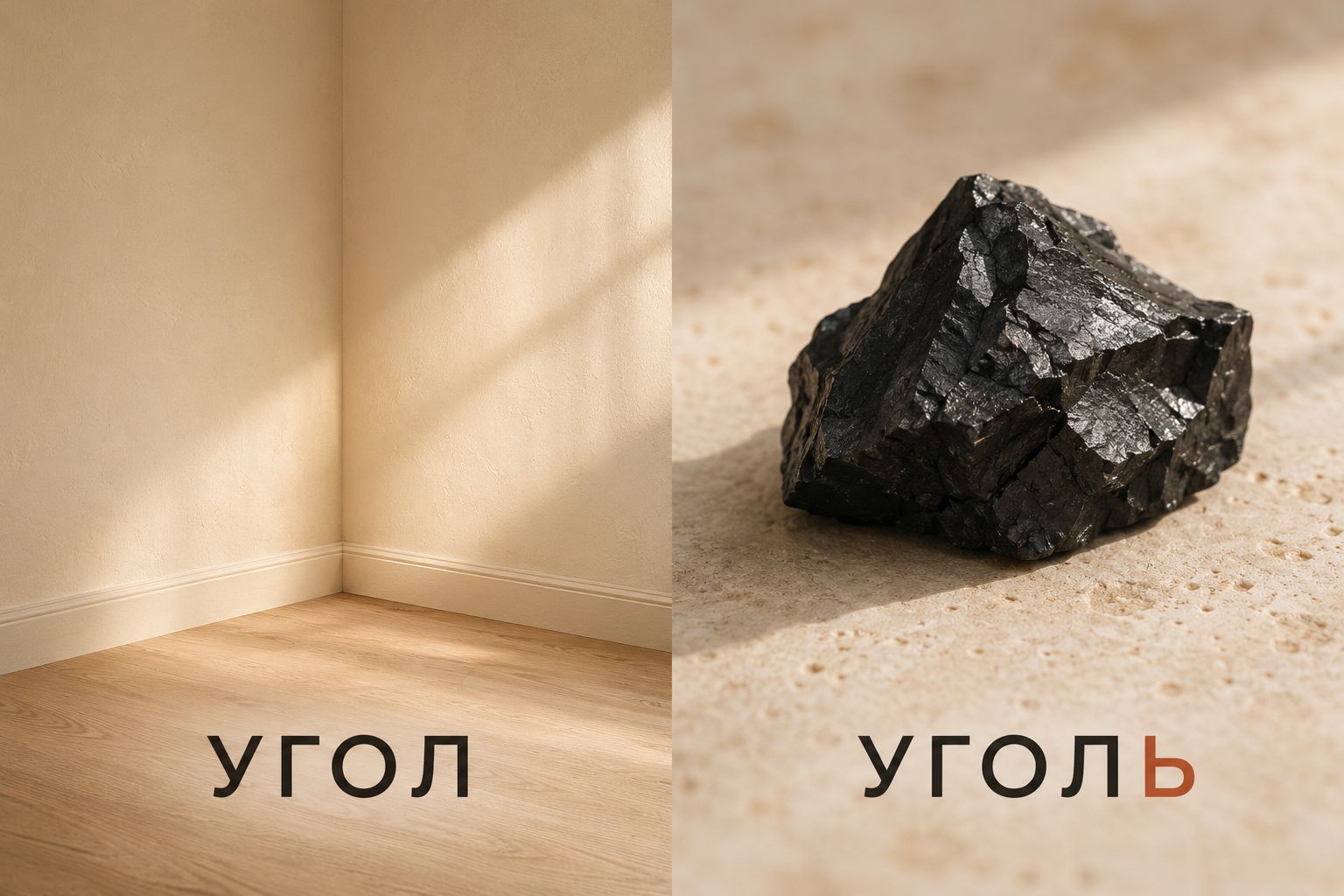
У́гол is a corner. У́голь is coal. The stress falls in the same place, the words have the same number of syllables, and the final ь adds no sound of its own. The difference is in the л itself. In the second word, the middle of the tongue rises toward the roof of the mouth as you say it. That small change is enough to turn the corner of a room into something you might put on a barbecue.
Then there’s подъе́зд, the entrance to an apartment building or the part of the building served by that entrance. Here the ъalso has no sound of its own, but you do hear a little “y” between the д and the vowel. So much for learning both letters as “the silent ones” and moving on.
The Russian soft sign ь (мя́гкий знак) often marks a soft consonant, sometimes signals a “y” sound before a vowel, and sometimes tells you something about grammar. The hard sign ъ (твёрдый знак) has one job in modern Russian spelling. It tells you to keep that “y” sound after a consonant. The names make the signs sound like opposites, but they share one of their jobs.
The soft sign can change the sound you’re already making
In Russian, a soft consonant is a palatalized consonant. The middle of the tongue lifts toward the hard palate while the consonant is being made. If you say the consonant and then add the “y” from English yes, you’ve made a sequence of two sounds. For the ль at the end of у́голь, you want one.
Try holding the last л in у́гол for a moment. Then listen to a recording of у́голь and try holding its last consonant too. Let the middle of the tongue rise while you’re still making the л. Stop there. If a little “ee” escapes at the end, try again and finish on the consonant.
у́гол (“corner”) and у́голь (“coal”)
брат (“brother”) and брать (“to take”)
мел (“chalk”) and мель (“shoal” or “shallow spot”)
Л is a useful place to start because the contrast is relatively easy to hear. Брат and брать may take longer. English speakers already know how to listen for a different vowel or an extra syllable. Here, the part worth replaying is the last fraction of a second.
The soft sign can do the same job inside a word, before another consonant. In па́льто (“coat”), ь marks the soft л before т. In ба́нька (“little bathhouse”), it marks the soft н before к. There’s no vowel letter immediately after either soft consonant to give you that information.
When a vowel letter does follow, the vowel letter itself can carry the cue. Compare лук (“onion” or “bow”) and люк(“hatch”). The ю in люк indicates a soft л followed by an “oo”-like vowel. Now add a soft sign between those same two letters and something else becomes audible.
Why лёд and льёт sound different
Лёд means “ice.” Льёт means “is pouring,” as in Дождь льёт (“It’s pouring”). Both words start with a soft л. Say them slowly and listen to what happens next. In лёд, you move straight into the vowel. In льёт, you pass through the little “y” of yes first. The ь between л and ё is doing the separating.
That “y” is written /j/ in phonetic notation and corresponds to the sound of Russian й. A separating soft sign can appear before е, ё, ю, я and и. You can hear the same glide in семья́ (“family”), вью́га (“blizzard”) and соловьи́(“nightingales”). A few borrowed words also use it before о, as in бульо́н (“broth”).
One example makes the term soft sign especially easy to overinterpret. In шью (“I sew”), Russian ш stays hard, as it normally does. The ь is there so that ю begins with the “y” glide. If you’ve been trying to soften the ш, you can stop making your tongue do overtime.
The distinction is worth hearing before you try to spell it. In льёт, the soft л and the glide both belong in the word. In у́голь, the word ends as soon as you finish the soft л. English-style spellings with a “y” after every soft consonant tend to blur that difference.
The hard sign often shows where a prefix ends
Imagine someone sends you Вход со двора́, второ́й подъе́зд. The entrance is from the courtyard, and you’re looking for the second entrance to the building. The ъ in подъе́зд sits between под- and the part of the word related to е́здить (“to go by vehicle”). The д stays hard, and е starts with the “y” sound. Say the two sounds in sequence, without inserting a pause.
The most useful spelling pattern is a prefix ending in a consonant, followed by е, ё, ю or я with that initial glide. The sign sits between them.
съе́сть (“to eat up”) has ъе.
подъём (“ascent” or “climb”) has ъё.
предъюбиле́йный (“preceding an anniversary”) has ъю.
объяви́ть (“to announce”) has ъя.
The rule depends on what follows the prefix. Отучи́ть (“to get someone out of a habit”) also starts with от-, and the уfollows it directly. The ъ appears in отъе́зд (“departure”) because the next letter is е with a glide.
You’ll also see ъ in some compounds, such as двухъя́русный (“two-tiered,” as in a bunk bed), and in borrowed words such as объе́кт (“object” or “site”). When the parts of a word are hard to spot, it’s easier to learn the whole spelling. The prefix pattern pays off with families of words like подъе́хать (“to drive up”) and подъездно́й путь (“access road” or “rail siding,” depending on context).
Sometimes the soft sign is there for the person writing
Look at ночь (“night”) and ключ (“key”). Both end in ч, which is already soft in standard Russian. That final ь in ночьhelps mark it as a feminine noun of a particular declension. Ключ is masculine. Here the spelling gives you information you can use to build a sentence, even though both words end with the same consonant sound.
Мышь (“mouse”) is another feminine noun in that group, but its final ш stays hard. Try learning the noun with an adjective, as in тёмная ночь (“a dark night”) or се́рая мышь (“a gray mouse”). The adjective lets you see what the spelling is telling you about the noun.
The same idea comes up in verbs. Учи́ться means “to study” or “to learn,” and у́чится means “he or she studies.” Their stress differs, but the written endings -ться and -тся sound alike in ordinary speech. To choose the spelling, look at the sentence.
Она́ хо́чет учи́ться. She wants to study. After “wants,” the verb is an infinitive, so write -ться.
Она́ у́чится в университе́те. She studies at a university. Here the verb goes with “she,” so write -тся.
An adult learner can spend a long time listening for a difference in those endings. Once you see what the sign is doing on the page, that particular listening problem disappears.
A two-minute reading check
Read фильм, семья́, съёмка and ночь aloud. At each sign, look at the letter on either side. Decide whether you need a soft consonant, a “y” glide, or simply the correct spelling for the word’s grammatical form.
Фильм (“film”) has a soft л before м.
Семья́ (“family”) has a soft м followed by a glide into я.
Съёмка (“filming” or “a shoot”) has a hard с followed by a glide into ё.
Ночь (“night”) already ends in a soft ч. The ь marks its noun class.
Then try the short phrase дверь в подъе́зд (“the door to the building entrance”). In дверь, finish on a soft р. In подъе́зд, carry the “y” into the stressed vowel. Those two words give you both signs in a phrase that could come up while someone is explaining where to meet.
Two spellings that can throw you off
Why do I see съемка without the dots? Russian texts often print е in place of ё, so съёмка can appear as съемка. The ъ still tells you to expect a glide. A dictionary can confirm that the vowel is ё.
Why do some old signs put ъ at the end of words? Before the spelling reform of 1917–1918, a word like дом (“house”) was written домъ. The reform dropped that final ъ and kept the separating use inside words. A modern sign with домъmay be borrowing the look of older Russian printing. Gramota’s note on the spelling reform.
Pronunciation and spelling references are available from Cornell University, Gramota and the academic handbook of Russian spelling.
There’s a satisfying moment when у́голь stops looking like у́гол with an extra letter and starts sounding like a word you’d recognize on its own. It can happen with a much less memorable word, too. You hear дверь in a sentence and catch the ending before you’ve had time to picture it.
If you’d like some feedback on what you’re hearing and saying, Polyglottist Language Academy offers live Russian classes for adults online and in person in Berkeley, California. Classes work on pronunciation alongside the Russian you’d use in conversation. Explore the Russian class options.