
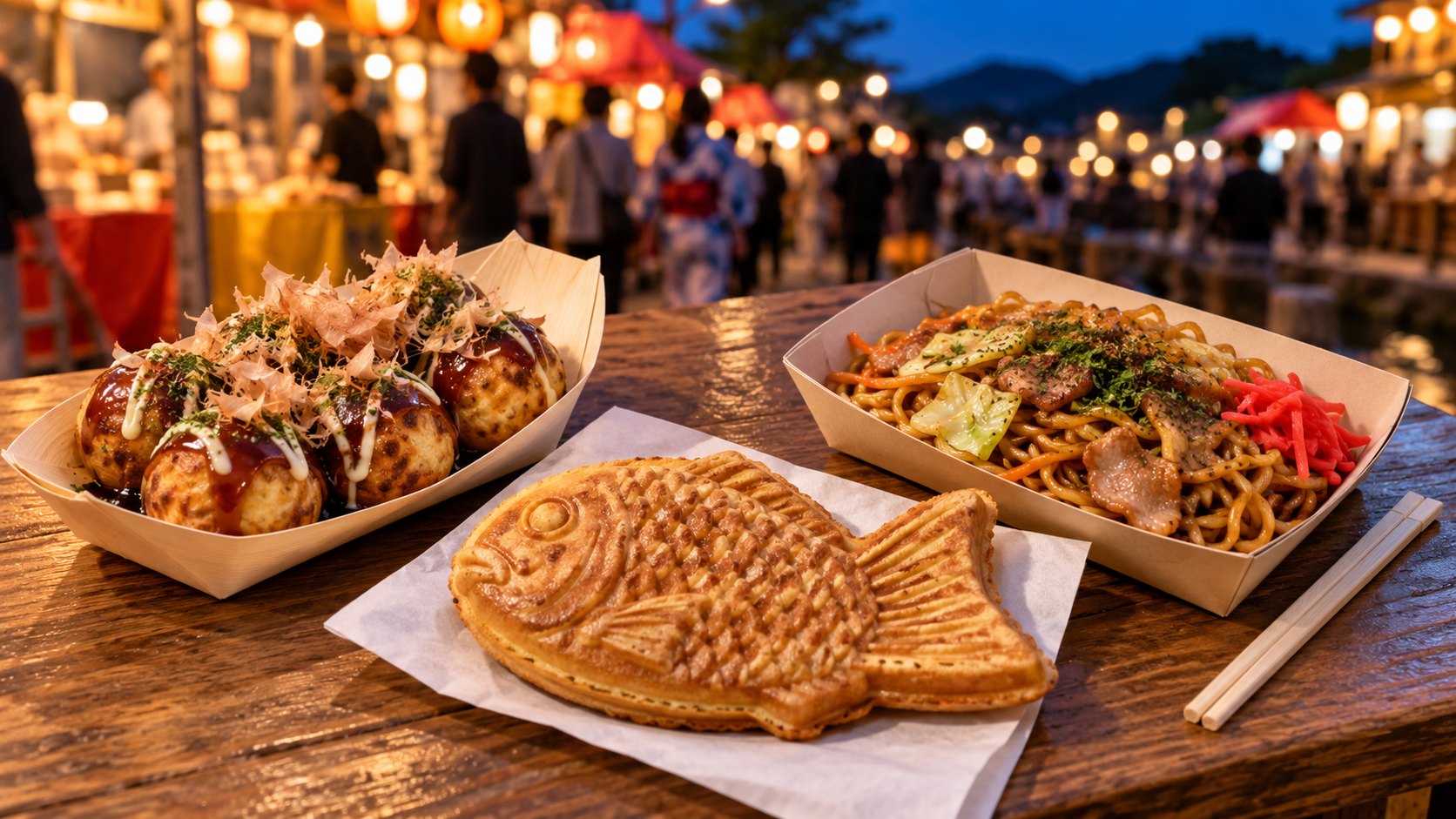
The phrase “Japanese street food” creates a slightly misleading picture.
Japan is not a country where every city center is lined with permanent food carts. In many places, eating while walking is less common than visitors expect, and street stalls are not necessarily part of everyday urban life.
Then a festival starts.
Lanterns appear. A shrine approach fills with people. Temporary stalls begin serving noodles, grilled seafood, candied fruit, fried chicken, and batter-covered octopus. Suddenly the quiet street has become a corridor of smoke, sweet sauce, sizzling griddles, and people carrying food in paper trays.
That is one of the best places to understand Japanese street food.
The dishes themselves are worth seeking out, but the setting matters too. Some foods are closely associated with festivals. Others belong to particular cities or regions. Some have become so common that they now appear everywhere from convenience stores to shopping malls.
Here are the Japanese street foods worth knowing, what they actually taste like, how to order them, and where they fit into Japanese food culture.
Takoyaki: Osaka's famous octopus balls
If one Japanese street food has become internationally recognizable, it is probably takoyaki (たこ焼き).
The name is very literal:
tako (たこ) means octopus.
yaki (焼き) refers to grilling or cooking with direct heat.
Takoyaki are round balls of soft batter cooked in a special molded griddle. Each usually contains a small piece of octopus, along with ingredients such as green onion and pickled ginger.
Once cooked, they are commonly topped with:
savory takoyaki sauce
Japanese mayonnaise
dried bonito flakes
powdered seaweed
The result is richer and softer than many first-time visitors expect.
A good takoyaki ball has a lightly cooked exterior but remains almost creamy inside. This sometimes surprises people who expect something crisp throughout.
That softness is not evidence that the batter is undercooked. It is part of the dish.
Be careful with the first bite
Takoyaki may be one of the most effective foods ever invented for burning the roof of one's mouth.
The outside can feel manageable while the inside is still extremely hot.
The experienced approach is not heroic. Break one open first.
Where is takoyaki from?
Takoyaki is strongly associated with Osaka, where it developed in the twentieth century and remains one of the city's signature casual foods.
Visitors will see it elsewhere in Japan, but eating takoyaki in Osaka has a different cultural weight. It belongs to the city's reputation for inexpensive, unpretentious, satisfying food.
Osaka is sometimes associated with the expression kuidaore (食い倒れ), roughly the idea of eating oneself into financial ruin.
Takoyaki fits the spirit nicely.
Taiyaki: a fish that contains no fish
The first thing to explain about taiyaki (たい焼き) is that it usually does not taste like seafood.
Taiyaki is a fish-shaped cake traditionally filled with anko (あんこ), sweet red bean paste.
The fish shape represents tai (鯛), sea bream, a fish associated with celebration and good fortune in Japan.
The batter is cooked in a hinged mold that creates the detailed fish shape: scales, fins, tail and all.
The classic filling is red bean paste, but modern taiyaki shops may offer:
custard
chocolate
sweet potato
cheese
matcha cream
seasonal fillings
The texture varies considerably.
Some versions are soft and cake-like. Others have a thin, crisp shell, particularly around the edges.
One of the small pleasures of taiyaki is deciding which part to eat first.
Head or tail?
Japanese people actually debate this.
It is not a particularly consequential question, which may be exactly why it survives.
Yakisoba: festival noodles, despite the name
Yakisoba (焼きそば) is another case where the name can mislead beginners.
Yaki means cooked or grilled.
Soba usually makes people think of buckwheat noodles.
But the noodles used in yakisoba are generally wheat-based noodles rather than the buckwheat noodles associated with dishes such as zaru soba.
Yakisoba is stir-fried on a hot griddle with ingredients that may include cabbage, pork, onion, bean sprouts, and carrots.
The defining flavor usually comes from a dark, slightly sweet and savory sauce.
It is often topped with:
青のり (aonori)
powdered green seaweed
and:
紅しょうが (beni shōga)
bright red pickled ginger
At festivals, watching yakisoba being made is part of the appeal. Large quantities are tossed across a flat iron griddle while steam rises above the stall.
It is not delicate food.
That is precisely the point.
Okonomiyaki: somewhere between pancake and dinner
Okonomiyaki (お好み焼き) is often described in English as a “Japanese savory pancake.”
That is not wrong, but it can create the wrong expectation.
It is much more substantial than an American breakfast pancake.
The name is useful:
okonomi (お好み) means something like “as you like it” or “your preference.”
yaki (焼き) means grilled or cooked.
The dish usually involves batter, cabbage, and various additions cooked on a griddle.
Popular ingredients include:
pork
shrimp
squid
green onion
cheese
mochi
It is typically topped with sauce, mayonnaise, seaweed, and bonito flakes.
There are important regional styles.
Osaka-style okonomiyaki
Ingredients are generally mixed together and cooked into a thick savory pancake.
Hiroshima-style okonomiyaki
Ingredients are layered rather than simply mixed, and noodles are usually incorporated.
People from Osaka and Hiroshima may have strong opinions about which is better.
Visitors are under no obligation to choose sides.
Karaage: Japanese fried chicken
Karaage (唐揚げ) is one of those foods that can make visitors wonder why they spent so much time chasing more exotic dishes.
It is simply very good fried chicken.
Pieces of chicken, often thigh meat, are usually seasoned with ingredients such as soy sauce, ginger, and garlic before being coated and fried.
The coating is typically lighter and less bread-like than American fried chicken.
Good karaage is crisp outside and juicy inside.
It is not exclusively street food. Karaage appears in restaurants, izakaya, bento boxes, convenience stores, supermarkets, and home kitchens.
But it is also common at festivals and outdoor events, where it may be served in a cup or paper container with a skewer.
If a traveler wants a low-risk introduction to Japanese festival food, karaage is an excellent place to begin.
Ikayaki: grilled squid without much disguise
Some Japanese street foods are carefully shaped, filled, sauced, and decorated.
Ikayaki (いか焼き) is often much simpler.
ika (いか) means squid.
The squid may be grilled whole or in large pieces, brushed with a soy-based sauce, and served on a stick or tray.
The smell is unmistakable when it hits a hot grill.
For visitors accustomed to calamari, grilled squid can be surprising because the texture is quite different. It is chewy rather than crisp, with a stronger seafood flavor.
This is a good example of a food where expectations matter.
If you approach ikayaki expecting fried calamari, it may seem tough.
If you expect smoky, savory grilled squid, the texture makes much more sense.
Yakitori: more than chicken teriyaki on a stick
Yakitori (焼き鳥) literally means “grilled chicken.”
Small pieces of chicken are placed on skewers and grilled, often over charcoal.
Some are seasoned simply with salt:
塩
shio
Others are brushed with a sweet-savory sauce called:
たれ
tare
Visitors may expect mostly chicken breast or thigh.
Traditional yakitori menus can be considerably more adventurous.
Different skewers may contain:
thigh
breast
skin
liver
heart
cartilage
meatballs
green onion with chicken
One of the pleasures of yakitori is trying several different cuts rather than ordering one large portion.
Yakitori is especially associated with izakaya and specialist restaurants, but skewers also appear at festivals and outdoor events.
A useful ordering word
If asked:
塩?たれ?
Shio? Tare?
you are being asked whether you want salt or sauce.
There is no universally correct answer.
Different cuts suit different seasonings, and Japanese diners disagree about this too.
Dango: chewy rice dumplings on a stick
Dango (団子) are small dumplings made from rice flour and usually served on skewers.
Their defining characteristic is the texture.
They are chewy.
Very chewy, by the standards of many Western desserts.
One common version is:
みたらし団子
mitarashi dango
These are coated in a glossy sweet-and-savory soy-based sauce.
The flavor can surprise visitors because it sits somewhere between dessert and snack.
Another familiar variety is hanami dango, with pink, white, and green dumplings often associated with the cherry blossom season.
Dango are a good reminder that Japanese sweets do not always follow the Western formula of sugar, butter, cream, and chocolate.
Texture is often just as important as sweetness.
Imagawayaki: the round cake with many names
A thick, round cake cooked in a metal mold and filled with red bean paste may appear under several names depending on where you are in Japan.
One common name is:
今川焼き
imagawayaki
Another is:
大判焼き
ōbanyaki
Regional names abound.
The basic idea is simple: batter is cooked around a filling, traditionally sweet red bean paste.
Custard and other fillings are now common.
Compared with taiyaki, imagawayaki is less visually charming. It is simply round.
That may be its main disadvantage in the age of Instagram.
As food, however, it is excellent, especially when freshly cooked and still hot.
Yakiimo: a sweet potato that barely needs improving
Not every memorable Japanese street food requires a sauce, filling, or specialized mold.
Yakiimo (焼き芋) is simply roasted sweet potato.
Traditionally, vendors sold them from trucks, sometimes calling out:
石焼き芋
ishiyaki imo
stone-roasted sweet potatoes.
Modern versions also appear in supermarkets and specialty shops.
Japanese sweet potatoes can become remarkably sweet when roasted slowly. The interior turns dense, soft, and almost custard-like.
The best ones need nothing added.
No butter.
No cinnamon.
No syrup.
For travelers visiting during colder months, yakiimo is one of the simplest and most satisfying Japanese snacks.
Kakigōri: shaved ice that can range from simple to extravagant
In summer, kakigōri (かき氷) appears everywhere from festival stalls to specialized dessert shops.
At its simplest, it is shaved ice topped with flavored syrup.
Classic festival flavors include:
strawberry
melon
lemon
blue Hawaii
The colors can be extremely bright, and the flavors are not always attempting botanical realism.
But modern kakigōri has become far more elaborate.
Specialty shops may serve finely shaved ice with:
fresh fruit
matcha
condensed milk
azuki beans
cream
house-made syrups
Some versions look closer to restaurant desserts than street food.
If visiting Japan in August, the humble cup of festival kakigōri may be more appealing than the sophisticated version simply because it is cold.
Choco banana: exactly what it sounds like
Japanese festival food is not all ancient culinary tradition.
Some of it is charmingly straightforward.
Choco banana consists of a banana on a stick covered in chocolate and often decorated with sprinkles or colorful toppings.
It is especially common at festivals.
Children like it.
Adults like it.
No complicated cultural interpretation is necessary.
Sometimes a chocolate-covered banana is simply a chocolate-covered banana.
Ringo ame: the Japanese candy apple
Ringo ame (りんご飴) means candied apple.
ringo means apple.
ame means candy.
The fruit is coated in a hard, glossy sugar shell and sold on a stick.
Other candied fruits may appear as well, including strawberries and grapes.
The effect is visually striking, particularly under festival lights.
Actually eating a whole candied apple neatly is another matter.
This is not necessarily a food to choose while wearing an expensive white shirt.
Senbei: rice crackers with a serious crunch
Senbei (せんべい) are Japanese rice crackers.
They come in countless varieties, but freshly grilled senbei can be particularly satisfying.
A cracker may be brushed with soy sauce and grilled until crisp, sometimes wrapped partly in nori seaweed.
The smell of soy sauce hitting a hot grill is one of those small details associated with traditional shopping streets and temple areas.
Senbei can be:
salty
sweet
spicy
glazed
seaweed-wrapped
extremely crunchy
They also travel better than takoyaki, which makes them much more sensible as a souvenir.
Where to find Japanese street food
This is where visitors sometimes make the wrong assumption.
If you arrive in central Tokyo expecting the street-food density of Bangkok, Taipei, or parts of Southeast Asia, you may be confused.
Japanese street food tends to cluster around particular settings.
Festivals
Japanese festivals, or matsuri (祭り), are among the best places to encounter classic food stalls.
Temporary stalls are known as:
屋台
yatai
A festival may have long rows of vendors selling takoyaki, yakisoba, grilled squid, sweets, and games.
Shrine and temple events
Major religious sites often host food stalls during holidays, festivals, and seasonal events.
New Year's shrine visits can bring enormous crowds and many temporary vendors.
Traditional shopping streets
Covered or open shopping streets, often called shōtengai (商店街), can be excellent places for casual snacks.
These may include croquettes, taiyaki, grilled foods, sweets, or regional specialties.
Tourist food districts
Places known for food often develop a concentrated snack culture.
Osaka is the obvious example, particularly around areas such as Dotonbori.
But tourist markets and historic districts elsewhere in Japan can also offer foods designed to be eaten immediately.
Is it rude to eat while walking in Japan?
This is one of the most repeated pieces of Japan travel advice, and it deserves some nuance.
It is not universally “forbidden” to eat while walking.
But eating while actively moving through ordinary public space is less common than in some countries.
At a street-food stall, people often buy something and eat nearby rather than continuing down the street with it.
In dedicated food streets or festival environments, behavior is naturally more relaxed.
The safest approach is very simple: observe what the people around you are doing.
If everyone is eating beside the stall, do that.
If people are walking with food, it is probably fine.
There is no need to transform a snack into an etiquette examination.
Useful Japanese for ordering street food
Ordering from a Japanese food stall is usually easier than beginners expect.
One, please
一つください。
Hitotsu kudasai.
“One, please.”
This works surprisingly often when pointing at something.
Two, please
二つください。
Futatsu kudasai.
“Two, please.”
What is this?
これは何ですか。
Kore wa nan desu ka?
“What is this?”
Which do you recommend?
おすすめはどれですか。
Osusume wa dore desu ka?
“Which do you recommend?”
Is it spicy?
辛いですか。
Karai desu ka?
“Is it spicy?”
Can I eat it here?
ここで食べてもいいですか。
Koko de tabete mo ii desu ka?
“Can I eat it here?”
Even limited Japanese can make these interactions considerably easier.
What to try first
For someone completely new to Japanese street food, a sensible first round would be:
Takoyaki for the classic Osaka experience.
Yakisoba for something filling and familiar.
Karaage because good Japanese fried chicken requires almost no explanation.
Taiyaki for something sweet.
Mitarashi dango for a texture and flavor combination less familiar to many Western visitors.
Then move toward grilled squid, unusual yakitori cuts, seasonal foods, and whatever the stall in front of you happens to be making well.
That last point matters.
A rigid checklist is rarely the best way to eat in Japan.
If ten people are standing in line for something you have never heard of while the supposedly famous stall beside it is empty, reconsider the itinerary.
Street food is partly about the occasion
Takoyaki purchased from a polished food court can be excellent.
Yakisoba eaten from a festival tray while fireworks are beginning is a different experience.
Japanese street food makes the most sense when viewed not as a separate national cuisine but as food tied to particular places and moments: shrine festivals, summer evenings, tourist districts, neighborhood shopping streets, winter snacks, and regional traditions.
The dishes carry vocabulary with them too.
Learn that yaki appears in takoyaki, yakisoba, yakitori, and okonomiyaki, and suddenly Japanese food names become easier to decode. Learn ika, and ikayaki stops being mysterious. Learn imo, and yakiimo begins explaining itself.
That is one reason food is such a useful doorway into Japanese.
At Polyglottist Language Academy, our Japanese classes for adults connect language with situations in which people actually use it, including travel, restaurants, ordering food, and everyday interaction. Polyglottist offers live online Japanese classes and selected in-person classes in Berkeley, California.
Knowing how to say “one, please” may seem like a tiny piece of Japanese.
Standing at a festival stall, trying not to burn your mouth on the first takoyaki of the evening, it suddenly feels quite useful.
Frequently asked questions about Japanese street food
What is the most famous Japanese street food?
Takoyaki is probably the best-known internationally, particularly because of its association with Osaka. Yakisoba, taiyaki, yakitori, karaage, and dango are also widely recognized.
Where is the best place to try Japanese street food?
Festivals, shrine and temple events, traditional shopping streets, food markets, and established food districts are usually better choices than simply wandering an ordinary business district looking for stalls.
Is Japanese street food expensive?
Many traditional snacks are relatively inexpensive compared with full restaurant meals, although prices vary considerably in heavily touristed areas and at specialty shops.
Is takoyaki raw inside?
Proper takoyaki is intentionally very soft and moist inside, which can surprise first-time eaters. The texture should not resemble a dry fried ball.
Is taiyaki made from fish?
No. Taiyaki is a fish-shaped cake. The traditional filling is sweet red bean paste, although custard, chocolate, and many other fillings are common.
Can you eat while walking in Japan?
It depends on the setting. Eating while walking is less common in ordinary public spaces than in many countries, but festivals, food markets, and tourist snack streets can be much more relaxed. Watching what local customers do is usually the easiest guide.
What Japanese words are useful at a food stall?
Hitotsu kudasai (“One, please”), kore wa nan desu ka? (“What is this?”), and osusume wa dore desu ka? (“Which do you recommend?”) cover a surprising number of situations.