Hayward and Union City are places where it is quite easy to encounter Filipino culture and surprisingly difficult to find a conventional adult Tagalog class.
That combination can be frustrating.
Someone may have Filipino coworkers, relatives speaking Tagalog at family gatherings, Filipino restaurants nearby, and friends who switch effortlessly between English and Tagalog. Then they search for “Tagalog classes near Hayward” or “Tagalog classes Union City” and discover that the local adult schools mostly teach English, career skills, citizenship, and high-school completion.
The language is present. The classroom infrastructure is much thinner.
For adult learners, that means the best option may not be the closest physical classroom. Depending on whether you are a complete beginner, a Filipino American heritage learner, or someone preparing to spend time in the Philippines, the right choice could be a university course, a live online small-group class, private instruction, or a combination of formal lessons and community exposure.
Why Tagalog can be strangely difficult to find locally
Hayward and Union City sit in a part of the Bay Area with substantial Filipino communities, but adult language education does not necessarily reflect the languages spoken around it.
Hayward Adult School currently emphasizes programs such as ESL, GED preparation, career education, citizenship, and related adult-learning services. Hayward Public Library likewise has an extensive adult education program, but its currently listed language offerings center on English learning rather than Tagalog.
In Union City, New Haven Adult School currently offers ESL and citizenship instruction alongside its other adult programs, but Tagalog is not listed among the language courses shown in its current program information.
That does not mean a temporary Tagalog workshop or community program can never appear. Local offerings change.
It does mean that an adult looking for a stable sequence of Tagalog classes should probably widen the search beyond city-run adult schools.
First decide what kind of Tagalog learner you are
“Beginner” is an unusually unhelpful label for Tagalog.
Two people can both describe themselves as beginners while having almost nothing in common.
One has never heard Tagalog before.
The other grew up hearing:
Kumain ka na?
“Have you eaten?”
They know when relatives are talking about them. They understand instructions from a parent. Their pronunciation may be quite good.
But ask them to answer in a complete Tagalog sentence and English immediately takes over.
That second person is a heritage learner, and heritage learners are extremely common in Filipino American communities.
A third student may speak some Tagalog conversationally but never learned to read or write it systematically.
A fourth might be learning because a spouse or partner is Filipino.
Someone else is planning an extended stay in Manila, Cebu, or another part of the Philippines and wants enough Tagalog to move beyond tourist English.
These people should not automatically be placed in the same class.
Before registering anywhere, ask what you can actually do:
Can you understand ordinary family conversation?
Can you answer in Tagalog without switching to English?
Can you form your own sentences?
Do you understand basic verb forms?
Can you read Tagalog comfortably?
Have you studied the language formally before?
That information matters much more than whether you consider yourself “Filipino enough” to know the language.
Tagalog or Filipino: which should you search for?
This causes unnecessary confusion.
Some programs advertise Tagalog. Universities are more likely to call the language Filipino.
Tagalog is the language historically associated with Manila and surrounding regions and forms the principal linguistic basis of Filipino, the national language of the Philippines. In practical beginner language instruction, a course called “Filipino” and one called “Tagalog” will usually overlap enormously.
There are linguistic, historical, and political distinctions behind the terminology, but an adult searching for a class should not reject a program merely because it uses the other name.
Search both:
Tagalog classes Hayward
Filipino classes Hayward
Tagalog classes Union City
Filipino language classes East Bay
You will find more options.
UC Berkeley offers the most academic nearby route
For someone who wants serious university-level language study, UC Berkeley has an established Filipino program through its Department of South and Southeast Asian Studies.
Its introductory Filipino curriculum emphasizes speaking, listening, reading, and writing, with practical functions such as introducing yourself, shopping, making appointments, asking directions, expressing feelings, and narrating simple events.
That depth is an advantage for the right student.
It can also be more than a working adult is looking for.
A university course generally assumes that the language is one significant part of a student's academic schedule. Someone who wants one evening lesson each week after work may not need that level of intensity.
There is also the practical question of location.
Berkeley is certainly reachable from Hayward and Union City. “Reachable,” however, is not the same as “pleasant to do every week at rush hour.”
That distinction matters in the Bay Area.
Online classes make particular sense from Hayward and Union City
For common languages, choosing between an in-person class and an online one might be largely a matter of preference.
For Tagalog, availability changes the calculation.
If the nearest suitable classroom requires driving north to Berkeley or elsewhere in the Bay Area, a one-hour class can become a much larger weekly commitment.
Live online instruction eliminates the commute without eliminating the parts of a language course that matter most: a real instructor, classmates, scheduled lessons, questions, corrections, and speaking practice.
The important word is live.
A collection of recorded videos is useful for explanations. An app can help with vocabulary. Neither can notice that you are constructing every Tagalog sentence according to English word order or that you repeatedly choose the wrong verb form.
A teacher can.
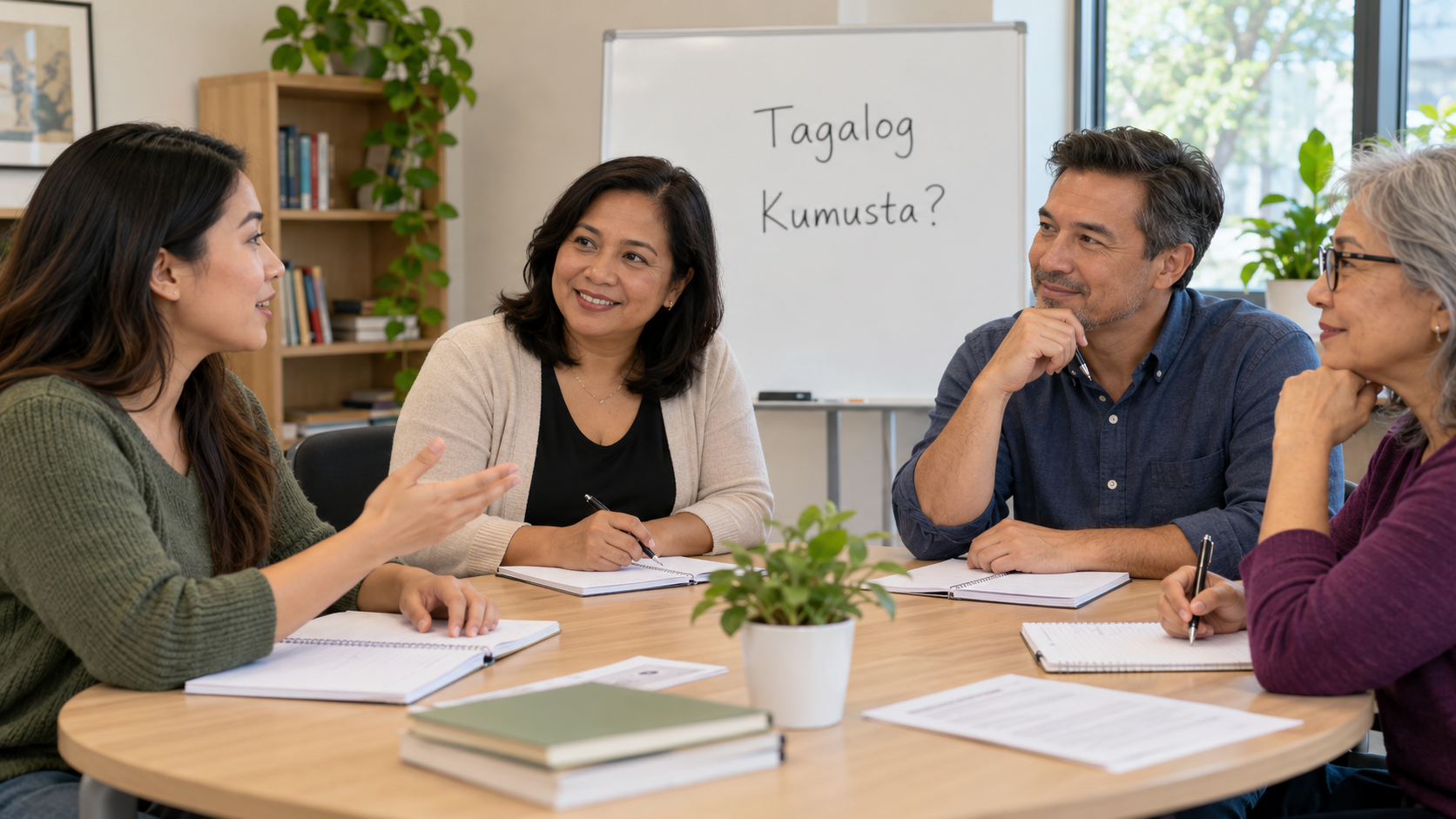
Polyglottist Language Academy currently offers live online Tagalog classes for adults in small groups. Its complete-beginner course is taught live rather than self-paced and includes pronunciation, grammar, sentence building, vocabulary, listening, speaking, reading, and cultural context.
For someone in Hayward or Union City, the attraction is not simply convenience. It is being able to take a structured course without turning one evening lesson into an evening commute.
Another online option: programs devoted specifically to Tagalog
Independent programs can also be worth comparing.
Tagalog Kids+, despite the name, currently offers a separate adult program for learners aged 18 and over. Its adult curriculum includes an introductory Tagalog level and combines language instruction with Filipino culture and history.
This illustrates why searching broadly matters.
A program whose name initially sounds child-focused may still have an adult curriculum.
When evaluating smaller programs, look beyond price and ask:
How much speaking will I do?
Will the instructor correct pronunciation?
Does the course explain grammar?
What happens after the first beginner level?
Is there a path into the next class?
Is the class intended for complete beginners, heritage learners, or both?
A cheap six-week introduction is less useful if there is nowhere to go afterward.
Heritage learners should be especially careful about placement
Hayward and Union City have the kind of Filipino American communities where heritage learners are likely to be a significant part of the local audience for Tagalog classes.
Heritage learners often have a peculiar skill profile.
They may know that a sentence sounds wrong but be unable to explain why.
They may pronounce words naturally while struggling with grammar.
They may understand far more than they can say.
They may know household language but not vocabulary for work, opinions, travel, or abstract topics.
And many have spent years saying:
“I understand Tagalog, but I don't speak it.”
That is not the same as starting from zero.
A course that spends several weeks teaching greetings and isolated family vocabulary can be painfully slow for someone who has heard the language since childhood.
At the same time, jumping into an intermediate class can expose gaps that were easy to hide in family conversation.
The best placement usually considers receptive ability and productive ability separately.
How much can you understand?
How much can you actually produce?
Those answers may differ dramatically.
Tagalog grammar is worth learning properly
There is a persistent idea that someone who mainly wants to speak Tagalog can skip the grammar.
That works for a little while.
You can memorize:
Kamusta?
“How are you?”
Salamat.
“Thank you.”
Magkano ito?
“How much is this?”
But eventually you need to build a sentence you have never memorized before.
That is where Tagalog begins to feel very different from English.
The language uses markers such as:
ang
ng
sa
These do not map neatly onto English articles and prepositions.
The verb system is even more important. Tagalog verbs can change according to aspect and grammatical focus, and the form chosen helps organize which participant in the action is being highlighted.
Consider forms related to the idea of eating:
kumain
kumakain
kakain
kinain
A learner does not need an advanced linguistic analysis on day one.
But simply memorizing all of these as unrelated vocabulary is not a good long-term strategy either.
A well-structured beginner class should gradually reveal the system.
Once the underlying patterns become visible, Tagalog starts feeling far less arbitrary.
Do not judge a course only by how much vocabulary it promises
Adult learners often measure progress in words.
“Learn 500 Tagalog words.”
“1,000 essential Filipino phrases.”
Vocabulary matters, but vocabulary without sentence-building ability produces a strange kind of learner: someone who recognizes many words and still cannot comfortably speak.
A useful beginner course should help you learn how to manipulate what you know.
If you learn a verb, can you use it to talk about yesterday?
Tomorrow?
A question?
A negative sentence?
If you learn family vocabulary, can you describe your own family rather than simply label a diagram?
If you learn food words, can you order, make a preference clear, or ask what someone else wants?
That distinction separates studying about Tagalog from beginning to use it.
For many learners, family is both the reason to study and a terrible classroom
Filipino American adults often have access to something language learners usually dream about: native speakers in their own family.
So why pay for a class?
Because relatives are not necessarily teachers.
A mother may correct a sentence by saying:
“No, don't say it like that.”
A cousin may laugh affectionately at an accent.
A partner may switch to English the second communication becomes slow.
A grandparent may know exactly what sounds natural without having any idea how to explain the grammatical pattern.
None of this is malicious.
Native speakers are usually experts at speaking their language, not at explaining it.
A class provides structure. Family provides exposure.
Together, they can work extremely well.
Once a learner studies a pattern formally, conversations at home become more useful because they start recognizing it in real speech.
Community exposure still matters
Even if the most practical class is online, living in Hayward or Union City provides an advantage that a learner in many other parts of the country does not have.
Tagalog is not entirely confined to the lesson.
Filipino community organizations, churches, businesses, restaurants, cultural events, friends, relatives, and coworkers can provide opportunities to hear Filipino and Tagalog used naturally.
But “being around the language” should not be confused with automatically learning it.
Plenty of heritage learners have heard Tagalog for twenty or thirty years without becoming confident speakers.
Exposure becomes more powerful when paired with deliberate attention.
Listen for expressions you have studied.
Notice how questions are formed.
Listen for particles.
Write down a phrase that keeps appearing.
Ask what something means.
Try answering in Tagalog before reverting to English.
The difference between passive exposure and active noticing is enormous.
How much should an adult Tagalog class cost?
Price should be considered per instructional hour, not simply by the total displayed tuition.
Compare:
number of weeks
lesson length
group size
live versus recorded instruction
materials
teacher qualifications
speaking time
continuation levels
A class of four students at a higher tuition can provide much more individual speaking time than a cheaper class of twenty.
Private lessons cost more per hour but may make sense for someone with a very specific goal, such as preparing to meet a partner's family or filling gaps as a heritage speaker.
Large university courses offer greater academic depth but usually require more work outside class.
There is no universally best format.
There is a best format for what you are trying to accomplish.
What should a complete beginner expect to learn first?
A good introductory Tagalog course should not bury students in advanced grammar immediately.
Early priorities usually include:
Pronunciation
Tagalog spelling is relatively approachable once the sound system is understood.
Greetings and introductions
Useful, but they should not occupy half the course.
Pronouns
Pronoun systems matter greatly in ordinary conversation.
Basic sentence patterns
Students need to see early that Tagalog sentences are not simply English sentences with Tagalog vocabulary inserted.
Common verbs
Preferably taught as patterns rather than isolated forms.
Ang, ng, and sa phrases
Not every nuance at once, but enough to begin recognizing how sentences are organized.
Questions and negation
Because actual conversation requires both almost immediately.
Everyday vocabulary
Family, food, places, routines, preferences, time, and common activities.
Culture should appear alongside the language rather than as a decorative lesson at the end.
Knowing when to use po and opo, for example, is simultaneously a language lesson and a lesson in Filipino social relationships.
How long does it take before you can actually speak?
Much depends on what “speak” means.
After a short beginner course, nobody should expect effortless conversations about politics, childhood memories, or complicated family drama.
But a well-taught beginner should be able to do more than recite vocabulary.
They should begin to:
introduce themselves
ask and answer basic questions
describe simple routines
understand common expressions
talk about preferences
recognize basic verb patterns
create short original sentences
The important milestone is not fluency.
It is moving from repeating Tagalog to constructing Tagalog.
Once that begins, the language becomes expandable.
A practical choice for Hayward and Union City learners
For adults in Hayward and Union City, the current landscape is slightly counterintuitive.
The nearest adult schools are useful institutions, but their current public course offerings concentrate on English, citizenship, career training, and other adult-education priorities rather than a regular Tagalog sequence.
UC Berkeley provides a serious academic Filipino option for learners seeking university-level depth.
Independent online programs offer another route, including both specialized Tagalog programs and live small-group instruction.
For many working adults, that last category is probably the practical sweet spot: enough structure to learn the language systematically, but without the time commitment of crossing the East Bay for every lesson.
At Polyglottist Language Academy, we offer live online Tagalog classes for adults, including complete beginners, in small groups focused on practical communication and understanding how the language actually works. PLA is based in Berkeley and offers online classes to students throughout the Bay Area, including Hayward, Union City, Fremont, Oakland, San Jose, and beyond.
For someone surrounded by Filipino culture but still answering every Tagalog sentence in English, geography may not be the real obstacle.
Finding the right place to start usually is.
Frequently asked questions about Tagalog classes near Hayward and Union City
Are there in-person Tagalog classes in Hayward?
Regular adult Tagalog classes are not currently listed among the main public programs shown by Hayward Adult School or Hayward Public Library. Their current adult education offerings focus heavily on ESL, literacy, citizenship, career education, and related programs.
Offerings can change, so it is worth checking local community organizations and seasonal programs as well.
Does Union City Adult School offer Tagalog?
New Haven Adult School in Union City currently lists ESL and other adult education programs, but its present public program information does not show a regular Tagalog language course.
Is there a university Filipino course nearby?
UC Berkeley has an established Filipino language program, including introductory Filipino study emphasizing speaking, listening, reading, writing, grammar, and practical communication.
Is Filipino different from Tagalog?
Filipino is the national language of the Philippines and is based principally on Tagalog. For beginning language study, courses labeled “Filipino” and “Tagalog” generally overlap substantially, although the terminology has broader linguistic and historical nuances.
Are online Tagalog classes worthwhile?
A live online class can work particularly well for a language with relatively few local classroom options. Look for real-time instruction, small classes, speaking practice, correction, grammar explanation, and a sequence of levels rather than prerecorded lessons alone.
Should heritage speakers start in a beginner class?
Not automatically. Someone who grew up hearing Tagalog may have strong comprehension or pronunciation despite limited speaking ability. Placement should reflect what the learner can understand and produce rather than simply whether they have formally studied the language.
What should I learn first in Tagalog?
Begin with pronunciation, basic sentence patterns, pronouns, common verbs, core markers such as ang, ng, and sa, questions, negation, and practical conversational vocabulary. Learning isolated phrases without understanding how sentences work becomes limiting very quickly.