
Tagalog for Travel: Essential Phrases Before Visiting the Philippines
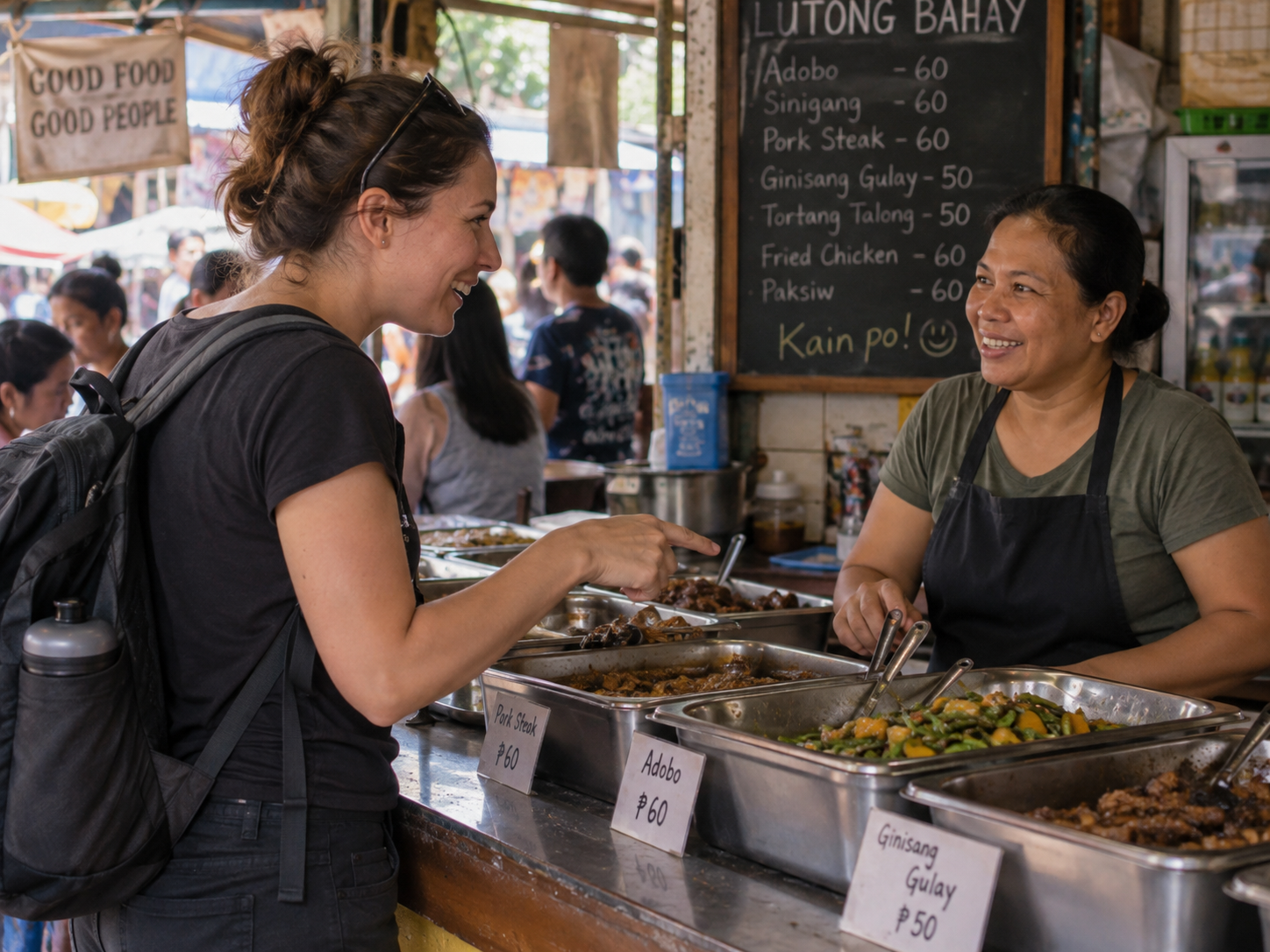
A traveler can spend a week in Manila speaking a great deal of English and still notice that one small Tagalog word changes the tone of an interaction: po.
Add it to a request or a thank-you and the sentence becomes more respectful. You may know only ten Tagalog phrases, but if you understand how po works, those ten phrases can sound more socially aware than a memorized page of vocabulary delivered without context.
This is a useful way to approach Tagalog before a trip to the Philippines. You do not need to pretend that English is unavailable. English is widely used in government, education, business, tourism, and everyday urban life. At the same time, even basic Tagalog can make routine interactions warmer and help you follow pieces of conversation that would otherwise pass by.
There is one more important qualification: the Philippines is multilingual. Cebuano, Ilocano, Hiligaynon, Waray, Bikol languages, and many others are spoken across the country. Tagalog, in its standardized national form Filipino, is broadly understood, but it is not everyone's home language. What is useful in Manila may coexist with another local language in Cebu, Davao, Iloilo, or elsewhere.
Start with respect, not vocabulary volume
The words po and opo are central to polite everyday speech. Po is inserted into many statements, questions, and requests to show respect, especially toward older people or in more formal interactions. Opo is a respectful form of “yes.”
Salamat. — Thank you.
Salamat po. — Thank you. (polite/respectful)
Oo. — Yes.
Opo. — Yes. (respectful)
Hindi po. — No. (polite)
A visitor does not need to attach po mechanically to every sentence, but using it naturally with older people, service workers in respectful exchanges, or anyone you wish to address politely is a good habit.
Greetings you will actually use
Kumusta? — How are you? / Hello.
Magandang umaga po. — Good morning.
Magandang hapon po. — Good afternoon.
Magandang gabi po. — Good evening.
Salamat po. — Thank you.
Walang anuman. — You're welcome / It's nothing.
Paumanhin po. — Excuse me / Sorry.
Ingat. — Take care.
Kumusta comes ultimately from Spanish cómo está, but in Filipino usage it has become thoroughly natural. You will also see the spelling kamusta in informal contexts.
Getting around: the phrases that reduce friction
Nasaan po ang banyo? — Where is the restroom?
Nasaan po ang hotel? — Where is the hotel?
Paano po pumunta sa ___? — How do I get to ___?
Malayo po ba? — Is it far?
Malapit lang po ba? — Is it nearby?
Dito po. — Here, please. / Here.
Doon po. — There.
Kaliwa. — Left.
Kanan. — Right.
Diretso. — Straight ahead.
If you are using taxis, ride-hailing apps, jeepneys, tricycles, or buses, destinations and landmarks often matter more than grammatically elaborate sentences. Being able to recognize dito, doon, kaliwa, kanan, and diretso helps you follow directions even when the rest of the conversation is in English or another Philippine language.
At restaurants and food stalls
Food is one of the easiest places to use a little Tagalog because the interaction is predictable.
Ano po ito? — What is this?
Ano po ang masarap dito? — What is good here?
Isa po nito. — One of these, please.
Dalawa po. — Two, please.
Tubig po. — Water, please.
May kanin po ba? — Do you have rice?
Maanghang po ba? — Is it spicy?
Hindi masyadong maanghang, please. — Not too spicy, please.
Ang sarap! — Delicious!
Bill po, please. — The bill, please.
Philippine conversations often move comfortably between Tagalog and English, so a mixed sentence is not necessarily a failure. Travelers frequently hear code-switching in urban areas. The goal is communication, not performing a textbook version of linguistic purity.
For serious food allergies, however, do not rely on a memorized phrase alone. Explain the allergy clearly, use written information if necessary, and confirm ingredients with staff. A phrasebook is not a substitute for a careful safety conversation.
Shopping and markets
Magkano po ito? — How much is this?
Magkano po? — How much?
May mas maliit po ba? — Do you have a smaller one?
May mas malaki po ba? — Do you have a bigger one?
Pwede pong card? — Can I pay by card?
Cash lang po ba? — Is it cash only?
Mahal. — Expensive.
Mura. — Cheap / inexpensive.
Gusto ko ito. — I like / want this.
Ayoko nito. — I don't want / like this.
In tourist areas, prices may be communicated in English, but numbers become useful quickly once you move into markets, transport, neighborhood shops, and informal transactions.
Small talk goes further than survival phrases
The phrases travelers remember most are often not emergency language. They are the phrases that let a short interaction become a conversation.
Taga-saan po kayo? — Where are you from?
Taga-Amerika ako. — I'm from the United States.
Unang beses ko po sa Pilipinas. — It's my first time in the Philippines.
Nag-aaral ako ng Tagalog. — I'm studying Tagalog.
Kaunti lang ang Tagalog ko. — I only know a little Tagalog.
Marunong po ba kayong mag-English? — Do you speak English?
These sentences also introduce an important feature of Tagalog pronouns: kayo can mean “you” when addressing more than one person, but it is also used respectfully for a single person. A phrasebook translation that simply says “you” does not show that social nuance.
If you need help
Tulong! — Help!
Kailangan ko po ng tulong. — I need help.
Nasaan po ang ospital? — Where is the hospital?
Nasaan po ang pulis? — Where are the police?
Nawawala ako. — I'm lost.
Hindi ko maintindihan. — I don't understand.
Pakiulit po. — Please repeat.
Dahan-dahan lang po. — Slowly, please.
These phrases are worth practicing aloud before departure. In a stressful situation, a sentence you have physically said several times is easier to retrieve than one you have only highlighted in a notes app.
A few pronunciation habits make a large difference
Tagalog spelling is relatively transparent compared with English. Vowels are generally stable, and words can often be pronounced reasonably well from the spelling.
Pay attention to ng, which represents a sound like the final sound in English sing, although its position in Tagalog words may feel unfamiliar. Also resist the temptation to reduce every unstressed vowel the way English often does. Clear vowels will usually make you easier to understand.
You do not need to imitate an accent perfectly. Aim for clear syllables, listen carefully, and repeat useful phrases as whole units rather than reading them word by word from English spelling habits.
Learn the sentences around the phrases
A travel phrasebook is most useful when it becomes a starting point rather than the entire method. If you know Magkano po ito? you can learn ito, “this,” and begin recognizing it elsewhere. If you know Nasaan po ang banyo? you can replace banyo with hotel, terminal, restaurant, or another destination.
That small amount of grammar gives you flexibility that memorization alone cannot.
Polyglottist Language Academy offers live online Tagalog classes for adults, including beginner levels that cover practical conversation, pronunciation, grammar, and cultural context. A traveler does not need months of study to benefit, but even a short structured introduction can make the phrases above easier to adapt once you are actually in the Philippines.
The most useful goal is not to arrive sounding fluent. It is to arrive able to greet people politely, ask a clear question, understand a little of the answer, and recognize that Tagalog is one part of a multilingual country rather than a script every interaction is expected to follow.