
Russian Classes in Baltimore: Options for Adults and Heritage Speakers
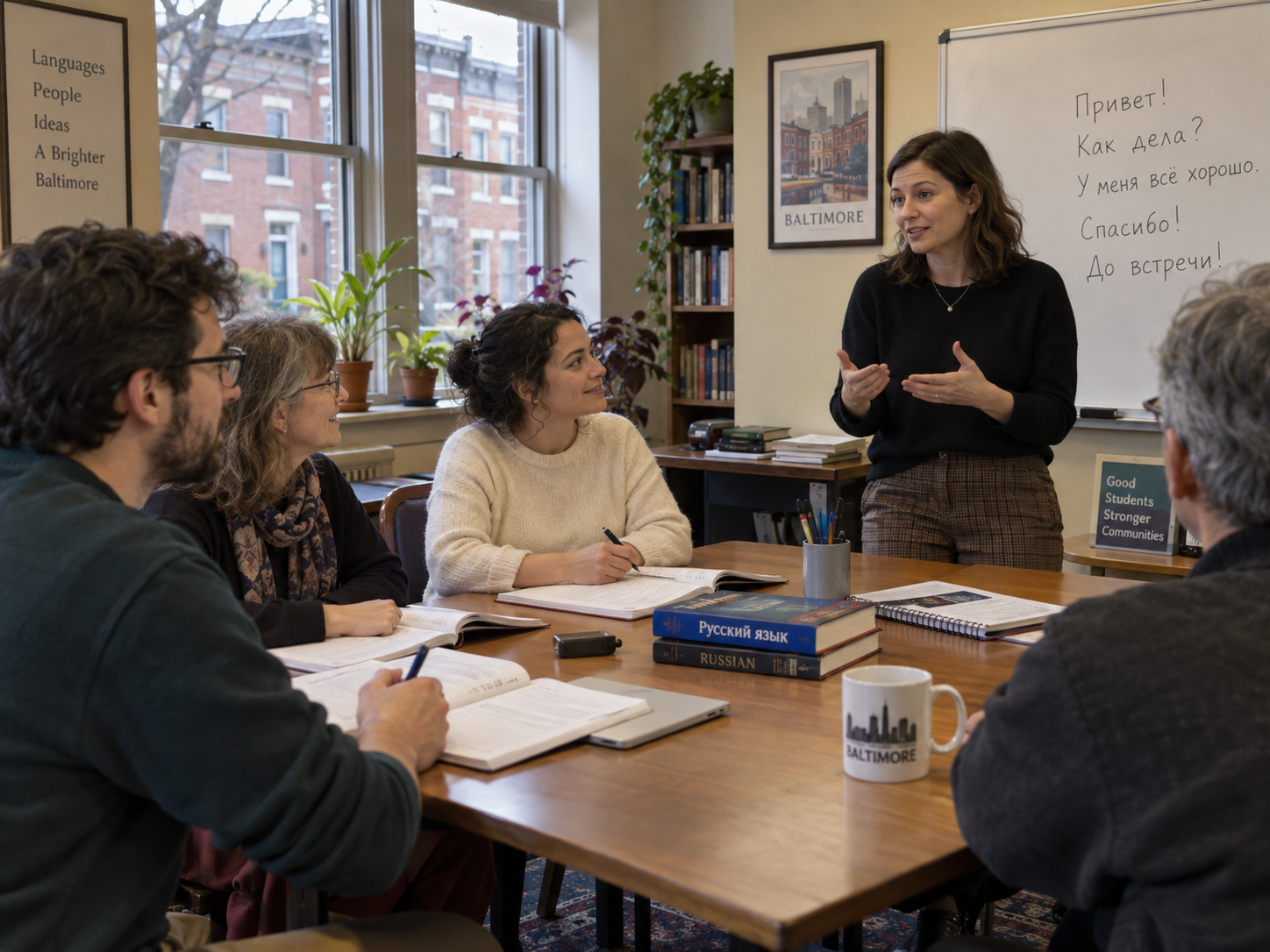
Baltimore-area adults looking for Russian have an advantage that is easy to miss in a quick Google search: the region has both a serious university program and a community-based Russian cultural center. Those are very different learning environments, and the difference matters more than simply finding the shortest drive.
A complete beginner who wants a structured academic sequence may be drawn to UMBC. An adult who wants a more community-oriented Sunday class may find Pikesville more natural. A heritage speaker who understands family Russian but cannot write comfortably may need something else again.
The first step is not choosing a school. It is identifying what kind of Russian you already have and what you want to be able to do with it.
UMBC offers the area's strongest academic Russian program
The University of Maryland, Baltimore County maintains an established Russian area within its Department of Modern Languages, Linguistics and Intercultural Communication. Its program includes language and culture courses as well as Russian-focused degree and certificate options.
What makes UMBC especially relevant to this article is that the department explicitly mentions Russian heritage students: people who may speak Russian at home but not at fully native or academic levels. That is a more realistic understanding of heritage ability than treating every learner as either “fluent” or “beginner.”
University study is a strong option if you want a systematic sequence and are comfortable with academic expectations. Courses can involve regular assignments, assessments, reading, and a semester pace. Before assuming that a particular course is available to a nondegree adult learner, check current enrollment policies and the actual term schedule.
Pikesville has a community-based adult option
The East-West Cultural and Educational Center in Pikesville lists Russian Language Classes for Adults among its current programs. That makes it one of the most concrete non-university options in the Baltimore area.
The setting is different from a college department. East-West describes itself as a cultural and educational center with Russian-language and cultural programming for both children and adults. For some learners, especially those hoping to meet Russian speakers and connect language study with community, that atmosphere may be a major advantage.
Pikesville is also geographically relevant. For someone living in northwest Baltimore County, Owings Mills, or nearby neighborhoods, it may be considerably more practical than crossing the region for a downtown or campus class.
As with any community program, confirm the current schedule, level, and enrollment status directly. A listing that says “Russian for adults” does not tell you whether the group is suitable for a true beginner, a heritage learner, or an intermediate speaker.
Heritage Russian is often stronger and weaker at the same time
A Baltimore adult who grew up in a Russian-speaking family may say, “I understand almost everything, but I can't speak properly.” Another may speak fluidly with parents and grandparents yet read slowly and avoid writing altogether. Both profiles are common.
Family language develops around family life. A heritage speaker may know exactly how a grandmother phrases a request, recognize jokes instantly, and have excellent pronunciation, while lacking vocabulary for professional topics or formal writing. Grammar may be accurate in familiar expressions but unstable when the learner tries to build a sentence outside those patterns.
For this reason, placing heritage learners by textbook chapter can be misleading. A good placement process should examine listening, spontaneous speaking, reading, writing, and grammatical awareness separately.
The goal is not to erase family Russian and replace it with textbook Russian. It is to expand what the learner can already do.
Complete beginners need speaking as early as possible
Russian courses sometimes become too fascinated with grammar at the beginning. Cases matter. Verb conjugations matter. So do gender, aspect, motion verbs, and stress. But adults do not need to master an entire case chart before they can begin communicating.
A good beginner course should use grammar to make communication clearer rather than treating grammar as the final product. Students can learn greetings, introductions, basic questions, numbers, simple descriptions, and everyday verbs while gradually understanding why endings change.
The Cyrillic alphabet is usually less difficult than new students expect. Most adults can begin reading simple words quickly if they practice every day. The greater long-term challenge is connecting spelling to stress and natural pronunciation, because Russian does not normally mark stress in ordinary text.
Private lessons work well for specific goals
Private instruction is particularly useful for adults whose needs do not fit a standard sequence. A researcher may need reading skills. A heritage learner may need writing and grammar. Someone with a Russian-speaking partner may want conversational fluency rather than academic analysis. A traveler may need practical speaking and listening.
The advantage is flexibility. The disadvantage is that you lose the variety of listening and turn-taking that comes from a group. For some learners, a small class plus occasional private lessons is a better combination than either format alone.
Online classes widen the Baltimore options considerably
Adults searching locally sometimes assume that an online class is equivalent to an app or prerecorded course. A live online class is different. You still have a fixed meeting time, an instructor who hears your pronunciation, classmates who ask unpredictable questions, and the need to answer in real time.
That can be valuable in Baltimore because specialized adult Russian programs are relatively limited. If the right level does not exist within a convenient drive, there is little pedagogical advantage in taking the wrong local class simply because it is nearby.
Polyglottist Language Academy offers live online Russian classes for adults in small groups, with levels ranging from complete beginner upward depending on the current schedule. Heritage learners can also consider individual instruction when a standard level does not match their profile.
How to compare Baltimore-area courses
Ask what happens during a typical lesson. If the answer is mostly “we cover chapters,” ask how much time students actually spend speaking. If you are a heritage learner, ask whether the instructor has experience teaching people who already understand Russian but have gaps in literacy or grammar. If you are a complete beginner, ask how pronunciation and Cyrillic are introduced and how quickly you begin using the language.
Also consider the practical details: parking, travel time, class frequency, homework, group size, and the number of weeks in a term. Adults often underestimate the effect of logistics on language learning. A slightly less convenient curriculum that you attend every week is usually better than an impressive program you regularly miss.
Baltimore's Russian-learning landscape is not enormous, but it is more varied than it first appears. UMBC provides academic depth, Pikesville offers a community setting, and online instruction makes small-group adult study available without geography deciding your level for you. The right course is the one that recognizes what kind of learner you actually are.