
Should I Learn Japanese or Korean? The Real Differences Explained
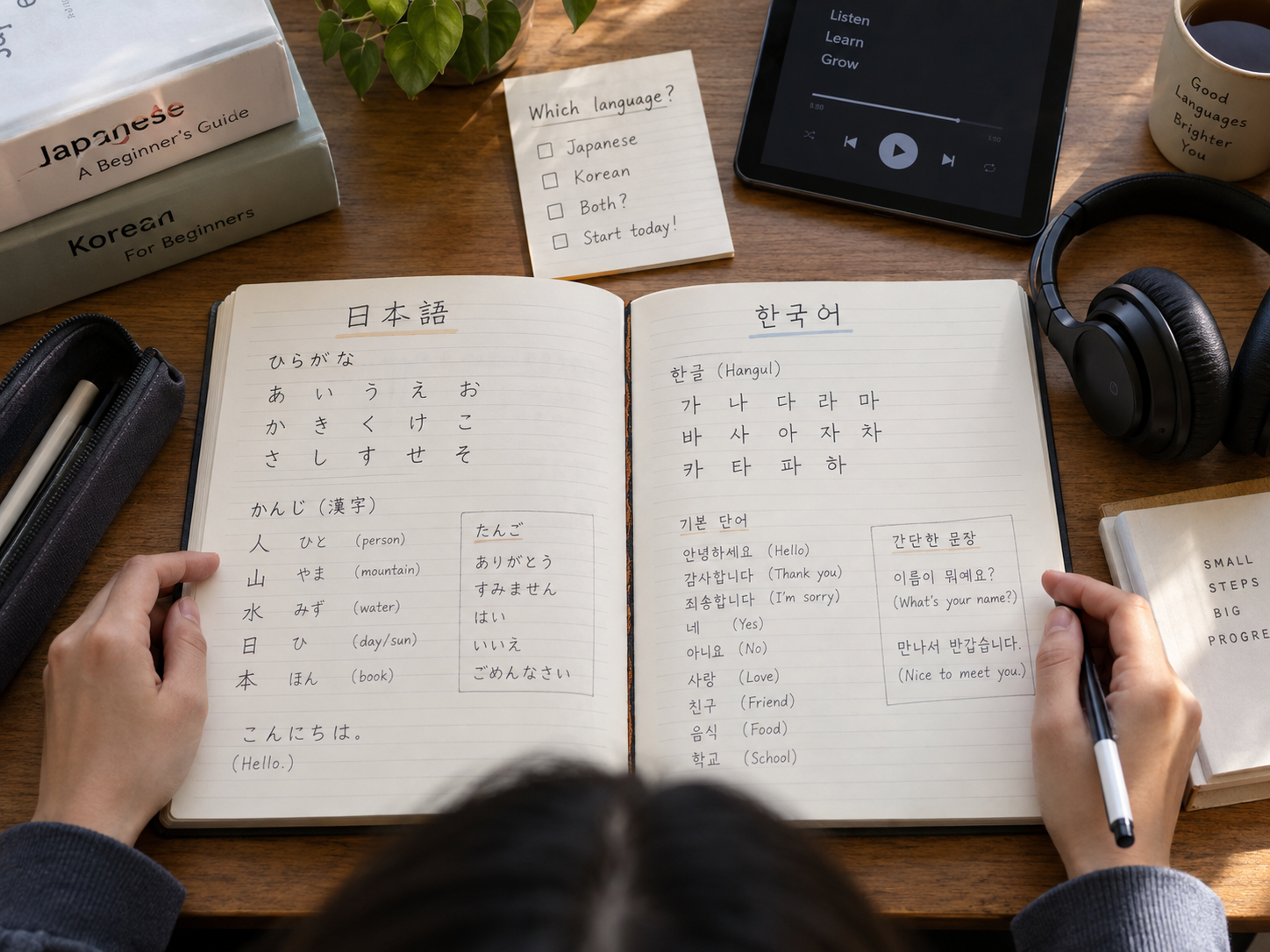
People choosing between Japanese and Korean are often given an answer that sounds decisive but is not very useful: Korean is easier because Hangul is simple, or Japanese is easier because the pronunciation is simpler. Both statements contain some truth. Neither tells you what learning the language will actually feel like after the first month.
The more accurate comparison is that Japanese and Korean distribute their difficulty differently. Korean lets you become literate at a basic decoding level very quickly, then asks you to master a demanding sound system and a large range of verb endings. Japanese is relatively forgiving to pronounce at the beginning, but reading authentic material becomes a long-term project because you are learning hiragana, katakana, and kanji together.
The question is therefore not which language is objectively easier. It is which kind of difficulty you are more willing to live with for several years.
Korean gives you an early reading victory
Hangul is one of the friendliest writing systems a beginner can encounter. Its basic letters represent consonants and vowels and are arranged into syllable blocks. Once you understand how those blocks work, you can sound out unfamiliar words even when you do not know what they mean.
That creates a satisfying early stage. Street signs, menus, song titles, and names stop looking like an undeciphered code much sooner than they do in Japanese.
The catch is that readable does not mean pronounceable. Korean spelling preserves information that everyday speech may reshape through sound-change rules. Final consonants, consonant assimilation, and the distinction among plain, aspirated, and tense consonants can be difficult for English speakers to hear and produce consistently.
A learner may be able to read a Korean word on the page within the first week and still need months before the spoken form feels obvious.
Japanese reverses that experience
Japanese pronunciation is not effortless, but the sound inventory is relatively compact. There are five basic vowels, and many syllables follow simple consonant-vowel patterns. English speakers can usually become understandable fairly quickly if they pay attention to long vowels, doubled consonants, the moraic rhythm of the language, and the Japanese r sound.
Reading is where the workload grows. Beginners normally learn hiragana and katakana first, then begin accumulating kanji. Daily Japanese writing combines all three systems. A sentence that looks perfectly normal to a Japanese reader may contain grammatical endings in hiragana, a foreign loanword in katakana, and several kanji carrying lexical meaning.
This means Japanese often feels accessible in the mouth before it feels accessible on the page. Korean often feels accessible on the page before it feels fully comfortable in the mouth.
The grammar is more similar than the writing suggests
Japanese and Korean look completely different when written, yet their sentence structure has striking parallels. Both commonly place the verb at the end. Both use particles after nouns to indicate grammatical relationships. Both allow subjects and pronouns to disappear when the context makes them obvious. Both build politeness and social relationships directly into the forms speakers choose.
English says, “I eat rice.” A beginner Japanese sentence may be structured more like “I, rice, eat,” and Korean follows a similar basic order. Once an English speaker becomes comfortable waiting until the end of a sentence for the verb, both languages begin to feel more internally logical.
The similarities should not be exaggerated. The vocabulary is not simply interchangeable, particles do not map perfectly from one language to the other, and each language has its own conjugations and idioms. Linguists also do not treat the structural resemblance as proof that Japanese and Korean are established members of one language family.
Still, a learner who becomes competent in one often finds the grammar of the other less alien than it would have seemed at the beginning.
Politeness is not an optional advanced chapter
English speakers often imagine honorific language as a formal layer they can add later. In both Japanese and Korean, social relationships influence ordinary grammar from the beginning.
Japanese beginners learn polite desu/masu forms early and later encounter casual speech, respectful language, and humble language. Korean learners meet speech levels and honorific choices very quickly because verb endings change depending on the relationship between speakers and the setting.
You do not need perfect command of every honorific form to have a conversation. You do need to understand that “correct grammar” cannot always be separated from “appropriate relationship.” A sentence may be grammatically possible and still sound odd because its level of formality does not fit the situation.
Vocabulary does not give either language an obvious victory
Japanese and Korean both contain large layers of vocabulary historically derived from Chinese. This creates conceptual parallels and sometimes recognizable sound correspondences for advanced learners, especially if they already know Chinese characters or one of the two languages.
For a monolingual English-speaking beginner, however, most everyday vocabulary still has to be learned from scratch. Neither language gives you the large number of immediately recognizable cognates that Spanish or French might.
Japanese does contain many modern loanwords from English, usually written in katakana. They can help, but they also create pronunciation traps. A word borrowed from English may have shifted in sound or meaning enough that simply saying the English original will not work.
Which language feels easier in the first six months?
If early reading progress motivates you, Korean often feels gratifying. You can learn Hangul quickly and begin decoding real-world text almost immediately. If pronunciation frustration bothers you more than memorization, Japanese may feel gentler in the first months.
If you love reading and want to consume novels, newspapers, games, or manga without assistance, Japanese requires accepting kanji as a long-term companion. There is no meaningful shortcut around literacy if your goal is serious reading.
If your goal is primarily conversation, Korean's writing system may get out of the way quickly, but pronunciation, listening, and speech levels will demand sustained attention.
Neither path is a trick. The difficulty simply arrives in a different order.
Your reason for learning matters more than the comparison chart
A learner fascinated by Korean music, television, food culture, and contemporary history is likely to persist through Korean pronunciation problems that would annoy someone with only mild interest. A learner who wants to read Japanese fiction, travel independently in Japan, or engage deeply with anime, film, design, or Japanese business culture may be perfectly willing to spend years building kanji knowledge.
That is why choosing a language only because someone on the internet called it “easier” is risky. The easier language is often the one you still want to study after the novelty of the first alphabet lesson wears off.
There are also practical considerations. If you have family connections, a partner, a relocation plan, or a job tied to one country, that usually outweighs abstract difficulty. Motivation becomes much more concrete when the language appears in your real life.
A simple way to decide
Choose Korean if the prospect of learning a compact alphabet quickly excites you, you are willing to work carefully on listening and pronunciation, and the culture or people connected to Korean are what you actually want access to.
Choose Japanese if you are comfortable with a slower road to literacy, prefer a somewhat simpler beginner sound system, and you have enough interest in Japan to make sustained kanji study feel worthwhile rather than punitive.
If you remain genuinely split, spend one week learning Hangul and one week learning hiragana. Listen to beginner dialogues in both languages. Try building a few basic sentences. The point is not to measure which one you “performed better” in after seven days. It is to notice which one makes you curious enough to continue.
Polyglottist Language Academy offers Japanese and Korean instruction for adults, including live online options. A structured class can be especially useful in either language because the most important early habits - pronunciation, particles, sentence order, and politeness - are easier to correct before they become automatic.
Japanese and Korean are close enough in grammar to invite comparison, yet different enough that the learning experience is never interchangeable. The better choice is the language whose particular difficulties you are willing to keep solving.