
Where to Learn Vietnamese in the East Bay
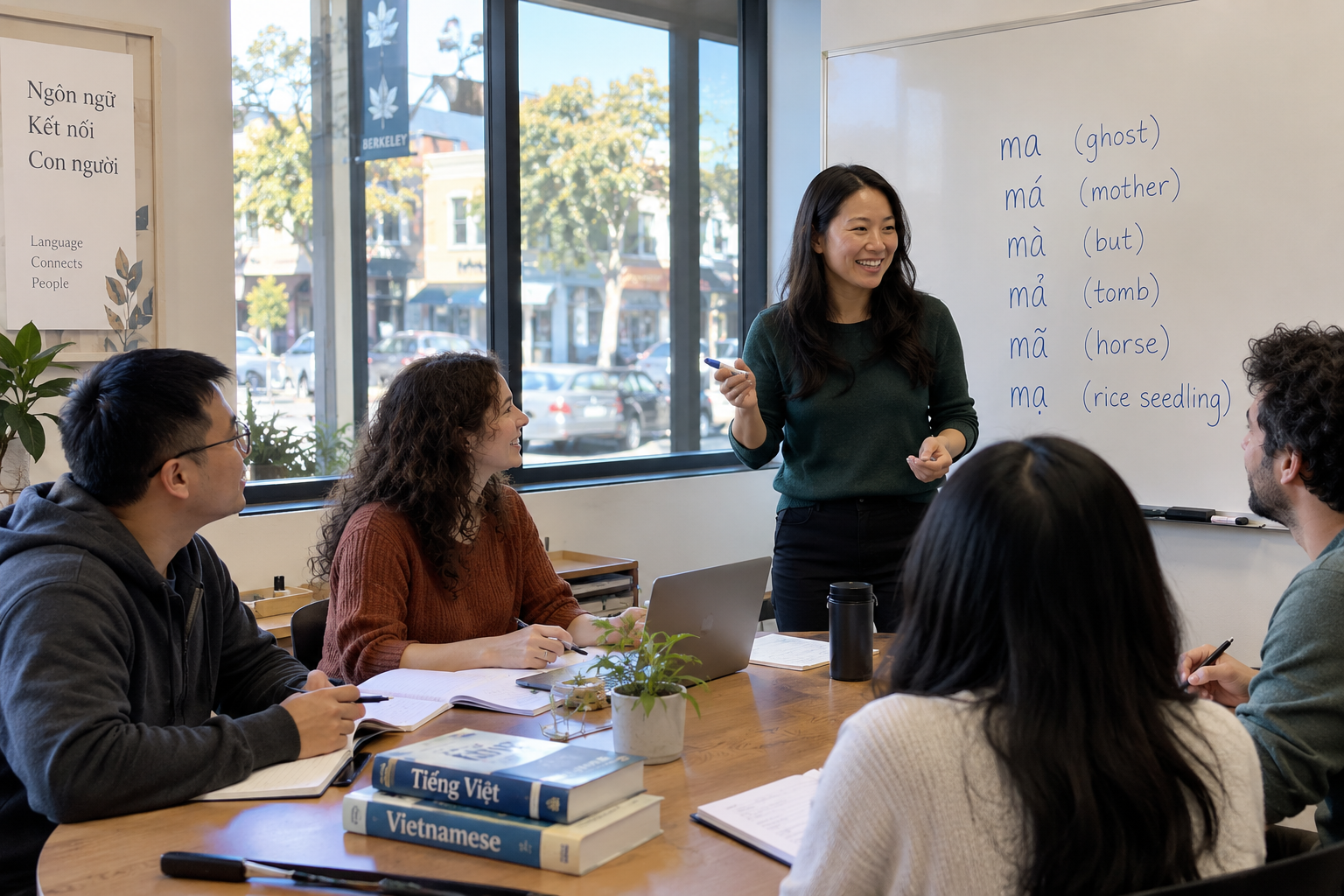
If you live in Berkeley or Oakland and start searching for an adult Vietnamese class, you run into an odd contradiction. Vietnamese is visibly part of the East Bay: you can hear it in restaurants and shops, see it in community organizations, and encounter it at cultural festivals. Yet the number of straightforward, evening, adult-beginner Vietnamese courses is much smaller than the size of the community might lead you to expect.
That means “Where can I learn Vietnamese in the East Bay?” is really several questions. Are you looking for a university course with five hours of class a week? A heritage program for children? A flexible adult class after work? A teacher who can help with family Vietnamese? The best option depends heavily on which of those describes you.
UC Berkeley offers the most substantial academic sequence in the East Bay
UC Berkeley’s Department of South and Southeast Asian Studies maintains a full Vietnamese sequence. For Fall 2026, the department lists Introductory Vietnamese (VIETNMS 1A), Intermediate Vietnamese (100A), and Advanced Vietnamese (101A). The beginning course emphasizes modern spoken and written Vietnamese, including phonology, tone distinctions, grammar, reading, and conversation.
For a university student, this is unusually thorough. Vietnamese is not treated as a casual enrichment course squeezed into one evening a week. The introductory course carries five units and meets frequently, which is exactly why students can make substantial progress.
For a working adult, however, that intensity can be the problem. UC Berkeley courses follow the university calendar and enrollment system, and you should not assume that a course listed in the catalog functions like an open community evening class. If you are not a Berkeley student, check current enrollment eligibility directly with the university before building your plan around it.
The academic option makes the most sense for someone who wants a serious multi-semester sequence and can accommodate the schedule.
Hướng Việt is an important East Bay language resource, but it is not an adult night school
Hướng Việt Community Center has served the Vietnamese American community in the East Bay for decades and operates a Vietnamese language school in Oakland. Its current 2026–27 school year is based at Oakland Unity High School, and the organization also supports cultural activities, lion dance, and celebrations such as Tết and the Mid-Autumn Festival.
This is a valuable part of the local language ecosystem, especially for families and heritage-language preservation. It is important, however, not to describe it as something it is not. Hướng Việt’s language school is oriented toward Vietnamese youth and families rather than being a standard adult second-language program.
For an adult learner, it may be more useful as a community and cultural reference than as your primary weekly class. Parents who want their children to maintain Vietnamese will see it differently from an English-speaking adult who is starting from zero.
Oakland itself gives you something a textbook cannot
In 2025, the City of Oakland formally recognized its Little Saigon community as a cultural and economic center. The neighborhood around Eastlake and International Boulevard has long contained Vietnamese businesses and community life, and events such as the Oakland Little Saigon Tết Festival make that presence especially visible.
For a learner, this matters, but cultural access should not be confused with free language tutoring. Going to a Vietnamese restaurant does not obligate the server to correct your tones. Walking through a neighborhood is not a substitute for a class.
What the neighborhood can give you is context. You begin recognizing words on signs. You notice which foods retain Vietnamese names. You hear forms of address used between different generations. You discover that the language in a beginner audio track and the language of a busy family conversation do not always arrive at the same speed.
That kind of exposure is much more useful when you already have a structured place to ask questions about what you hear.
Live online Vietnamese can be the most practical adult option
For many East Bay adults, the real competition is not “online versus in person.” It is “a live online course you can attend consistently versus an in-person option whose schedule or enrollment rules make regular attendance unrealistic.”
Polyglottist Language Academy, based in Berkeley, currently offers live online Vietnamese group and individual classes for adults. The small-group format is particularly useful for Vietnamese because pronunciation needs active correction. A learner can read a word correctly letter by letter and still produce a vowel or tone that changes how the word is heard.
This is also where class size matters. In a very large lecture, a teacher cannot correct every student’s tone production repeatedly. In a small live group, pronunciation, listening, and short exchanges can occupy a much larger part of the hour.
Online study also removes a distinctly Bay Area problem: a class that looks close on a map can become a major commitment at 5:30 p.m. A Berkeley resident may be willing to cross town, but someone in Alameda, El Cerrito, Walnut Creek, or farther east may find that a good Zoom class is easier to sustain than a nominally “local” class requiring a long commute.
What should a complete beginner look for?
Vietnamese makes it tempting to choose a course by price and schedule alone. The writing system uses the Roman alphabet, so beginners often assume they can handle pronunciation themselves. That confidence can disappear quickly once tones, vowel quality, final consonants, and regional differences enter the picture.
Ask whether pronunciation is taught explicitly from the beginning. Find out which regional variety the instructor speaks and whether the class exposes students to other varieties. Northern and southern Vietnamese are mutually intelligible, but pronunciation and vocabulary differences are real enough that learners benefit from knowing what they are hearing.
Also ask how much speaking actually happens in class. A course can cover a great deal of grammar while giving each student only a few minutes of active speech.
Heritage learners need a different kind of placement
The East Bay has many adults who grew up around Vietnamese without studying it formally. A heritage learner may understand parents or grandparents extremely well but have difficulty answering. Another may speak comfortably at home but read slowly. Someone else may pronounce family vocabulary naturally while lacking the words needed for work, politics, education, or adult social life.
Putting all three into “Beginner Vietnamese” because they cannot explain grammar terminology is usually a mistake.
A useful placement process should look separately at listening, speaking, reading, and writing. Heritage learners often need to fill gaps rather than start over. They may also speak a family or regional variety that deserves to be understood, not “corrected” out of existence.
So where should you start?
If you are eligible for UC Berkeley coursework and want intensive academic study, the university offers the East Bay’s clearest multi-level sequence. If your interest is family heritage and youth language maintenance, Hướng Việt is a significant Oakland resource. If you are an adult who needs evening flexibility, live speaking practice, and pronunciation feedback, a small online course or private instructor may be the most practical path.
Polyglottist Language Academy’s Vietnamese classes are taught live online in small groups, so East Bay learners can study from Berkeley, Oakland, Alameda, Richmond, or farther inland without adding a commute to the learning process.
The East Bay already gives Vietnamese learners something valuable: the language is connected to a living local community rather than existing only inside a textbook. The most effective plan is usually to pair that local cultural exposure with instruction structured enough to help you understand what you are hearing.