Tagalog Classes in South San Francisco and Daly City: What Are Your Options?
In Daly City and South San Francisco, looking for a Tagalog class is not quite the same as looking for one in a city with little connection to the Philippines. Tagalog is already present in family conversations, restaurants, churches, community events, and everyday life across the northern Peninsula. For many adults, the question is not simply how to begin learning a foreign language. It is how to turn a language they have heard around them for years into something they can actually use.
That is especially true for Filipino American heritage learners. A person may understand a parent speaking Tagalog, know food and family vocabulary, and have natural pronunciation, yet freeze when asked to answer in a full sentence. Someone else may speak comfortably but read slowly. Those learners need a different starting point from a true beginner.
Fortunately, the Daly City–South San Francisco area has more than one route into the language.
Skyline College is the clearest nearby classroom option
Skyline College in San Bruno currently lists Filipino among its World Languages offerings. Its catalog includes Elementary Filipino and Advanced Elementary Filipino, making it one of the most concrete local options for learners who want formal college-style study without traveling into San Francisco or across the Bay.
That location is particularly practical for people in Daly City and South San Francisco. It is close enough to be a genuine Peninsula option rather than a nominally “Bay Area” program that requires a long evening commute.
A college language course, however, has its own rhythm. Expect a syllabus, assignments, assessments, and a pace designed around an academic term. That can be excellent for students who want systematic grammar, reading, and writing. Adults primarily interested in family conversation may prefer a smaller weekly group or private lessons with more time devoted to speaking.
Because community-college schedules change, check the current term rather than assuming every cataloged course runs every semester.
Tagalog or Filipino: which class name should you look for?
This confuses many new learners because schools may advertise “Tagalog” while colleges use “Filipino.” Tagalog is the language historically associated with the Manila region and serves as the principal basis of the national language, Filipino. In everyday language learning, especially at beginner levels, courses labeled Tagalog and Filipino often teach largely the same core language.
The names can carry cultural and political nuance, but a beginner should not assume that “Filipino” means a completely different language from Tagalog. When comparing courses, look at the syllabus, instructor, and level rather than rejecting a class because it uses one label instead of the other.
Heritage learners should not automatically start at lesson one
Daly City has one of the strongest Filipino communities in the United States, which means local Tagalog classes attract a type of student that generic beginner curricula do not always handle well: the adult who has been listening for years.
A heritage learner might understand “Kumain ka na?” immediately because it has been heard at home hundreds of times, but still hesitate over how to build a different sentence with the same verb. Another person may use po correctly by instinct but have no idea why certain verb forms change. Family vocabulary can be surprisingly rich while vocabulary for work, politics, health care, or abstract ideas is limited.
Placement should therefore look at four things separately: listening, speaking, reading, and grammatical control. If a program only asks whether you have ever taken a class, it may place you too low or too high.
Live online classes can solve a very Bay Area problem
The Peninsula has many language learners and many language schools, but distance is deceptive. A class in Berkeley or Oakland can be excellent and still be impractical for someone leaving work in South San Francisco at 5:30 p.m. The weekly commute may matter more than the difference between two good curricula.
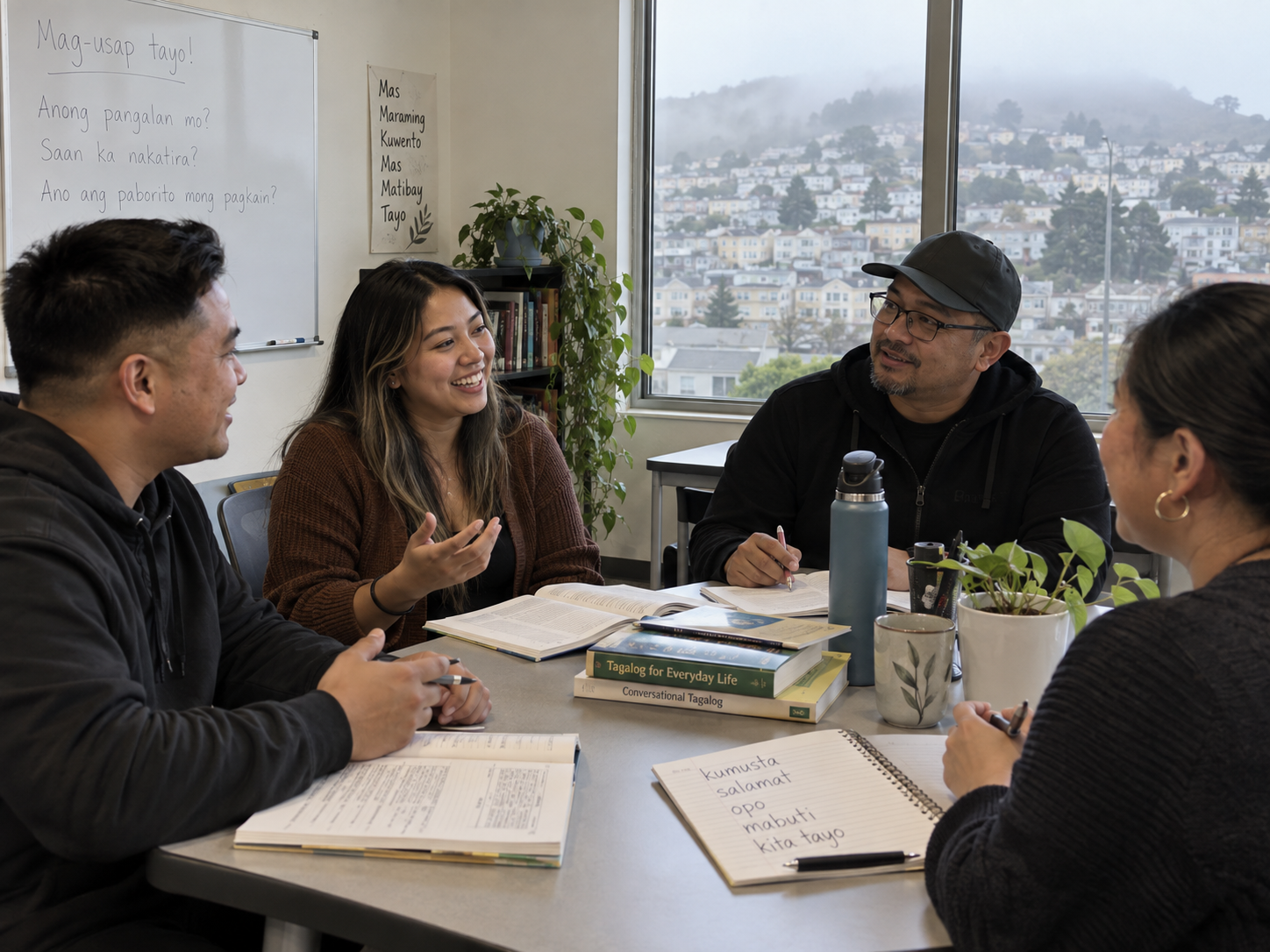
Live online groups are useful here because they remove the commute without turning the course into self-study. You still have an instructor, classmates, a scheduled meeting time, and the awkward but necessary experience of producing sentences before you feel completely ready.
That last part matters. Apps can be very good at helping learners recognize vocabulary. They are less good at reproducing the social pressure of a real conversation in which another person is waiting for your answer.
Private instruction is useful when your Tagalog is uneven
One-on-one lessons make particular sense for heritage learners, mixed-language families, and adults preparing for a specific trip or family event. A private teacher can skip material you already know and spend more time on the gaps that are actually limiting you.
For example, a learner who already understands household Tagalog may not need six weeks of basic greetings. The same learner may need explicit practice with focus-marking verbs, pronouns, connectors, and the difference between understanding relatives and following unfamiliar speakers at normal speed.
The downside is that private lessons do not automatically provide the peer interaction of a group. Some adults speak more freely one-on-one; others become more confident when they realize classmates are making the same mistakes.
Culture around the language matters, but it is not the same as a class
Daly City's Filipino community also gives learners something a purely online student elsewhere may not have: cultural context close to home. Kapwa Kultural Center, for example, describes itself as a Filipino community center and café focused on cultural identity, wellness, and community connection.
A cultural center should not be treated as a substitute for a language curriculum unless it is currently offering language instruction. Still, participating in Filipino community life can make the language feel less abstract. Words you study begin to appear in food, family terms, music, signs, events, and conversations around you.
What should a complete beginner look for?
A good beginner Tagalog course should move beyond memorized greetings fairly quickly. You need pronunciation, pronouns, sentence markers, common question forms, practical vocabulary, and an introduction to the verb system. Tagalog verbs can feel unfamiliar to English speakers because the sentence organizes information differently from English and verb forms interact with what the speaker is foregrounding.
This is one reason students who memorize phrase lists sometimes hit a wall. They can say ten useful sentences but cannot easily create the eleventh. Structured instruction should explain enough grammar to let you build new sentences without turning every class into a lecture about terminology.
For travel or family communication, polite forms also matter. The small word po carries social meaning that an English translation does not fully capture. Learners who practice it from the beginning often sound more natural in everyday interactions than students who know more vocabulary but ignore how politeness is expressed.
Online Tagalog classes from the Peninsula
Polyglottist Language Academy offers live online Tagalog classes for adults in small groups, with beginner and continuing levels depending on the term. Students in Daly City and South San Francisco can join without traveling to Berkeley, while still getting live speaking practice and instructor feedback.
For local learners, the most sensible choice is often not the class with the fanciest description. It is the one whose level is accurate and whose schedule you can keep. In a community where Tagalog may already be around you, a good course should help you turn recognition into participation: not simply understanding what someone said, but having enough control of the language to answer.