
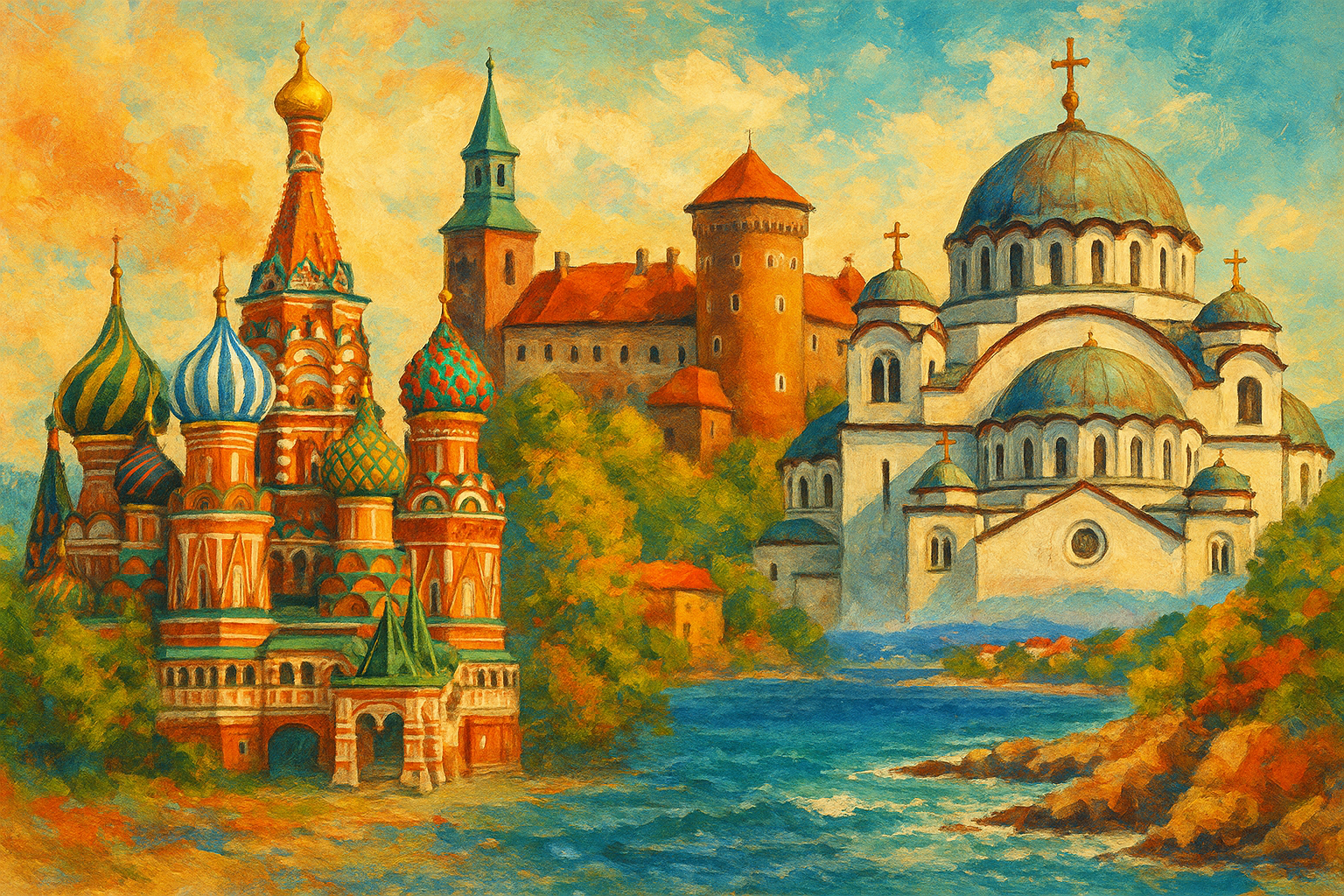
For anyone who has studied Russian long enough to notice its echoes in other tongues, the realization can be thrilling: Russian is not an isolated language but part of a vast linguistic family tree that stretches across Eastern and Central Europe, connecting nations through shared history, vocabulary, and structure. Known collectively as the Slavic languages, this group includes not only Russian but also Polish, Czech, Slovak, Bulgarian, Serbian, Croatian, Ukrainian, Belarusian, and several others. Together, they are spoken by more than 300 million people, forming one of the largest language families in Europe. To learn Russian is to gain a key that can unlock the doors to understanding many of its linguistic cousins.
What makes Russian particularly interesting is its dual role: it is at once a unique language with its own quirks, grammar, and cultural identity, and also a member of a family with striking similarities to its neighbors. Words, sounds, and grammatical patterns recur across borders, sometimes in ways that make comprehension surprisingly easy, and sometimes in ways that trick learners with false friends. For language enthusiasts, this interplay of kinship and difference makes studying Russian more than just mastering one language—it becomes an exploration of how languages evolve, influence one another, and reflect the histories of their speakers.
For example, a Russian speaker might be able to grasp a basic Polish sentence because of shared vocabulary (chleb in Polish, khleb in Russian, both meaning “bread”), yet stumble over differences in pronunciation or case endings. Similarly, Russian shares its Cyrillic script with Bulgarian and Serbian, but while the letters may look familiar, meanings can differ significantly. These points of contact and divergence are not only fascinating for linguists—they are practical for learners who may one day want to branch out into other Slavic languages.
In this article, we will explore Russian in the context of the broader Slavic family. We’ll look at the historical roots of the Slavic languages, examine how Russian compares with East, West, and South Slavic branches, and highlight the similarities and differences in grammar, vocabulary, and pronunciation. We’ll also consider how these languages influence one another today, and why understanding their connections can enrich your journey as a Russian learner. By the end, you’ll see Russian not just as an individual language but as part of a living, breathing family of voices that have shaped—and continue to shape—Eastern Europe.
The Slavic Language Family: A Brief Overview
Linguists divide the Slavic languages into three major branches:
East Slavic: Russian, Ukrainian, Belarusian
West Slavic: Polish, Czech, Slovak, Sorbian
South Slavic: Bulgarian, Serbian, Croatian, Bosnian, Slovenian, Macedonian, Montenegrin
All of these languages trace their roots back to Proto-Slavic, the ancestral language spoken around the first millennium CE. Over centuries, as Slavic peoples migrated and settled in different regions, their languages evolved, diverging into distinct but related tongues.
Russian, Ukrainian, and Belarusian are the direct descendants of Old East Slavic, the language of the medieval state of Kievan Rus. Meanwhile, Polish, Czech, and Slovak developed in Central Europe, influenced by Germanic and Latin neighbors. South Slavic languages, spoken in the Balkans, absorbed elements of Greek, Turkish, and other regional languages.
Russian and Its East Slavic Sisters
Russian and Ukrainian
Russian and Ukrainian share a high degree of mutual intelligibility. Their vocabularies overlap significantly, though pronunciation and certain grammatical forms differ. For example:
Hello: Russian privet (привет), Ukrainian pryvit (привіт).
Bread: Russian khleb (хлеб), Ukrainian khlib (хліб).
I love you: Russian ya lyublyu tebya (я люблю тебя), Ukrainian ya lyublyu tebe (я люблю тебе).
The biggest differences lie in pronunciation and certain vowel shifts. Ukrainian also retains more vocabulary from Polish due to historical ties.
Russian and Belarusian
Belarusian is closer to Russian than Ukrainian, but with distinctive sounds and spellings. For example, the Russian word for milk is moloko (молоко), while in Belarusian it is malako (малако).
Many Belarusians are bilingual in Russian and Belarusian, further blurring the lines between the two.
Russian and the West Slavic Languages
Russian and Polish
Polish is part of the West Slavic branch and uses the Latin alphabet. While the vocabulary often overlaps, the pronunciation and spelling can be challenging.
Examples:
Book: Russian kniga (книга), Polish książka.
Friend: Russian drug (друг), Polish przyjaciel.
City: Russian gorod (город), Polish miasto.
Grammatically, both languages use cases, though Polish has more complex consonant clusters and nasal vowels.
Russian and Czech/Slovak
Czech and Slovak also share vocabulary with Russian, though mutual intelligibility is limited. For instance:
Russian most (мост) and Czech most both mean “bridge.”
Russian den’ (день) and Slovak deň both mean “day.”
However, differences in syntax and phonetics often make communication challenging without study.
Russian and the South Slavic Languages
Russian and Bulgarian
Bulgarian shares the Cyrillic alphabet with Russian, which makes reading easier for learners. However, its grammar is quite different: Bulgarian has largely lost the case system that Russian retains.
Examples:
Water: Russian voda (вода), Bulgarian voda (вода).
Mother: Russian mat’ (мать), Bulgarian mayka (майка).
Russian and Serbian
Serbian also uses Cyrillic (as well as Latin), and its vocabulary overlaps significantly with Russian. Still, pronunciation and grammar diverge.
Example:
Word “good”: Russian khorosho (хорошо), Serbian dobro.
Despite differences, Russian speakers often find it easier to pick up South Slavic languages than unrelated European languages due to shared roots.
Shared Features Across Slavic Languages
Cases: Most Slavic languages (except Bulgarian and Macedonian) use grammatical cases to mark nouns and adjectives.
Aspect in Verbs: All Slavic languages distinguish between perfective and imperfective verbs, though details vary.
Vocabulary: Core words such as family terms, numbers, and natural elements often look or sound similar.
Diminutives: Slavic languages love using diminutives, adding emotional nuance to words.
False Friends and Surprises
Despite similarities, there are pitfalls:
Russian magazin (магазин) means “store,” while in English “magazine” is a publication.
Polish droga means “road,” but in Russian droga (дрога) is an old word for a type of cart.
Bulgarian izvinete (извинете) means “excuse me,” close to Russian izvinite (извините).
These “false friends” make cross-Slavic communication both amusing and challenging.
Why Learn Russian First?
For learners interested in multiple Slavic languages, Russian can be an excellent starting point:
It has the largest number of speakers (over 150 million native speakers).
Its Cyrillic alphabet eases transition to other Cyrillic-based languages.
Its vocabulary overlaps with both East and South Slavic languages.
Knowing Russian provides cultural access to literature, films, and music that resonate across the Slavic world.
Russian in the Modern Slavic Context
Today, Russian functions not only as a national language but also as a lingua franca across parts of Eastern Europe and Central Asia. For many Slavic speakers, knowledge of Russian facilitates communication, business, and travel. At the same time, each Slavic language maintains its unique identity, reflecting the rich diversity of the region.
FAQs: Russian and Other Slavic Languages
1. Can a Russian speaker understand Polish?
Not without study, though shared roots make learning easier than starting from scratch.
3. Is Russian the hardest Slavic language?
It depends on your perspective. Russian’s Cyrillic alphabet and case system are challenging, but it is highly standardized and well-documented.
4. Which Slavic languages use Cyrillic?
Russian, Ukrainian, Belarusian, Bulgarian, Serbian (alongside Latin), and Macedonian.
5. Do all Slavic languages have cases?
Most do, except Bulgarian and Macedonian, which rely on word order and prepositions instead.
6. Can learning Russian help me learn other Slavic languages?
Yes. Familiarity with Russian gives you a strong foundation in grammar and vocabulary useful for other Slavic tongues.
7. Which Slavic language is easiest for Russians to understand?
Ukrainian and Belarusian, followed by Bulgarian and Serbian.
8. Is Russian closer to Polish or Bulgarian?
Linguistically, Russian is closer to Bulgarian (East vs. South Slavic) than to Polish (West Slavic), though history complicates the picture.
Conclusion: Russian as Part of the Slavic Family
Learning Russian is not just about entering the world of Dostoevsky, Tolstoy, or Pushkin—it is also about stepping into a broader family of languages that span Eastern and Central Europe. Russian shares roots, structures, and words with its Slavic siblings, making it a gateway to understanding how languages grow and connect across borders.
At Polyglottist Language Academy, we teach Russian with an appreciation for its cultural and linguistic context. By learning Russian, you gain not only access to one of the world’s major languages but also a foundation that makes other Slavic languages more approachable. If you’re ready to expand your horizons and connect with this vast language family, sign up for our Russian classes today.
And if you enjoyed this article, we invite you to explore more of our insights into Russian language and culture: