
If you’re an English speaker learning Russian, you’ve probably had this thought: “Why does everything feel so different?” Russian grammar can seem like a maze of endings, verb pairs, and unfamiliar patterns. But underneath the surface, Russian is logical, consistent, and learnable—once you understand a few key ideas.
In this article, we’ll walk through the five most important differences between Russian and English grammar that every beginner and intermediate learner should know. You’ll see clear examples, intuitive explanations, and practical tips to help you feel more confident instead of overwhelmed.
We’ll look at:
Cases vs English word order
Verb aspect (imperfective vs perfective)
The lack of articles (a / the)
Gender and agreement
Verb conjugation simplicity compared to English
Along the way, you’ll see real-life mini-dialogues, common mistakes English speakers make, and concrete strategies for practicing. At the end, you’ll also find FAQs, information about Russian classes at Polyglottist Language Academy, and links to other Russian-learning articles to continue your journey.
1. Why Russian Grammar Feels So Different (But Is Learnable)
For English speakers, Russian can feel like stepping into a completely new way of organizing ideas. In English, you lean heavily on word order and little helper words like “do,” “will,” “a,” and “the.” In Russian, a lot of that work is done by endings on words.
Here are a few reasons Russian grammar feels challenging at first:
The alphabet looks different (Cyrillic), so even familiar-sounding words can look unfamiliar.
Nouns change their endings depending on their role in the sentence (cases).
Verbs come in pairs that show whether an action is ongoing or complete (aspect).
There are no words for “a” or “the,” so you have to rely on context.
Nouns have gender, and other words change to match that gender.
This sounds like a lot—but the good news is that these differences follow patterns. Once you learn to spot those patterns, Russian stops feeling like chaos and starts feeling like a system you can navigate.
Think of it this way: in English, you learned to rely on word order and extra little words. In Russian, you’ll learn to rely more on endings and verb choices. Different tools, same goal: clear communication.
2. Russian Cases vs English Word Order
If you’ve ever asked why “dog” keeps changing in Russian, you’ve discovered cases.
What Are Cases?
In Russian, nouns change their endings depending on their role in the sentence. These roles are called cases. Instead of using mostly word order to show who is doing what, Russian uses endings.
In English, we might say:
I see the dog.
The dog sees me.
In both sentences, “dog” looks the same. You know who sees whom because of the word order: Subject–Verb–Object.
In Russian, the ending on “dog” changes to show its role:
Я вижу собаку.
I see the dog.Собака видит меня.
The dog sees me.
Here, собака is the subject (the dog does the action), собаку is the object (the dog receives the action). The ending tells you the role.
The Main Cases (Simple, Intuitive View)
There are several cases in Russian, but for now, think of them as answers to simple questions:
Nominative: “Who? What?” (subject, dictionary form)
Accusative: “Whom? What?” (direct object)
Genitive: “Of whom? Of what?” (possession, “of,” “from,” sometimes “no/none”)
Dative: “To whom? To what?” (indirect object, “to/for someone”)
Instrumental: “With whom? With what?” (tool or companion, “with/by”)
Prepositional: “About whom? About what?” (used with some prepositions like “in,” “on,” “about”)
You don’t need to memorize long tables at once. Start by understanding that endings answer “Who/What?”, “Whom/What?”, “Of whom/what?”, and so on.
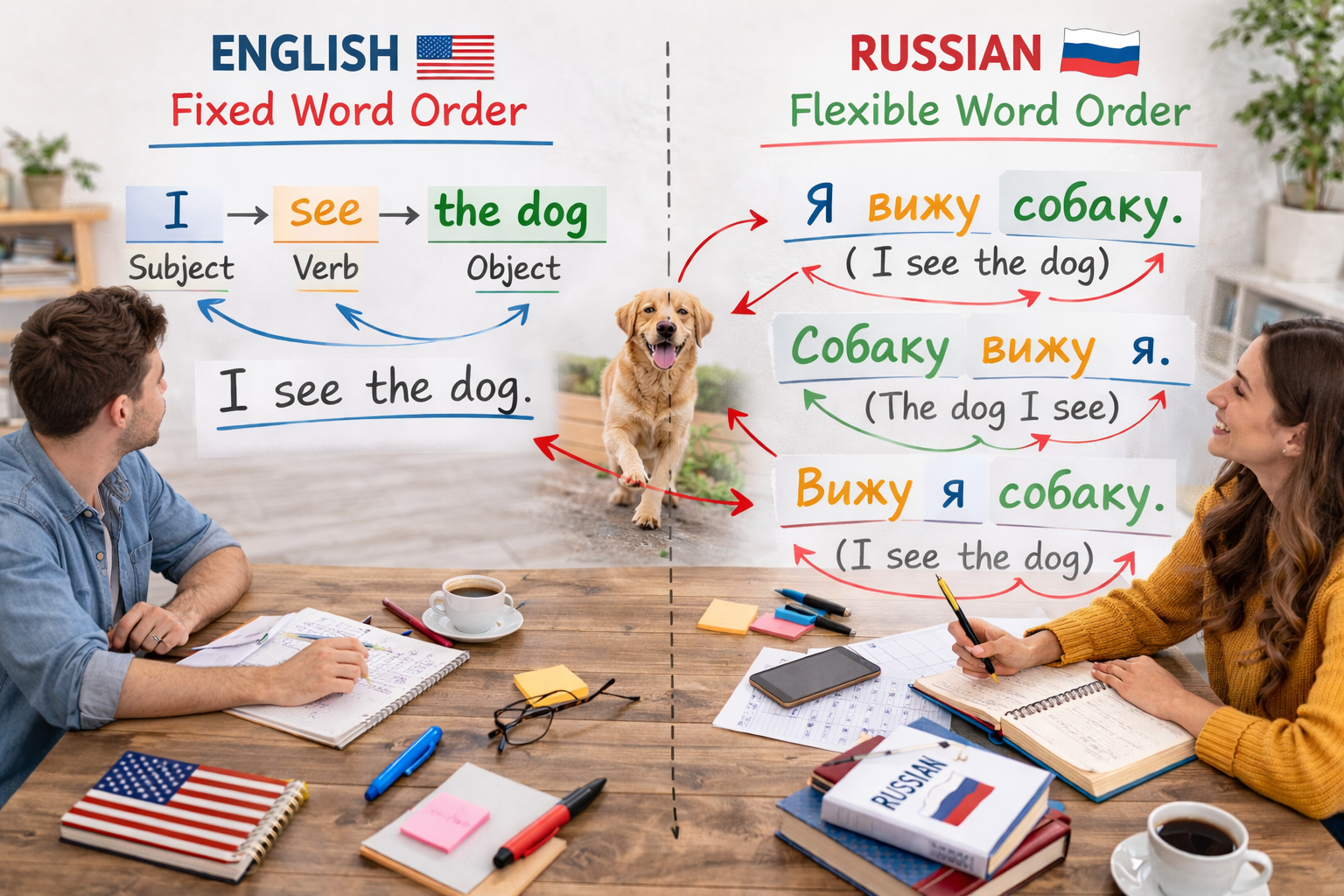
Russian vs English: Word Order vs Endings
In English, you rely heavily on word order:
I see the dog.
The dog sees me.
If you swap the words, you change the meaning.
In Russian, cases give you more flexibility:
Я вижу собаку. – I see the dog.
Собаку вижу я. – The dog, I see. (Emphasis on “the dog.”)
Even though the words move around, the ending -у in собаку tells you it’s the object. The meaning stays clear because the roles are encoded in the endings, not only in the order.
A Few More Case Examples
Subject vs object:
Я люблю кофе. – I love coffee.
Кофе любит меня. – Coffee loves me. (Strange sentence, but grammatically fine.)
In the first sentence, я (I) is the subject. In the second, кофе (coffee) is the subject. If you replaced a noun that changes its ending, the difference would be even clearer.
Possession (genitive):
Это книга Марии. – This is Maria’s book.
У меня нет книги. – I don’t have a book. (Literally: “At me there is no book.”)
Here, книги is a genitive form meaning “of a book / of the book.”
How to Think About Cases
Don’t try to remember “this is the genitive singular feminine blah blah.” Instead:
Ask: “What role does this noun play?”
Subject (who/what does it)? Use nominative.
Direct object (who/what is affected)? Use accusative.
Possession (of whom/what)? Use genitive.
Over time, your brain will start recognizing endings the way you now recognize English word order.
3. Verb Aspect: Imperfective vs Perfective
Verb aspect is one of the most Russian-feeling parts of Russian. There’s no direct one-word equivalent in English, but the idea is intuitive once you see it: are you focusing on the action as a process, or as a finished event?
What Is Aspect?
Most common Russian verbs come in pairs:
Imperfective: focuses on the process, the habit, or the general action.
Perfective: focuses on the completed action, the result, or a one-time event.
You can think of it like choosing a camera mode: do you want to show the action “in progress,” or a snapshot of it “as a whole” once it’s done?
The Classic Example: читать / прочитать
Let’s take the verb “to read”:
читать – to read (imperfective)
прочитать – to read (through), to finish reading (perfective)
Now look at these sentences:
Я читал книгу.
I was reading a book. / I used to read a book.
(Focus on the process or ongoing nature; we don’t know if you finished.)Я прочитал книгу.
I (have) read the book. / I finished reading the book.
(Focus on the result: the book is now read.)
Same time frame (past), but different angle. The first sentence paints the activity as something happening; the second paints it as done.
Aspect vs English Tenses
English uses tenses and auxiliary verbs to express similar ideas:
I read.
I was reading.
I have read.
I finished reading.
Russian uses aspect plus a simpler tense system. The imperfective often covers:
Ongoing actions: I was reading.
Repeated actions: I used to read.
General habits: I read (books in general).
The perfective often covers:
Completed actions: I finished the book.
Single events: I read it (once).
Future one-time actions: I will read it (once).
For example:
Каждый вечер я читал.
Every evening I used to read. (Imperfective, repeated habit.)Вчера я прочитал три статьи.
Yesterday I read (finished) three articles. (Perfective, completed and countable.)
Why Aspect Is Hard for English Speakers
As an English speaker, you naturally ask: “When did it happen? Past, present, or future?” That’s tense-oriented thinking.
In Russian, you also need to ask: “How do I see this action? As a process or as a completed whole?” That’s aspect-oriented thinking.
Compare:
Ты уже читал эту книгу?
Have you (ever) read this book? / Have you read (some of it)?
(Imperfective: experience or process.)Ты уже прочитал эту книгу?
Have you already finished this book?
(Perfective: result and completion.)
Both are about the past, but they ask different questions about the action.
How to Learn Aspect
A few practical strategies:
Memorize verbs in pairs: делать / сделать (to do), покупать / купить (to buy), писать / написать (to write), and so on.
When speaking about past or future, ask yourself: “Am I talking about the result/completion (perfective) or the process/repetition (imperfective)?”
Practice with mini-contrasts:
Вчера я писал письмо. (I was writing a letter.)
Вчера я написал письмо. (I wrote/finished the letter.)
Once this “result vs process” question becomes automatic, aspect will feel much more natural.
4. No Articles (a / the)
If you’ve ever paused and thought, “Wait, how do I say ‘a’ or ‘the’ in Russian?”—here’s the answer: you don’t.
Russian doesn’t have words for “a,” “an,” or “the.” At all.
How Does Russian Work Without Articles?
In Russian, the same sentence can be translated into English with “a,” “the,” or no article, depending on context. The language doesn’t mark definiteness (new vs known, specific vs general) with special little words; it relies on context.
For example:
Я видел собаку в парке.
I saw a dog in the park.
I saw the dog in the park.
Both English versions are possible, depending on whether the dog is “new” in the conversation or already known.
Another example:
Я купил книгу.
I bought a book. / I bought the book.
Again, Russian doesn’t force the distinction; it’s context-based.
Making Things Specific When You Need To
If Russian needs to be clearly specific, it often uses demonstrative words like “this” and “that”:
Я видел эту собаку в парке.
I saw this dog in the park.Положи книгу на стол.
Put the book on the table.
In the second sentence, “the book” and “the table” are understood from the context of the conversation. Russian doesn’t need articles; your brain fills in the rest.
How to Adjust Your Thinking
The main challenge for English speakers is psychological. You’re used to “needing” an article. But in Russian:
Don’t try to replace “a” or “the” with something else.
Focus on the noun and its ending (case, number, gender) instead.
Let context carry the burden of new vs known information.
The positive side? You never have to worry about choosing between “a” and “the” in Russian. One area of grammar simply disappears.
5. Gender and Agreement
In Russian, every noun has a grammatical gender: masculine, feminine, or neuter. Other words in the sentence “agree” with that gender by changing their endings. This includes adjectives and past tense verbs in the singular.
Noun Gender: The Basics
You can often guess a noun’s gender from its dictionary form (nominative singular):
Masculine: usually ends in a consonant or -й
стол (table) – masculine
музей (museum) – masculine
Feminine: usually ends in -а or -я
машина (car) – feminine
неделя (week) – feminine
Neuter: usually ends in -о or -е
окно (window) – neuter
море (sea) – neuter
There are exceptions and special cases, but these patterns cover a lot of words.
Adjective Agreement
Adjectives in Russian change their endings to match the noun in gender, number, and case. At first, this can feel like extra work, but it actually helps you understand sentences once you get used to it.
Compare:
большой стол – big table (masculine)
большая машина – big car (feminine)
большое окно – big window (neuter)
Same “big,” different endings to match the gender of each noun.
Past Tense Verb Agreement
In English, the past tense verb “was” is the same with “he,” “she,” and “it.” In Russian, past tense verbs agree with the subject’s gender in the singular:
он был дома. – He was at home.
она была дома. – She was at home.
оно было дома. – It was at home.
они были дома. – They were at home. (Plural form, no gender here.)
This might feel odd at first, but it quickly becomes natural if you practice short patterns like:
он был… / она была… / оно было… / они были…
How to Learn Gender and Agreement
Some practical tips:
Always learn nouns together with a “this” word:
этот стол (this table – masculine)
эта машина (this car – feminine)
это окно (this window – neuter)
Use color-coding or symbols in your notes to mark gender.
Pay special attention to feminine past tense forms (была, жила, говорила, and so on), because they reveal gender in stories and dialogues.
Once you start hearing gender patterns, you’ll catch a lot more detail in Russian without even trying.
6. Verb Conjugation: Simpler and Trickier Than English
Compared to English, Russian has fewer tense forms, but it uses more verb endings and relies heavily on aspect.
Fewer Tenses, More Aspect
English has a rich tense system:
I read.
I am reading.
I have read.
I had been reading, etc.
Russian mostly works with three grammatical tenses—present, past, and future—but combines them with aspect (imperfective vs perfective). That means you spend less time on complex auxiliary structures and more time choosing the right aspect.
Present Tense Conjugation
In Russian, most verbs have one clear present tense form for each person. No “do/does,” no “am/is/are” in front of them.
Take работать (to work):
я работаю – I work / I am working
ты работаешь – you work / you are working (singular, informal)
он/она/оно работает – he/she/it works / is working
мы работаем – we work / are working
вы работаете – you work / are working (plural or formal)
они работают – they work / are working
One Russian form corresponds to both “I work” and “I am working.” The meaning is clear from context.
Questions are also simpler:
Ты работаешь?
Do you work? / Are you working?
No “do” or “are” needed—intonation and context do the job.
Future Tense: One-Word vs Two-Word
For imperfective verbs, Russian often uses a two-word future with “to be”:
Я буду читать. – I will be reading. / I will read. (ongoing / general future.)
For perfective verbs, the future is usually a single word:
Я прочитаю. – I will read (and finish).
This is another place where aspect and tense work together. Imperfective future: process or repeated action. Perfective future: one completed event.
Easier and Harder Parts
Easier than English:
No “do/does” for questions or negatives.
Simpler present tense system (one set of endings instead of many auxiliary combinations).
Many future forms are straightforward one-word verbs.
Harder than English:
You must memorize patterns of endings for different verb groups.
You need to keep aspect in mind when choosing which verb form to use.
Some verbs have stem changes and irregularities.
A good strategy is to go deep on a small set of high-frequency verbs: быть, делать, говорить, жить, работать, понимать, хотеть, and so on. Once you can easily use them in all persons and basic tenses, everything else feels less scary.
7. Real-Life Examples and Mini Dialogues
Seeing grammar in action makes it stick. Here are short, natural dialogues that show the differences we’ve discussed: cases, aspect, no articles, gender, and conjugation.
A. Introductions and Past Travel
Привет, я Анна. Я из Канады.
Hi, I’m Anna. I’m from Canada.Приятно познакомиться. Я Питер. Я был в Канаде в прошлом году.
Nice to meet you. I’m Peter. I was in Canada last year.
What to notice:
Я был в Канаде – past tense with gender (был is masculine). If Anna said this, she would say: Я была в Канаде.
в Канаде – prepositional case used with the preposition “in.”
B. At a Café
Мне, пожалуйста, кофе и торт.
For me, please, (a) coffee and (a) cake.Вы будете есть здесь или с собой?
Will you eat here or take away?Я уже ел, я просто попью кофе.
I already ate, I’ll just drink (some) coffee.
What to notice:
мне – dative case (“to me”), typical in ordering situations.
No articles: “coffee” and “cake” appear without words for “a/the.”
ел – masculine past tense (I ate).
попью – perfective future (I’ll have a bit of coffee).
C. Reading a Book
Вчера я читал книгу весь вечер.
Yesterday I was reading a book all evening.Сегодня я наконец прочитал эту книгу.
Today I finally finished this book.
What to notice:
читал vs прочитал – imperfective vs perfective; process vs completed result.
эту книгу – accusative case, feminine, with adjective agreement (эту matches книгу).
Time words (вчера, сегодня) and aspect work together to tell the story.
D. In the Park (Word Order and Cases)
Imagine you’re talking about a dog you saw yesterday:
Вчера я видел собаку в парке.
Yesterday I saw a dog in the park.
You can move the words to emphasize different parts, and the meaning stays clear because of endings:
Собаку я видел вчера в парке.
The dog, I saw yesterday in the park. (Emphasis on “the dog.”)
The accusative ending -у in собаку tells you it’s the object. This flexibility is a direct result of the case system.
8. Common Mistakes English Speakers Make
Making mistakes is part of learning. But it helps if you know the typical traps so you can avoid building bad habits.
1. Overusing English Word Order, Ignoring Cases
Wrong:
Я вижу собака.
Right:
Я вижу собаку.
The learner used the nominative собака instead of the accusative собаку. They treated “dog” as if it never changes, like in English. Always remember: in Russian, objects usually need the accusative form.
2. Using the Wrong Aspect
Wrong (if the speaker means “I finished it yesterday”):
Вчера я читал эту книгу.
Right (for a completed action):
Вчера я прочитал эту книгу.
читал focuses on the process; прочитал focuses on completion. If you want to say “I finished the book,” you need the perfective form.
3. Mixing Up Gender and Agreement
Wrong:
Она был дома.
Right:
Она была дома.
The past tense verb must match the subject’s gender. For a female subject, use была.
4. Translating Articles Too Literally
Wrong:
Я видел один собака. (Trying to use один to mean “a.”)
Right:
Я видел собаку.
You don’t need to “replace” English “a” with a number like один. The case ending and context are enough.
5. Inserting an Unnecessary “To Be”
Wrong:
Я есть студент.
Right:
Я студент.
In the present tense, Russian usually leaves out “to be.” You simply say “I student” in Russian, and it’s correct.
9. Learning Tips: How to Think Differently From English
Knowing the rules isn’t enough—you need new habits of thinking. Here are practical strategies for working with each major difference.
For Cases: Think in Roles, Not Positions
Ask: “Who is doing the action? What is being affected? Who owns what?”
Practice with simple sentence patterns:
Я вижу ___. (I see __.)
Я люблю ___. (I love __.)
Я иду в ___. (I’m going to __.)
Fill in different nouns and pay attention to how their endings change. This trains your brain to connect meaning to endings, not just word order.
For Aspect: Ask “Process or Result?”
Whenever you talk about past or future actions, ask two questions:
When did it happen? (Tense)
How do I see the action—ongoing, repeated, or completed? (Aspect)
Create your own pairs:
Я делал / Я сделал.
Я писал / Я написал.
Я покупал / Я купил.
Say them out loud with different time expressions: вчера, уже, всегда, часто, наконец. This helps you feel when each aspect is natural.
For Gender and Agreement: Make Gender Impossible to Ignore
Learn nouns with a “this” word: этот стол, эта книга, это окно.
When you write new vocabulary, always mark the gender.
Practice simple patterns daily:
Он был… / Она была… / Оно было… / Они были…
This turns agreement into a reflex rather than a mental calculation.
For No Articles: Accept the “Missing Words”
When reading, notice where English uses “a/the” but Russian uses nothing.
Try to mentally delete “a/the” from the English translation when working with Russian sentences.
When speaking, focus on choosing the correct noun form and aspect instead of hunting for article equivalents.
General Practice Strategies
Shadow dialogues: listen to native speakers and repeat after them, focusing on endings and verb forms.
Write mini-stories in the past using both imperfective and perfective. Then check: are you describing processes or results?
Record yourself speaking about your day in Russian. Listen back and see if your endings and verb choices match what you wanted to say.
The more you use Russian as Russian (not as “code English”), the faster it will feel natural.
10. FAQs About Russian Grammar for English Speakers
Here are answers to some questions that often come up when English speakers start learning Russian.
1. Do I really need to master all six cases right away?
No. You don’t have to master everything at once. A smart approach is:
Start with nominative (subject) and accusative (object), because they appear in almost every sentence.
Add genitive (of/from, possession) and prepositional (in/on/about) as you need them.
Later, work more on dative and instrumental.
Focus on the cases that show up in your real-life phrases first.
2. Is verb aspect more important than tense?
Both matter, but aspect is one of the most distinctive features of Russian. If your tense is right but aspect is wrong, people will understand you, but your sentence may sound strange or not match what you mean.
For example, saying:
Вчера я читал письмо.
might sound like you were in the process of reading, not that you finished. If you want to say you completed the action, aspect becomes crucial.
3. How can I stop translating in my head from English?
This is a gradual process. Some tips:
Learn set phrases as chunks: Мне нравится…, Я хочу…, Я люблю…, У меня есть…
Use Russian-only explanations or bilingual resources that emphasize patterns, not word-for-word translation.
Practice thinking in very simple Russian sentences about your surroundings (“Я дома. На столе книга. Я пью чай.”).
The more you work with Russian patterns directly, the less you’ll depend on English.
4. Why do some words not change endings, like “кофе”?
Some nouns are indeclinable or have irregular patterns. This is normal in many languages (think “sheep” in English). Learn them as exceptions over time. Don’t let a few irregularities scare you away from the general patterns, which are quite consistent.
5. Can I speak correctly without fully understanding the grammar terms?
Absolutely. You don’t need to remember words like “accusative” or “imperfective” to speak well. What you need is to recognize patterns and use them correctly. Grammar terms are helpful labels, but your goal is to build intuitive habits.
11. Learn These Concepts in a Structured Way: Russian Classes at Polyglottist Language Academy
Understanding Russian cases, aspect, and agreement on your own is possible, but having a structured path and a teacher who can correct you makes a huge difference.
At Polyglottist Language Academy, our Russian courses are designed specifically with English-speaking learners in mind. We:
Break down cases into digestible, real-life patterns instead of long, abstract tables.
Teach verb aspect through stories, timelines, and practical contrasts like “I was doing” vs “I finished doing.”
Build in constant small corrections on gender and agreement, so you don’t develop fossilized mistakes.
Use dialogues and role-plays (cafés, travel, introductions, daily routines) that repeatedly recycle the key differences you’ve just read about.
Whether you’re a complete beginner or at an intermediate level trying to “finally understand aspect,” guided practice can save you months of confusion.
If you’d like to turn these five big differences from “mysteries” into tools you can actually use, check out the Russian classes at Polyglottist Language Academy here:
Learn more and enroll in Russian classes at Polyglottist Language Academy
12. Further Reading: Other Russian Grammar and Culture Articles
If this article helped you, you might enjoy diving deeper with these related topics. They’re great next steps to reinforce what you’ve learned and expand your understanding.
Beyond “Спасибо”: How Russians Actually Say Thank You (And When It Really Matters)
Essential Russian Pronouns: Personal, Possessive, And Reflexive
Building Your First 50 Russian Verbs: A Beginner’s Blueprint
Learn Russian Online In Seattle: Language, Culture, And Real Conversation
Online Russian Classes In Palo Alto: Language Learning For Global Thinkers
Learn Russian Online In Los Angeles: Flexible Classes For Busy Creatives & Professionals
Learn Russian Like A Native: Classes In San Francisco And Berkeley