
Russian Noun Genders: Masculine, Feminine, and Neuter Explained
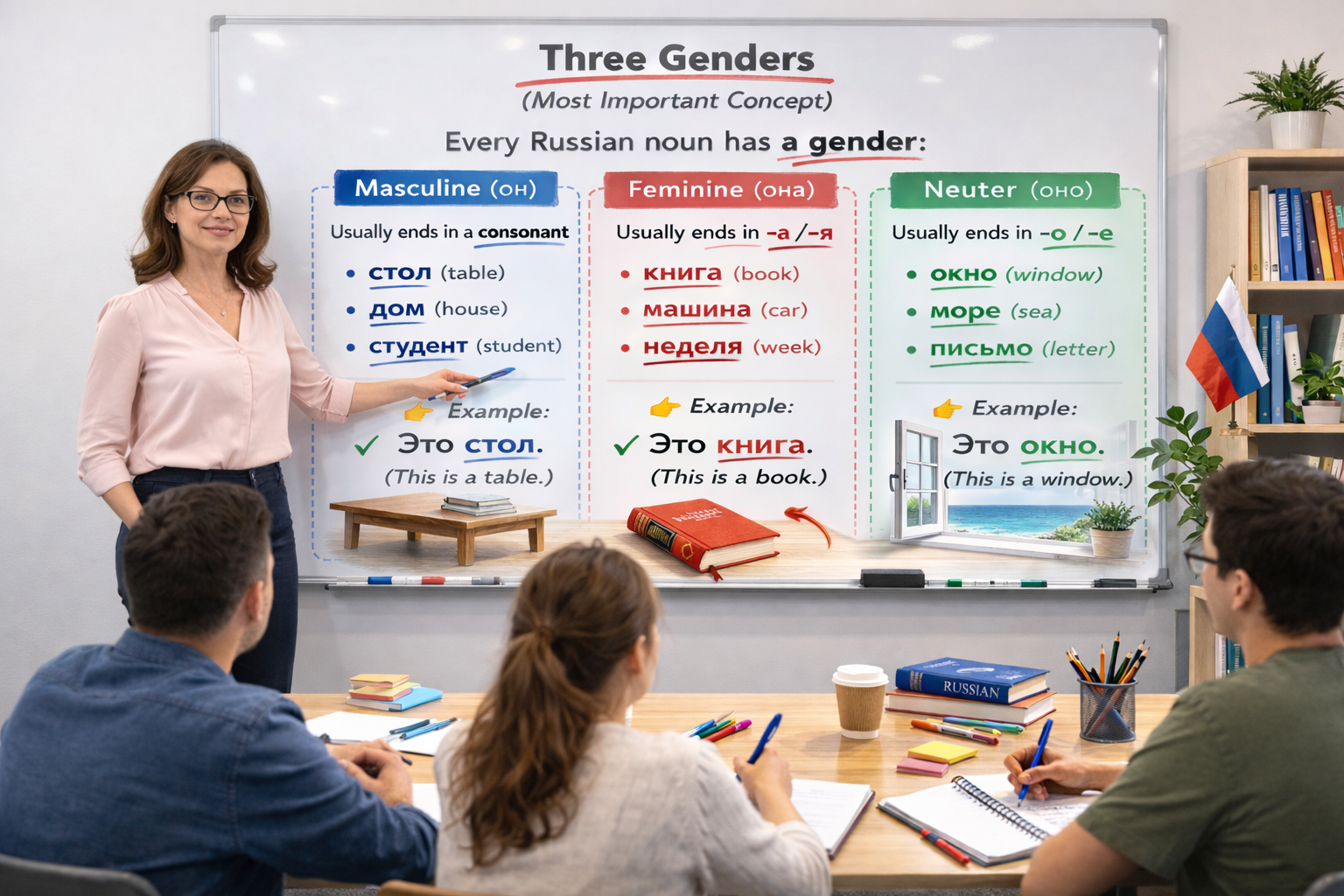
Learning Russian is full of exciting patterns that gradually start to make sense the more you dive in. One of the first grammatical topics that puzzles new learners is gender. In English, we barely think about it—objects don’t have gender, and adjectives don’t change depending on the noun. But in Russian, gender is one of the key systems holding the language together.
Before you panic about memorizing every single word, take a deep breath: Russian gender makes sense once you know where to look. Most nouns follow predictable rules, and with a bit of practice, identifying gender will start to feel natural. Let’s explore how it all works so you can use it confidently in your everyday Russian conversations.
What Is Grammatical Gender and Why Does It Matter?
In Russian, every noun belongs to one of three categories: masculine, feminine, or neuter. This classification affects how other words—like adjectives, pronouns, and past-tense verbs—change around that noun.
For example, consider these three short phrases:
новый стол — new table
новая книга — new book
новое окно — new window
Notice how “new” changes its ending each time, even though it’s the same word in English. The adjective must “agree” with the gender of the noun. The noun tells the rest of the sentence how to behave, like a conductor guiding the other instruments.
Understanding gender helps you:
Speak correctly and sound natural.
Understand why words around a noun change forms.
Catch meaning clues when reading or listening.
Best of all, it’s logical! Most nouns follow consistent spelling patterns that reveal their gender instantly. Once you learn the signals, you’ll rarely have to guess.
The Three Genders in Russian
The Russian language organizes its nouns into three grammatical genders—each with distinct patterns.
1. Masculine
Most masculine nouns end in a consonant. These words often refer to male people, professions, and objects that don’t have gender in English but are grammatically “he” in Russian.
Examples:
дом (house)
стул (chair)
город (city)
учитель (teacher, masculine)
брат (brother)
Masculine nouns take the pronoun он (he).
Example: Он красивый. — “He/It is beautiful.”
2. Feminine
Feminine nouns almost always end in –а or –я. They often refer to female people or animals, though many objects use this pattern simply because of how the word ends.
Examples:
книга (book)
мама (mom)
неделя (week)
кошка (female cat)
сестра (sister)
Feminine nouns take the pronoun она (she).
Example: Она красивая. — “She/It is beautiful.”
3. Neuter
Neuter nouns usually end in –о or –е. These are neutral objects or abstract things, often inanimate.
Examples:
окно (window)
море (sea)
письмо (letter)
молоко (milk)
Neuter nouns use the pronoun оно (it).
Example: Оно большое. — “It’s big.”
In English, we say “the window” or “the table” without assigning gender. In Russian, every noun “tells” you its gender through its ending—and the rest of the sentence must agree.
How to Identify Gender: The Key Patterns
Here’s where everything comes together: endings are your roadmap.
Masculine: usually ends in a consonant (e.g., дом, стол, паспорт).
Feminine: usually ends in –а or –я (e.g., книга, неделя, собака).
Neuter: usually ends in –о or –е (e.g., окно, море, письмо).
To internalize this, try thinking in trios with adjectives:
новый стол — new table (masculine)
новая книга — new book (feminine)
новое окно — new window (neuter)
You’ll notice a pattern in adjectives:
Masculine adjectives end in –ый / –ий
Feminine adjectives end in –ая / –яя
Neuter adjectives end in –ое / –ее
The endings are like color codes. If you learn these sets together, you’ll always know what goes with what.
Important Exceptions to Remember
No rulebook is complete without a few exceptions—but these are limited and easy to spot once you know the system.
Nouns Ending in –ь (Soft Sign)
This ending can be masculine or feminine, depending on the word. There’s no visible clue, so these need to be memorized or recognized by context.
Common masculine –ь examples:
день (day)
учитель (teacher)
Feminine –ь examples:
ночь (night)
дверь (door)
A good strategy is to learn common phrases:
день длинный — the day is long (masculine)
ночь короткая — the night is short (feminine)
Irregular or Borrowed Words
Borrowed words from other languages often don’t follow normal patterns. The good news is that most are masculine or neuter, and you’ll see them often.
Examples:
какао (cocoa) — neuter
кино (cinema) — neuter
пальто (coat) — neuter
The most practical tip? When in doubt for a borrowed word, guess neuter—it’s correct most of the time.
Gender and Word Agreement
Gender isn’t just a feature of the noun—it affects how the whole sentence behaves.
Adjectives
Adjectives must match the noun’s gender, number, and case. For now, focus on gender agreement in simple sentences.
GenderExampleTranslationMasculineновый домnew houseFeminineновая комнатаnew roomNeuterновое окноnew window
Try swapping in different adjectives: старый, большой, маленький, etc. It’s the perfect way to reinforce the endings naturally.
Past Tense Verbs
In the past tense, Russian verbs also reflect gender.
Он был дома. — He was at home.
Она была дома. — She was at home.
Оно было дома. — It was at home.
The only difference between masculine, feminine, and neuter here is the verb ending—был / была / было. It’s subtle but vital for clear, correct expression.
Real-Life Usage: Gender in Everyday Russian
Now that you’ve got the structure, let’s make it real. Gender is everywhere in Russian—introducing people, describing objects, talking about daily life.
Example conversation:
– Это твой брат? (Is that your brother?)
– Да, это мой брат. Он высокий. (Yes, this is my brother. He’s tall.)– А это твоя сестра? (And is that your sister?)
– Да, моя сестра. Она красивая. (Yes, my sister. She’s beautiful.)– А это что? (And what’s this?)
– Это моё окно. Оно большое! (That’s my window. It’s big!)
In just a few lines, you can see three sets of agreements:
мой/моя/моё, он/она/оно, and adjective endings that match each noun.
Try describing objects around you in Russian using это (“this is”). It’s one of the best ways to make gender stick:
Это мой ноутбук. Он новый.
Это моя чашка. Она красивая.
Это моё кресло. Оно удобное.
Common Mistakes and How to Fix Them
Even consistent learners slip up occasionally—here’s how to catch those errors early.
Guessing gender by meaning instead of by ending.
❌ день (“day”) feels neutral, but it’s masculine.
✅ день хороший (good day).
Forgetting adjective agreement.
❌ новая стол → ✅ новый стол.
Mixing up similar endings.
Easy mix-up: –а and –о.
Use phrase drills with colors: красная книга, красное окно.
Ignoring exceptions.
Keep a short list of your “rule-breakers.” A personal cheat sheet saves time.
Visual learning tip: Create a three-column chart on paper—blue for masculine, pink or red for feminine, green for neuter. Write each noun with an adjective. Seeing the endings together strengthens your memory.
Practical Learning Tips for Mastering Gender
Think of gender as a voice pattern in the language. Each noun “sounds” a certain way, and the sentence harmonizes with it. Here’s how to absorb it effortlessly:
1. Always learn the noun with its pronoun.
For example:
стол — он
книга — она
окно — оно
2. Use color-coding.
Color your vocabulary lists: blue for masculine, red for feminine, green for neuter.
3. Build small sentences immediately.
Use это + adjective + noun:
Это большая собака. — This is a big dog.
4. Practice with emotion and sound.
Saying words out loud makes endings more memorable.
5. Use spaced repetition.
Digital flashcard apps like Anki or Quizlet can help review older words automatically before you forget them.
6. Learn by theme.
Study sets like “People,” “Food,” “Home,” “Nature.” Gender patterns repeat across these categories.
Over time, gender ceases to feel like a rule—it becomes an instinct.
Mini Practice Section
Try these short exercises to test your feel for gender.
A. Identify the gender.
стул → ______
комната → ______
письмо → ______
ночь → ______
(Answers: 1. masculine, 2. feminine, 3. neuter, 4. feminine)
B. Match the correct adjective.
Use “новый” (new).
___ дом → новый дом
___ книга → новая книга
___ окно → новое окно
C. Translate the following.
Это мой брат.
Это моя подруга.
Это моё кафе.
(Answers: 1. This is my brother. 2. This is my (female) friend. 3. This is my café.)
These short drills reinforce the visual and sound patterns that cement gender memory.
FAQ: Russian Gender Questions Explained
Q: Why do I need to know gender so early?
A: Because it affects almost everything in a sentence—adjectives, past tense, and word endings. The earlier you get it right, the smoother everything else becomes.
Q: Do Russians actually think of objects as “he” or “she”?
A: Not really—gender in Russian is grammatical, not conceptual. It’s about how words interact, not how people “feel” about a table or a door.
Q: Are there any shortcuts to remember tricky nouns?
A: Yes! Learn them in short phrases: тёплый день (warm day), холодная ночь (cold night). The adjective reinforces the correct gender naturally.
Q: Is there a way to “hear” the gender of a word when speaking?
A: Often yes—because adjective endings and certain sounds strongly hint at gender. With practice, your ear will pick up these cues automatically.
Q: How many exceptions are there really?
A: Fewer than you think. About 90–95% of Russian nouns follow the standard patterns. Focus on those first, then handle exceptions as special friends you meet later.
Learn Gender Naturally with Polyglottist Language Academy
Grammar rules get easier—and more enjoyable—when you study in a guided environment. At Polyglottist Language Academy, our Russian courses take these core grammar topics and turn them into living, interactive practice through conversation, listening, and contextual drills.
In our beginner-friendly Russian classes, you’ll:
Practice gender agreement through storytelling and dialogue.
Learn visual memory techniques to reinforce endings.
Get personalized feedback on pronunciation and grammar use.
Build confidence using gender correctly in real communication.
Our approach blends structured explanation with actual speaking—so by the time you finish a lesson, you’ve used the grammar, not just memorized it.
👉 Join a Russian class at Polyglottist Language Academy
Explore More Russian Learning Articles
If you enjoyed this guide, continue your Russian learning journey with these related articles from Polyglottist’s Russian series:
Beyond “Спасибо”: How Russians Actually Say Thank You (And When It Really Matters)
Essential Russian Pronouns: Personal, Possessive, And Reflexive
Building Your First 50 Russian Verbs: A Beginner’s Blueprint
Learn Russian Online In Seattle: Language, Culture, And Real Conversation
Online Russian Classes In Palo Alto: Language Learning For Global Thinkers
Learn Russian Online In Los Angeles: Flexible Classes For Busy Creatives & Professionals
Learn Russian Like A Native: Classes In San Francisco And Berkeley