
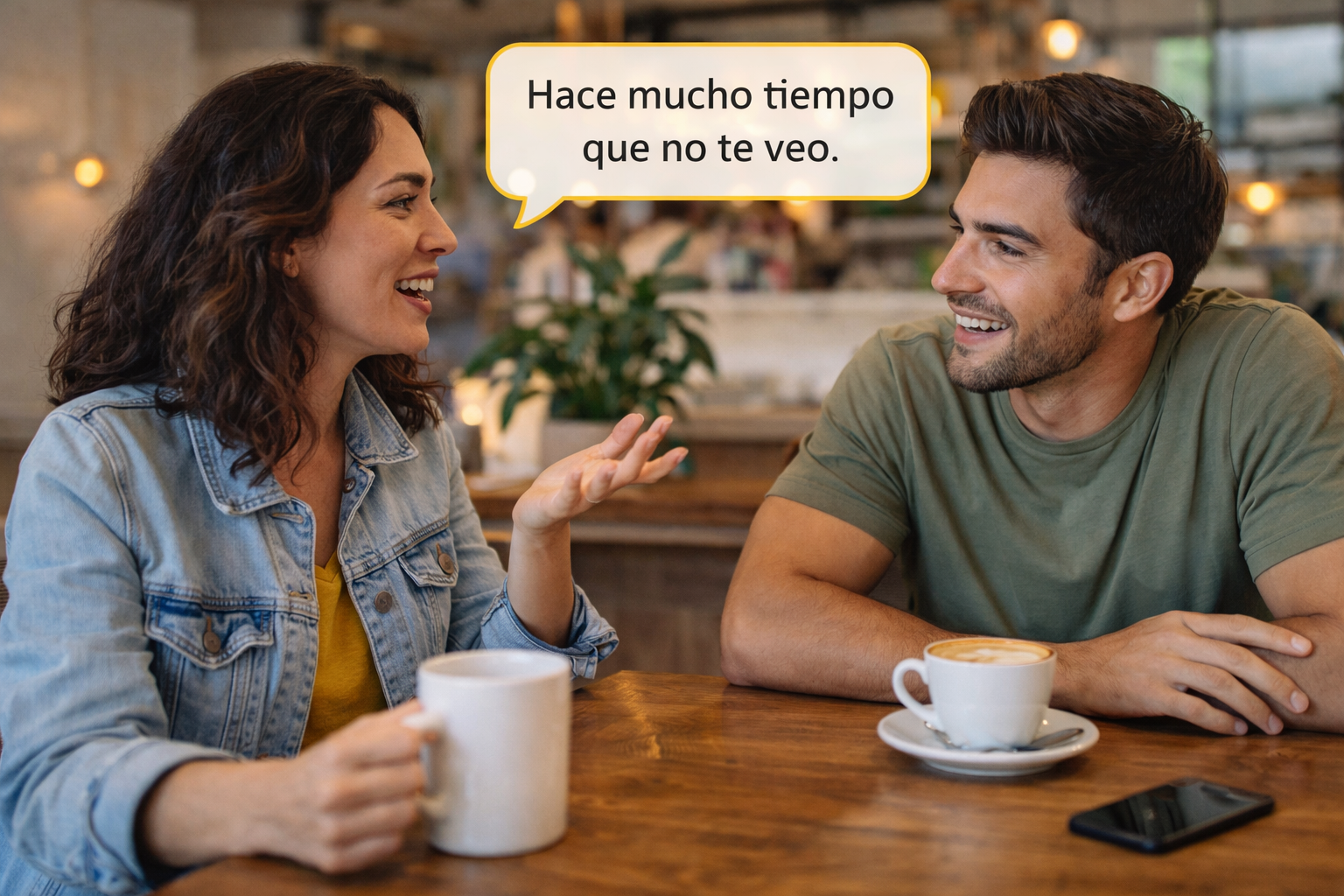
If you’ve been learning Spanish for a while, you’ve probably met the verb hacer and learned that it means “to do” or “to make.” Then suddenly your teacher says things like Hace dos años que vivo aquí or Fui a España hace tres años, and your brain goes: “Wait… who is doing what?”
This article will show you, step by step, how hace works when we use it to talk about time. You’ll see how it matches (and doesn’t match) English phrases like “ago,” “for,” and “since,” and you’ll learn simple patterns you can reuse in real life. We’ll also look at typical mistakes and give you practice and learning strategies you can apply right away.
1. What Does “Hace” Mean?
1.1 The basic verb “hacer”
Let’s start from the beginning. The infinitive hacer means “to do” or “to make.” That’s probably what you learned first.
Some basic examples:
Yo hago la tarea todos los días.
I do my homework every day.Tú haces café por la mañana.
You make coffee in the morning.Mi hermano hace ejercicio en el parque.
My brother works out in the park.
In these sentences, hacer is a normal verb of action: doing, making, creating something.
Now look at one more form of this verb:
hace → third person singular (él/ella/usted) of hacer
Él hace la cena. → He makes dinner.
Ella hace yoga. → She does yoga.
So far so good. But now we come to the special use that confuses learners.
1.2 “Hace” as a time word
In many time expressions, hace no longer really means “does/makes.” Instead, it works more like a time marker, similar to English “ago” or part of “have been doing… for.”
For example:
Llegué hace dos horas.
Literally: “I arrived two hours does.”
Real meaning: “I arrived two hours ago.”Hace muchos años que vivimos aquí.
Literally: “It does many years that we live here.”
Real meaning: “We’ve lived here for many years.”
If you try to translate these sentences word by word, they make no sense. That’s why it’s important to think of hace + time as a fixed pattern or chunk, not as “does + time.”
1.3 Think of “hace” as a time marker
A helpful way to think about it:
In time expressions, hace answers questions like:
“How long ago?”
“For how long?”
“Since when?”
Don’t ask yourself “Who is doing?” or “What is being made?” when you see hace in this context. Instead, ask:
“Is this telling me how long ago something happened?”
“Is this telling me how long something has been happening?”
If the answer is yes, you are in the world of time expressions with hace.
2. “Hace” for “Ago” (Past Time Expressions)
One of the main jobs of hace is to express “ago”—that is, how long ago something happened and is now finished.
In Spanish, there are two common structures to say “ago”:
hace + time + que + verb
verb + hace + time
Both are correct, and they often mean the same thing. Let’s look at each one.
2.1 Structure 1: “hace + time + que + verb”
This structure is often taught first because it’s very clear and you can see the time information at the beginning of the sentence.
Structure:
hace + amount of time + que + verb
When we use a past tense verb (usually the preterite), we normally talk about a finished action in the past, like “I moved,” “I saw,” “I met.”
Examples:
Hace dos años que me mudé aquí.
I moved here two years ago.Hace tres meses que conocí a Marta.
I met Marta three months ago.Hace una semana que vi esa película.
I saw that movie a week ago.
In all of these, the action is completed. You’re not still moving, meeting, or seeing. You’re just saying how long ago that past event happened.
2.2 Structure 2: “verb + hace + time”
This version is shorter and extremely common in everyday speech. Many native speakers use this structure more often than the previous one in casual conversation.
Structure:
verb (usually in past) + hace + amount of time
Examples:
Me mudé aquí hace dos años.
I moved here two years ago.Conocí a Marta hace tres meses.
I met Marta three months ago.Vi esa película hace una semana.
I saw that movie a week ago.
Compare:
Hace dos años que me mudé aquí.
Me mudé aquí hace dos años.
The meaning is the same: “I moved here two years ago.” The difference is just emphasis and word order. Putting hace dos años at the beginning puts more focus on the time period. Putting it after the verb is more neutral.
For most learners, it’s perfectly fine (and often easier) to use:
past tense + hace + time
as your main “ago” structure.
2.3 The “vivo aquí” examples: ongoing vs finished
Now, compare these two examples:
Hace dos años que vivo aquí.
Vivo aquí hace dos años.
Here the verb vivo is in the present tense, not past. That changes the meaning: you’re not saying “I lived here two years ago and no longer live here.” You’re saying:
“I’ve been living here for two years (and I still live here now).”
When the verb is in present, hace + time doesn’t mean “ago” (finished). It means “for [amount of time] (ongoing).” We’ll explore this more in Section 3.
For now, remember:
Past verb + hace + time → “X time ago” (finished action).
Present verb + hace + time → “for X time” (ongoing action).
2.4 Which structure should you use?
Both structures for “ago” are correct:
Hace dos años que me mudé aquí.
Me mudé aquí hace dos años.
As a learner, you can:
Start with the shorter one: Verbo en pasado + hace + tiempo.
Get comfortable saying things like:
Llegué hace dos horas.
Conocí a Ana hace diez años.
Fui a Madrid hace un mes.
Later, you can add the hace + time + que + verb structure to give more variety to your speaking and writing.
3. “Hace” for Ongoing Actions (“For” / “Since” Meaning)
So far, we have used hace mainly for “ago” and finished actions. But we also use hace to talk about actions that started in the past and continue now.
In English, you usually use the present perfect (“have + past participle”) to express this idea:
I have lived here for two years.
She has worked there for three months.
We have been friends for a long time.
In Spanish, we often use the present tense with hace or desde hace.
3.1 Structure: “hace + time + que + present”
Let’s look at this pattern:
hace + amount of time + que + verb in present
Examples:
Hace un año que vivo en Madrid.
I’ve lived in Madrid for a year. / I’ve been living in Madrid for a year.Hace tres meses que trabajo en esta empresa.
I’ve worked at this company for three months.Hace mucho tiempo que estudiamos español.
We’ve studied Spanish for a long time.
In all these sentences:
The action started in the past.
It continues in the present.
So while English uses present perfect (“have lived,” “have worked,” “have studied”), Spanish uses present tense plus the time expression hace + time + que.
3.2 Structure: “present + desde hace + time”
There is another very common pattern:
present tense + desde hace + amount of time
This is similar in meaning to the previous structure and also corresponds to English “have been doing… for X time.”
Examples:
Vivo en Madrid desde hace un año.
I’ve lived in Madrid for a year.Trabajo en esta empresa desde hace tres meses.
I’ve worked at this company for three months.Estudiamos español desde hace mucho tiempo.
We’ve studied Spanish for a long time.
Compare:
Hace un año que vivo en Madrid.
Vivo en Madrid desde hace un año.
Both mean: “I’ve lived in Madrid for a year.”
For learners, it’s useful to see them as two interchangeable ways to talk about how long something has been true.
3.3 Visualizing the timeline
Imagine a horizontal line:
The left end: the moment the action started.
The right end: now.
The distance between them: the period of time (two years, three months, etc.).
When we say:
Hace dos años que vivo aquí.
Vivo aquí desde hace dos años.
we are saying: “The action started two years ago and is still true now.”
So:
Use these when you talk about current habits or states that began in the past:
living somewhere
working in a place
being in a relationship
studying a language
3.4 Finished vs ongoing: a simple rule
To keep things simple, here’s a strong rule you can remember:
If the action finished:
→ Use a past tense + hace + time.
Example: Llegué hace dos horas. (I arrived two hours ago.)If the action continues now:
→ Use present + hace / desde hace + time or hace + time + que + present.
Examples:Hace dos años que vivo aquí. (I’ve lived here for two years.)
Vivo aquí desde hace dos años. (I’ve lived here for two years.)
This one rule will help you avoid a lot of confusion.
4. “Hace,” “Desde,” and “Desde Hace”: What’s the Difference?
Now we’ll zoom in on three related expressions:
hace
desde
desde hace
It’s very common for learners to mix them up, especially because English often uses the same words (“for” and “since”) where Spanish splits them.
4.1 “Hace” – focus on the amount of time
Hace is used with an amount of time:
Hace dos horas… (two hours ago / for two hours)
Hace tres días… (three days ago / for three days)
Hace muchos años… (many years ago / for many years)
When you use hace:
By itself with a past tense → usually “ago”
Fui al médico hace tres meses. → I went to the doctor three months ago.
At the beginning or with present → often “for” (ongoing)
Hace tres años que vivo aquí. → I’ve lived here for three years.
4.2 “Desde” – focus on the starting point
Desde means “since” and introduces a starting point in time, not an amount.
You use it with:
A date:
Vivo en España desde 2010. → I’ve lived in Spain since 2010.
A moment:
Trabajo aquí desde marzo. → I’ve worked here since March.
A specific event:
Somos amigos desde la universidad. → We’ve been friends since college.
Notice that you don’t say how long; you say since when.
4.3 “Desde hace” – since + amount of time
Desde hace is a combination that literally feels like “since for,” which is impossible in English, but very natural in Spanish.
You use it with an amount of time, and it also indicates an ongoing action:
Somos amigos desde hace veinte años.
We’ve been friends for twenty years.Bebo café desde hace cinco años.
I’ve been drinking coffee for five years.Mi hermana vive aquí desde hace seis meses.
My sister has lived here for six months.
Compare:
Somos amigos desde 2004. (since a calendar year)
Somos amigos desde hace veinte años. (for twenty years)
Both sentences express a long friendship that started in the past and continues now.
4.4 Typical confusion (and how to fix it)
English uses “for” and “since”, and learners often try to map them like this:
for → por or para (wrong in this context)
since → desde
Then they produce sentences like:
✗ Vivo aquí hace 2015.
(trying to say “I’ve lived here since 2015.”)
But in Spanish, we do not use hace directly with a date. Instead:
✓ Vivo aquí desde 2015.
I’ve lived here since 2015.
Another common confusion is using hace with ongoing actions but putting the verb in past:
✗ Viví aquí hace dos años. (often misused to mean “I’ve lived here for two years.”)
In reality, this means “I lived here two years ago” (finished, not ongoing).
If you want to say “I’ve lived here for two years,” you should say:
✓ Hace dos años que vivo aquí.
✓ Vivo aquí desde hace dos años.
5. Common Mistakes Learners Make
Let’s look systematically at the errors that English-speaking learners make with hace, and how to correct them.
5.1 Literal “do/make” translations
Because hacer means “to do/make,” beginners sometimes try to translate English directly:
✗ I do two years that I live here.
✗ It makes two years that I live here.
Instead, you should use the fixed pattern:
✓ Hace dos años que vivo aquí.
I’ve lived here for two years.
or:
✓ Vivo aquí desde hace dos años.
The key message: don’t translate “do/make”. Think of hace + time as its own time expression.
5.2 Confusing “ago” with ongoing actions
English clearly distinguishes:
“I moved here two years ago.” (finished)
“I have lived here for two years.” (ongoing)
In Spanish, learners sometimes do this:
✗ Viví aquí hace dos años.
(intending “I have lived here for two years.”)
But Viví aquí hace dos años actually means: “I lived here two years ago.” It implies that you no longer live there.
To say “I have lived here for two years,” use:
✓ Hace dos años que vivo aquí.
✓ Vivo aquí desde hace dos años.
5.3 Word order mistakes around “hace”
Another very common error is mixing up the word order:
✗ Hace vivo aquí dos años.
✗ Dos años hace que vivo aquí (possible in very formal or poetic Spanish, but not recommended at beginner/intermediate level).
At your level, keep to these safe patterns:
Hace dos años que vivo aquí.
Vivo aquí hace dos años.
Vivo aquí desde hace dos años.
5.4 Mixing “desde” and “hace” with dates vs amounts
Remember:
Use desde + date / point in time:
✓ Vivo aquí desde 2015.
✓ Trabajo aquí desde marzo.
Use hace + amount of time:
✓ Me mudé aquí hace dos años.
✓ Vi a Ana hace una semana.
Avoid:
✗ Vivo aquí hace 2015. (wrong – amount + date mixed)
✗ Me mudé aquí desde hace dos años. (odd and confusing – mixing patterns)
5.5 Confusing finished vs ongoing meaning
Pay very close attention to whether the action still continues or not:
Hace tres años que dejé de fumar.
I stopped smoking three years ago. (Finished: you stopped three years ago; you don’t smoke now.)Hace tres años que no fumo.
I haven’t smoked for three years. (Ongoing: you started “not smoking” three years ago and still don’t smoke now.)
Notice how a small change in the verb (dejé de fumar vs no fumo) creates a different nuance. The English translations are different too.
6. Real-Life Contexts: Everyday Sentences with “Hace”
Now let’s see hace in natural, everyday situations. You can adapt these sentences to talk about your own life.
6.1 Talking about where you live, work, or study
Hace cinco años que vivo en Nueva York.
I’ve lived in New York for five years.Vivo en esta ciudad desde hace un año.
I’ve lived in this city for a year.Trabajo en esta empresa desde 2020.
I’ve worked at this company since 2020.Hace dos años que estudio español.
I’ve studied Spanish for two years.Estudio español desde hace seis meses.
I’ve studied Spanish for six months.
Try replacing the city, company, and year with your own information.
6.2 Talking about the last time you did something
Fui al médico hace tres meses.
I went to the doctor three months ago.Fui al cine hace una semana.
I went to the cinema a week ago.Hace mucho tiempo que no veo a mis abuelos.
I haven’t seen my grandparents for a long time.Tomé café hace dos horas.
I had coffee two hours ago.
These sentences are very useful in conversations about health, social life, and habits.
6.3 Work and travel
Empecé este trabajo hace seis meses.
I started this job six months ago.Hace un año que trabajo desde casa.
I’ve worked from home for a year.Viajé a México hace un año.
I travelled to Mexico a year ago.Hace dos semanas que estoy de vacaciones.
I’ve been on holiday for two weeks.
These will help you describe your professional situation and your travel experiences.
6.4 Relationships and everyday life
Somos novios desde hace cuatro meses.
We’ve been dating for four months.Hace diez años que estamos casados.
We’ve been married for ten years.Hace media hora que te espero.
I’ve been waiting for you for half an hour.Vivimos juntos desde 2019.
We’ve lived together since 2019.
Again, notice how these sentences all describe situations that began in the past and continue in the present.
7. Mini Practice Section
Now it’s your turn to practice. Try to answer without looking at the explanations, then check your answers.
7.1 Fill in the blank
Complete each sentence with hace, desde, or desde hace, and adjust the structure if needed.
______ tres años que estudio español.
Vivo en esta ciudad ______ 2018.
Empecé a trabajar aquí ______ dos meses.
Somos amigos ______ diez años.
No veo a mi primo ______ mucho tiempo.
Suggested answers:
Hace tres años que estudio español.
Vivo en esta ciudad desde 2018.
Empecé a trabajar aquí hace dos meses.
Somos amigos desde hace diez años.
No veo a mi primo desde hace mucho tiempo.
Check:
Did you use desde with a date in sentence 2?
Did you use hace with a past tense in sentence 3?
Did you use desde hace with an amount of time in sentences 4 and 5?
7.2 Sentence transformation
Rewrite these English sentences in Spanish using hace + time + que + present.
a) I have lived here for five years.
b) We have known each other for a long time.
c) She has worked in this company for three months.
Possible answers:
a) Hace cinco años que vivo aquí.
b) Hace mucho tiempo que nos conocemos.
c) Hace tres meses que trabaja en esta empresa.
You can also try the present + desde hace + time version:
a) Vivo aquí desde hace cinco años.
b) Nos conocemos desde hace mucho tiempo.
c) Trabaja en esta empresa desde hace tres meses.
7.3 Translation (English → Spanish)
Translate these sentences into Spanish using the most natural structures:
I went to Spain three years ago.
We have been married for ten years.
He has studied Spanish since 2020.
Possible answers:
Fui a España hace tres años.
Hace diez años que estamos casados.
Estudia español desde 2020.
For sentence 3, if you want to emphasize the amount of time instead of the date, you could say:
Estudia español desde hace cuatro años. (when speaking in 2024).
8. Teaching Tips and Learning Strategies
Whether you’re a self-learner or working with a teacher, these strategies can make hace much easier to internalize.
8.1 Learn chunks, not individual words
Don’t try to “build” your sentences from zero each time. Instead, memorize short patterns and drop in your details.
For example, learn these as ready-made frames:
Hace X que vivo aquí.
Vivo aquí desde Y.
Vivo aquí desde hace X.
Llegué aquí hace X.
Then just change X (the time) and aquí (the place):
Hace dos años que vivo aquí.
Hace tres meses que vivo en Chile.
Llegué a Madrid hace una semana.
This will help your Spanish sound more natural and fluent.
8.2 Use two “decision questions”
When you want to talk about time, ask yourself two quick questions in English:
Is the action finished or still true now?
Do I want to say “how long ago” or “for how long / since when”?
If the action is finished, choose:
past tense + hace + time
If the action is ongoing, choose one of:
hace + time + que + present
present + desde hace + time
present + desde + date/point
This habit encourages you to think in Spanish patterns, not literal translation.
8.3 Make mini-contrast lists
Take pairs of sentences where only a few words change, but the meaning changes a lot. For example:
Conocí a Ana hace dos años.
I met Ana two years ago. (first meeting, finished)Hace dos años que conozco a Ana.
I’ve known Ana for two years. (ongoing relationship)
Or:
Fumé mi último cigarrillo hace tres años.
I smoked my last cigarette three years ago.Hace tres años que no fumo.
I haven’t smoked for three years.
Write these pairs in your notebook, highlight hace, and read them aloud several times. This trains your brain to notice the differences.
8.4 Practice with your own life
Take a few minutes and write down:
How long you have lived where you live now.
How long you have studied Spanish.
When you started your current job or studies.
Important events: meeting a partner, moving city, graduating, etc.
Then express all of them in Spanish using hace, desde, and desde hace. Try to write both the “ago” version and the “ongoing” version when possible.
9. Learn with Polyglottist Language Academy (In-Person and Online)
Understanding hace, desde, and desde hace is much easier when you can practice them in real conversations, get instant feedback, and hear how native speakers use them spontaneously. That’s where guided classes can make a big difference.
At Polyglottist Language Academy, you can work with experienced Spanish teachers who are used to helping English-speaking learners navigate exactly these kinds of structures. In both in-person classes and live online lessons, you can:
Practice real-life dialogues that use time expressions constantly: talking about your job, your studies, your relationships, your travels.
Get personal corrections on your use of hace and desde, so you don’t repeat the same mistakes.
Ask follow-up questions like “Can I also say it this way?” and get clear, simple explanations.
Some ways Polyglottist could help you master this topic:
Beginner and lower-intermediate courses that introduce hace with carefully graded examples.
Conversation classes where you talk about your life story and daily routines using hace, desde, and desde hace.
Grammar-focused workshops that dive into tricky areas like time expressions, giving you guided practice and clear summary charts.
Online lessons with flexible scheduling, so you can join from anywhere and still get the benefits of live interaction.
If you’ve read this far, you already care about speaking Spanish clearly and accurately. Working with a teacher who knows your language background and goals can help you move from “I know the rule” to “I actually use it naturally when I speak.”
Sign up for Spanish Classes at Polyglottist Language Academy
10. FAQs About “Hace” and Time Expressions
Here are some common questions learners ask about hace.
10.1 Do I always need “que” after “hace + time”?
No. You only use que in the pattern:
Hace + time + que + verb
For example:
Hace dos años que vivo aquí.
But when you use the shorter pattern, you drop que:
Vivo aquí hace dos años.
Both are correct. Beginners often find the “hace + time + que” pattern easier to see and understand at first.
10.2 What’s the difference between “Vivo aquí hace dos años” and “Viví aquí hace dos años”?
Vivo aquí hace dos años.
I’ve lived here for two years (and I still live here). The verb is in present and the action is ongoing.Viví aquí hace dos años.
I lived here two years ago (but I don’t live here now). The verb is in past and the action is finished.
The only difference is the verb tense, but the meaning changes a lot.
10.3 Can I always use “desde hace” instead of “hace + time + que + present”?
In many cases, yes, but not always. For ongoing actions, these two are often interchangeable:
Hace tres años que trabajo aquí.
Trabajo aquí desde hace tres años.
Both mean: I’ve worked here for three years.
However, the rhythm of the sentence changes, and in some contexts one may sound slightly more natural than the other. At your level, it’s safe to treat them as alternatives and choose the one that feels easier to say.
10.4 Should I use the Spanish present perfect instead?
Sometimes Spanish uses the present perfect (he vivido, he trabajado) for recent or result-focused events:
He vivido en varias ciudades. → I’ve lived in several cities.
But when you say how long something has been true and it still is true (like “I’ve lived here for three years”), Spanish usually prefers the present tense with hace or desde hace:
Hace tres años que vivo aquí.
Vivo aquí desde hace tres años.
So don’t automatically mirror English “have lived” with Spanish “he vivido.” Look for patterns like hace + time + queinstead.
10.5 Is it wrong to say “desde hace tres años que vivo aquí”?
That structure is not standard in everyday Spanish. It’s much more natural to say:
Hace tres años que vivo aquí.
orVivo aquí desde hace tres años.
Try to avoid mixing the two patterns in one sentence.
11. Quick Summary: Rules You Can Review Fast
To finish, here are the key ideas you can review at a glance.
Hacer means “to do / to make,” but hace in time expressions is a time marker, not “does/makes.”
For a finished action (“ago”):
Use past tense + hace + amount of time
Llegué hace dos horas. → I arrived two hours ago.
For an ongoing action (“for / since” with “have been doing”):
Use hace + time + que + present
Hace dos años que vivo aquí. → I’ve lived here for two years.
Or present + desde hace + time
Vivo aquí desde hace dos años. → I’ve lived here for two years.
Use desde + date/point in time:
Vivo aquí desde 2015. → I’ve lived here since 2015.
Don’t translate literally. Learn and use the whole patterns as chunks.
If you revisit this summary after doing the practice exercises, you’ll reinforce both the rules and your confidence.
12. Keep Learning: Other Blog Articles to Read
If you found this guide useful, you’ll probably like deepening your Spanish with related topics.
Why Spanish Is Spoken In So Many Countries (And How It Spread)
European Spanish Vs. Mexican Spanish: Which One Should You Learn?
Latin America Vs. Spain: Historical Roots Of Language And Culture Differences
10 Words That Mean Something Completely Different In Spain And Latin America
.