
Weddings in Italy are not simply formal events where two people exchange vows—they are grand cultural spectacles that embody centuries of tradition, social meaning, and unspoken rituals. They are at once deeply personal and deeply communal, intimate moments for the bride and groom yet shared with entire families, neighborhoods, and sometimes whole villages. To attend an Italian wedding (il matrimonio italiano) is to witness a uniquely Italian balance of solemn ritual and joyous festivity, where language, gestures, music, and symbolism all work together to create an experience that feels timeless, theatrical, and profoundly human.
For Italians, marriage has never been just a private agreement between two individuals—it is a union of families, a weaving together of histories, and often a continuation of customs that stretch back for generations. This is why Italian weddings are layered with meaning. Every detail, whether it is the bride’s veil, the throwing of rice outside the church, or the sugared almonds offered as favors, has roots in traditions that reflect Italy’s complex cultural tapestry. These customs are not merely decorative; they are reminders of continuity, community, and the importance Italians place on honoring the past while celebrating the future.
Language itself plays a vital role in the celebration. Italian is often called one of the most romantic languages in the world, and at weddings it comes alive in ways that are both formal and spontaneous. The legal and religious vows are spoken in measured tones, yet the heartfelt cries of “Viva gli sposi!” echoing joyfully outside the church or town hall reveal the warmth and enthusiasm of community blessing. Toasts at the reception, blessings from grandparents, even playful teasing between friends—all of these moments show how words, in Italian culture, are inseparable from love. An Italian wedding is not just an event—it is a living dialogue between tradition and celebration.
The regional diversity of Italy also makes weddings endlessly fascinating. A marriage in Sicily may feature a lively parade with musicians escorting the couple through town, while a wedding in Tuscany might take place in a rustic vineyard with understated elegance. In Naples, it might be customary to release white doves for peace and harmony, whereas in Venice, echoes of carnival might appear in music and masks. Each region infuses the universal rituals of love and union with local flavor, making no two Italian weddings alike. What unites them, however, is the spirit of abundance—of food, music, community, and symbolism—that marks the day as one of life’s most important passages.
But Italian weddings are not only about ritual—they also reveal Italian values in action. Italians believe in savoring life, in celebrating joy publicly, in weaving family and community into personal milestones. Weddings are where these values are on full display: food that seems to have no end, dancing that continues until dawn, and ceremonies that intertwine sacred tradition with spontaneous bursts of joy. Even gestures of superstition—like breaking a vase to predict the years of happiness—speak to the cultural instinct to blend practicality, symbolism, and celebration.
To understand Italian weddings is, in many ways, to understand Italy itself. The attention to detail, the centrality of family, the importance of ritual, the expressive use of language, and the balance between elegance and exuberance all reflect the broader Italian worldview. In this article, we’ll dive deeply into the world of Italian wedding traditions—exploring the language, customs, and rituals that shape these unforgettable events. We’ll uncover the meanings behind the ceremonies, the regional variations that give them flavor, and the cultural values that shine through in every toast, dance, and blessing. By the end, you’ll see that an Italian wedding is not just a ceremony—it’s a cultural masterpiece, a living tradition that continues to evolve while honoring its past.
The Language of Love: Italian Wedding Vocabulary
Italian weddings are as much about words as they are about rituals. Understanding some of the most common phrases and terms used in the context of il matrimonio is key to grasping the culture.
Gli sposi – The bride and groom.
La sposa / Lo sposo – The bride / the groom.
Le nozze – The nuptials or wedding.
Fidanzati – Engaged couple.
Viva gli sposi! – Long live the bride and groom!
Il ricevimento – The wedding reception.
La promessa di matrimonio – The formal promise of marriage.
These words are not just vocabulary—they are part of the cultural script, shouted, sung, and whispered throughout the day.
Pre-Wedding Customs
The Engagement (Il fidanzamento)
Traditionally, engagements in Italy were formal events where families met to agree on the union. Today, engagements are more modern and personal, but many couples still host a dinner to mark the official announcement.
The Night Before the Wedding
In some regions, it is considered bad luck for the bride and groom to see each other before the wedding day. Families might host informal gatherings the night before, often filled with music and last-minute blessings.
Bridal Preparations
Italian brides often wear a ribbon tied across their dress or in their bouquet, symbolizing purity and unity. Some traditions also include the bride carrying something old, new, borrowed, and blue—an influence borrowed from Anglo traditions but adapted in Italy.
The Ceremony
Church Weddings
Italy, as a traditionally Catholic country, places strong emphasis on church weddings. Even today, many couples marry in ornate churches, where rituals like the scambio degli anelli (exchange of rings) are performed under the guidance of a priest.
Civil Ceremonies
In towns and cities, civil ceremonies in municipal buildings have become common, though they still include uniquely Italian touches, such as the playing of traditional music or readings of romantic Italian poetry.
Symbolic Gestures
Throwing rice over the couple after the ceremony symbolizes fertility and prosperity.
Breaking a vase at the reception: the number of shards predicts the number of years the couple will be happy together.
The Reception (Il ricevimento)
Food and Drink
Italian wedding receptions are legendary for their abundance. Depending on the region, a reception may include up to 14 courses, ranging from antipasti to pasta, fish, meat, and dessert. Wine flows generously, and champagne is reserved for the final toast.
Music and Dancing
The tarantella, a fast-paced folk dance, is often performed at weddings, symbolizing joy and good fortune. In modern weddings, DJs and bands keep guests dancing until dawn.
The Wedding Cake
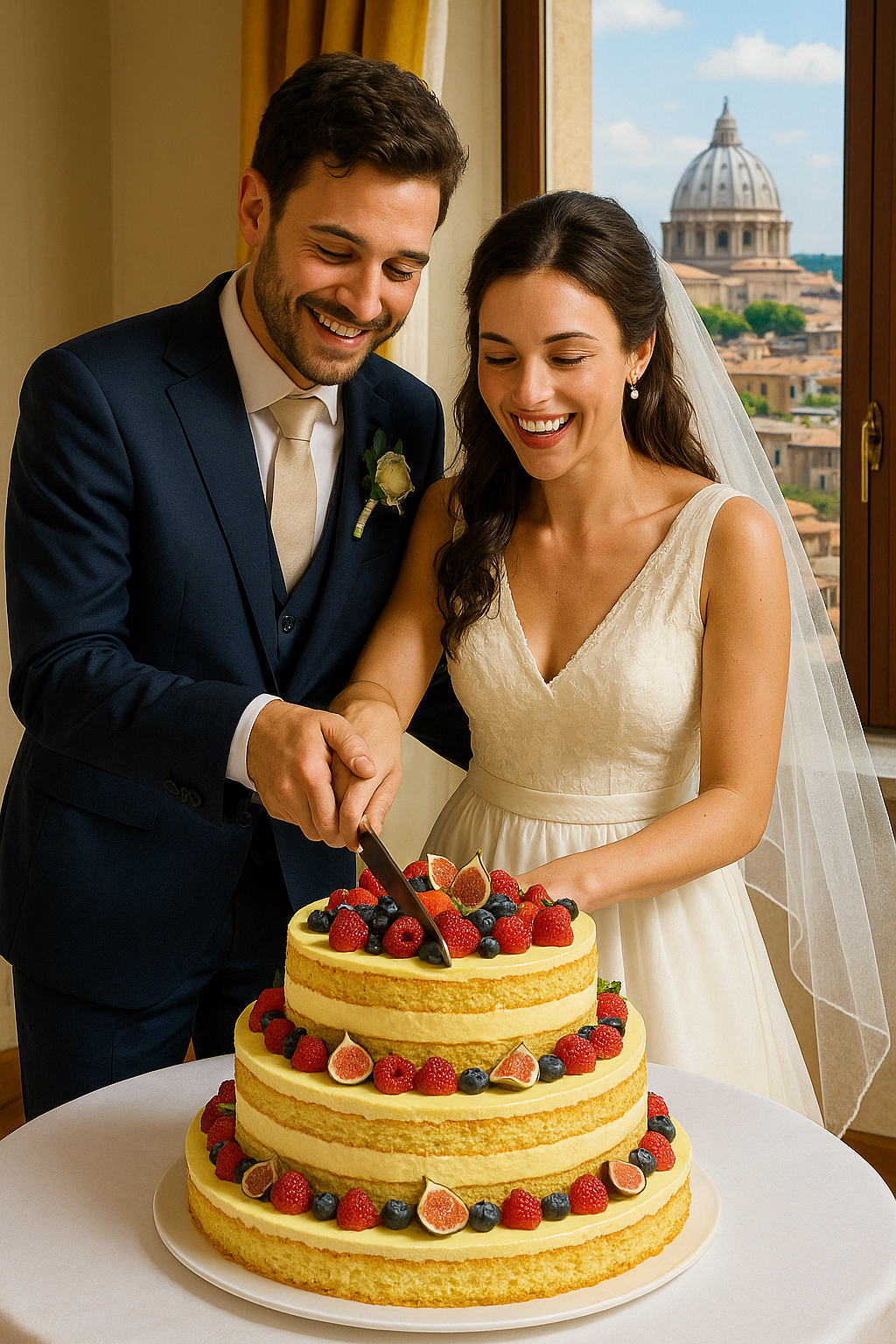
Known as la torta nuziale, Italian wedding cakes are often less sweet than American ones, with layers of sponge, custard, and fresh fruit. Cutting the cake together symbolizes the couple’s shared future.
Regional Traditions
Sicily: Weddings often involve parades through town, with musicians leading the bride and groom to the reception.
Naples: It is traditional to release doves as a symbol of peace and harmony.
Veneto: Weddings may include elements of carnival traditions, such as music and masks.
Tuscany: Receptions emphasize rustic elegance, often held in vineyards or countryside estates.
Post-Wedding Customs
The Honeymoon (La luna di miele)
The phrase itself, “honey moon,” reflects Italy’s long tradition of poetic imagery in love. Couples often travel to romantic destinations, both within Italy and abroad.
Wedding Favors (Le bomboniere)
Guests receive small gifts, usually sugared almonds (confetti), symbolizing life’s sweetness and bitterness. The almonds are always given in odd numbers (usually five), representing indivisibility.
FAQs About Italian Wedding Traditions
Q: Do Italians always get married in church?
A: No. While Catholic weddings remain common, many Italians choose civil ceremonies, especially in cities.
Q: Why do Italians throw rice at weddings?
A: Rice symbolizes fertility and prosperity. Some modern weddings substitute rice with flower petals or eco-friendly confetti.
Q: What’s unique about Italian wedding receptions?
A: The sheer abundance of food and the length of the celebration. Receptions often last until dawn, with multiple courses and endless dancing.
Q: Do Italian weddings include dowries or arranged elements?
A: Historically yes, but today marriages are based on personal choice, though family involvement remains strong.
Q: What do Italian brides traditionally wear?
A: A white dress, often with symbolic ribbons or accessories. Veils are common in religious ceremonies.
Q: Why are sugared almonds given as favors?
A: They represent the bittersweet nature of life and marriage. Given in odd numbers, they symbolize unity.
Q: Do all regions follow the same traditions?
A: No. While some rituals are shared, each region has its own unique customs, foods, and celebrations.
Q: How important is language at Italian weddings?
A: Very. Specific phrases, blessings, and toasts are central to the atmosphere, and many rituals are amplified by the beauty of the Italian language.
Conclusion
Italian weddings are more than ceremonies—they are cultural masterpieces that weave together family, food, ritual, and language into a celebration of love that is both deeply traditional and joyfully alive. To witness or take part in one is to experience the very heart of Italian culture: warmth, elegance, and a devotion to life’s most important bonds.
If you’re captivated by these traditions and want to connect more deeply with Italian culture, learning the language is the perfect first step. At Polyglottist Language Academy, we offer Italian classes that don’t just teach grammar and vocabulary but immerse you in the cultural fabric of Italy. Join us and start your journey into the language of love, family, and tradition.
Explore More from Our Blog
If you enjoyed this article, check out our other posts:
Why Italians Live With Their Parents Longer (And What It Says About Culture)
How Italians Really Eat Pasta (And The Rules Tourists Break)
How Italians Really Speak: Street Italian Vs. Textbook Italian
Italian Language Meets Italian Lifestyle: What You Can Only Learn On The Ground
Learning Italian In San Francisco: Best Places, Classes, And Meetups