
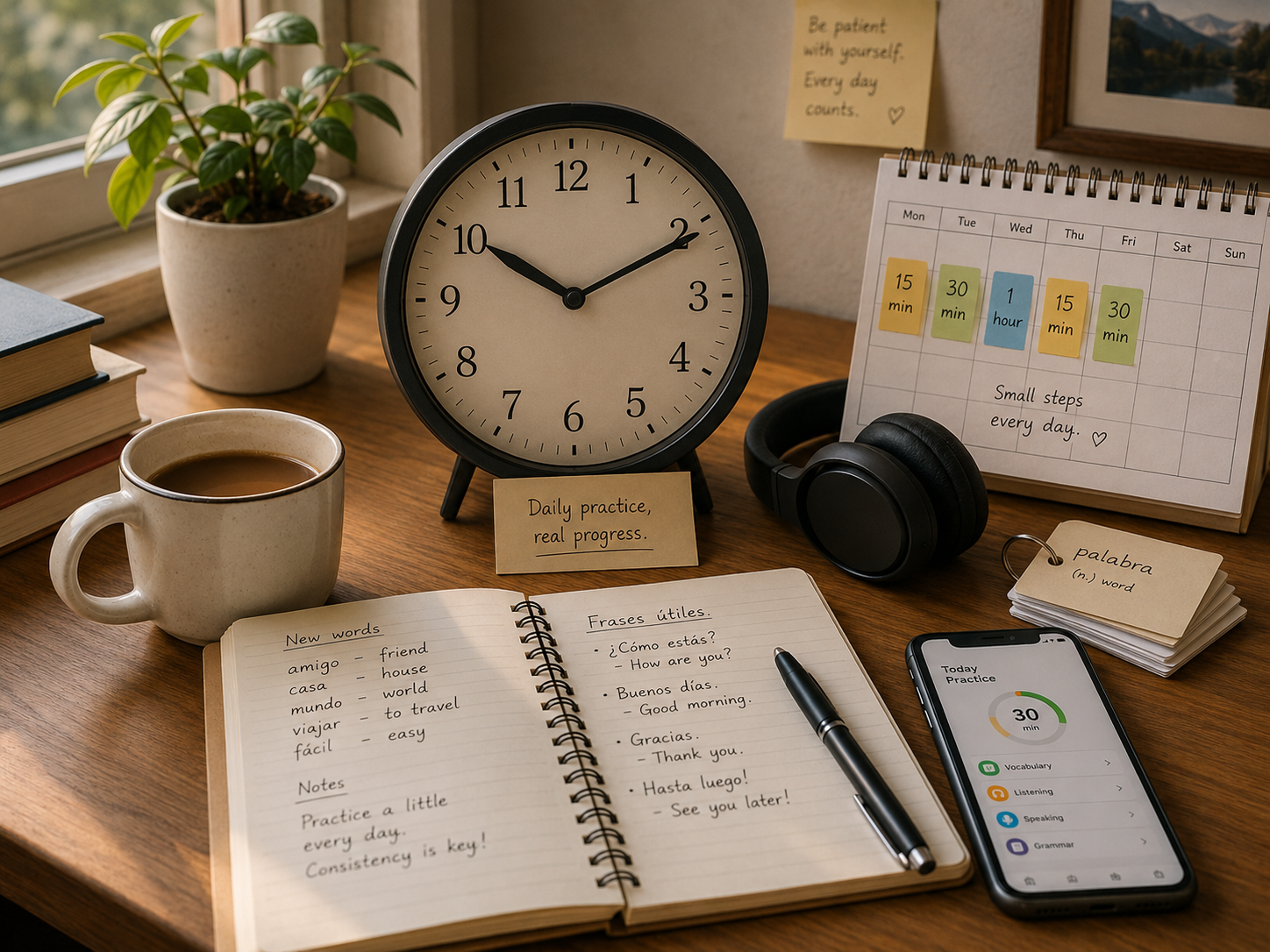
When people imagine learning a new language, they often picture themselves sitting for hours at a desk with textbooks, grammar charts, vocabulary lists, audio exercises, and a heroic amount of discipline, as if fluency belongs only to those who can disappear from ordinary life and dedicate entire afternoons to conjugations, pronunciation drills, and carefully color-coded notebooks.
But real language learning rarely works that way.
Most adults who want to learn French, Spanish, Italian, Russian, German, Mandarin, Japanese, Portuguese, Dutch, Korean, or any other language are not living inside a language-learning retreat. They have jobs. They have families. They have appointments, bills, commutes, emails, meals to cook, and a mind that is already tired by the end of the day. They may begin with great enthusiasm, study intensely for a week, miss two days, feel guilty, try to “catch up” with a three-hour session, and then slowly start to associate the language with pressure instead of curiosity.
That is one of the biggest reasons people quit.
They do not quit because they are incapable of learning a language. They quit because they build a practice routine that is too heavy to survive real life.
So the question “How much should you practice per day when learning a new language?” is more important than it seems. It is not just a question about minutes. It is a question about rhythm, consistency, memory, motivation, and the kind of relationship you want to build with the language over time.
The honest answer is this: most learners make better progress with 20–30 minutes of focused daily practice than with long, irregular study sessions once or twice a week. If you can practice more, wonderful. If you only have 10 minutes, that can still be useful. But the key is not the dramatic study marathon. The key is regular contact.
A language is not like a fact you memorize once and keep forever. It is more like a musical instrument, a physical skill, or a relationship. It needs repeated exposure. It needs small returns. It needs your ear, your mouth, your memory, and your confidence to keep meeting it again and again.
This article will help you understand how much daily practice is realistic, what kind of practice matters most, how your goals affect your study time, and how to create a language-learning routine that you can actually keep.
The Simple Answer: Aim for 20–30 Minutes Per Day
For most beginner and intermediate learners, 20 to 30 minutes per day is an excellent target.
It is long enough to do meaningful work but short enough that it does not feel impossible. In 20–30 minutes, you can review vocabulary, listen to a short dialogue, practice pronunciation, write a few sentences, complete a grammar exercise, or prepare for class. You can touch the language in a way that keeps it alive in your brain.
This amount of time is especially useful because language learning depends heavily on repetition. You are not trying to “finish” the language. You are trying to build familiarity. Every time you return to a phrase, word, sound, or sentence pattern, your brain has another chance to recognize it faster.
For example, if you are learning Italian, seeing Come stai? once is not enough. You may understand it today and forget it tomorrow. But if you hear it, say it, write it, answer it, and encounter it again in a conversation, it starts to become automatic.
That automatic feeling is what you are really trying to build.
The same is true in Russian with Как дела?, in French with Comment ça va?, in Spanish with ¿Cómo estás?, or in Japanese with お元気ですか? At first, the phrase feels foreign. Then it feels familiar. Then it becomes something you can use without translating every word.
That transformation happens through repeated contact, not through one heroic study session.
Why Daily Practice Works Better Than Occasional Long Sessions
Many language learners say, “I don’t have time every day, but I can study for two hours on Sunday.”
That is better than nothing, but it is usually not the most effective approach.
Imagine trying to get physically stronger by working out for three hours once a week and doing nothing the rest of the time. You might improve a little, but the process would be slow, exhausting, and inconsistent. Your muscles need regular stimulation. Your brain works similarly with language.
A new language involves several systems at once:
You need to recognize new sounds.
You need to remember vocabulary.
You need to understand grammar patterns.
You need to produce sentences.
You need to hear words at natural speed.
You need to build confidence speaking.
Each of these skills benefits from frequent practice. When you study once a week, you spend too much time recovering what you forgot. When you study a little every day, you build continuity.
This is why a learner who practices 25 minutes daily may often outperform someone who studies for three hours only on the weekend.
The daily learner is not starting over each time. The language remains present.
Is 10 Minutes a Day Enough?
Yes, 10 minutes a day can be enough to maintain contact with the language, especially if you are very busy or just beginning.
But 10 minutes has limits.
If your goal is simply to keep the language alive, review what you already know, or slowly build a habit, 10 minutes can be very helpful. You can review flashcards, listen to a short audio clip, repeat a dialogue, or read a few sentences.
However, if you want steady progress toward conversation, 10 minutes may not be enough as your only form of study. You will probably need longer sessions several times per week, especially for speaking practice, listening comprehension, grammar, and writing.
A good way to think about 10 minutes is this:
Ten minutes keeps the door open. Twenty to thirty minutes lets you walk through it.
If you are tired, overwhelmed, or restarting after a break, begin with 10 minutes. It is much better to practice for 10 minutes every day than to promise yourself an hour, fail repeatedly, and give up.
Language learning is full of emotional traps. One of the biggest is perfectionism. People think, “If I can’t study properly today, I won’t study at all.” This is a mistake.
A small session still counts.
Even five minutes of reviewing phrases while waiting for coffee can strengthen your memory. Even listening to one short dialogue before bed can help your ear. Even saying five sentences out loud can keep your speaking muscles engaged.
Do not underestimate small practice.
Is One Hour a Day Better?
One hour a day can be excellent if you can sustain it without burning out.
If you are preparing for travel, trying to pass an exam, moving abroad, studying for professional reasons, or hoping to make serious progress quickly, one hour per day can make a major difference. With an hour, you can combine several types of practice in one session.
For example:
10 minutes: vocabulary review
15 minutes: listening practice
15 minutes: grammar or sentence building
10 minutes: speaking out loud
10 minutes: reading or writing
That kind of routine gives your brain multiple ways to interact with the language. You are not only memorizing. You are hearing, producing, noticing, and using.
However, one hour per day is only better if it is realistic. If you can maintain it, wonderful. If it feels heavy after three days, it may not be the right starting point.
Many learners begin with too much ambition. They decide they will study every day for one hour, but they have not yet built the habit. After a few missed days, the routine collapses.
It is often better to begin with 20 minutes and gradually increase.
You can always add more time later. It is much harder to recover from discouragement.
The Best Practice Time Depends on Your Goal
There is no single perfect number of minutes for everyone. The right amount depends on what you want.
If You Are Learning Casually
If you are learning for fun, travel, culture, or personal interest, 15–30 minutes per day is a very good target.
You do not need to pressure yourself. You can focus on useful phrases, pronunciation, listening, and simple conversations. The goal is to enjoy the language and make steady progress.
For example, if you are learning French because you love French culture or want to travel more comfortably, 20 minutes a day can take you far over time. You can learn greetings, café phrases, polite expressions, basic verbs, and listening skills without turning the process into a second job.
If You Are Taking a Weekly Class
If you are enrolled in a weekly language class, try to practice 20–30 minutes per day between classes, or at least three to five times per week.
This is where many students make a mistake. They attend class once a week and expect the class itself to create fluency. A class gives you structure, explanation, correction, and interaction, but the real progress happens when you review and reuse the material between lessons.
If you take a German class on Wednesday and do not look at German again until the following Wednesday, your teacher will spend part of every class helping you recover what you already learned.
But if you review for 15–20 minutes a few times during the week, you arrive prepared. You remember more. You speak more confidently. You can build on the previous lesson instead of restarting.
If You Are Preparing for Travel
If your trip is coming soon, aim for 30–45 minutes per day, especially in the final weeks before departure.
Focus on practical language:
Greetings
Ordering food
Asking for directions
Numbers and prices
Transportation
Hotel phrases
Polite requests
Emergency phrases
Basic questions and answers
You do not need to master the entire grammar system before traveling. You need survival fluency: the ability to greet people, ask simple questions, understand common responses, and be polite.
For travel, daily short speaking practice is especially useful. Say phrases out loud. Practice real situations. Do not only read silently.
If You Want Conversational Fluency
If your goal is conversational fluency, you should aim for 30–60 minutes per day, with real speaking practice included several times per week.
Fluency requires more than vocabulary recognition. You need to produce language under pressure. You need to answer questions, make mistakes, recover, and keep going.
This does not mean every practice session must be intense. But you do need regular active use.
Reading and listening are important, but if you never speak, speaking will remain difficult.
If You Are Studying for an Exam
If you are preparing for a formal exam, you may need 60–90 minutes per day, depending on the level and deadline.
Exam preparation often requires a balanced routine: grammar review, reading comprehension, listening exercises, writing tasks, vocabulary, and timed practice. It is more demanding than casual learning because you are not only trying to communicate; you are trying to perform under specific conditions.
Still, even exam learners should avoid burnout. Longer practice should be structured and varied, not just hours of passive review.
Quality Matters More Than Quantity
One of the most important things to understand is that not all practice is equal.
Thirty minutes of focused, active practice is better than two hours of distracted, passive exposure.
For example, watching a movie in your target language can be enjoyable, but if you understand almost nothing and do not actively engage with it, it may not help much at the beginner level. On the other hand, listening to a two-minute dialogue several times, repeating the lines, writing down key phrases, and answering questions about it can be extremely valuable.
Good practice usually includes one or more of these elements:
You are paying attention.
You are retrieving information from memory.
You are speaking or writing.
You are listening for specific meaning.
You are reviewing material before you forget it.
You are using language in context.
You are correcting mistakes.
You are repeating important patterns.
Passive exposure has its place. Music, films, podcasts, and background listening can help you feel connected to the language. But if you only consume the language passively, progress may be slow.
Active practice is what turns recognition into ability.
What Should You Actually Do During Daily Practice?
A common problem is that learners know they should practice but do not know what to do.
Here is a simple 30-minute daily routine that works for many learners.
5 Minutes: Review Old Material
Start with something familiar. Review vocabulary, phrases, or notes from your last lesson. This warms up your memory and prevents forgetting.
Do not spend the whole session reviewing, but do not skip it either. Review is what makes learning stick.
10 Minutes: Learn or Strengthen One Small Thing
Choose one focus. Not five. One.
For example:
A new verb pattern
Five useful phrases
A pronunciation rule
Numbers
Past tense forms
Question words
Restaurant vocabulary
A short dialogue
Many learners overwhelm themselves by trying to learn too much at once. A small amount learned well is better than a large amount half-recognized.
10 Minutes: Use the Language Actively
This is the most important part.
Say sentences out loud. Write your own examples. Answer questions. Record yourself. Make a mini-dialogue. Describe your day in simple language.
If you are learning Spanish, do not only read Me gusta el café. Say it. Change it. Make it personal:
Me gusta el café.
Me gusta el té.
No me gusta el vino.
Me gusta estudiar español.
This kind of active manipulation helps you own the language.
5 Minutes: Listen or Read
End with input. Listen to a short audio clip, read a short paragraph, or review a dialogue. Try to notice something you learned earlier in the session.
This creates a satisfying feeling of recognition: “I know this now.”
That feeling is powerful. It motivates you to return tomorrow.
The Beginner’s Mistake: Too Much New Information
Beginners often think progress means learning as many words and rules as possible. They may try to memorize long vocabulary lists, study multiple verb tenses, or understand every grammar detail right away.
This usually backfires.
At the beginner level, your brain is already working hard. The sounds are new. The spelling may be new. The sentence structure may be unfamiliar. Even simple phrases can feel strange.
If you add too much information at once, you may feel productive in the moment but remember very little later.
A better beginner routine is slow, repetitive, and practical.
Learn a small set of useful phrases. Practice them in different ways. Hear them. Say them. Write them. Use them in tiny conversations. Add grammar gradually.
For example, instead of learning 50 Russian words in one day, a beginner might do better with five phrases:
Здравствуйте.
Меня зовут…
Очень приятно.
Как дела?
До свидания.
Then the learner can practice pronunciation, meaning, response, and usage. These phrases become usable, not just recognizable.
That is real progress.
The Intermediate Mistake: Avoiding Speaking
Intermediate learners often have the opposite problem. They may know a lot of vocabulary and grammar but avoid speaking because they are afraid of making mistakes.
They read articles, complete exercises, watch videos, and understand more than before. But when someone asks them a question, they freeze.
For intermediate learners, daily practice should include more output.
That means speaking and writing.
You can start small:
Describe your morning.
Summarize a short article.
Answer three questions.
Record a one-minute voice note.
Retell a dialogue in your own words.
Write five sentences using a new grammar structure.
The goal is not perfection. The goal is access. You want to train your brain to find words when you need them.
Speaking is not something you save for after you “know enough.” Speaking is part of how you learn.
Should You Practice Every Day?
Ideally, yes — but “every day” does not need to mean intense study every day.
It is useful to distinguish between practice days and contact days.
A practice day might be 30–60 minutes of focused work.
A contact day might be 5–10 minutes of listening, review, or speaking.
This distinction prevents all-or-nothing thinking.
You may not have time for a full session every day. But you can usually have some contact with the language. Even a tiny connection keeps the habit alive.
For example:
Monday: 30-minute lesson review
Tuesday: 10-minute vocabulary practice
Wednesday: 45-minute class
Thursday: 20-minute listening practice
Friday: 5-minute phrase review
Saturday: 30-minute speaking practice
Sunday: relaxed movie, song, or reading
This is a realistic rhythm. It allows life to happen without abandoning the language.
How Much Practice Do Children Need Compared to Adults?
Adults often worry that children learn languages more easily. In some ways, children do have advantages, especially when they are immersed and hear the language for many hours a day. But adults have advantages too.
Adults can understand explanations.
Adults can use learning strategies.
Adults can compare languages.
Adults can set goals.
Adults can practice deliberately.
The problem is that adults often expect adult-style efficiency from a process that still requires repetition. You may understand a grammar rule quickly, but that does not mean you can use it automatically in conversation.
Understanding is fast. Acquisition is slower.
This is why daily practice matters so much. It bridges the gap between “I understand this” and “I can use this.”
Is It Better to Practice in the Morning or Evening?
The best time to practice is the time you can keep.
Some people love morning practice because their mind is fresh. A 20-minute language session with coffee can be a beautiful way to start the day. Others prefer evening practice because the day’s responsibilities are finished. Some people practice during lunch, on public transportation, or while walking.
The specific time matters less than consistency.
That said, morning practice has one advantage: it is less likely to be stolen by the rest of the day. If you always plan to study “later,” later may never come.
A good strategy is to attach language practice to something you already do:
After morning coffee
Before checking email
During lunch break
After dinner
Before bed
Right after a weekly class
This is called habit stacking. You are not relying only on motivation. You are building the language into your existing routine.
How Much Should You Practice Speaking?
If your goal is to speak the language, you should practice speaking almost every day, even briefly.
This does not always require another person. You can speak to yourself, repeat audio, shadow dialogues, read aloud, answer prompts, or record your voice.
Of course, real conversation with a teacher, tutor, classmate, or language partner is extremely valuable. But solo speaking practice also matters.
Many learners make the mistake of studying silently. They read silently, review silently, and answer grammar questions silently. Then they are surprised that speaking feels difficult.
Speaking is physical. Your mouth needs practice. Your tongue needs practice. Your breathing and rhythm need practice. The sounds need to become comfortable.
Even five minutes of speaking out loud can help.
Try this simple daily speaking routine:
Choose three useful sentences.
Say each one slowly.
Say each one naturally.
Change one word.
Ask yourself a question.
Answer it out loud.
This is simple, but it builds confidence.
How Much Should You Practice Listening?
Listening should be part of your routine from the beginning.
Many learners postpone listening because they feel they are “not ready.” But listening is not a final test. It is a skill you build gradually.
At the beginner level, listen to short, clear audio. Dialogues are especially useful. Listen several times. Do not expect to understand everything at once.
First listening: catch the general situation.
Second listening: identify familiar words.
Third listening: follow the transcript.
Fourth listening: repeat out loud.
Listening improves through repetition. If you jump immediately to fast news, films, or native podcasts, you may feel discouraged. Those materials can be useful later, but beginners need comprehensible input: language that is slightly challenging but not completely overwhelming.
For daily practice, even 5–10 minutes of listening can make a difference.
How Much Vocabulary Should You Learn Per Day?
A realistic beginner target is 5–10 useful words or phrases per day.
Not 50. Not 100. Five to ten.
The goal is not to “see” as many words as possible. The goal is to remember and use them.
Phrases are often better than isolated words. For example, instead of only learning the French word besoin meaning “need,” learn the phrase:
J’ai besoin de…
I need…
Now you have a structure you can use.
J’ai besoin d’aide.
I need help.
J’ai besoin d’un café.
I need a coffee.
J’ai besoin de pratiquer.
I need to practice.
This is much more useful than memorizing a single word with no context.
Vocabulary grows best when it is connected to sentences, situations, and personal meaning.
How Long Does It Take to See Progress?
You can often feel small progress within a few weeks if you practice regularly.
After one week, you may recognize greetings and basic phrases.
After one month, you may understand simple dialogues and introduce yourself.
After three months, you may handle basic conversations in familiar situations.
After six months, you may feel much more comfortable, especially if you combine class, review, listening, and speaking.
Progress depends on the language, your previous experience, the quality of instruction, and how consistently you practice. A language closely related to one you already know may feel easier. A language with a new writing system or very different grammar may require more time.
But the principle remains the same: small daily practice creates visible progress.
You may not notice improvement every day. That is normal. Language learning often feels slow while it is happening. Then suddenly you realize you understood a sentence without translating. You answered a question faster. You remembered a word you used to forget. You watched a short video and caught the main idea.
Those moments are the reward of consistency.
What If You Miss a Day?
You will miss days. Everyone does.
Missing one day is not a problem. Turning one missed day into a week of guilt is the problem.
The best rule is simple:
Never miss twice if you can avoid it.
If you miss Monday, do 10 minutes on Tuesday. Do not try to punish yourself with a two-hour catch-up session. Just return.
Language learning should be steady, not dramatic. Your routine should be forgiving enough to survive real life.
If you have a very busy week, switch to maintenance mode. Review flashcards. Listen to a short audio. Read one paragraph. Say five sentences.
Then return to deeper practice when you can.
The Best Daily Practice Plan by Time Available
If You Have 5 Minutes
Review five phrases.
Say them out loud.
Listen to one short audio clip.
Write one sentence.
This is not enough for rapid progress, but it keeps the habit alive.
If You Have 15 Minutes
Review old material for 5 minutes.
Practice one small new thing for 5 minutes.
Speak or write for 5 minutes.
This is a great minimum routine.
If You Have 30 Minutes
Review for 5 minutes.
Learn or strengthen one focus area for 10 minutes.
Practice actively for 10 minutes.
Listen or read for 5 minutes.
This is the best daily target for many learners.
If You Have 60 Minutes
Review for 10 minutes.
Study grammar or vocabulary for 15 minutes.
Listen for 10 minutes.
Speak for 15 minutes.
Read or write for 10 minutes.
This is excellent for serious progress.
If You Have 90 Minutes or More
Break your study into sections. Do not do one thing for the entire time.
For example:
30 minutes: class material review
20 minutes: listening
20 minutes: speaking
20 minutes: reading or writing
Long sessions are useful when varied. They are less useful when they become passive or exhausting.
The Role of Classes in Daily Practice
A good language class gives you something self-study cannot always provide: structure, correction, interaction, and accountability.
When you study alone, you may not know what to focus on next. You may repeat mistakes without noticing. You may avoid speaking. You may spend too much time on apps and not enough time forming real sentences.
A class helps organize the process.
But class alone is not enough. The students who progress fastest are usually the ones who practice between lessons. They do not necessarily study for hours. They simply return to the material regularly.
A weekly class plus 20 minutes of daily practice can be a powerful combination.
The class introduces and activates the language. Daily practice helps it settle.
Why Consistency Builds Confidence
Language learning is not only intellectual. It is emotional.
Many learners feel embarrassed when they speak. They worry about sounding foolish. They compare themselves to others. They think they should remember more than they do.
Daily practice helps reduce this anxiety because the language becomes less foreign. The more often you meet it, the less intimidating it feels.
At first, even basic sentences may feel strange. But after repeating them many times, they become familiar. Familiarity creates confidence.
Confidence does not come from waiting until you are perfect. It comes from proving to yourself that you can return, try again, and improve.
That is why a realistic daily routine is so important. It teaches your brain: “I am someone who practices this language.”
Identity matters. Once language learning becomes part of who you are, progress becomes easier to sustain.
So, How Much Should You Practice Per Day?
Here is the clearest answer:
If you are a beginner, aim for 20–30 minutes per day.
If you are very busy, do 10 minutes per day and stay consistent.
If you want faster progress, aim for 45–60 minutes per day.
If you are preparing for an exam or major life change, you may need 60–90 minutes per day.
If you are taking a class, review between lessons for at least 15–30 minutes several times per week.
But above all, choose a routine you can repeat.
A language is learned through return. Return to the sounds. Return to the phrases. Return to the questions. Return to the grammar. Return to the conversation. Return even after a bad day, a busy week, or a period of low motivation.
You do not need to practice perfectly.
You need to keep coming back.
FAQs: Daily Language Practice
Is 30 minutes a day enough to learn a language?
Yes, 30 minutes a day can be enough to make steady progress, especially if your practice is focused and consistent. You should include review, listening, speaking, and active use of the language. For faster progress, combine daily practice with a structured class.
Can I learn a language with only 10 minutes a day?
You can build a habit and maintain progress with 10 minutes a day, but it may be slow if that is your only practice. Ten minutes is excellent for review, vocabulary, and listening, but you may need longer sessions for speaking, grammar, and conversation.
Is it better to study every day or once a week?
It is better to study a little every day than to study for a long time only once a week. Daily practice helps memory, pronunciation, listening, and confidence. A weekly class is very useful, but it works best when combined with regular review between lessons.
How many words should I learn per day?
Most beginners should aim for 5–10 useful words or phrases per day. It is better to learn fewer words deeply than many words superficially. Try to learn vocabulary in sentences, not just isolated lists.
Should I practice speaking every day?
If your goal is conversation, yes, you should practice speaking regularly, ideally every day, even for a few minutes. You can repeat dialogues, answer questions, read aloud, or record yourself. Speaking improves through use, not just study.
What should I do if I miss several days?
Simply restart with a small session. Do not try to punish yourself or catch up all at once. Review familiar material, do 10–15 minutes, and rebuild the habit. Missing days is normal; returning is what matters.
How much should I practice before traveling?
If you are preparing for travel, 30–45 minutes per day for several weeks can be very helpful. Focus on practical phrases: greetings, ordering food, asking directions, transportation, hotels, numbers, and polite expressions.
Do language apps count as practice?
Yes, language apps can count as practice, especially for vocabulary and review. However, apps should not be your only method. To become conversational, you also need listening, speaking, real sentence practice, and ideally interaction with a teacher or classmates.
Learn a Language with Polyglottist Language Academy
If you want to make language learning part of your life but you are not sure how to structure your practice, Polyglottist Language Academy can help.
We offer small, supportive language classes designed for adults who want real progress without feeling overwhelmed. Whether you are learning for travel, culture, family, work, literature, or personal growth, our classes give you the structure and guidance that self-study often lacks.
At Polyglottist Language Academy, students learn in small groups where they can ask questions, practice speaking, review important material, and build confidence step by step. Our classes are designed to help you continue beyond the first few lessons and gradually develop a real relationship with the language.
We offer classes in languages such as Italian, German, Russian, Spanish, Mandarin Chinese, Tagalog, Japanese, Korean, and Vietnamese, depending on current schedules and availability.
If you are ready to stop guessing how to study and start building a realistic language-learning routine, we invite you to explore our current classes and sign up for the language that inspires you most.
A little practice every day can change what feels possible. A good class can help you keep going.
Check Out Our Other Blog Articles
If you enjoyed this article, you may also like these related posts from our language-learning blog:
Japanese Classes In San Francisco For Adults: Where To Start
How Long Does It Take To Learn Japanese? A Realistic Timeline
Coming Later This Year: Practical Digital Language Courses From Polyglottist Language Academy
Where To Learn German In Oakland: A Practical Guide For Adult Learners
Small-Group Spanish Classes In Berkeley Vs Apps: What Produces Real Results?
Why Brazilian Portuguese Is Often Considered Easier For Beginners
Best Portuguese Classes In San Francisco: Where To Learn Locally And Online