
Japanese Classes in Seattle: From Complete Beginner to Conversational Japanese
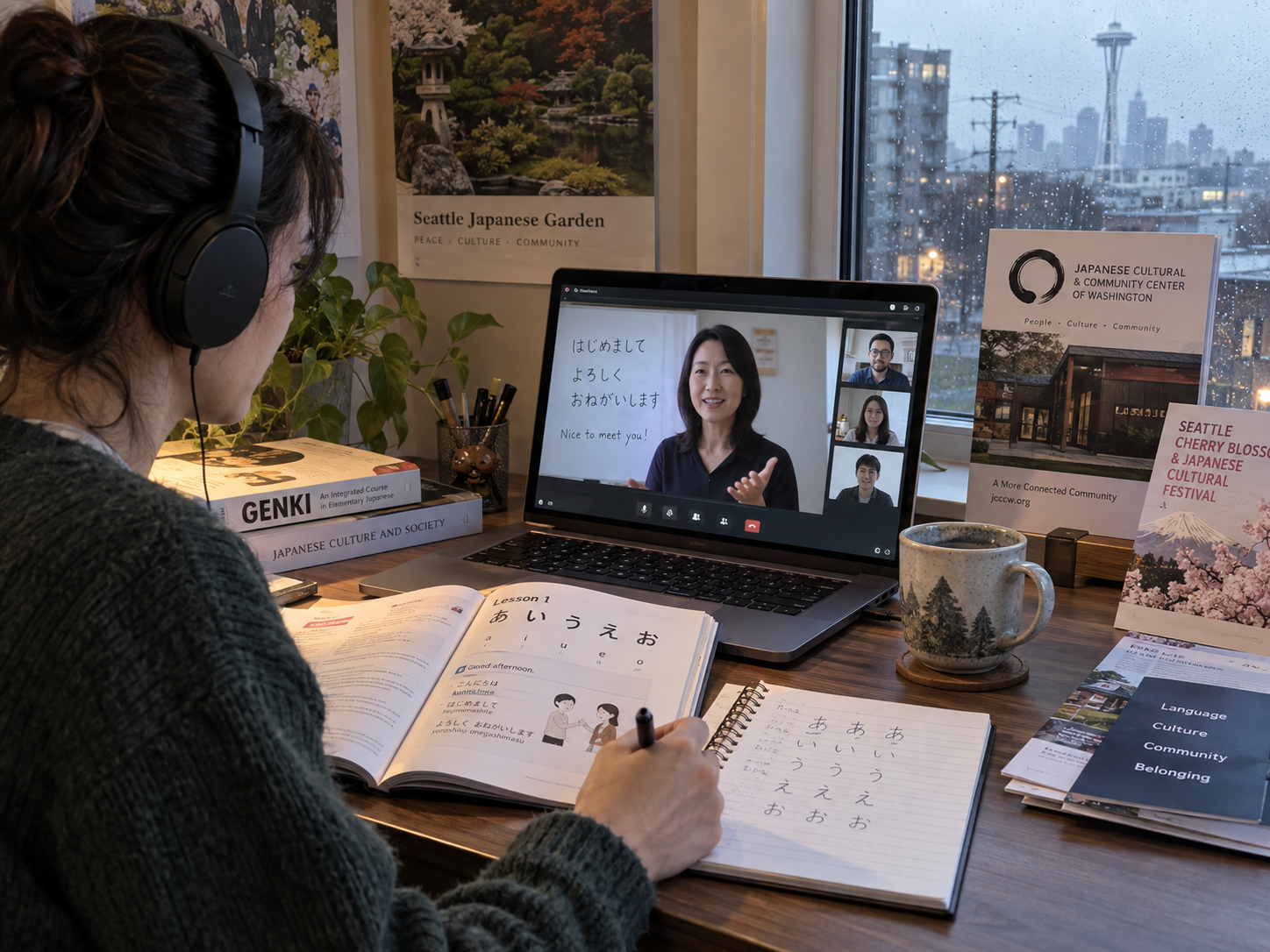
Seattle has something many American cities do not: a Japanese language school with more than a century of history and an adult program large enough to offer a real sequence of levels.
That makes the city unusually promising for adult learners, but there is one detail that surprises people searching for “Japanese classes in Seattle”: the Seattle Japanese Language School's current adult classes are online, even though the institution itself is deeply rooted in the local Japanese American community.
Seattle Japanese Language School and JCCCW
The Seattle Japanese Language School operates through the Japanese Cultural & Community Center of Washington. The school dates back to 1902 and offers both youth and adult education. For Fall 2026, adult classes include multiple novice, intermediate, and high-intermediate levels, along with Marugoto courses and Japanese for Travelers.
Current adult sections meet on weekday evenings and, in some cases, Saturday mornings. The school lists 10-week adult sessions and small online classes designed to preserve interaction rather than functioning as recorded self-study.
For a complete beginner, the Genki Novice 1 and Marugoto Entry offerings are particularly relevant. The school explicitly describes Novice 1 as appropriate for learners with no prior Japanese.
Why an online class can still be locally meaningful
It may sound contradictory to recommend a Seattle institution whose adult classes meet online. In practice, the community connection still matters. JCCCW is not simply a remote language platform: it is a cultural center with local history, events, collections, and community activity.
That gives learners a path from online grammar practice to real-world cultural engagement. Someone who studies from home on Tuesday night can still attend a Seattle-area cultural event or visit the center at another time.
Genki or Marugoto?
The program's use of both Genki and Marugoto reflects two somewhat different approaches to Japanese study.
Genki is widely used in college and adult classes. It builds grammar, reading, writing, vocabulary, and kanji in a fairly systematic sequence. Learners who like clear chapters and cumulative structure often respond well to it.
Marugoto is more strongly organized around communicative tasks and real-life scenarios. Some adults prefer that emphasis, especially if their immediate goal is practical interaction rather than academic grammar study.
Neither approach is automatically better. The more useful question is which one matches how you learn and what you want to do with Japanese.
What progress from beginner to conversational actually looks like
“Conversational Japanese” is not a single level. A beginner may be able to order food and introduce themselves after a short period of study while still being unable to follow two native speakers talking naturally to each other.
As learners progress, the difficult part becomes less about knowing isolated grammar points and more about processing them quickly. You may know that 〜てもいいですか asks permission, but real conversation requires you to recognize it immediately, formulate your own response, and keep listening while planning what to say next.
Teachers often notice that adults who read well can still hesitate in conversation because they have had too little timed interaction. Live classes help by making language retrieval unavoidable.
Returning learners need placement, not a restart
Seattle's large level sequence is particularly useful for people who studied Japanese years ago. Returning adults often have uneven skills: hiragana comes back quickly, kanji recognition is patchy, and grammar feels familiar without being fully accessible.
Starting from lesson one can be boring, but jumping into an intermediate course can be frustrating. A placement or self-assessment process is therefore more useful than counting how many years you studied in high school or college.
Tutoring versus group classes
JCCCW also offers tutoring. One-on-one lessons are useful for targeted needs: pronunciation, business Japanese, a trip, JLPT preparation, or repairing specific gaps. Group classes provide something tutoring cannot fully reproduce: multiple conversation partners and the experience of listening to learners who phrase things differently from you.
For most adults, a group course is the better default and tutoring is the better supplement.
Using Seattle itself as part of your study
Seattle's Japanese and Japanese American community gives learners opportunities to connect language with food, history, art, and community institutions. The goal is not to turn every cultural outing into a vocabulary exercise. It is simply easier to sustain a language when it appears in your city rather than existing only on a screen.
If Seattle's schedule does not fit
A structured outside program can still work well. Polyglottist Language Academy offers live online Japanese classes for adults at multiple beginner and continuing levels. For someone whose work schedule conflicts with Seattle's sections, another live small-group class may be preferable to waiting several months.
The strongest feature of learning Japanese in Seattle is not that every class is in person. It is that learners can combine serious instruction with a local cultural environment. A complete beginner can start online, progress through a real sequence, and still feel connected to a community that has been teaching Japanese in Seattle for generations.