
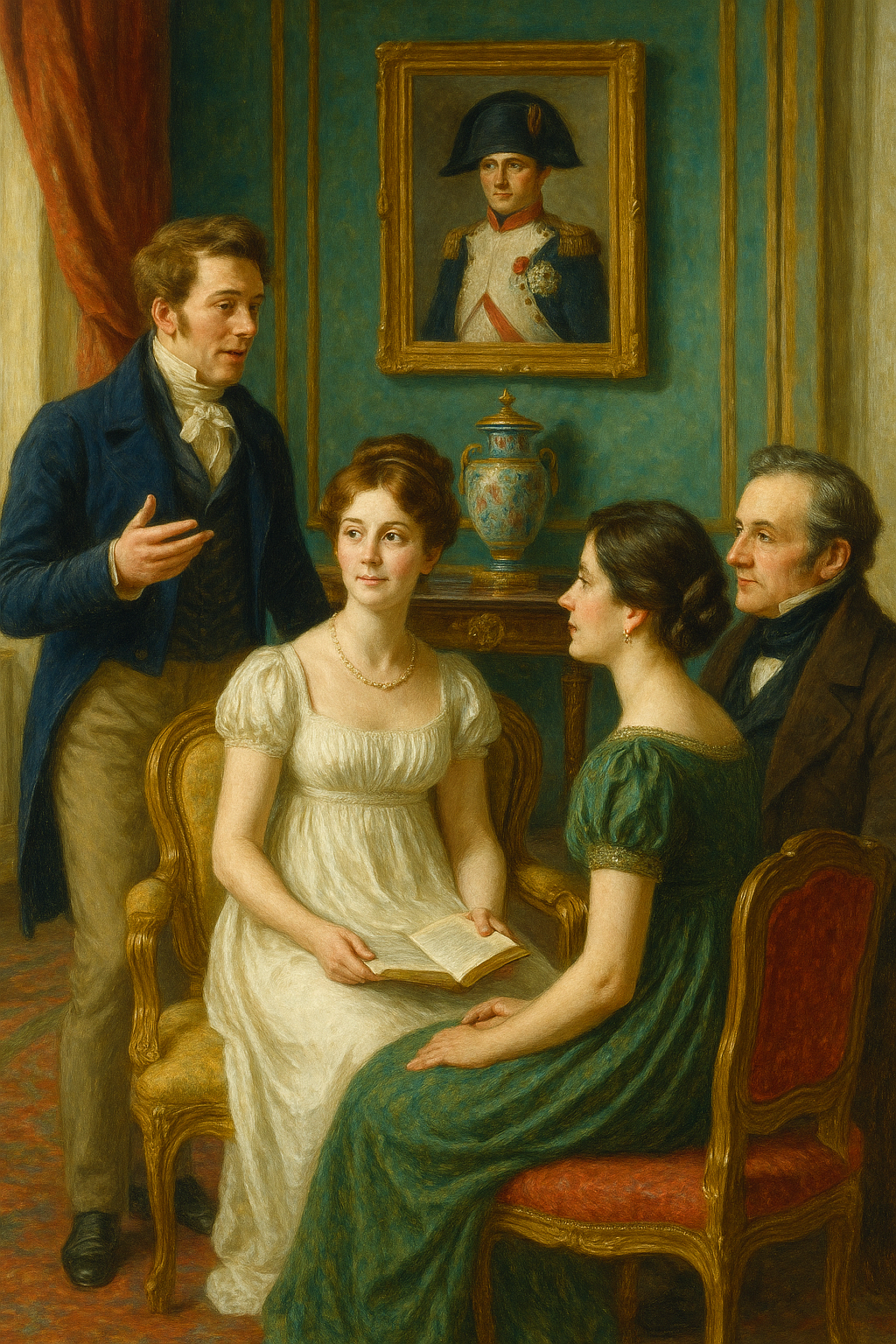
The story of 19th-century Russia cannot be told without French. For decades, French was not only the language of diplomacy and international refinement across Europe—it was also the language of the Russian aristocracy, shaping the way nobles thought, spoke, and even dreamed. To step into a drawing room of St. Petersburg or Moscow in the early 1800s was to enter a world where French conversation flowed more readily than Russian, where letters, diaries, and even intimate family exchanges were written in a language imported from Paris. To be a noble in Russia during this period meant not just owning land and enjoying privilege but also mastering the delicate art of French language and manners.
This phenomenon was more than a matter of style. It reflected Russia’s long struggle to define itself between East and West, to cultivate a place in the European community while still clinging to its Slavic roots. French became a marker of refinement and social distinction, but it also created tensions—between classes, between urban elites and rural peasants, and within individuals who often felt torn between their Russian identity and their French words. This duality produced some of the greatest literature the world has ever known, with authors like Tolstoy and Pushkin grappling with what it meant to be both Russian and European in spirit.
In this article, we will explore the deep influence of French on the Russian nobility of the 19th century. We’ll trace how it began in the 18th century, why it flourished in the 19th, how it manifested in daily life, and how it eventually declined. Along the way, we’ll look at examples from literature, history, and cultural life, and we’ll see how this linguistic and cultural exchange shaped not just the nobility but the very trajectory of Russian identity.
The Roots of Francophilia in Russia
The story begins in the 18th century under Peter the Great and Catherine the Great. Both rulers sought to modernize Russia by importing European practices, from military organization to architecture. French, as the dominant language of European high society, naturally became the language of the Russian court. Catherine corresponded in French, French tutors were hired for noble children, and French etiquette became the model for aristocratic behavior.
By the end of the 18th century, Russian noble families saw French not as a foreign language but as the default medium of polite society. Children were raised by French governesses, and it was not uncommon for nobles to speak Russian with their servants but French with each other.
French as the Language of Status
In 19th-century Russia, speaking French fluently was an essential marker of aristocratic status. To falter in French was to expose oneself as provincial or unsophisticated. A noble who could not conduct witty repartee in French might be quietly mocked in salons.
Social currency: Just as today’s elite may flaunt knowledge of English or global trends, the Russian nobility of the 1800s signaled their belonging through impeccable French.
Education: Noble children learned French before Russian in some households, leading to anecdotes of nobles struggling to express themselves in their “native” tongue.
Marriage and diplomacy: Many cross-border marriages and diplomatic exchanges depended on French, making it practical as well as fashionable.
The Role of French Tutors and Governesses
An entire generation of Russian nobles was raised by French tutors and governesses. These expatriates, often fleeing economic hardship or political upheaval in France, found lucrative work in aristocratic Russian households.
Impact: They not only taught the language but also transmitted cultural values, manners, and literary tastes.
Criticism: Some Russian intellectuals worried that children raised this way would grow up “alienated” from their own people, unable to connect with peasants who spoke only Russian.
French in Russian Literature
Russian literature of the 19th century provides vivid evidence of this phenomenon.
Tolstoy’s War and Peace: Large sections of dialogue are in French, reflecting the reality of noble life. Tolstoy even uses the switch between French and Russian to highlight themes of identity and authenticity.
Pushkin: Fluent in French, Pushkin often drew upon French literary models while simultaneously striving to assert Russian cultural independence.
Turgenev: Living much of his life in France, Turgenev wrote works in both languages and embodied the bicultural tension of his class.
The fact that great Russian authors wrote for an audience comfortable reading both French and Russian shows how deeply ingrained bilingualism was among the nobility.
The Paradox of Identity
French fluency created a paradox. On one hand, it brought Russia into European intellectual and cultural life. On the other, it widened the gap between nobles and the masses.
Peasant life: While nobles discussed Rousseau and Voltaire in French, the serfs who worked their estates spoke dialects of Russian that nobles often barely understood.
Nationalism: The Napoleonic Wars (1812) sparked a wave of Russian patriotism. Suddenly, speaking French carried ambivalence—it was the enemy’s language, yet still the nobility’s mother tongue.
Literary reflection: Authors used this paradox as a theme, questioning whether Russia’s true identity lay in Europe or in its own soil.
Decline of French Dominance
By the late 19th century, the dominance of French began to wane.
Rise of Russian language: Intellectuals like Dostoevsky championed Russian as the true medium of national spirit.
Educational reforms: Russian schools began emphasizing native literature and history.
Political shifts: Revolutionary movements stressed the need to connect with the Russian masses, making exclusive reliance on French appear elitist and outdated.
Still, traces of French lingered well into the 20th century, and many aristocratic memoirs from the early 1900s are still written in elegant French prose.
Everyday Life in French and Russian
A Russian noble household in 1850 might look like this:
Breakfast conversation in French, with witty banter about Parisian fashions.
Letters to relatives written entirely in French.
Russian spoken with estate managers and peasants.
Literary salons where French dominated, but Russian poetry was recited as an expression of patriotism.
This constant code-switching created a layered identity that was both sophisticated and fractured.
Cultural Consequences
The French influence on Russian nobility left enduring legacies:
Literary richness – Russian authors developed techniques of multilingual dialogue, which gave their works unique depth.
Hybrid culture – Russian high society became a blend of European refinement and Slavic traditions.
National awakening – The tension eventually fueled nationalist movements that sought to elevate Russian language and culture.
FAQs About French Influence on Russian Nobility
Q: Why did the Russian nobility choose French and not German or English?
A: In the 18th and early 19th centuries, French was the universal language of European high society and diplomacy. It was the natural choice for elites across the continent.
Q: Did all nobles speak French fluently?
A: Not all, but most educated nobles did. Fluency in French was considered essential for social advancement and participation in salons.
Q: Was Russian neglected entirely?
A: In some households, yes—children sometimes learned Russian later in life. But by the mid-19th century, there was a growing push to value Russian language and literature.
Q: How did peasants view nobles speaking French?
A: Often with indifference or resentment. It reinforced the social divide, as peasants could not understand French and sometimes felt alienated from their own landowners.
Q: Does French influence remain in Russian today?
A: Yes. Many French loanwords entered Russian (e.g., бутоньерка – boutonnière, пальто – coat, парикмахер – hairdresser).
Final Thoughts
The influence of French on 19th-century Russian nobility was profound and paradoxical. It elevated the aristocracy into European high society, gave birth to a rich bilingual literary culture, and shaped Russian manners for generations. Yet it also deepened class divisions and raised questions about national identity that still resonate in Russian culture today.
For learners of Russian, exploring this history is more than an academic exercise—it is a way of understanding the cultural crossroads that shaped the language you are studying. Each French loanword, each bilingual passage in Tolstoy, is a reminder that Russian identity has always been complex, dynamic, and deeply connected to its neighbors.
At Polyglottist Language Academy, we bring these cultural dimensions into our teaching. Learning Russian with us means not just mastering grammar, but also discovering the stories, traditions, and historical influences that give the language its soul. If you’re ready to learn Russian in a way that connects history, culture, and communication, sign up for our classes today.
Keep Reading
Explore more of our deep-dive articles on Russian language and culture: