
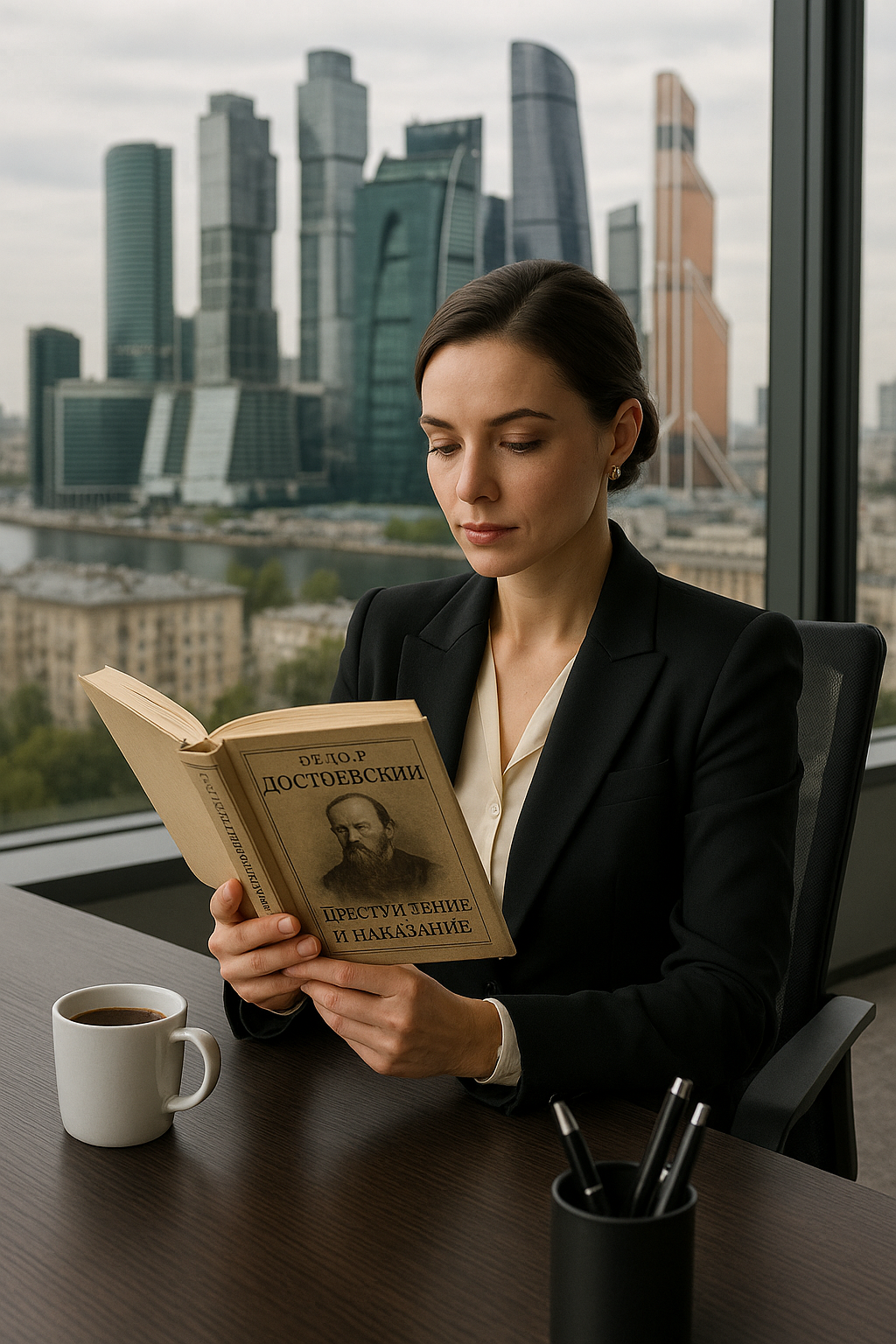
Even in an age defined by smartphones, streaming platforms, and artificial intelligence, Russian literature continues to resonate with an almost eerie immediacy. It doesn’t politely stay in the past—it crashes into the present, demanding to be felt. Pick up a novel by Dostoevsky, a short story by Chekhov, or a satirical dystopia by Zamyatin, and you’ll find yourself confronted with questions that feel unsettlingly contemporary: What happens when we lose our moral compass? Can individual freedom survive in the face of bureaucracy and control? How do we reconcile faith and doubt, reason and madness, love and destruction?
These are not just literary curiosities—they’re the same issues haunting our headlines, echoing through our political debates, and gnawing at the edges of our private lives. While many modern novels shy away from the messy contradictions of being human, Russian literature dives headfirst into the chaos. It’s unafraid of emotional extremes, unflinching in its explorations of pain, guilt, ecstasy, and despair. The Russian literary canon is filled with characters on the edge—of madness, of revolution, of spiritual collapse—and somehow, they feel more like our neighbors than our ancestors.
This uncanny relevance isn’t an accident. Russian writers have long been obsessed with the eternal—and the existential. They wrote not just to entertain, but to diagnose the soul of a nation, to protest injustice, to wrestle with God, and to expose the hypocrisies of power. In doing so, they anticipated many of the anxieties we now see playing out on a global scale: authoritarianism masquerading as order, technology outpacing ethics, loneliness in an allegedly connected world, and the crisis of meaning in a society obsessed with surfaces.
Far from being dusty relics of a bygone era, these works are razor-sharp tools for understanding our own. Russian literature still feels shockingly modern not because the world has remained the same—but because these writers saw deeper than most. They looked past the noise and into the soul, and what they found there still speaks, still startles, and still stings. The question isn’t whether Russian literature is relevant today. The real question is whether we’re brave enough to hear what it has to say.
1. Timeless Themes with Unflinching Honesty
Russian literature is obsessed with the big stuff: good and evil, justice and cruelty, freedom and oppression, God and nihilism. But it treats these themes not as abstractions, but as gut-level realities. Whether it’s Raskolnikov agonizing over a murder in Crime and Punishment, or Ivan Karamazov declaring rebellion against a God who allows innocent suffering, the questions don’t feel theoretical—they feel lived.
In a cultural climate where complexity is often flattened into soundbites, Russian authors resist resolution. They lean into contradiction and ambiguity, allowing us to live inside the struggle rather than rushing to closure. That honesty is rare—and bracing.
2. Psychological Depth Before Freud
One of the reasons Russian literature feels so modern is its deep psychological insight. Long before Freud formalized theories of the unconscious, Russian writers were mapping its contours. Dostoevsky, in particular, understood the self as fragmented, conflicted, and often at war with itself. His characters aren’t “developed”—they’re detonated.
Modern readers, used to psychological realism in film and television, are startled to discover how vivid and ahead-of-its-time Russian character development is. Whether it’s the guilt-ridden murderer in Crime and Punishment or the suicidal bureaucrat in Chekhov’s “The Death of a Government Clerk,” these characters feel like people you could meet on the street—or see in your reflection.
3. Dystopian Visions That Predated the Genre
Long before Orwell wrote 1984, Russian writers were exploring the nightmare of totalitarianism and the crushing weight of conformity. Yevgeny Zamyatin’s We (1921) is one of the earliest examples of dystopian fiction and directly influenced Orwell’s later work. In Zamyatin’s world, people are known by numbers, watched constantly, and punished for dreaming.
These dystopias didn’t emerge from pure imagination—they were rooted in real political turmoil, censorship, and the collapse of personal freedom. Reading them today feels less like time travel and more like a chilling warning from the future we’re already living.
4. Rebellion Against the Machinery of Modern Life
Russian literature often presents its protagonists as resisting the machinery of life—bureaucracy, materialism, meaningless work. Gogol’s “The Overcoat,” for instance, tells the tragicomic story of a lowly clerk whose entire identity is wrapped up in a threadbare coat—and what happens when it’s stolen. It's both absurd and heartbreaking, and it eerily prefigures the burnout and alienation many feel in today’s corporate world.
Tolstoy’s The Death of Ivan Ilyich goes even further, exposing the existential emptiness of a man who did everything “right” by society’s standards—and finds, at the end of his life, that none of it meant anything. Sound familiar?
5. A Different Kind of Realism
Russian realism isn’t about photographic accuracy. It’s about moral and emotional truth. These stories often take liberties with time, logic, or plausibility in order to highlight a deeper layer of reality—the kind that reveals what it feels like to be alive, to suffer, to yearn.
This “spiritual realism” makes Russian literature uniquely suited to the modern moment, when people are increasingly hungry for meaning. It’s not realism as documentation—it’s realism as revelation.
6. Moral Urgency in an Amoral World
One of the defining features of Russian literature is its moral intensity. Writers like Tolstoy and Dostoevsky weren’t just telling stories—they were staging ethical debates. Every scene, every sentence, seems to ask: How should we live? What do we owe each other? What is worth dying for?
In a cultural moment marked by cynicism and irony, that moral seriousness feels radical. These writers weren’t moralistic—they were morally serious. They acknowledged the messiness of human behavior, but they never stopped searching for truth, grace, and redemption.
7. The Poetry of Suffering
It’s impossible to talk about Russian literature without acknowledging its profound engagement with suffering. But this isn’t self-pity—it’s a kind of sacred witnessing. Whether it’s the spiritual torment of Ivan Karamazov or the quiet despair of a woman trapped in a provincial marriage, suffering is treated not as a flaw to be corrected, but as a portal to deeper understanding.
This is perhaps why Russian literature still resonates in times of crisis. It doesn’t try to cheer us up or distract us. It joins us in the depths—and helps us find dignity there.
8. Subversive Humor and Absurdity
While Russian literature is often seen as dark and brooding, it also has a sharp, subversive sense of humor. From Gogol’s grotesque bureaucrats to Bulgakov’s talking cat in The Master and Margarita, absurdity is used to reveal the surreal logic of power and the grotesque failures of systems.
This blend of tragedy and comedy feels strikingly modern. It anticipates the “dark humor” and irony that saturate today’s films, memes, and satire. In a world where nothing makes sense, laughter becomes a survival strategy—and Russian writers knew it well.
9. Women’s Voices You Didn’t Expect
While the canon is often dominated by men, Russian literature also boasts a powerful tradition of women writers whose work feels just as urgent today. Anna Akhmatova’s poetry, written in the shadow of Stalinist terror, speaks with quiet defiance and lyrical restraint. Tatyana Tolstaya and Ludmila Ulitskaya offer vivid portraits of post-Soviet identity and the complexities of womanhood.
These voices add nuance and dimension to the Russian literary tradition, challenging patriarchal narratives and expanding the canon in ways that resonate with contemporary feminist thought.
10. Russia as a Mirror for the World
Finally, part of what makes Russian literature feel so modern is its scope. These writers weren’t just diagnosing Russia—they were diagnosing humanity. Their questions weren’t provincial, they were universal. Their insights into suffering, power, conscience, and love don’t stop at the Russian border.
In a fractured world, their stories remind us of our shared longings and contradictions. They show us the ways we break—and the strange beauty in our attempts to put ourselves back together.
FAQs
Q: Do I need to know Russian history to enjoy Russian literature?
Not at all. While some background helps with context, the emotional and philosophical power of Russian literature is universal. Many themes—identity, injustice, alienation—speak for themselves.
Q: What’s a good book to start with?
Try The Death of Ivan Ilyich by Tolstoy or Chekhov’s short stories. They’re accessible, profound, and surprisingly short. For novels, Crime and Punishment or Master and Margarita are both immersive and unforgettable.
Q: Isn’t Russian literature too dark and depressing?
It’s intense, yes—but not hopeless. There’s beauty, humor, compassion, and deep insight in even the darkest works. These are books that don’t flinch—but also don’t give up.
Q: Why does so much Russian literature focus on suffering?
Because suffering, in the Russian tradition, is often seen as a path to truth or redemption. It’s not glorified, but it’s taken seriously—as something that can refine the soul, not just break it.
Q: Can I appreciate Russian literature in translation?
Absolutely. While reading in the original is rewarding, many English translations are excellent. Pevear and Volokhonsky, for instance, are renowned for preserving the tone and texture of the original Russian.
Final Thoughts
Russian literature continues to astonish, not because it clings to the past, but because it sees into the present with surgical clarity. These are not books you read and forget. They unsettle, awaken, and stay with you. They offer no easy answers—but they ask the questions we most need to face.
If this kind of reading speaks to you, why not take the next step and dive into the language itself?
At Polyglottist Language Academy, we offer engaging, conversation-driven Russian classes that not only help you master the language, but also unlock the cultural depth behind every phrase, novel, and proverb. Whether you're a total beginner or an advanced learner aiming to read Tolstoy in the original, our expert instructors will guide you every step of the way.
Explore the world of Russian literature with us—from the inside.
Ready to start? Sign up for Russian classes today..
Want to explore more about Russian language and culture?
Check out our full collection of articles on the Polyglottist Language Academy Blog, where we dive into everything from why fluent Russian isn’t fast Russian to how to survive a Russian toast and what it’s like to be the only foreigner in a Russian dacha community. Whether you're curious about grammar tips, cultural faux pas, or how Russians navigate public space, our blog offers fresh, engaging insights to support your learning journey.