
Language is never static—it bends, twists, borrows, reinvents, and reshapes itself through the voices of its speakers, and nowhere is this more visible than in the speech of the younger generation, where the Russian language today is undergoing a transformation that mirrors the country’s social shifts, technological changes, and global interactions.
Introduction: The Changing Sound of Russian Youth
Over the last thirty years, Russian has moved from the closed information spaces of the late Soviet Union to a hyperconnected world where TikTok, Telegram channels, English-language memes, and pan-Slavic online communities mix together in a constant swirl of cultural exchange. Young people are at the center of this linguistic experimentation. They shorten, simplify, borrow, and play with words in ways that both horrify purists and delight linguists. Their speech offers a living laboratory for understanding where Russian might be heading in the 21st century.
What makes this trend so fascinating is that Russian is often seen as a “serious” language, steeped in literature, tradition, and weighty cultural associations. Dostoevsky, Tolstoy, Chekhov, Pushkin—these giants hover over every student who learns Russian, shaping the idea that the language is defined by formality, deep thought, and historical weight. But when you listen to Russian teenagers in Moscow, Kazan, or Vladivostok, or even watch Russian-language Twitch streams or Telegram voice chats, you encounter a completely different linguistic ecosystem. Here, Russian is light, ironic, fragmented, globalized, and full of inventive shortcuts.
In this article, we’ll explore the future of Russian by looking at how young people are speaking today: what slang dominates their conversations, what grammatical patterns are shifting, how English and Internet culture seep into everyday vocabulary, and why even seemingly “incorrect” changes can reveal deeper truths about where Russian is headed.
1. The Rise of Internet Slang in Russian
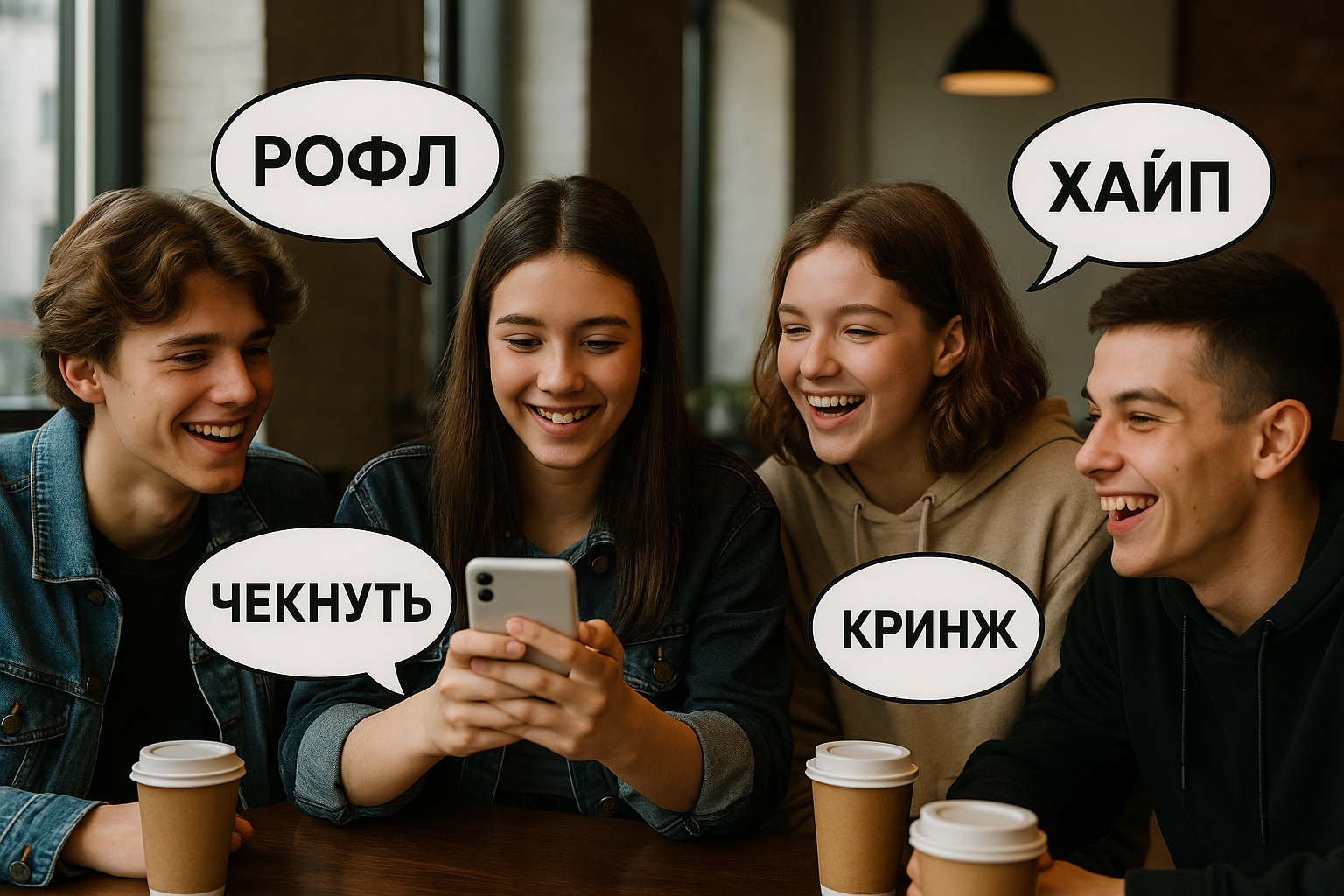
One of the most visible transformations in youth Russian is the flood of Internet-born slang. Just as English has absorbed terms from online gaming, social media, and meme culture, Russian has developed its own digital lexicon:
Кринж (krinzh) – from “cringe,” used to describe something awkward or embarrassing.
Хайп (haip) – from “hype,” meaning attention or buzz.
Рофл (rofl) – from “rolling on the floor laughing,” borrowed wholesale from English internet shorthand.
Чекнуть (cheknut’) – from “check,” meaning to look at or verify something.
These words spread at lightning speed across Telegram channels, VK (VKontakte), Discord servers, and TikTok. Unlike older slang that might have been tied to a specific subculture (say, 1990s criminal jargon or Soviet-era student slang), today’s words circulate nationally and even globally almost overnight.
Interestingly, young Russians often hybridize English with Russian suffixes, making words feel both foreign and native at once. For example, “лайкать” (laikat’) means “to like” a post, and “зашеймить” (zasheimit’) means “to shame someone.” This blending demonstrates not only the impact of English but also the adaptability of Russian morphology.
2. Borrowings from English: Influence or Invasion?
English borrowings are nothing new in Russian—words like “компьютер” (kompyuter, computer) or “интернет” (internet) have been standard for decades. What’s different today is the sheer casualness with which English slips into Russian speech among young people. A conversation between two 20-year-olds might include phrases like:
“Я фейл сделал.” (I made a fail.)
“У нас был тим-билдинг.” (We had a team-building session.)
“Я не чекал.” (I didn’t check.)
Linguists debate whether this represents a cultural dependency on English or simply a normal process of global borrowing. Either way, it suggests that the Russian of the future will be increasingly hybridized, especially in informal speech.
3. Shortened Words and Abbreviations
Another hallmark of youth Russian is the passion for shortening words. Much like English speakers say “info” instead of “information,” Russian teens say:
“Клава” instead of “клавиатура” (keyboard).
“Универ” instead of “университет” (university).
“Фак” instead of “факультет” (faculty).
“Серва” instead of “сервер” (server).
This economy of expression mirrors the fast-paced rhythm of online life. Shortened words are quicker to type, easier to say, and instantly mark the speaker as young and in-the-know.
4. The Explosion of Verbal Creativity
Young Russians often create playful, semi-nonsensical verbs by adding Russian endings to borrowed roots. Words like “гуглить” (to Google), “лайкать” (to like), and “скринить” (to take a screenshot) have become normalized. Beyond that, however, teens invent new verbs spontaneously—verbs that might only last a few weeks but showcase the creativity of the language.
For example:
“Зумиться” – to attend a Zoom call.
“Фотошопить” – to edit in Photoshop.
“Мутить движ” – to organize an event or party (literally “to stir up movement”).
These ephemeral verbs point to a Russian that is playful and constantly shifting, unafraid of bending grammar for the sake of expression.
5. Grammar Trends: Simplification in Real Time
Slang is the flashy side of language change, but grammar often changes more subtly. Linguists studying youth Russian have noticed trends such as:
Dropping case endings in fast speech, especially in accusative or genitive plural forms.
Using nominative forms where other cases would traditionally be required.
Simplifying aspectual distinctions between perfective and imperfective verbs in casual conversation.
For example, a student might say “Я типа делать домашку” instead of “Я делал домашку” (“I was doing homework”). While older speakers might cringe, these shortcuts reflect natural simplification processes that happen in every living language.
6. Code-Switching: Russian + English Hybrids
In many major Russian cities, young people frequently code-switch mid-sentence, blending Russian and English without hesitation:
“Я вообще не понимаю, это было so random.”
“I totally don’t understand, that was so random.”
This is particularly common in academic or professional settings, where English terminology dominates fields like IT, finance, and marketing. Over time, code-switching may become a normal part of Russian urban speech, much like Spanglish or Hinglish have developed in other contexts.
7. The Role of Memes in Shaping Russian Speech
Memes have become a linguistic engine in their own right. Phrases from viral videos, popular YouTubers, or TikTok trends quickly enter spoken Russian, often carrying humor, irony, or sarcasm. Some catchphrases last only a few weeks, while others—like “я устал, я ухожу” (“I’m tired, I’m leaving”)—become cultural shorthand.
Memes flatten the hierarchy between “high” and “low” language, putting slang on equal footing with literary quotations. A Russian teenager today is as likely to quote a viral streamer as they are to quote Pushkin—and that balance itself says much about the shifting cultural values behind language use.
8. Regional Variations Among Young Russians
Not all trends are Moscow-centered. Regional slang still thrives, and online communities sometimes reinforce local identity. For example:
In St. Petersburg, “поребрик” (porebrik, curb) instead of the Moscow “бордюр.”
In Siberia, “шо” instead of “что” (what).
In southern Russia, influences from Ukrainian and Caucasian languages filter into slang.
The internet connects these dialects, but it also highlights differences, as young Russians playfully argue online about which word is “correct.”
9. The Influence of Global Pop Culture
Anime, K-pop, American TV shows, and European football all leave linguistic fingerprints on Russian youth speech. Words like “отаку,” “камбек,” or even English “fan” are absorbed seamlessly into Russian. This global layer of vocabulary ensures that Russian youth culture is never isolated—it participates in global trends while filtering them through uniquely Russian humor and grammar.
10. What Does the Future Hold for Russian?
So where is all this headed? Linguists propose several possibilities:
Greater divergence between formal and informal Russian. The Russian of academic papers and government documents will remain highly codified, while spoken youth Russian will become increasingly flexible.
Continued borrowing from English. Especially in tech, business, and pop culture, English will remain a central source of new vocabulary.
Potential standardization of some slang. Just as “гуглить” has entered mainstream dictionaries, today’s slang might become tomorrow’s standard vocabulary.
Regional resilience. Local slang will persist, especially as online communities emphasize regional identity.
Russian will remain recognizably itself, but the gap between Pushkin’s refined prose and a Moscow teenager’s Telegram chat will only widen.
FAQs: The Future of Russian
Q: Will English completely take over Russian youth speech?
A: No. While English borrowings are common, they are integrated into Russian grammar and pronunciation. Russian remains the structural base, and English simply enriches it with new vocabulary.
Q: Is young people’s speech “ruining” Russian?
A: Linguists argue that no generation ruins a language—each generation reshapes it. Many features we now consider standard Russian were once controversial slang.
Q: Do young Russians still read classic literature?
A: Yes, schools still emphasize literature, but its influence on everyday speech is weaker compared to the power of online slang and global media.
Q: Will slang words like “крингe” or “рофл” survive long-term?
A: Some will fade quickly, others will become permanent. For example, “гуглить” and “лайкать” are now standard, while many meme-driven words vanish after a few months.
Q: How do older generations react to youth Russian?
A: Often with frustration or confusion. But this is a universal pattern: every generation feels that the younger one speaks “incorrectly.” Over time, many youth patterns become normalized.
Q: Are there big regional differences in youth slang?
A: Yes, though the Internet reduces some differences, regional vocabulary—like Petersburg’s “поребрик”—still sparks playful debates about correctness.
Q: Will Russian grammar itself change in the future?
A: Likely, yes. Simplification of case endings and verb aspects in casual speech may eventually influence broader usage, though formal Russian will resist rapid change.
Q: What does this mean for learners of Russian?
A: Learners should study both “textbook Russian” and contemporary youth slang if they want to understand films, social media, and everyday conversation. Both registers coexist.
Conclusion: Russian in Motion
The Russian language of young people is vibrant, experimental, and in constant motion. It borrows without hesitation, shortens without guilt, and invents without apology. While purists may worry, this creative energy is precisely what keeps Russian alive and adaptable in a rapidly changing world.
At Polyglottist Language Academy, we believe that learning Russian means more than memorizing grammar tables—it means engaging with a living language in all its forms, from the poetry of Pushkin to the slang of Telegram chats. If you want to truly understand Russian culture and communication, join us for classes that combine structure with real-world speech.
👉 Sign up today for our Russian classes.
And if you enjoyed this article, be sure to check out our other blog posts: