
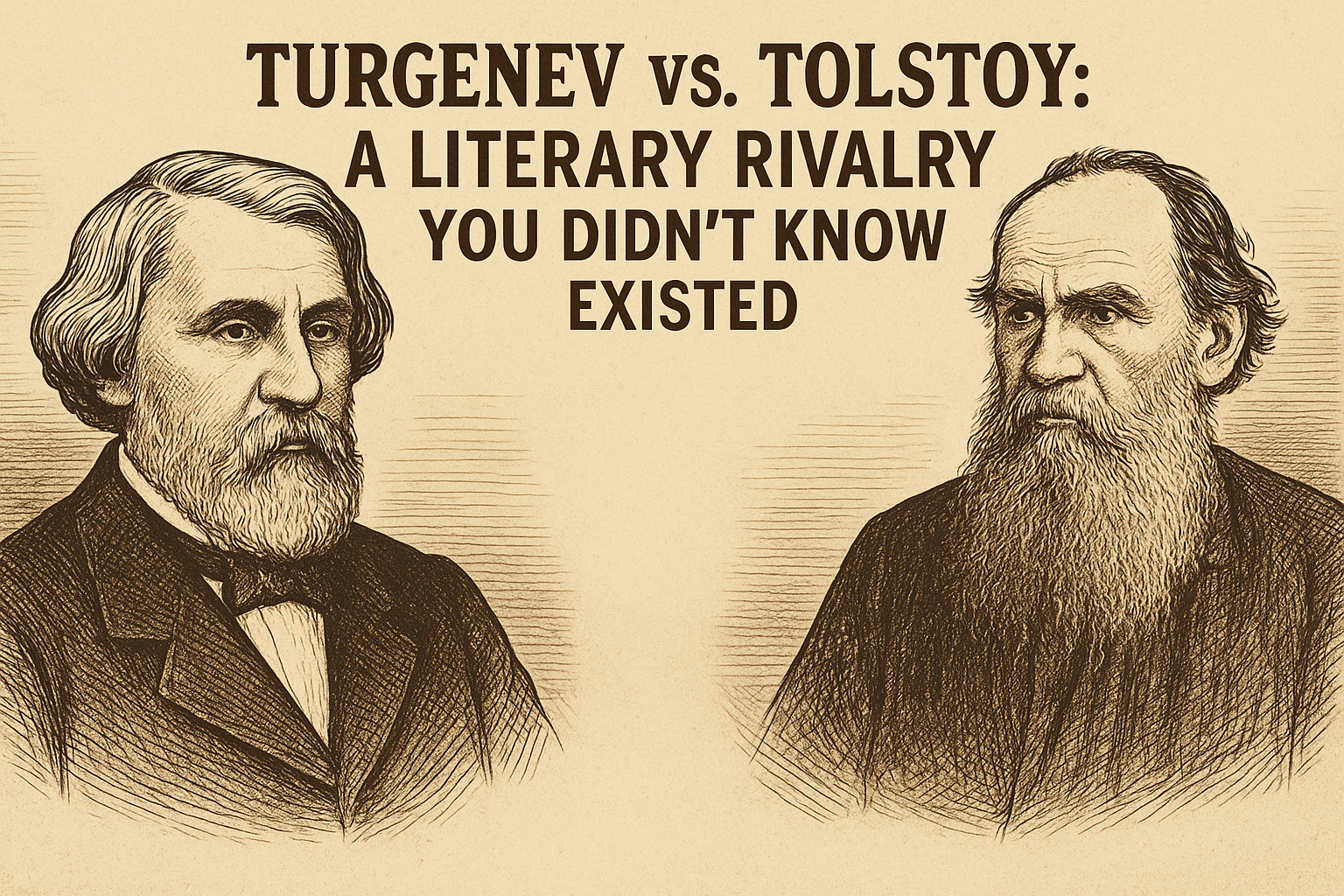
Great literary rivalries are rarely just about books—they are about personalities, philosophies, and the clash of egos that define an era. In 19th-century Russia, a country roiling with political change, philosophical debates, and an explosion of literary talent, two towering figures found themselves not just standing side by side in greatness but often nose-to-nose in tension: Ivan Turgenev and Leo Tolstoy. Their relationship was as complicated as the characters they created—filled with admiration, jealousy, intellectual sparring, and moments of outright hostility. While Dostoevsky battled his own demons and Chekhov quietly redefined the short story, Turgenev and Tolstoy embodied the Russian literary elite’s fiery spirit, arguing not just about style and storytelling but about how one should live and what one should believe.
The rivalry between Turgenev and Tolstoy was not the kind of petty spat that dissipates with time; it was a clash of worldviews. Turgenev, the aristocratic gentleman, was polished, urbane, and cosmopolitan. He spent much of his life in Europe, speaking French as comfortably as Russian, and maintaining friendships with literary giants like Flaubert and George Sand. He championed Western ideals—liberal reforms, education, and a refined aesthetic sensibility. Tolstoy, on the other hand, was rooted in the soil of Russia itself. He was a man who sought truth not in the salons of Paris but in the fields of Yasnaya Polyana, where peasants tilled the earth and the rhythms of life were raw, brutal, and beautiful. If Turgenev was a diplomat with a pen, Tolstoy was a prophet with a sword—his words cut through hypocrisy, pretension, and anything that did not ring with moral truth.
Their relationship was tumultuous from the start. While they respected each other’s genius, they rarely saw eye-to-eye on art, politics, or life itself. Turgenev once called Tolstoy “a great writer who doesn’t understand Europe,” while Tolstoy dismissed Turgenev’s novels as too polished, too French, too detached from the real struggles of the Russian people. Yet beneath the rivalry was a curious magnetism: each man was intrigued by what the other represented. Turgenev admired Tolstoy’s raw power and moral conviction, while Tolstoy recognized that Turgenev possessed a mastery of language and social nuance that could make even the smallest scene shimmer with meaning.
This rivalry didn’t just shape their personal relationship; it shaped Russian literature itself. Their debates—both in public and in private letters—pushed them to refine their own artistic visions. It’s not an exaggeration to say that the golden age of Russian literature would have been less golden without the sparks that flew between these two giants. In this article, we’ll dive into the lives, works, and ideologies of Turgenev and Tolstoy, exploring how their rivalry played out and what it reveals about the very soul of Russian literature.
I. The World They Inherited: Russia in the 19th Century
To understand Turgenev and Tolstoy, one must first understand the world that produced them. The 19th century was a period of seismic change for Russia. The country was still largely feudal, with serfs bound to the land, yet intellectual movements were pushing for reform and modernization. The Decembrist revolt of 1825 had been crushed, but its ideas—freedom, constitutional monarchy, and Westernization—lingered. Writers became the voice of the people, filling the vacuum left by the absence of political representation. Literature wasn’t just art; it was a form of resistance, a way of imagining a different future for Russia.
Education and publishing flourished in the major cities of Moscow and St. Petersburg, and a new class of thinkers emerged: the intelligentsia. These were the doctors, journalists, teachers, and authors who believed it was their duty to awaken the moral conscience of the nation. Turgenev and Tolstoy were among them, though they would soon part ways in terms of how they envisioned the future. The Westernizers, with whom Turgenev sympathized, believed that Russia must embrace European Enlightenment values. The Slavophiles, closer to Tolstoy’s heart, argued that Russia’s strength lay in its Orthodox Christian faith, rural traditions, and rejection of Western decadence.
This ideological division was not merely academic—it defined the art and literature of the age. Novels, poems, and essays were coded with political meaning. Every literary gesture was seen as either a nod to progress or a nostalgic clinging to the past. It was in this charged environment that Turgenev and Tolstoy began their careers, each attempting to speak not just to readers, but to history itself.
II. Turgenev’s Gentle Realism
Ivan Turgenev (1818–1883) was, in many ways, a writer ahead of his time. He combined a lyrical style with sharp social commentary, using the subtleties of human relationships to explore broader themes of political and cultural transformation. His most famous novel, Fathers and Sons, introduced Russian readers to the term “nihilism” and captured the generational divide between the old aristocratic order and the young radicals of the 1860s.
Turgenev’s genius lay in his ability to render characters with empathy and nuance. His heroes are often conflicted, caught between tradition and modernity, between love and duty. Unlike Tolstoy, who immersed himself in sweeping philosophical statements, Turgenev preferred implication to declaration. He was a master of subtext, the kind of writer whose meanings unfold gradually, like the delicate petals of a flower. This subtlety made him beloved in France and Germany, where readers admired the psychological depth of his prose.
His early novella A Sportsman’s Sketches helped ignite the call to emancipate the serfs by offering vignettes of rural life filled with quiet dignity and poignant injustice. While Tolstoy would later delve deeper into the peasant soul, Turgenev was one of the first Russian authors to present serfs as complex human beings, not caricatures. His prose had the clarity of glass and the force of emotion that never needed to shout to be heard.
For all his refinement, however, Turgenev’s works were often criticized for being too “Western.” Critics accused him of lacking a truly Russian soul. Tolstoy himself once remarked that Turgenev wrote “as if he were a Frenchman trying to describe Russia.” Yet it was precisely this fusion of Russian and European sensibilities that made Turgenev such an important voice. He brought a level of psychological depth and stylistic elegance to Russian literature that influenced countless writers, including Chekhov, who would later perfect the art of the understated tragedy.
III. Tolstoy’s Epic Vision
Leo Tolstoy (1828–1910), on the other hand, was a force of nature. His novels—War and Peace and Anna Karenina—are not just stories; they are entire worlds, teeming with life, history, and moral inquiry. Tolstoy believed that literature should grapple with the deepest questions of human existence: What is the meaning of life? What is the nature of happiness? How should one live? His works reflect a relentless search for truth, both personal and universal.
Tolstoy’s writing style is famously expansive. Where Turgenev would hint, Tolstoy would dissect, laying bare every motive, every flicker of thought in his characters’ minds. His narrative technique allowed for interior monologue, digressions on history and philosophy, and a panoramic view of society that few authors have ever matched. War and Peace alone encompasses multiple families, national wars, existential crises, and philosophical treatises—all within the pages of one novel.
Yet Tolstoy was not merely a novelist; he was a moral philosopher, a spiritual seeker, and eventually a religious radical. In the later part of his life, he renounced organized religion, condemned private property, and advocated for nonviolent resistance, influencing figures like Mahatma Gandhi. These beliefs strained his family relationships and isolated him from many in Russian high society, but they also infused his later writings with an unmistakable sense of urgency and authenticity.
Tolstoy’s characters—Pierre, Natasha, Levin, Anna—are among the most fully realized in world literature. Their internal struggles become our own, and the questions they ask are the ones we continue to ask today. His insistence that art must serve a moral purpose set him apart not just from Turgenev, but from many of his contemporaries. While Turgenev painted the world as it was, Tolstoy demanded we consider how it could be.
IV. A Relationship of Fire and Ice
Turgenev and Tolstoy’s personal relationship was as stormy as their ideological differences. They first met in the 1850s, and while there was mutual admiration, tensions quickly emerged. Turgenev found Tolstoy’s moral fervor excessive and even judgmental, while Tolstoy thought Turgenev was too detached and elitist. Their arguments were legendary—so intense that at one point Tolstoy challenged Turgenev to a duel (though he later apologized and withdrew the challenge).
They exchanged letters filled with praise, criticism, sarcasm, and occasional warmth. Turgenev, ever the diplomat, often tried to smooth things over, while Tolstoy vacillated between cordiality and condemnation. One of their most infamous disputes involved Tolstoy's treatment of his serfs and family. Turgenev accused him of hypocrisy—preaching selflessness while maintaining wealth and control over others. Tolstoy responded with biting disdain, questioning Turgenev’s literary relevance.
And yet, despite it all, there was respect. When Turgenev was on his deathbed in France, he wrote Tolstoy a final letter imploring him to return to literature: "My friend, great writer of the Russian land, return to your literary work. That gift has been given to you, and you have no right to bury it." Tolstoy would later reflect on that letter with tears in his eyes, acknowledging the strange, enduring bond they had shared.
V. Legacy and Influence
Today, both Turgenev and Tolstoy are celebrated as pillars of Russian literature, but their reputations have evolved differently. Tolstoy is often seen as the quintessential Russian novelist, a writer of unmatched moral and philosophical depth. His works are studied not just as literature but as profound meditations on life itself. His influence extends well beyond literature into philosophy, religion, and political thought.
Turgenev, by contrast, has been somewhat eclipsed by the towering figures of Tolstoy and Dostoevsky. Yet his legacy remains strong, particularly among writers who value restraint, subtlety, and emotional complexity. He paved the way for modern psychological realism and helped establish the Russian novel on the world stage. Without Turgenev, there might be no Chekhov, no Nabokov, no Hemingway.
Their rivalry, far from diminishing their achievements, actually enriched Russian literature. By challenging each other—by embodying two different visions of what literature could and should be—they expanded the possibilities of the novel as a form. Turgenev’s realism and Tolstoy’s epic moralism are two sides of the same coin, offering readers a panoramic view of the human condition. And for those of us lucky enough to read them, the result is a literary dialogue that still resonates today.
FAQs
1. Why did Turgenev and Tolstoy dislike each other? Their differences were rooted in personality and worldview. Turgenev’s refined, European sensibilities clashed with Tolstoy’s intense moral convictions and focus on the Russian soul.
2. Did Turgenev and Tolstoy ever reconcile? Yes, though their relationship remained complicated. They had periods of mutual admiration, especially as they aged, but they never fully bridged their ideological divide.
3. Who had more influence on Russian literature? Both were influential in different ways. Tolstoy’s epics changed the landscape of the novel, while Turgenev introduced psychological realism and influenced Western writers.
4. Are Turgenev’s books easier to read than Tolstoy’s? Generally, yes. Turgenev’s novels are shorter and more focused, while Tolstoy’s works are expansive and filled with philosophical digressions.
5. How did their rivalry affect their writing? Their mutual criticism pushed both writers to refine their craft. Tolstoy’s moral intensity sharpened in response to Turgenev’s elegance, while Turgenev sought deeper emotional resonance in part to match Tolstoy’s epic scope.
Ready to Dive into Russian Literature?
If this journey through Turgenev and Tolstoy has inspired you to read these literary giants in their original language, why not take the next step? At Polyglottist Language Academy, we offer dynamic Russian language classes that go beyond grammar and vocabulary—we immerse you in the cultural and literary traditions that shaped masterpieces like War and Peace and Fathers and Sons.
Whether you’re a beginner or an advanced learner, our expert instructors will guide you in exploring the beauty of the Russian language and its literature.
Sign up today and start reading the Russian classics the way they were meant to be read—without losing any of their depth or power in translation.
Want to explore more about Russian language and culture?
Check out our full collection of articles on the Polyglottist Language Academy Blog, where we dive into everything from why fluent Russian isn’t fast Russian to how to survive a Russian toast and what it’s like to be the only foreigner in a Russian dacha community. Whether you're curious about grammar tips, cultural faux pas, or how Russians navigate public space, our blog offers fresh, engaging insights to support your learning journey.