
How to Say “It Depends” and Other Nuanced Responses in French
Introduction: Why Nuance Matters When You Speak French
Language learners often reach a point where they can express themselves clearly, but not subtly. They can order food, describe their day, and talk about where they’re from — but when it comes to expressing ambivalence, hesitation, or conditionality, they freeze. That’s because the real magic of fluency lies in nuance — in being able to say “maybe,” “I suppose so,” or “it depends” with the same natural rhythm as a native speaker.
In English, we use vague or conditional expressions constantly: “It depends,” “not necessarily,” “kind of,” “in theory, yes,” “ideally,” “unless…” These phrases allow us to express uncertainty, to navigate gray areas, and to reflect complexity in our thoughts. In French, similar expressions exist — and they’re used just as frequently. But they often don't appear in beginner textbooks.
And that’s where many learners get stuck. They end up sounding overly black-and-white, overly formal, or simply too sure of themselves. Native French speakers, on the other hand, are masters of nuance. Whether you’re in Paris discussing politics over wine, or in Marseille negotiating your rent, the ability to hedge your statements, signal doubt, or show open-mindedness is a crucial part of sounding truly fluent.
In this article, we’ll explore how to say “it depends” in French — and we’ll go far beyond that. You’ll learn a whole toolbox of expressions that let you be vague, hesitant, non-committal, diplomatic, or cautiously optimistic. In other words, you’ll learn how to speak French like a real human being — not like a language app robot.
1. How to Say “It Depends” in French (And Actually Sound Natural)
Let’s start with the most fundamental phrase:
🟢 Ça dépend.
Literally: “It depends.”
✅ This is the default, and it’s used all the time in everyday conversation.
But French offers richer ways to build on that idea:
Ça dépend de la situation. – “It depends on the situation.”
Ça dépend de toi / de lui / de ce que tu veux dire. – “It depends on you / him / what you mean.”
Ça dépend des circonstances. – “It depends on the circumstances.”
Ça peut dépendre du contexte. – “That can depend on the context.”
To sound even more natural, consider softening or hedging:
Je dirais que ça dépend. – “I’d say it depends.”
Tout dépend de comment on voit les choses. – “It all depends on how you look at it.”
Ça dépend, mais en général… – “It depends, but generally…”
2. Softening Opinions: Avoiding Absolutes
In France, nuance is not just tolerated — it’s a mark of intelligence. People expect you to acknowledge complexity.
Here are common phrases to express opinions with a light touch:
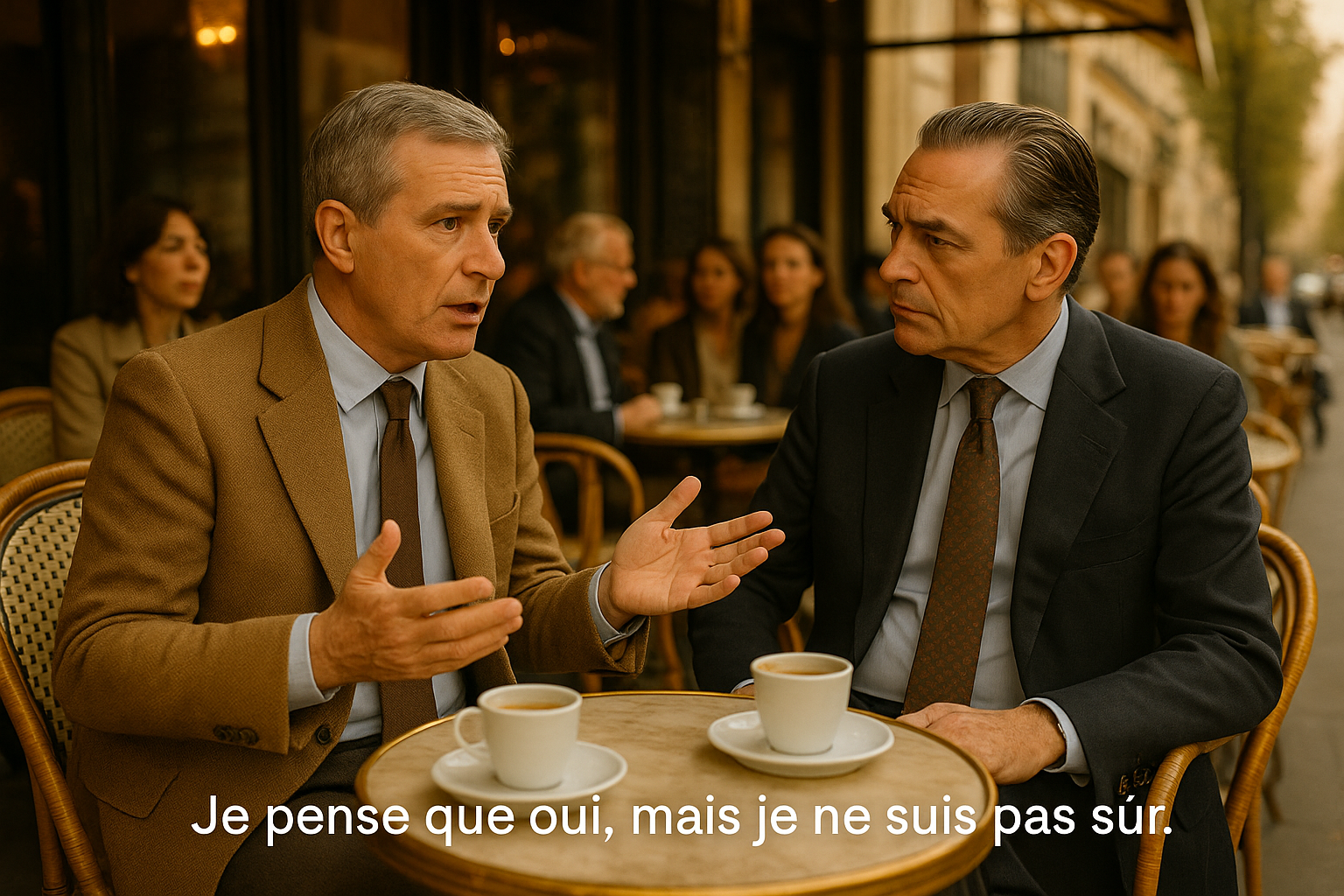
Je pense que oui, mais je ne suis pas sûr(e).
“I think so, but I’m not sure.”Il me semble que…
“It seems to me that…” (softer than “je pense que”)C’est possible, mais pas garanti.
“It’s possible, but not guaranteed.”Peut-être, mais ça reste à voir.
“Maybe, but that remains to be seen.”Je ne suis pas convaincu(e).
“I’m not convinced.”
These are key in discussions, especially if you don’t want to sound too blunt.
3. Expressing Uncertainty or Hesitation
Hesitation isn't a weakness — it shows thoughtfulness. Here’s how French speakers do it:
Euh… je sais pas trop.
“Uh… I’m not really sure.”J’hésite.
“I’m hesitating.”Je dirais que oui, mais…
“I’d say yes, but…”Je ne pourrais pas dire.
“I couldn’t say.”Je suppose que oui.
“I suppose so.”C’est difficile à dire.
“It’s hard to say.”
Add hesitation words like ben, euh, bah, or enfin to sound even more natural.
4. Vague Affirmations (The French “Kind Of”)
Sometimes you want to say “yes,” but not completely. Try these:
Oui, en quelque sorte.
“Yes, in a way.”Plus ou moins.
“More or less.”On peut dire ça, oui.
“You could say that, yes.”C’est pas faux.
“That’s not false.” (Used ironically sometimes)Dans une certaine mesure.
“To a certain extent.”Disons que…
“Let’s say that…”
5. Diplomatic Disagreement
Want to disagree without sounding rude?
Pas nécessairement.
“Not necessarily.”Je ne suis pas certain(e) que ce soit le cas.
“I’m not sure that’s the case.”Je vois ce que tu veux dire, mais…
“I see what you mean, but…”Je comprends ton point de vue, mais…
“I understand your point of view, but…”Je ne suis pas d’accord, mais je respecte ton avis.
“I don’t agree, but I respect your opinion.”
French speakers value intellectual debate — but delivered politely.
6. Expressing Conditions and Hypotheticals
French is rich in conditional phrases:
À condition que…
“On the condition that…”Si jamais…
“If ever…”Dans le cas où…
“In the case where…”En supposant que…
“Assuming that…”Seulement si…
“Only if…”
Pair these with the subjunctive when required (e.g., à condition que tu viennes).
7. Showing Indifference or Open-Mindedness
Peu importe.
“It doesn’t matter.”Ça m’est égal.
“It’s all the same to me.”Comme tu veux.
“As you like.”Je suis ouvert(e) à tout.
“I’m open to anything.”Je suis flexible.
“I’m flexible.”
These expressions are key for everyday social coordination — choosing restaurants, making plans, etc.
8. French Filler Words That Help You Stall or Sound Casual
Don’t underestimate these little words:
Ben… – like “well…”
Euh… – “uh…”
Bah… – an informal version of “meh”
Enfin… – “anyway / I mean…”
Tu vois ? – “you know?”
Genre… – “like…”
Use them to keep speaking while you think.
9. Common Cultural Contexts for Nuance
In France, being too direct can come off as rude or simplistic. Here are examples where nuance is expected:
Talking politics? Use il me semble que, je crois que, and à mon avis rather than bold declarations.
Discussing cheese? Say c’est particulier (it’s…distinct) or c’est fort en goût (strong in flavor) instead of “ew.”
Making plans? Say on verra (we’ll see), ça dépend de l’heure (depends on the time), or je te tiens au courant (I’ll keep you posted).
FAQs
Q: Can I just use “ça dépend” for everything?
A: It’s very common and accepted, but native speakers often build on it to specify what it depends on — so you should too.
Q: What’s the difference between “je pense” and “il me semble”?
A: “Je pense” is stronger and more direct. “Il me semble” is softer and more tentative — ideal for French-style diplomacy.
Q: How can I practice these phrases?
A: Use them in low-stakes conversations — ask your teacher to challenge you with hypothetical or opinion-based questions.
Q: Do these phrases work in formal writing?
A: Some do (like dans une certaine mesure), but many are spoken. Use context to guide you.
Q: What if I overuse filler words like “euh” and “ben”?
A: It’s totally fine at first — it buys you thinking time and sounds natural. Just don’t rely on them forever.
Ready to Add Nuance to Your French?
At Polyglottist Language Academy, we believe true fluency starts where the textbook ends — in the gray areas of real life, where language becomes art. Our in-person and online French classes for adults are designed to help you go beyond grammar and vocabulary and start thinking in French — subtly, fluently, and confidently.
Whether you’re in Berkeley, San Francisco, Oakland, San Jose, or tuning in online from anywhere in the world, our small-group and individual lessons will help you level up fast — with native-speaking instructors and a vibrant, supportive learning community.
👉 Join us today and discover the joy of speaking French like a native — not just correctly, but intelligently.
Enjoyed this article? Check out these other popular posts from our blog:
Avoiding Tourist Mistakes In Paris: Cultural Tips That Make A Difference
How To Blend In While Traveling In France (Hint: It's Not Just About Clothes)
How Polyglottist Language Academy Makes French Learning Feel Like Travel
Bon courage et à bientôt dans nos cours !