
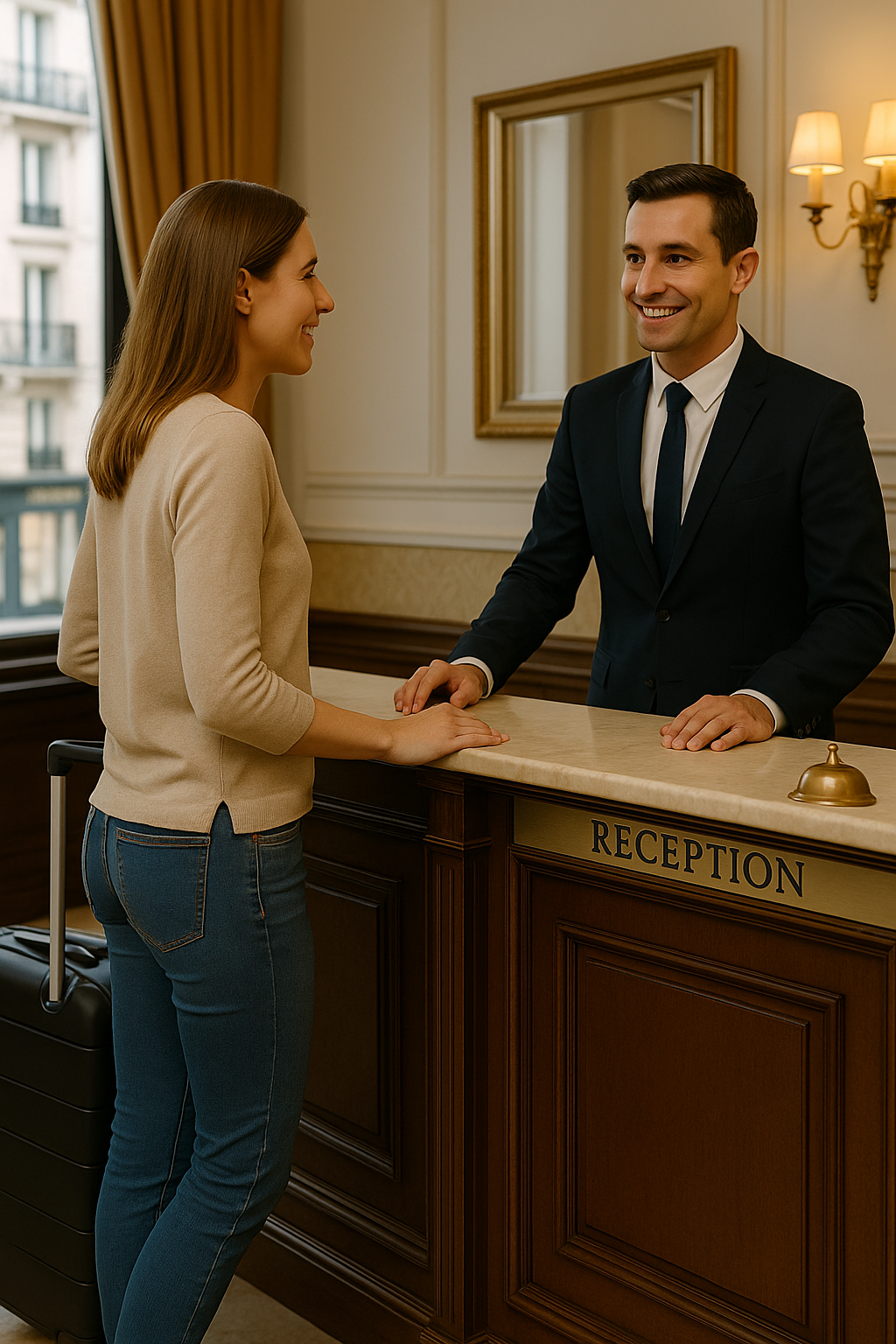
Planning a trip to France? Find out how much French you actually need to make your experience smooth, fun, and immersive. Tips from Polyglottist Language Academy, serving Berkeley, Oakland, San Francisco, and San Jose.
Introduction: Bonjour, Confidence! Speaking French Abroad Isn’t as Hard as You Think
You’ve finally booked that dream trip to Paris, Provence, or maybe a charming château in the Loire Valley. Your itinerary is ready, your bags are (almost) packed, and visions of croissants and lavender fields are dancing in your head. But one nagging question remains:
Do I really need to speak French to enjoy my trip to France?
Or maybe you’ve heard the myths:
"The French don’t like speaking English."
"You have to be fluent to get around."
"If you make a mistake, they’ll laugh at you."
Let’s get one thing straight: You don’t need to be fluent in French to have a wonderful time in France. But knowing a core set of phrases, mastering basic etiquette, and understanding how to ask for help will not only make your trip easier—it will make it far more memorable and immersive.
You don’t need to master grammar, study conjugations for months, or memorize a textbook. You just need a little linguistic awareness, a few expressions, and a dash of confidence. Whether you're exploring cobblestone streets in Montmartre or sipping wine at a seaside café in Nice, those first few French words—bonjour, merci, s’il vous plaît—become the bridge between being a tourist and being a traveler.
Think of language as a passport to culture. While your physical passport gets you through customs, your French phrases get you through the human side of your journey: meeting locals, navigating new cities, appreciating menus, and having spontaneous moments that go beyond the guidebook. You don’t have to say everything perfectly. You just have to try.
In fact, many seasoned travelers will tell you that some of their favorite moments came not from polished plans but from unscripted encounters—asking a stranger for directions in broken French, complimenting a baker on their croissants, or ordering something from a menu you can’t quite pronounce but want to try anyway. These tiny moments become treasured memories.
And then there’s the practical side. Sure, apps like Google Translate are helpful. But nothing beats being able to walk into a shop and say: Bonjour, je cherche une écharpe (Hello, I’m looking for a scarf). Or to confidently ask for a table at a bustling restaurant without pointing and panicking. These are the small victories that add up to a smoother, more enjoyable experience.
At Polyglottist Language Academy, we’ve helped hundreds of Bay Area travelers—from Berkeley, San Francisco, Oakland, and San Jose—learn just enough French to navigate their vacations with confidence, ease, and joy. Our travel-focused French classes are designed to prioritize what you’ll actually use—so you spend less time on grammar drills and more time preparing for real-life situations.
So if you're wondering how much French is "enough," pour yourself a café and read on. The answer might be simpler than you think.
Do You Need to Speak French in France?
Technically, no. But practically? Knowing some French helps a lot. Especially if you plan to venture beyond the big cities or want to interact more authentically.
Here’s the deal:
In Paris, many people in hospitality and tourism speak English, but not all.
In smaller towns, English may be rare or spoken with hesitation.
Politeness matters immensely in France, and a few French words go a long way in winning goodwill.
Travelers who make a little effort with the language consistently report warmer interactions, fewer misunderstandings, and a stronger sense of connection.
The French You Really Need to Know (By Category)
1. Politeness & Basics
These phrases form your social toolkit:
Bonjour / Bonsoir (Hello / Good evening)
S'il vous plaît (Please)
Merci (Thank you)
Excusez-moi (Excuse me)
Je suis désolé(e) (I’m sorry)
Parlez-vous anglais ? (Do you speak English?)
Je ne parle pas bien français. (I don’t speak French well.)
Pouvez-vous répéter, s'il vous plaît ? (Can you repeat, please?)
2. Getting Around
Où est la station de métro la plus proche ? (Where is the nearest metro station?)
Je voudrais un billet pour... (I would like a ticket to...)
Combien ça coûte ? (How much is it?)
Ce train va à... ? (Does this train go to...?)
3. Eating Out
Une table pour deux, s'il vous plaît. (A table for two, please.)
La carte, s'il vous plaît. (The menu, please.)
Je suis allergique à... (I’m allergic to...)
L’addition, s’il vous plaît. (The bill, please.)
4. Shopping & Markets
Combien ça coûte ? (How much does it cost?)
Je voudrais acheter... (I would like to buy...)
Avez-vous ceci en taille M ? (Do you have this in size M?)
5. Emergencies & Help
J’ai besoin d’aide. (I need help.)
Appelez une ambulance ! (Call an ambulance!)
Où est la pharmacie la plus proche ? (Where’s the nearest pharmacy?)
How Much Grammar Do You Need?
Good news: not much.
You can get by on:
Present tense only
A handful of verbs: être (to be), avoir (to have), aller (to go), vouloir (to want), pouvoir (to be able to), faire (to do/make)
Basic sentence structure: subject + verb + object
For example:
Je voudrais un café. (I would like a coffee.)
Nous allons à Bordeaux. (We’re going to Bordeaux.)
Elle est médecin. (She is a doctor.)
Forget the subjunctive. Skip past conditional. Focus on clarity and politeness.
Cultural Tips That Go with the Language
✅ Always say “Bonjour” when entering a shop or greeting someone.
✅ Don’t jump into English without asking: Parlez-vous anglais ?
✅ Use formal forms (vous) with strangers.
✅ A little effort shows respect—and earns big points.
French people don’t expect you to be perfect. But they appreciate effort. That’s why even beginners often report positive, patient responses from locals.
Real-Life Scenarios: Using Beginner French in France
✈️ At the Airport
Bonjour, où est la sortie ? (Hello, where is the exit?)
🏨 At the Hotel
J’ai une réservation. (I have a reservation.)
A quelle heure est le petit-déjeuner ? (What time is breakfast?)
🥐 At a Bakery
Je voudrais une baguette et deux croissants. (I’d like one baguette and two croissants.)
🚕 In a Taxi
Je vais à la gare, s’il vous plaît. (I’m going to the train station, please.)
🏥 At the Pharmacy
J’ai mal à la tête. (I have a headache.)
These practical moments are what most travelers care about. You don’t need to debate politics—you need to get through the day smoothly.
Can’t I Just Use Google Translate?
Yes, but:
Google Translate works best with written language.
It’s awkward in face-to-face interactions.
It won’t help you understand responses.
It can’t replace knowing merci or bonjour at the right moment.
Use it as a backup, not a substitute. Real connection comes from real language.
What You Can Learn in a Month (Or Less)
Even with just a few weeks before your trip, you can learn:
Greetings & introductions
Ordering food & drinks
Asking for directions
Buying tickets & making reservations
Our crash-course travelers at Polyglottist in Berkeley often report that 10–20 hours of study makes a major difference. That’s just one hour a day over a few weeks.
How Polyglottist Language Academy Prepares Travelers
We offer:
Fast-track classes just for travelers
In-person sessions in Berkeley
Online lessons for flexible access
Realistic dialogues, cultural insights, and survival vocabulary
You’ll walk away with:
A pocket-sized phrasebook
Confidence to speak
Tools to keep learning on your trip
Our traveler students have gone on to France, Belgium, Quebec, and Africa—and come back saying: "This made all the difference."
FAQs
❓ Will people in France really understand me if I speak beginner French?
Yes! Clear pronunciation and polite delivery matter more than perfection.
❓ What if I’m too nervous to speak?
Start small—just greetings and simple questions. Most people will help you.
❓ How long before a trip should I start learning?
Ideally 1–3 months, but even a week is better than nothing.
❓ Do I need to learn to read or just speak?
Basic reading helps with signs, menus, and maps—definitely worth it.
❓ Is it rude to speak English in France?
Not if you ask first. Always lead with a French greeting and question.
❓ What’s the easiest way to learn fast?
Take a class! Especially one designed for travel.
Loved This? Read These Next:
How To Think In French: 7 Mental Shifts That Will Change How You Learn
Why The French Are Obsessed With Grammar (And How To Keep Up)
Ready to travel with confidence and style?
Join our French classes at Polyglottist Language Academy and prepare for your trip with expert support, a relaxed environment, and lessons you’ll actually use abroad.
Your adventure starts before takeoff—let’s make it unforgettable.