
The Café as Literary Space in French Novels
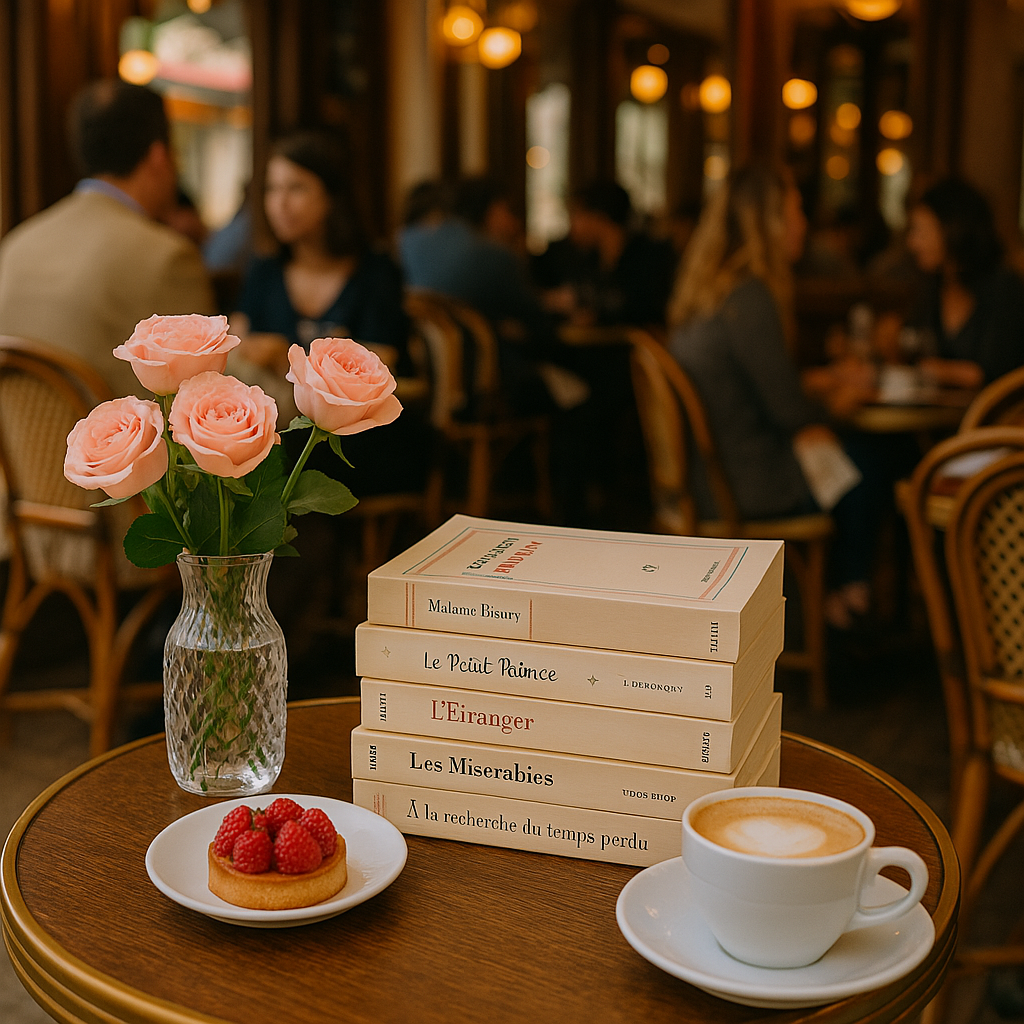
Introduction: Where Espresso Meets Existentialism
Picture this: a wrought-iron table for two on a Parisian sidewalk, a half-drunk espresso cooling beside a notebook, and a character watching the world stroll by. For readers of French literature, this is more than a scene—it’s a symbol. The café is a fixture in the French novel, not just as a setting but as a lens through which identity, politics, and philosophy unfold.
From the smoky interiors of 19th-century brasseries to the sunlit terraces of modern-day Montmartre, the café is where characters confront themselves, each other, and society. It is a space of reflection and revolution, of flirtation and frustration. It is a place where solitude is possible, but never lonely. For French writers, the café is less a backdrop than a character in its own right.
Why does the café occupy such a central role in French storytelling? The answer lies at the intersection of history, culture, and language. Cafés have long been public-private spaces: open to all, yet intimate enough for confessions. They are democratic but curated, performative but sincere. And in the hands of French novelists, they become stages for transformation.
French café culture itself is a phenomenon deeply woven into the national identity. From the enlightenment salons of the 18th century to the existential debates of post-war Paris, the café has always served as more than a place to sip a beverage. It’s a place to linger, to read the newspaper, to observe, to think. It’s where revolutions have been whispered and literary movements born. In this context, it’s only natural that the café would find its way so centrally into fiction.
Imagine a young writer in the 1920s, seated at a smoky table with a glass of red wine, eavesdropping on conversations while scribbling dialogue into a leather notebook. Imagine a woman in the 1950s sipping a citron pressé while she contemplates her future, aware that her thoughts might not be welcome in the boardroom, but they’re entirely at home on this terrace. Imagine a teenager today, headphones in, scrolling through a novel on their phone while the scent of espresso and buttered croissant wafts in the air. In every era, the café holds space—for voices that need quiet, for ideas that need fermenting, for characters both fictional and real who crave room to breathe.
The café in literature is rarely incidental. It’s symbolic. It represents a borderland between the internal and the external, between the private mind and the public world. It offers writers a natural setting for moments of realization, confession, connection, and alienation. It’s where characters articulate what they’ve struggled to say at home or in the workplace. It’s where the background noise of cups clinking and steam hissing becomes the rhythm of introspection.
And then there’s the café’s visual richness. The tables, the menus, the posture of the waiter, the view of the street—they all lend themselves to vivid description. A character in a café can remain still while everything around them moves. That stillness, that observational pause, gives novelists the opportunity to slow time and deepen narrative.
This article explores the café not as a pitstop for caffeine but as a rich literary space that reveals as much about France as it does about the fictional people who sit at its tables. We’ll visit the cafés of Balzac, Proust, Sartre, Duras, and contemporary authors who continue the tradition. We’ll see how cafés function as mirrors of class, theaters of language, and sites of existential awakening.
Whether you're a student of literature, a traveler with a well-worn Moleskine, or a language learner hoping to eavesdrop your way to fluency, this tour of French cafés in fiction will show you why these spaces still matter.
1. Balzac’s Cafés: The Pulse of Parisian Society
In Honoré de Balzac’s vast social panoramas, the café is the heartbeat of the city. In La Comédie humaine, cafés are where men climb or fall in the social order. They’re places of overheard conversations, power plays, and economic exchange.
In Illusions perdues, Lucien Chardon moves from the provincial town of Angoulême to the literary circles of Paris. It is in cafés that he meets editors, poets, and patrons—some of whom help him rise, others who engineer his ruin. The café in Balzac’s world is aspirational. It reflects a character’s ambitions, their access to Parisian life, and often their eventual disillusionment.
More than a setting, the café represents the public performance of intellect and ambition. For Balzac, who wrote obsessively about class and mobility, the café is a social engine where success is brewed alongside espresso.
2. Proust’s Teahouse of Memory: Café as Mnemonic Device
Marcel Proust famously found an entire universe in a madeleine dipped in tea. But cafés, too, in In Search of Lost Time, are spaces where memory is triggered and time collapses.
In the seaside cafés of Balbec or the bourgeois salons of Paris, the narrator observes, muses, and reinterprets his life. Cafés become dreamlike zones where perception is heightened. They are not simply social; they are psychological. They allow characters (and readers) to drift between past and present.
Proust’s cafés are less public squares than private laboratories. Here, memory is brewed as carefully as the perfect cup of Darjeeling. In these moments of pause, the everyday becomes poetic, and the café becomes a temple of introspection.
3. Sartre and Beauvoir: The Café as Stage for Existentialism
No discussion of cafés in French literature would be complete without Sartre and Beauvoir. Their haunt, Les Deux Magots in Saint-Germain-des-Prés, was more than a location—it was a movement. In Nausea and The Mandarins, the café is where characters wrestle with freedom, responsibility, and absurdity.
For Sartre, the café is a space of observation and alienation. Antoine Roquentin, in Nausea, sits at a café and is overcome by the absurdity of existence after gazing too long at a chestnut tree. These moments of existential crisis occur in mundane places, making the café an unexpectedly profound site of awakening.
Simone de Beauvoir’s work, meanwhile, uses the café as a feminist space. Her characters seek autonomy and voice in a world dominated by masculine norms. The café offers both visibility and agency. It becomes a space to think, argue, write, and resist.
4. Marguerite Duras: The Silence Between Sips
In Duras’s spare, emotionally resonant prose, the café is often a site of unspoken tension. In Moderato Cantabile, the recurring café setting becomes a ritualized space where a woman and a man meet to not-quite-flirt, to not-quite-reveal, to circle around a murder that has shaken their provincial town.
Here, the café is not a bustling Parisian hub but a quiet provincial corner. It is the repetition of ordinary gestures—coffee, conversation, silence—that lends the space its emotional weight. Duras strips the café of its glamour and exposes its core: a place where people wait to be understood.
5. Contemporary Cafés: Intimacy in a Global Age
Modern French writers continue to use cafés as crucial narrative spaces. In The Elegance of the Hedgehog by Muriel Barbery, characters meet in a building’s café to share philosophical musings and discover each other beyond class stereotypes. In works by Leïla Slimani or Edouard Louis, cafés are often spaces of confrontation—between cultures, generations, or versions of the self.
Today’s cafés are multicultural, digital, and ever more reflective of France’s complexity. They remain places of reflection and interaction, but also of friction. Whether in a Paris arrondissement or a suburb on the RER line, the café still tells stories that no other space can.
Conclusion: More Than a Cup of Coffee
From Balzac to Slimani, the café in French literature has served as everything from a career launchpad to a chamber of memory, a philosophical arena to a site of emotional withholding. It is where words happen, where identities shift, where time can pause or accelerate.
In a French novel, the café is never just a café. It is layered with meaning, ritual, history, and hope. It reminds us that even in the most ordinary of places, something extraordinary might be waiting—in the next overheard sentence, in the silence between sips, in the mind of a character realizing who they really are.
Want to Experience French Culture Beyond the Page?
At Polyglottist Language Academy, we believe language learning should immerse you in the world that native speakers actually live—cafés included. Our French classes not only help you communicate fluently but help you read, think, and experience French culture in a whole new way.