
How to Stop Translating and Start Thinking in French
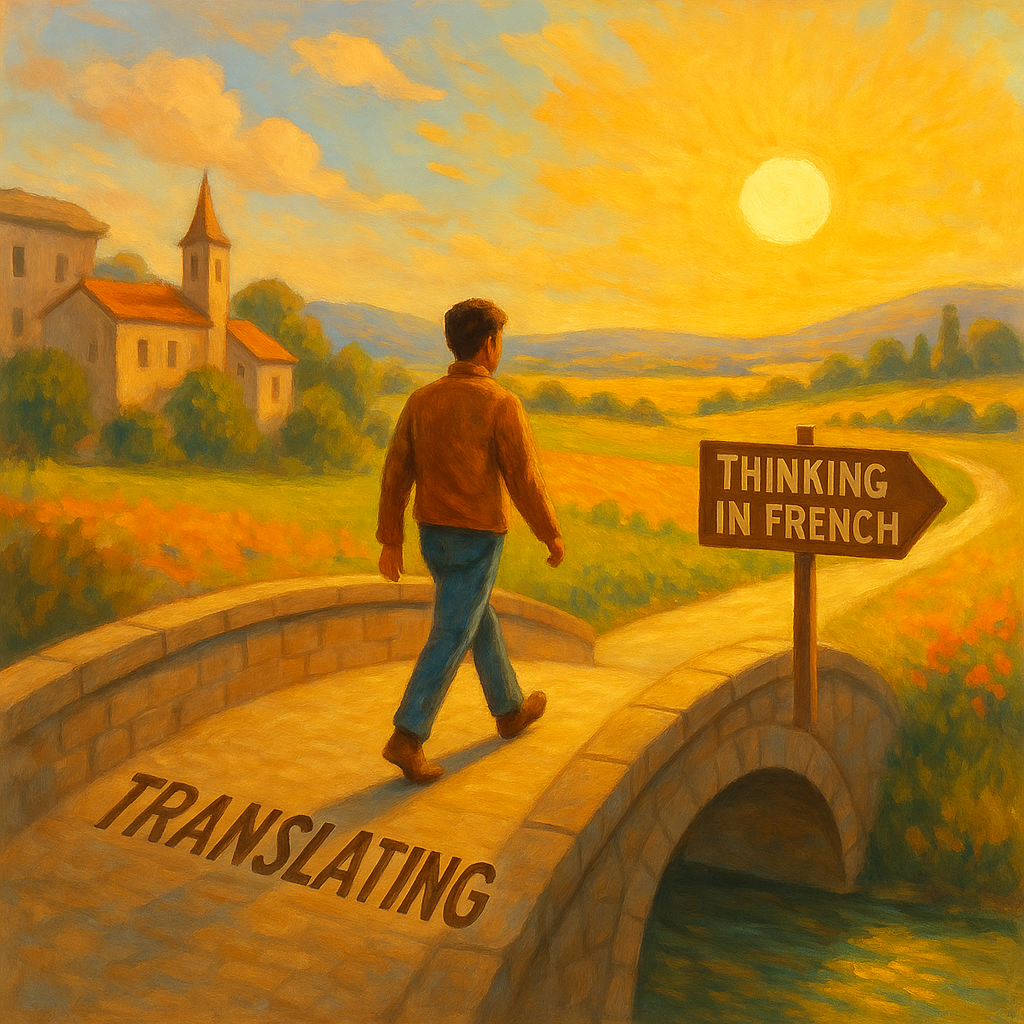
Introduction: From Word-by-Word to Fluent Flow
You’re mid-conversation with a French speaker. You understand what they said. You know what you want to say in English. But before you can respond, your brain goes into overdrive: translate the idea, restructure the sentence, look for the right verb, remember if it takes être or avoir, and—wait, is it au magasin or dans le magasin?
By the time you speak, the moment has passed.
Sound familiar?
If you’ve been studying French for a while and still find yourself mentally translating everything from English, you’re not alone. It’s one of the biggest hurdles intermediate learners face—and it’s also one of the most frustrating. You’ve put in the hours, built up your vocabulary, learned the grammar rules... but when it comes time to speak or listen quickly, you hit a wall.
The problem isn’t your memory. It’s your mental approach.
You’re still thinking in English—and trying to fit French into it.
Here’s the truth: French isn’t just English in different words. It’s a different way of expressing ideas, organizing thoughts, and even feeling emotions. If you want to speak French fluently, you have to learn to think in French. That’s when real fluency begins—not just in words, but in instinct.
In this article, we’ll show you exactly how to make that leap. We’ll break down:
Why translating slows you down and holds you back
What “thinking in French” actually looks like
Practical, step-by-step methods to train your brain to operate in French
Tools, routines, and mental shifts that help you transition to fluency
And how to make it all feel natural—not forced
Whether you're an upper beginner, an intermediate plateau-dweller, or an advanced learner who still hesitates, this guide will help you stop translating and start flowing.
Part I: Why Translating Doesn’t Work (Most of the Time)
It’s tempting to rely on mental translation—it feels safe. You already know English, so it makes sense to use it as a base. But here’s what goes wrong when you do:
❌ Translation Is Slow
French word order, idioms, and expressions often don’t match English logic. So translating sentence-by-sentence creates friction and delay.
Example:
English: I miss you.
French: Tu me manques.
(Totally different structure. Literal translation doesn’t help.)
❌ Translation Distorts Meaning
Some French words don’t have exact English equivalents. Think of words like râler, flâner, dépaysement, voilà. Trying to shoehorn them into English limits your understanding.
❌ Translation Blocks Spontaneity
You can’t fully engage in a conversation when your mind is stuck in a translation loop. Real-time speaking demands automatic recall, not mental gymnastics.
❌ It Keeps You in “Student Mode”
Translating reinforces the feeling that French is foreign, hard, or artificial. It keeps you from owning the language—and that undermines your confidence.
Part II: What Does It Mean to Think in French?
Thinking in French doesn’t mean you suddenly narrate your entire life in flawless Parisian monologue. It means that:
You associate French words with concepts, not English equivalents.
You recall phrases automatically, without running them through English.
You process instructions, signs, and conversations in French directly.
You form thoughts in French word order, even if your sentence isn’t perfect.
Example:
Instead of thinking:
"I am hungry. Let’s see... 'hungry' is... faim? So ‘I have hunger’… J’ai faim?”
You simply think:
J’ai faim. (Because it feels like the natural way to say it.)
Part III: How to Train Yourself to Think in French – Step by Step
Here’s how to retrain your brain to bypass English and operate directly in French.
Step 1: Label Your World in French
Start with visual thinking. Label everyday items around you:
le frigo, la chaise, le sac, la fenêtre, le miroir
Look at them and only think the French word. Don’t “translate” them—associate them visually and directly.
Step 2: Use French for Mental Narration
Begin narrating small parts of your day in French:
Je vais au travail.
Il pleut aujourd’hui.
J’ai oublié mes clés !
Even if your vocabulary is limited, work with what you know. Don’t pause to find perfect words—use approximate ones and keep going.
Step 3: Practice “Staircase Monologues”
When you’re walking, cooking, or doing something mundane, talk to yourself in French:
Je coupe les légumes. Je vais préparer une salade. Où est le vinaigre ? Ah, là !
This builds internal fluency by linking your actions with French thinking.
Step 4: Avoid Subtitles (Or Use French Ones)
Watching French TV or films? Ditch the English subtitles. Use French subtitles—or none at all—and train your brain to connect sound to meaning directly.
Start with shows you already know or that have visual clues (like Dix pour cent or Call My Agent!).
Step 5: Use Flashcards with Images, Not English
Apps like Anki or Quizlet let you make image-based flashcards. Don’t include English. Just a picture and the French word. This builds direct neural pathways.
Example: 🐱 → un chat (not 🐱 → cat → un chat)
Step 6: Speak Out Loud—Even If You’re Alone
Sound helps lock in fluency. Don’t just think in French—speak in French. Use mirror exercises, read aloud, or simulate conversations with yourself.
Part IV: Intermediate-Level Habits to Build Automaticity
Once you’re comfortable narrating simple things in French, build complexity gradually.
✅ Use Sentence Starters
Train with sentence stems that reflect real thinking:
Je pense que… (I think that…)
J’ai l’impression que… (I feel like…)
Ce que je veux dire, c’est… (What I mean is…)
Repeat these often so they become reflexes.
✅ Roleplay in Your Head
Imagine real-life scenarios: buying a train ticket, calling a friend, being late to work. Play both parts of the conversation in French.
✅ Keep a Micro-Journal
Each day, write 3–5 sentences in French about your day. Use a notebook or app. Don’t aim for perfection—just fluency.
✅ Practice Shadowing
Listen to a French audio clip, pause after each line, and repeat exactly with the same rhythm and tone. It’s like musical mimicry—and it rewires your brain for French flow.
Part V: Advanced Strategies – Living in French (Even from Home)
Even if you don’t live in a French-speaking country, you can create a French bubble around you.
🧠 Switch Devices to French
Set your phone, GPS, Netflix profile, and Google account to French. You’ll learn contextually, every time you click.
📚 Read Simple French Books
Start with graded readers or short stories. Choose books written for native children or teens, not just translated English books. Think: Le Petit Nicolas, Astérix, Petit Ours Brun.
🎧 Listen to Podcasts for Native Speakers
Try:
InnerFrench – For learners who want native flow with clear pacing.
Transfert – True personal stories in beautifully spoken French.
Change ma vie – Coaching podcast that models natural, reflective French.
🗣 Join French-Speaking Groups
Attend conversation meetups (in person or online), language exchanges, or group classes where English isn’t allowed.
FAQs About Thinking in French
Q: How long does it take to start thinking in French?
A: It depends on your level and consistency. Some learners begin thinking in basic French within weeks of daily practice. Full fluency takes longer—but even small steps make a huge difference in flow and speed.
Q: Can I really think in French if I’m not fluent yet?
A: Yes! Start with what you know. Thinking in French helps you become fluent faster because it forces your brain to adapt, instead of relying on translation.
Q: Should I stop translating completely?
A: Not entirely. Translation is useful for understanding new grammar or complex texts. But in everyday thinking, aim to use French directly as much as possible.
Q: What if I don’t know how to say something in French?
A: Say it in a simpler way! Replace the unknown word with a known one, describe it, or skip it. Native speakers do this too.
Q: How can I tell if I’m making progress?
A: You’ll notice you hesitate less, react more quickly, and sometimes “hear” your inner voice in French before English. That’s fluency emerging.
Ready to Think in French—Not Just Speak It?
At Polyglottist Language Academy, we teach French the way it’s actually spoken. Our courses go beyond vocabulary and grammar—they train your brain to process, think, and express in French from day one.
Our online and in-person classes (in Berkeley, Oakland, San Francisco, and San Jose) are:
✅ Small-group or one-on-one
✅ Conversation-centered
✅ Designed for adults with busy lives
✅ Focused on confidence, fluency, and cultural understanding
If you’re ready to stop translating and start flowing, we’re here to guide the shift.
👉 Explore our French courses and sign up today.
You Might Also Like…
Want more tools for real French fluency? Check out these other blog posts:
Must-Know French Gestures And Body Language For Travelers
How To Shop At A French Market Like A Local
What Americans Find Most Surprising About France (And How To Prepare)
Using Your French In Real Life: From Check-In To Check-Out
French Supermarket Survival Guide: What To Expect And What To Say
Avoiding Tourist Mistakes In Paris: Cultural Tips That Make A Difference
Navigating French Trains, Metros, And Buses Like A Local
French Etiquette 101: Do’s And Don’ts For Visitors
What To Pack For France: A Seasonal Guide For Smart Travelers
How Much French Do You Really Need To Know For A Trip?
How To Order At A French Café Without Embarrassing Yourself
🧠 Fluency isn’t about speaking fast. It’s about thinking clearly—in the language itself.
Start thinking in French today—and everything else gets easier.
À bientôt chez Polyglottist ! 🇫🇷