
“Il y a,” “C’est,” or “Voilà”? Choosing the Right Expression
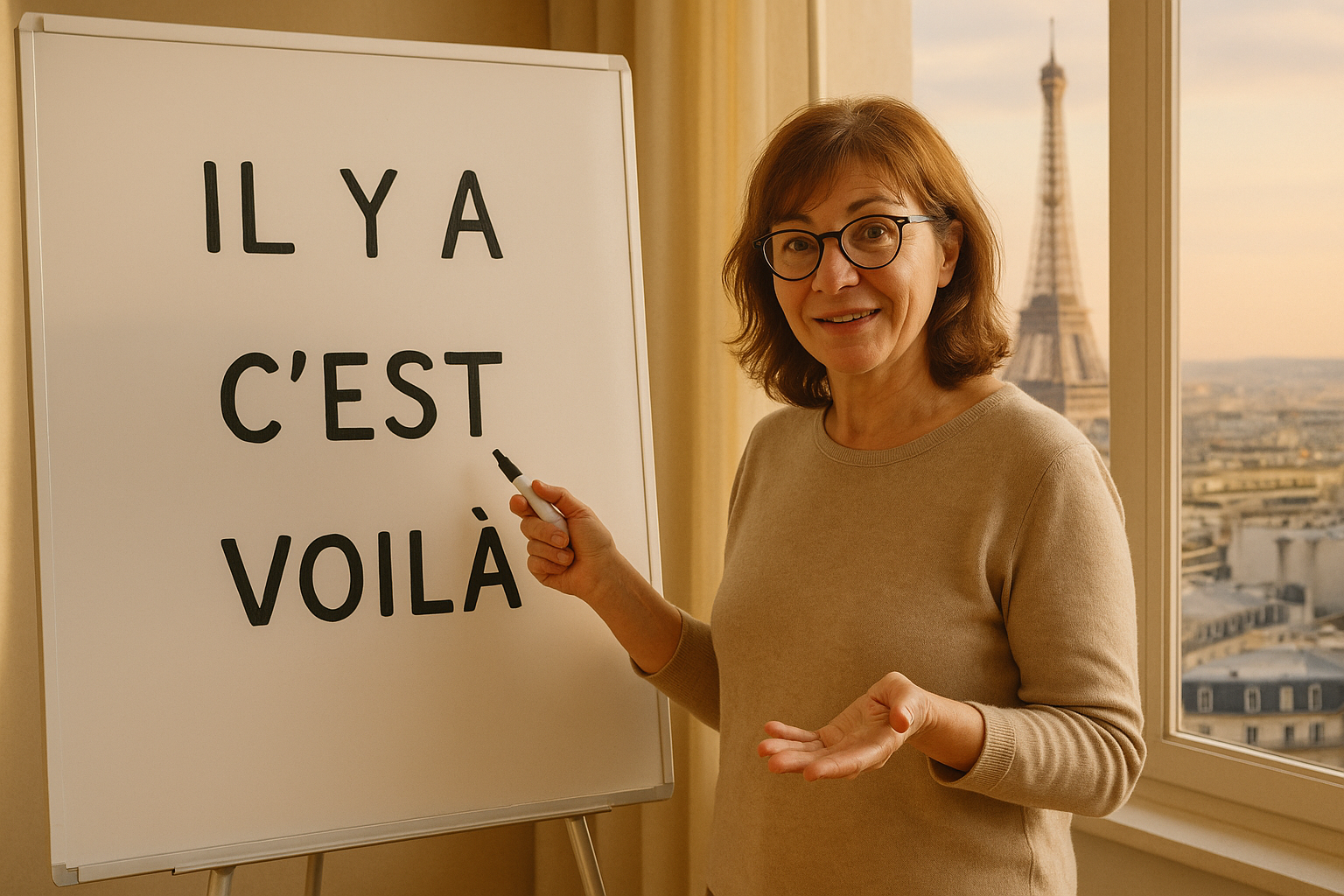
Introduction: Three Small Phrases, One Big Puzzle
Imagine you’re strolling through a bustling Parisian market. Vendors call out “Voilà, les tomates!” A friend points to the Eiffel Tower and says “C’est magnifique!” A shopkeeper explains “Il y a trois sortes de fromage.”
Suddenly, you realize you’ve heard three simple French expressions—il y a, c’est, and voilà—all in the space of five minutes.
At first glance, they seem interchangeable. After all, they all translate loosely to “there is,” “it is,” or “here/there it is.” But then you try to use one, and you see your French friend tilt their head, a polite but unmistakable sign that you’ve chosen the wrong phrase.
Welcome to the great French learner’s dilemma: when do you use il y a, c’est, and voilà?
These three little phrases may be small, but they carry enormous weight in spoken and written French. They’re the backbone of describing things, pointing things out, and introducing people and ideas. Yet they each serve unique functions—and using the right one adds a crucial touch of authenticity and finesse to your French.
So why are they so tricky?
Because each has overlapping meanings but distinct uses. And while a slip-up won’t earn you a fine from the Académie Française, it can mark the difference between sounding like a beginner and sounding like someone who truly understands how French thinks and feels.
In this article, we’re going to untangle the mystery once and for all. You’ll learn:
✅ What each expression means and how it works
✅ Common mistakes and how to avoid them
✅ Everyday examples you’ll actually use
✅ Fun phrases and cultural contexts that make these words shine
By the end, you’ll be able to stroll through that market—or any French conversation—with confidence.
So grab your café crème, settle in, and let’s conquer il y a, c’est, and voilà once and for all.
Part 1: IL Y A — “There Is / There Are”
Let’s start with il y a, one of the first expressions you’ll encounter in French class.
Meaning: “There is / there are”
But it’s more versatile than that. It can talk about:
Existence: describing what’s present
Quantity: how much of something there is
Past time: how long ago something happened
A) Talking About Existence
Use il y a when pointing out that something exists somewhere.
✅ Il y a un chat dans la rue.
(There is a cat in the street.)
✅ Il y a des étudiants dans la bibliothèque.
(There are students in the library.)
It’s impersonal. You’re not identifying what something is—that’s a job for c’est. You’re simply saying it’s there.
B) Expressing Quantity
Il y a is perfect for counting things:
✅ Il y a trois pommes sur la table.
(There are three apples on the table.)
✅ Il y a beaucoup de bruit ici.
(There’s a lot of noise here.)
C) Talking About Time Ago
Here’s a use that often surprises learners: il y a expresses how long ago something happened.
✅ Je suis arrivé il y a deux jours.
(I arrived two days ago.)
✅ Elle a déménagé il y a un an.
(She moved a year ago.)
Don’t Confuse Il y a With…
Many learners mix up il y a with voilà or c’est when talking about presence vs. identification. Remember:
Il y a → Describes that something exists.
C’est → Identifies or describes what something is.
Voilà → Physically points things out or presents them.
Part 2: C’EST — “It Is / This Is”
Now let’s look at the all-star of French expressions: c’est.
Meaning: “It is,” “This is,” or “That is.”
It’s the identity badge of French. When you want to say what something is, reach for c’est.
A) Identifying People or Things
✅ C’est Marie.
(This is Marie.)
✅ C’est un problème.
(It’s a problem.)
✅ C’est mon livre.
(That’s my book.)
B) Describing People or Things
Use c’est before adjectives describing a situation or thing, especially with nouns:
✅ C’est difficile.
(It’s difficult.)
✅ C’est intéressant.
(That’s interesting.)
✅ C’est une bonne idée.
(That’s a good idea.)
C) Talking About Professions or Roles
✅ C’est un médecin.
(He/She is a doctor.)
But be careful—if you drop the article, use il est instead:
✅ Il est médecin.
(He is a doctor.)
D) Emphasizing Opinions or Feelings
✅ C’est incroyable !
(That’s incredible!)
✅ C’est dommage.
(That’s a pity.)
When NOT to Use C’est
Don’t use c’est simply to say something exists. That’s a job for il y a. For example:
🚫 C’est deux pommes sur la table.
✅ Il y a deux pommes sur la table.
(There are two apples on the table.)
Part 3: VOILÀ — “There It Is / Here It Is”
Now for the most charming expression of all: voilà.
Meaning: “Here is / there is / there you go.”
A) Pointing Things Out
Use voilà when physically presenting or pointing out something.
✅ Voilà la Tour Eiffel !
(There’s the Eiffel Tower!)
✅ Voilà ton café.
(Here’s your coffee.)
B) Handing Something to Someone
✅ Voilà votre addition.
(Here’s your check.)
✅ Voilà tes clés.
(Here are your keys.)
C) Summarizing or Concluding
✅ Voilà pourquoi je suis parti.
(That’s why I left.)
✅ Voilà, c’est tout.
(There you go, that’s all.)
D) Expressing Agreement or Emphasis
✅ Voilà ! Exactement !
(Exactly! That’s it!)
It’s a versatile word that can mean:
“Look!”
“Here!”
“Done!”
Voilà vs. Voici
Both mean “here is / there is,” but voici is usually for things closer to you, while voilà often points further away or indicates completion.
✅ Voici mon passeport. (Here’s my passport.)
✅ Voilà ton sac là-bas. (There’s your bag over there.)
Quick Comparison Table
ExpressionMeaningExampleIl y aThere is / there are / agoIl y a un chien dans le parc.C’estIt is / this isC’est une belle journée.VoilàHere/there it is / there you goVoilà ta commande.
Real-Life Examples
Let’s look at how all three might appear in real conversation.
At a Market:
Il y a des tomates fraîches aujourd’hui.
(There are fresh tomatoes today.)C’est délicieux, ces fraises !
(These strawberries are delicious!)Voilà vos légumes, Madame.
(Here are your vegetables, madam.)
Telling a Story:
Il y a deux semaines, je suis allé à Paris.
(Two weeks ago, I went to Paris.)C’était magnifique.
(It was magnificent.)Et voilà pourquoi j’adore cette ville.
(And that’s why I love this city.)
Why This Matters
Mastering these small expressions does more than avoid mistakes—it helps you:
✅ Sound more natural in conversation
✅ Avoid awkward “translation thinking”
✅ Connect culturally with French speakers
✅ Feel confident expressing yourself
Common Mistakes
🚫 C’est deux pommes sur la table.
✅ Il y a deux pommes sur la table.
🚫 Il y a mon frère. (If introducing someone)
✅ C’est mon frère.
🚫 Voici ton café là-bas. (if pointing far away)
✅ Voilà ton café là-bas.
Learning Tips
Listen to native speakers and note how they use these words.
Practice swapping examples: “C’est un livre” vs. “Il y a un livre.”
Memorize set phrases like “Voilà pourquoi…”
Don’t stress over small slips—most French speakers will help you gently correct them!
Frequently Asked Questions (FAQs)
Q1: Can I use “c’est” for people?
Yes, but mainly for introductions: “C’est Paul.” For describing professions without an article, use il est: “Il est médecin.”
Q2: Is “voilà” formal or informal?
It’s used in all contexts—from handing someone change to finishing a speech. Tone and context make the difference.
Q3: Can I just stick with “c’est” for everything?
Not really. While versatile, using c’est everywhere sounds unnatural. Il y a is crucial for “there is/are,” and voilà has unique uses.
Q4: What’s the difference between “voilà” and “voici”?
Voici points to things close to you. Voilà points further away or emphasizes presentation.
Q5: Can I use “il y a” in the future tense?
Yes! Il y aura means “there will be.”
Q6: How do I know when to use “c’est” vs. “il est”?
Use c’est with nouns and adjectives describing a situation.
Use il est with adjectives describing a person or thing without a noun.
Q7: Is “il y a” always followed by a noun?
Mostly, yes. It introduces existence or quantity.
Q8: What’s the best way to practice these expressions?
Use them in short daily phrases, and pay attention to how natives use them in conversation and media.
Bring Your French to Life with Polyglottist!
At Polyglottist Language Academy, we believe that learning French should be more than memorizing words—it’s about mastering the rhythms, expressions, and subtle details that make French sing.
Ready to go beyond grammar charts and speak with true confidence? Join our French classes, and let’s make your French natural, authentic, and fluent—from il y a to voilà!
Check Out More Articles On Our Blog!
Hungry for more French secrets? Explore these articles:
Why Fluent French Isn’t Perfect French—And Why That’s A Good Thing
A Crash Course In “French Filler Words” (Eh Bien, Tu Vois, Genre...)
Street French Vs. School French: What You’ll Hear Vs. What You Learn
What Learning French Teaches You About English (Yes, Really!)
10 “Invisible Words” In Spoken French That Aren’t In Your Textbook
The Sound Of French: How To Train Your Ear To Understand Spoken French Fast
From Oui To Oops: The Funniest Mistakes French Learners Make (And What They Teach Us)