
How French Parenting Culture Shapes the Language of Childhood
Introduction: The Magic and Mystery of French Childhood
Picture a sunlit park in Paris. Children are playing on neatly maintained playgrounds. A mother sits on a bench, chatting quietly with a friend while her toddler toddles nearby. A father calmly instructs his child to say bonjour to the neighbor passing by. In the corner, a group of preschoolers sits in a circle, listening attentively as their teacher tells a story in beautifully precise French.
It all feels so orderly, so… French.
Ask many foreigners what they find striking about life in France, and you’ll often hear this observation: French children seem unusually well-behaved, polite, and self-possessed. They greet adults properly, wait their turn, and seem remarkably comfortable in grown-up spaces—restaurants, markets, museums. Books like Bringing Up Bébé by Pamela Druckerman have popularized the idea that French parenting holds secrets that produce confident, polite, and independent kids.
But here’s something equally fascinating for language lovers: French parenting culture doesn’t just shape children’s behavior—it shapes the entire language of childhood itself.
In France, the way adults speak to children is deliberate, measured, and respectful. It’s infused with linguistic habits that reflect broader cultural values: formality, precision, boundaries, and social rituals. Even the words used with children—from tiny commands like tiens and allez to elaborate explanations—are windows into how the French see childhood as a stage full of potential and responsibility.
As a foreigner learning French, understanding these nuances is crucial. It’s not just about vocabulary—it’s about how language and culture intertwine. Whether you’re living in France, raising bilingual children, teaching French, or simply fascinated by cultural differences, discovering how French parenting influences the language of childhood reveals hidden layers of meaning in everyday speech.
So pour yourself a café au lait, and join me as we explore how French parenting culture shapes not only how children grow—but how they speak, listen, and understand the world around them.
1. The French Concept of “Cadre” — The Framework
Ask any French parent or teacher how they manage children, and you’ll likely hear the word cadre (framework). It’s the idea that children thrive within clear, firm boundaries, but enjoy significant freedom inside them.
In language, this translates into:
✅ Clear rules and explanations rather than vague threats.
✅ Speaking to children as rational beings capable of understanding.
✅ Consistent vocabulary around limits and permissions.
Examples:
Ce n’est pas possible. (That’s not possible.)
Ce n’est pas un choix. (That’s not a choice.)
Tu as le droit de… (You’re allowed to…)
Tu n’as pas le droit de… (You’re not allowed to…)
Children hear this type of precise, authoritative language daily. It helps them understand boundaries without feeling crushed by authority.
2. Speaking to Children as Small Adults
One of the most noticeable differences between French and Anglophone parenting is how adults speak to children.
In France:
✅ Adults avoid baby talk once children begin speaking.
✅ Vocabulary used with children is sophisticated and grammatically correct.
✅ Explanations—even about discipline—are given calmly and rationally.
Example: Instead of saying:
No touchy! (English baby talk)
A French parent might say:
Tu ne dois pas toucher ça. C’est fragile. (You mustn’t touch that. It’s fragile.)
Politeness is Non-Negotiable
From a young age, children are taught to say:
Bonjour, Madame/Monsieur. (Hello, ma’am/sir.)
Merci. (Thank you.)
S’il vous plaît. (Please.)
Failing to greet adults properly is seen as disrespectful, no matter how young the child.
3. The Importance of Self-Expression — But With Restraint
French children are encouraged to express themselves—but within polite limits. Parents teach them how to share opinions without interrupting or dominating conversation.
Language lessons include:
Attends ton tour de parler. (Wait your turn to speak.)
Exprime-toi clairement. (Express yourself clearly.)
Utilise des mots, pas des cris. (Use words, not screams.)
4. The Power of “Non”
French parents are not afraid to say non—firmly and without apology.
Non, ce n’est pas possible. (No, that’s not possible.)
Non, pas maintenant. (No, not now.)
But it’s often paired with a brief explanation to respect the child’s intelligence.
5. Magic Words in French Parenting
French parents rely on certain words and phrases that carry cultural weight:
Allez ! — Let’s Go!
Used to motivate children:
Allez, on y va ! (Come on, let’s go!)
Tiens — Here You Go
Used when handing something to a child:
Tiens, prends ton doudou. (Here, take your blankie.)
Doucement — Gently
Reminding children to handle things carefully:
Doucement avec ton frère. (Be gentle with your brother.)
Ça suffit ! — That’s Enough!
A phrase that signals the conversation is over:
Ça suffit, maintenant. (That’s enough, now.)
6. Language and Autonomy
French parenting values independence from an early age. Children are taught to:
Dress themselves.
Pour their own water.
Wait quietly without constant entertainment.
This extends to language. Children are expected to use precise words to express needs rather than whining or tantrums.
Example:
Dis-moi ce que tu veux. (Tell me what you want.)
7. Storytelling as Education
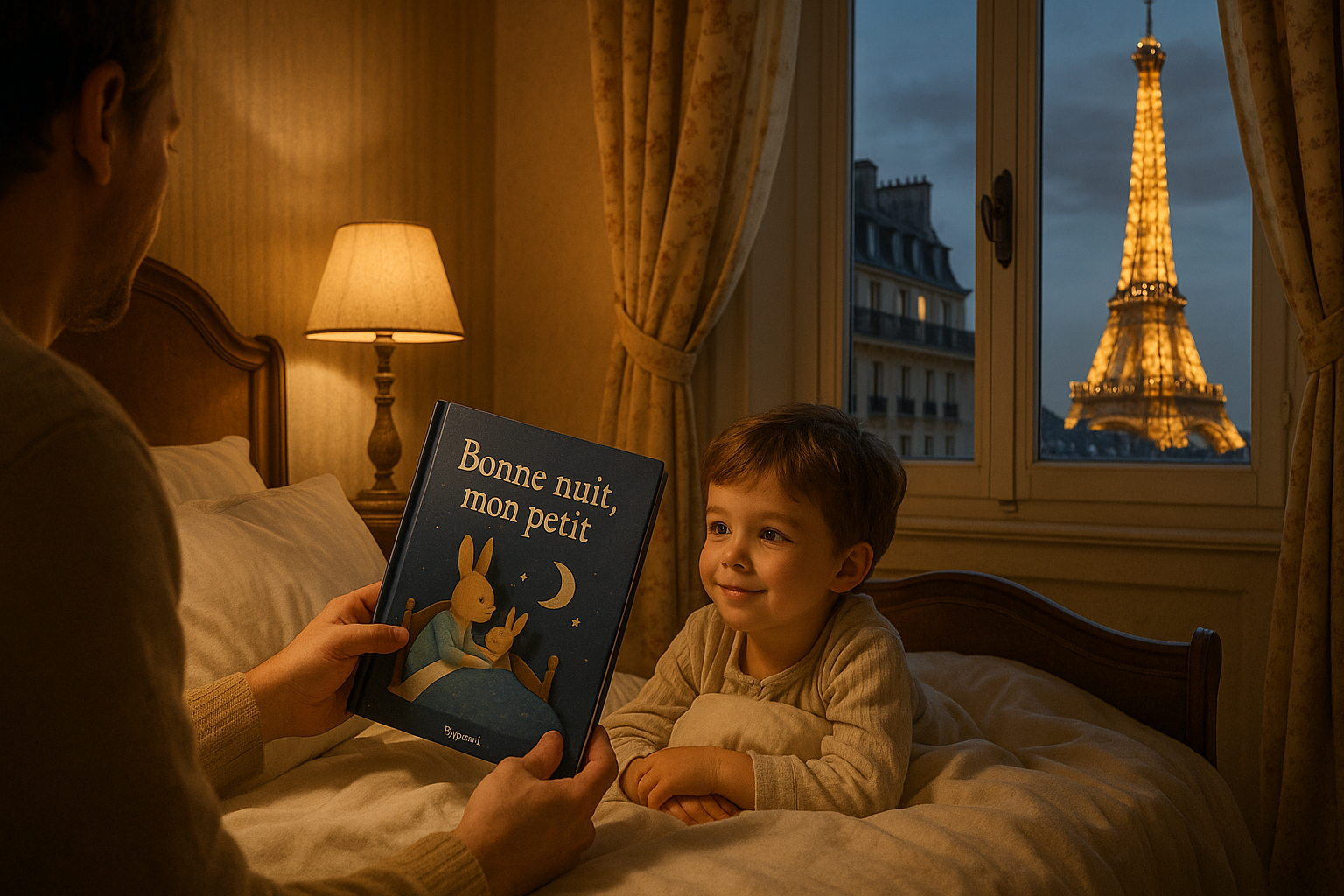
French parents read extensively to children, not just for entertainment but as moral education. The language of stories is often sophisticated, exposing kids to rich vocabulary.
Classic books include:
Le Petit Prince by Antoine de Saint-Exupéry
Les Contes de Perrault (Perrault’s fairy tales)
Les Fables de La Fontaine
Even children’s cartoons in France often include complex language and cultural references.
8. Emotional Vocabulary
French parents teach children to name emotions:
Je suis fâché(e). (I’m angry.)
Je suis triste. (I’m sad.)
J’ai peur. (I’m scared.)
This builds emotional intelligence and helps children articulate feelings rather than act them out.
9. School Language: The Early Introduction of Formality
From maternelle (preschool), children hear language emphasizing structure:
Asseyez-vous. (Sit down.)
Écoutez bien. (Listen carefully.)
Levez la main. (Raise your hand.)
This early formality instills respect for authority and organized communication.
10. The Vocabulary of Mealtime
Meals are sacred in French culture—and a language lesson in themselves. Children learn:
Attends ton tour. (Wait your turn.)
Mange proprement. (Eat neatly.)
On ne parle pas la bouche pleine. (Don’t talk with your mouth full.)
On goûte avant de dire qu’on n’aime pas. (Taste before saying you don’t like it.)
11. Play and Language Learning
French playgrounds often ring with phrases like:
À toi ! (Your turn!)
Je compte jusqu’à trois. (I’ll count to three.)
Tu triches ! (You’re cheating!)
Learning social dynamics in play reinforces polite disagreement, negotiation, and group dynamics.
12. Why This Matters for Language Learners
Understanding how French parents speak to children helps language learners:
✅ Understand cultural values reflected in everyday speech.
✅ Learn practical vocabulary not found in textbooks.
✅ Communicate effectively if teaching, working with families, or raising bilingual kids.
14. How to Incorporate This Knowledge
If you’re learning French:
Watch French children’s shows for authentic language.
Read French children’s books—even as an adult.
Practice phrases used in parenting to build polite, natural language skills.
Observe how French parents speak in public spaces.
FAQs: French Parenting and Language
Q: Why don’t French parents use baby talk?
A: They believe speaking properly helps children develop precise language skills and respect adult communication.
Q: Do French children really behave better?
A: French kids still have tantrums, but cultural norms often encourage calm behavior in public.
Q: Is “no” really non-negotiable in France?
A: Often, yes. French parents set firm boundaries but explain reasons calmly.
Q: Why do French children speak so politely?
A: Politeness is instilled early as a core value, reflected in mandatory greetings and respectful speech.
Q: Is emotional vocabulary important in French parenting?
A: Yes, it helps children articulate feelings and manage emotions appropriately.
Q: Are French kids allowed to disagree?
A: Yes—but they’re taught to do it politely and wait their turn to speak.
Q: Are French parenting methods universal in France?
A: Practices vary regionally and individually, but certain cultural norms (like politeness and cadre) are widespread.
Q: Should I learn French parenting vocabulary even if I don’t have kids?
A: Absolutely! It offers insights into the culture and improves your conversational range.
Learn Real-Life French with Polyglottist Language Academy
At Polyglottist Language Academy, we believe learning French goes beyond verbs and grammar—it’s about understanding how people truly live and speak. Whether you’re exploring parenting culture, planning to raise bilingual children, or simply fascinated by French society, our courses help you connect with authentic language and real-life contexts.
✨ Ready to master French that’s as real as it is elegant? Join Polyglottist Language Academy today and discover the secrets of speaking—and thinking—like a native. ✨
Check Out More Articles on Our Blog!
Keep exploring the world of French language and culture: