
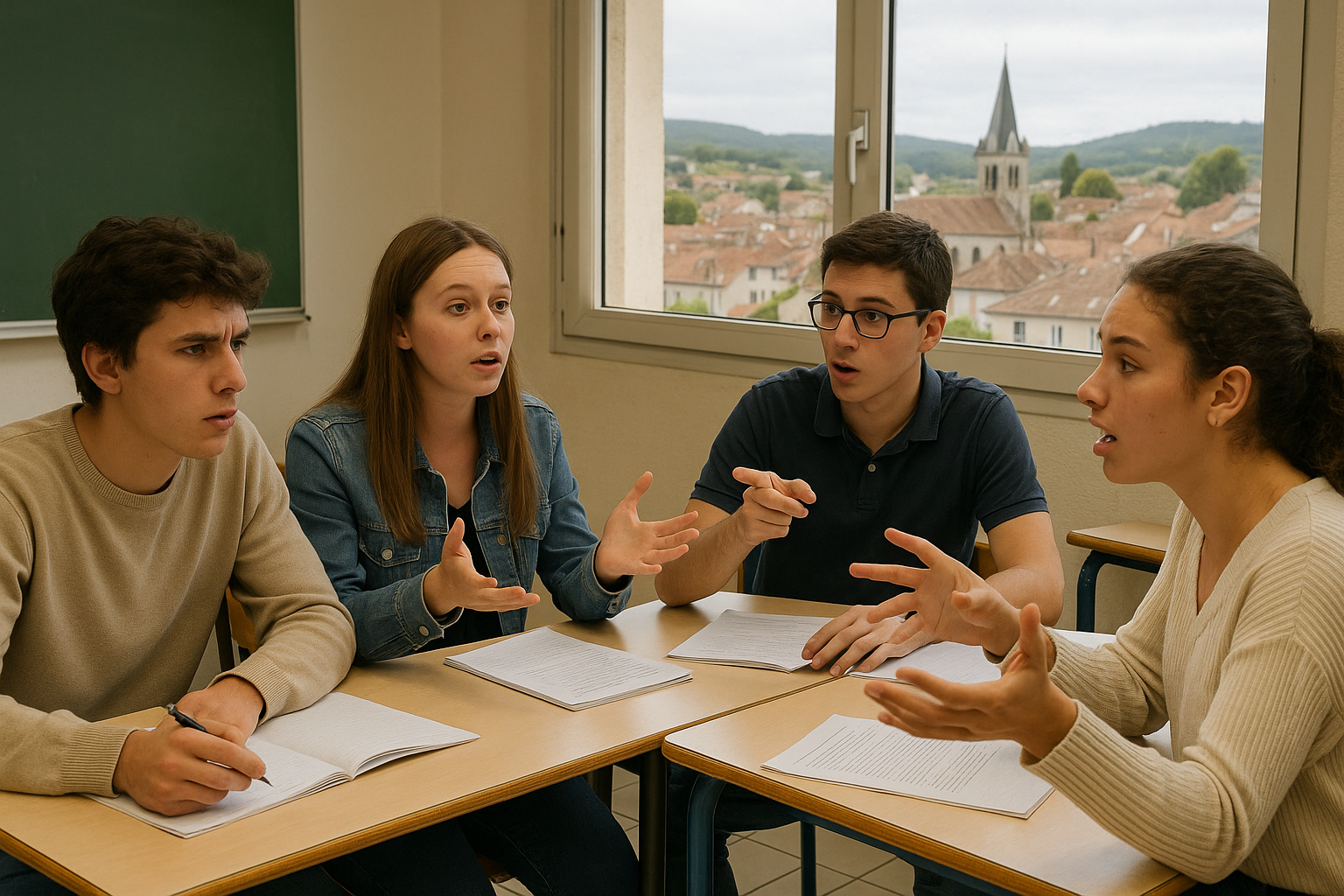
Introduction: Why Do the French Sound So Convincing—Even in Casual Conversations?
If you've ever spoken with a French person and felt like you were suddenly in the middle of a courtroom drama or a televised political roundtable—even if you were just discussing vacation plans or cheese—you’re not imagining things. French conversation often feels like a structured argument, even when it’s friendly. Opinions are stated clearly, objections are welcomed (or expected), and points are delivered with a kind of elegant, intellectual flair that’s both intimidating and impressive.
Why does this happen?
Because from an early age, French students are taught to debate. Not in the spontaneous, back-and-forth way we might associate with high school debate clubs in English-speaking countries—but in a rigorous, highly structured, and deeply philosophical way. By the time a French student finishes secondary school, they’ve not only read Montaigne, Rousseau, and Sartre—they’ve also been trained to defend a point of view with logic, clarity, and rhetorical finesse.
This tradition isn’t just academic. It influences everything from politics and journalism to dinner-table conversations and dating. It explains why French people are more comfortable with disagreement, more likely to enjoy intellectual tension, and often come across as more "argumentative" to those raised in more conflict-averse cultures.
In this article, we’ll explore how debate is taught in French schools, how it shapes everyday interactions, and what language learners can gain by embracing this aspect of French communication.
Part I: The Foundations of French Debate Culture
La Dissertation: The Cornerstone of Argumentation
From middle school onward, French students learn to write the “dissertation”—a structured essay that requires them to take a position, develop it with evidence, and counter opposing arguments. This isn't a casual opinion piece. It’s a highly codified form with an expected structure:
Introduction with a problem/question
Thesis: Presenting one possible answer
Antithesis: Presenting the opposite view
Synthesis: Reconciling or evaluating both
Conclusion that restates and extends the findings
This method is known as the dialectical method, and it’s central to how the French are taught to think and speak. It’s not about being right—it’s about building an argument.
Philosophy Is Mandatory
In the final year of lycée (high school), every French student—regardless of their academic track—is required to take philosophy. It’s not just a side elective. It’s a major part of the final baccalauréat exam.
Students debate questions like:
“Can freedom exist without laws?”
“Is art the product of culture or individuality?”
“Is it possible to know everything?”
The goal isn’t just to know philosophers. It’s to develop a way of speaking and writing that reflects critical engagement with complex ideas.
Public Speaking Is Practiced—Not Feared
While public speaking is a source of anxiety in many cultures, in France, students regularly present oral arguments in class, often under timed conditions. These exercises reward not only substance but style—clarity, confidence, and elegance are key.
Part II: How This Shapes the Way French People Converse
1. Disagreement Is Not Disrespect
If you say something a French person disagrees with, they’ll tell you—immediately and with precision. But they’re not being rude. For them, challenging ideas is a sign of engagement, not aggression.
Where Anglo cultures may use hedges (“I might be wrong, but…”), French speakers dive right in:
“Non, je ne suis pas d’accord.” (No, I don’t agree.)
“Mais justement, c’est le contraire.” (Actually, it’s the opposite.)
This can feel jarring to Americans or Brits used to softening disagreement. But in France, a good conversation is one with tension—as long as it’s intellectual, not personal.
2. Speaking in Paragraphs
Thanks to years of training in essay writing and structured oral exams, French speakers often organize their thoughts like mini-essays. Even in casual settings, you might hear:
An introduction (“Bon, je pense que le vrai problème, c’est…”)
A developed argument (“Parce que si on regarde l’histoire…”)
A conclusion (“Donc, finalement, on ne peut pas vraiment dire que…”)
This makes French speakers sound confident, coherent, and compelling—even when they’re just talking about weekend plans.
3. The Importance of Eloquence
French culture places a premium on style in speech. It's not enough to be correct; one must be persuasive, elegant, and sharp. That’s why political debates in France often feel like theatrical performances and why being “bon orateur” (a good speaker) is a major compliment.
Even in everyday life, well-crafted phrasing is admired. Puns, rhetorical flourishes, and historical references are all fair game in casual conversation.
Part III: Everyday Scenarios Where French Debate Culture Shows Up
At the Dinner Table
Don’t expect a polite exchange of small talk. French meals—especially long Sunday lunches—often turn into free-for-all discussions about politics, education, or ethics. You’ll be expected to defend your position, even if you’re a guest.
In Politics
French politicians are often trained at institutions like Sciences Po or ENA, where debate and rhetorical skill are paramount. TV political shows feature roundtables where interruptions, cross-talk, and verbal jousting are the norm.
In the Classroom
Even 12-year-olds are asked to present both sides of an argument in history class. By the time they reach university, students are comfortable presenting, arguing, and being critiqued—publicly.
In Personal Relationships
Romantic partners, friends, and family members often engage in heated debates—not as fights, but as a way of showing interest and care. Silence is more awkward than conflict.
Part IV: What This Means for Language Learners
Embrace Disagreement
Don’t be afraid to disagree respectfully in French. It shows you’re thinking. Learn phrases like:
“Je vois ce que tu veux dire, mais…” (I see what you mean, but…)
“Tu as raison sur un point, mais je pense que…” (You’re right on one point, but I think…)
Organize Your Thoughts
Practice framing your opinions in a logical way. Even if you’re not fluent, you can start with:
“D’abord…” (First…)
“Ensuite…” (Then…)
“Enfin…” (Finally…)
This helps your listener follow your reasoning and gives you confidence.
Watch French Debates
Check out YouTube clips of:
“C dans l’air”
“On n’est pas couché”
Presidential debates (débat présidentiel)
Listen for structure, transitions, and vocabulary. Take notes!
Take a Philosophy-Inspired Approach
Even simple conversations can be deep. Ask:
“Pourquoi, à ton avis?” (Why, in your opinion?)
“Est-ce que c’est toujours vrai?” (Is that always true?)
“Mais qu’est-ce que ça veut dire, en fait?” (But what does that really mean?)
You’ll impress your conversation partner—and stretch your mind.
FAQs: French Debate Culture and Communication
Q: Why do French people interrupt each other so much during conversations?
In France, interrupting can signal enthusiasm, not rudeness. It's part of fast-paced, dynamic dialogue.
Q: Is it rude to disagree with a French person directly?
Not at all. As long as you stay calm and clear, disagreement is welcome and respected.
Q: How can I learn to speak more like a French person?
Practice organizing your thoughts clearly, expanding your vocabulary of transition words, and watching or listening to real French debates.
Q: What’s a “dissertation” and should I try writing one in French?
A dissertation is a formal essay structure taught in school. Writing one—even a short version—can sharpen your thinking and improve fluency.
Q: How can I practice debate-style French at home?
Try journaling arguments for and against a topic, recording yourself giving a short opinion, or joining a conversation class that emphasizes speaking.
Q: Are French people always this argumentative?
Not always—but they do value verbal sparring as a form of connection and intelligence. Don’t take it personally.
Want to Debate (Politely) in French Like a Native?
At Polyglottist Language Academy, we offer more than just vocabulary and grammar. We train you to think, speak, and argue in French—with clarity, confidence, and cultural awareness. Whether you're a beginner or an advanced learner, our small-group online and in-person classes (3–6 students) give you the tools to express yourself authentically.
👉 Start your French journey with us today at Polyglottist Language Academy.