
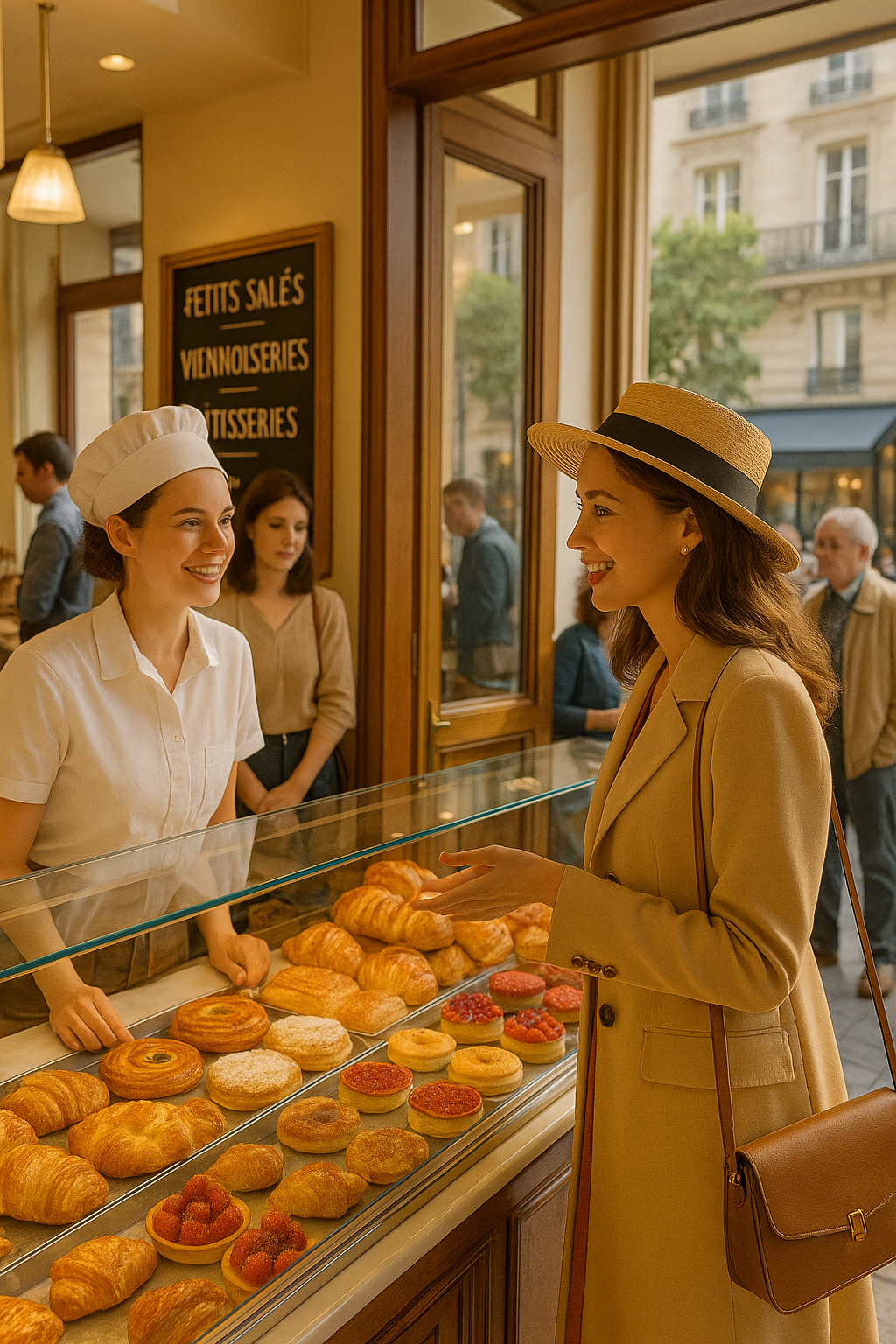
Introduction: Where Culture Rises with the Bread
The moment you step into a French bakery—la boulangerie—you enter more than a shop. You step into a deeply ingrained cultural ritual, where language, politeness, and tradition rise alongside the fresh loaves of bread and golden croissants. The warm scent of butter, flour, and sugar wraps around you, and behind the counter stands a baker or vendor ready to greet you—if you know what to say.
For travelers and French learners, this setting is both thrilling and intimidating. You may think, “It’s just a croissant!”—but in France, how you ask for that croissant matters. The words you choose, your tone, and even the order in which you greet and request can affect how welcome you feel—or whether you’re subtly judged by locals.
And make no mistake: the French take their bakeries seriously. From knowing the difference between pain complet and pain de campagne to understanding when to say bonjour (and when not to say bonjour again), your bakery interactions can be an unexpected crash course in real-life French culture.
This article will help you navigate the dos and don’ts of speaking in a French bakery, give you the essential phrases you’ll need, and help you avoid common missteps that instantly mark you as a tourist. Whether you’re practicing your French or simply want to blend in better next time you're in Paris or Provence, consider this your ultimate boulangerie survival guide.
Part 1: What to Say When You Enter
1. Always Say Bonjour First
The absolute golden rule: never walk into a French bakery without saying “Bonjour” (Hello). Even if the person behind the counter is busy, even if there’s a line, even if you don’t think they heard you—say it.
Greeting the vendor sets the tone. It’s not just polite—it’s essential. Failing to say bonjour is often seen as abrupt or even disrespectful.
If it’s after 6 p.m., switch to “Bonsoir” (Good evening). It’s a subtle way of showing you understand French social norms.
Better yet:
Bonjour Madame / Bonjour Monsieur – Shows extra politeness.
2. Wait Your Turn and Make Eye Contact
In many French bakeries, there may not be an obvious queue system. Instead, people wait and subtly signal whose turn is next. Be patient, make gentle eye contact with the staff, and wait for them to invite you to order.
Part 2: Phrases for Ordering Like a Local
Once it’s your turn, it’s time to place your order clearly and politely. Here’s how to do it:
1. Start with “Je voudrais” or “J’aimerais”
These mean “I would like” and are far more polite than simply naming the item.
Je voudrais une baguette, s’il vous plaît. – I’d like a baguette, please.
J’aimerais deux croissants et un pain au chocolat, s’il vous plaît. – I’d like two croissants and a chocolate bread, please.
Avoid just pointing and saying “Un croissant.” It sounds abrupt. French etiquette prefers softeners.
2. Use Numbers and Articles Properly
Make sure to use “un” (one), “deux” (two), and so on. And always add “s’il vous plaît” (please).
Trois pains au chocolat, s’il vous plaît.
Une tartelette aux fraises, s’il vous plaît.
3. Ask for Recommendations
If you're feeling adventurous or curious:
Qu’est-ce que vous me recommandez ? – What do you recommend?
Quel est le plus populaire ? – What’s the most popular?
C’est fait maison ? – Is it homemade?
These phrases not only show respect for the baker’s craft, but also open the door to friendly interaction.
Part 3: What Not to Say or Do
1. Don’t Skip the Greeting
We can’t say it enough. No bonjour, no good service.
2. Don’t Touch the Bread or Pastries
In most French bakeries, everything is behind glass. Don’t point too closely or touch any items. Wait for the staff to handle your selection.
3. Avoid Mixing Up Pastry Names
French pastries often have similar names. Calling a pain au chocolat a “chocolate croissant” won’t just get you corrected—it may earn you a disapproving look.
Do your homework:
Croissant – Flaky, buttery crescent
Pain au chocolat – Rectangular pastry with chocolate
Brioche – Sweet, eggy bread
Tarte – Tart, usually with fruit or cream
Éclair – Long pastry filled with cream and topped with icing
4. Don’t Linger Too Long If It’s Busy
French bakeries are often fast-paced in the morning. Have your order ready if there’s a line. Chatting is fine when it’s quiet, but during peak hours, keep it brief.
Part 4: Useful Vocabulary for the Bakery
Here’s a cheat sheet of essential terms:
Breads
La baguette tradition – Traditional baguette
Le pain de campagne – Country-style bread
Le pain complet – Whole wheat bread
Le pain aux céréales – Multigrain bread
Pastries
Le croissant – Croissant
Le pain au chocolat – Chocolate-filled pastry
La brioche – Soft, rich bread
Le chausson aux pommes – Apple turnover
La tartelette au citron – Mini lemon tart
Le flan pâtissier – Custard tart
Extras
C’est pour emporter ? – Is it to go?
Vous prenez la carte ? – Do you take card?
Avez-vous du pain sans gluten ? – Do you have gluten-free bread?
Part 5: Wrapping Up the Transaction Politely
Once your order is complete:
Merci beaucoup ! – Thank you very much!
Bonne journée / Bon week-end ! – Have a good day / Have a good weekend!
These small phrases leave a lasting impression—and help you blend in.
And remember: just as you entered with bonjour, you should always exit with au revoir or bonne journée. Leaving in silence is considered rude.
FAQs
Q: Is it rude to speak English in a French bakery?
A: Not necessarily, but trying even basic French shows respect. Start with bonjour, and then politely ask, “Parlez-vous anglais ?” if needed.
Q: What if I mispronounce something?
A: Don’t worry! French people appreciate the effort. A smile and “Je suis désolé, je suis en train d’apprendre” (I’m sorry, I’m learning) goes a long way.
Q: Can I pay with card?
A: Yes, most bakeries accept card now, but smaller ones may have a minimum. It’s polite to ask: “Je peux payer par carte ?”
Q: Should I tip in a bakery?
A: Tipping isn’t expected in bakeries, though you might leave small change in a jar if one is present. It’s more about courtesy than money.
Q: What time do bakeries usually open?
A: Many open early—between 6:30 and 8:00 a.m.—and close in the afternoon. Some also close for lunch or on Mondays.
Q: What’s the difference between a boulangerie and a pâtisserie?
A: A boulangerie focuses on bread and basics; a pâtisserie specializes in cakes, tarts, and desserts. Some shops are both.
Q: Can I sit and eat inside?
A: Only if there’s a café section. Most bakeries are takeaway. If you want to sit, ask: “Puis-je manger ici ?”
Q: What’s the best way to sound more local?
A: Use full sentences, speak softly, and don’t forget bonjour, s’il vous plaît, and merci!
Learn to Speak French Like a Local (Croissant Included)
At Polyglottist Language Academy, we believe that real fluency goes beyond textbooks. It’s about knowing how to live the language—from ordering your morning baguette to asking for directions with confidence.
Our small, conversation-focused French classes (offered in Berkeley, Oakland, San Jose, Marin, and online) help you master the everyday moments that matter most.
👉 Sign up today and start learning the French that gets smiles—not stares—at the bakery.