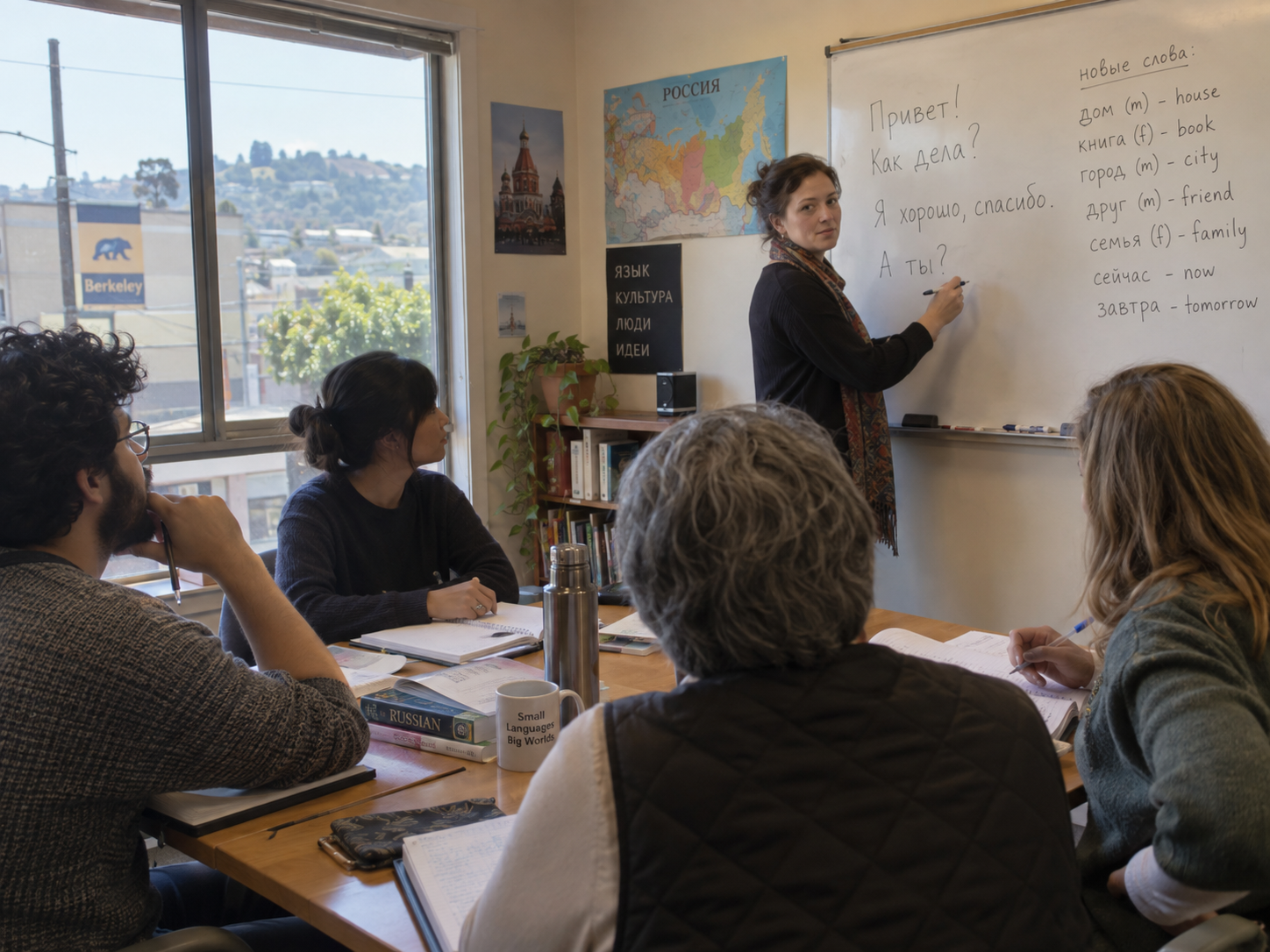
For an adult in the Bay Area, Russian can look like an unusual choice at first. Spanish is everywhere, Mandarin has obvious local relevance, and Japanese is closely connected with technology and travel. Russian tends to enter the picture for more personal reasons: a family connection, literature, travel, history, a partner, or simply the experience of learning a language that works very differently from English.
What is easy to miss is that the Bay Area is actually a good place to study it. Russian is not a language you have to learn in isolation here. There are university programs, cultural organizations, heritage communities, lectures, performances, bookstores, churches, and online classes that can turn an abstract language project into something connected with real people and real cultural life.
1. You can study Russian seriously without leaving the Bay Area
Russian is one of those languages where structure matters. Apps can help with vocabulary, but eventually learners have to understand cases, aspect, verbs of motion, pronunciation, and a writing system that becomes easy only after it stops feeling new. Having access to teachers and an established academic tradition makes a difference.
The Bay Area has unusually deep resources for this. Stanford’s Language Center currently offers Russian from first-year courses through advanced conversation, reading, heritage-speaker study, and upper-level language work. UC Berkeley’s Slavic department also maintains Russian language and culture as a substantial academic field rather than an occasional elective.
Most adult learners will not enroll in a university degree program, of course. The point is that Russian exists here as a living field of study. Public lectures, cultural events, faculty work, student organizations, and visiting speakers create a broader environment than a learner in many American cities would find.
2. Russian culture has a visible local history
San Francisco has had Russian and Russian-speaking communities for generations, and the Russian Center of San Francisco has operated since 1939. Its museum, library, cultural programs, and annual events preserve the history of Russian emigration and Russian-American life in the city.
That history matters for a language learner because culture stops being something that exists only in a textbook. You can encounter immigration stories, music, dance, religious traditions, food, art, and different generations of Russian speakers in the same metropolitan area.
It is also useful to remember that “Russian-speaking” is broader than “Russian.” Many people who use Russian have family roots in Ukraine, Kazakhstan, Belarus, the Caucasus, Central Asia, the Baltic region, or Jewish communities of the former Soviet Union. The language can be shared even when identities, histories, and political views are very different. A thoughtful learner should approach that diversity with curiosity rather than treating Russian as the voice of a single culture.
3. Russian gives you access to material that changes in translation
Many students begin Russian because of literature, and that is not a cliché so much as a practical observation. Chekhov, Tolstoy, Dostoevsky, Bulgakov, Akhmatova, Nabokov, and many other writers are widely available in excellent English translations. Yet even a modest amount of Russian changes how you read them.
A beginner notices names, diminutives, forms of address, and repeated words that disappear or shift in translation. An intermediate learner begins to hear register: when a character sounds formal, intimate, irritated, old-fashioned, bureaucratic, or unexpectedly tender. Russian is rich in small suffixes and grammatical choices that carry attitude as well as information.
The same is true of film, songs, interviews, podcasts, comedy, and online culture. Translation gives you the content. Language gives you more of the tone.
4. Russian trains skills that English speakers do not usually have to practice
Russian forces English speakers to pay attention to information they normally ignore. Nouns change according to their grammatical role. Adjectives agree with nouns. Verbs distinguish completed actions from processes. Word order can shift to emphasize what is new or important. Stress moves unpredictably and can affect pronunciation.
This sounds intimidating when listed all at once, but teachers often notice that adult learners enjoy Russian more once they stop expecting it to behave like English. The language becomes a kind of pattern-recognition exercise. Instead of relying mainly on fixed word order, you learn to notice endings and relationships between words.
That mental shift is one of the most satisfying parts of Russian. A sentence that looked dense in the first month can become transparent later because you have learned where the information is stored.
5. The Bay Area makes it easy to combine local life with online study
The practical problem with less commonly taught languages is scheduling. A good class may exist, but not on the evening you are free. The instructor may be across the bridge. A cultural event may be in San Francisco while you live in the East Bay or South Bay.
Russian works particularly well with a mixed approach. A live online class can give you a weekly structure, speaking practice, correction, and progression through grammar. Local cultural institutions, university events, conversation partners, films, and community programs can then give the language a life outside the class.
For adults, this combination is often more sustainable than waiting for one perfect in-person course to provide everything.
What kind of Russian learner does especially well here?
Bay Area students often arrive with very different goals. One person wants to read literature; another has Russian-speaking relatives; someone else is preparing for travel or simply wants a demanding intellectual hobby. Those students may be at the same nominal level while needing different kinds of practice.
A good class should therefore do more than move through grammar chapters. Beginners need pronunciation and speaking from the start. Heritage learners may need to fill gaps in reading and formal grammar. Returning learners often remember more than they think, but their knowledge is uneven and needs to be reorganized.
Polyglottist Language Academy offers structured Russian instruction for adults who want that combination of grammar, conversation, and steady progression. The Bay Area already supplies plenty of cultural context; the class should give you the language tools to make use of it.
Explore Russian Classes at Polyglottist Language Academy
Related Articles
Why Russian Feels Hard At First (And Why It Gets Easier After 6 Months)
Why Russian Is A Critical Language — And What That Means For Your Career
Can You Learn Russian In A Year? What's Actually Possible And How To Do It
Is Russian Worth Learning? An Honest Look For English Speakers
How Long Does It Take To Learn Russian? A Realistic Breakdown By Level (A1 To C1)
The Russian Alphabet In 2 Hours: A Complete Beginner's Guide To Cyrillic