
One of the easiest mistakes to make when looking at Spanish architecture is to assume that an old building belongs to one historical period. A traveler sees a Gothic cathedral, recognizes the pointed arches and soaring vaults, and reasonably assumes that everything in front of them is medieval. In Spain, that assumption can fall apart surprisingly quickly.
The facade of Barcelona Cathedral that most visitors photograph, for example, looks convincingly Gothic, but much of it was completed in the nineteenth century. Girona Cathedral contains the widest Gothic nave in the world, yet its monumental main facade is Baroque. At Santiago de Compostela, an eighteenth-century Baroque facade stands in front of a much older Romanesque cathedral. Burgos Cathedral accumulated Gothic, Renaissance, and later additions over several centuries.
This is a better way to approach Spanish architecture than imagining a tidy sequence in which Gothic ended, Renaissance began, and Baroque eventually replaced it. Styles overlapped. Regional traditions persisted. New rulers altered buildings commissioned by their predecessors, and architects regularly worked with structures that had already been standing for generations.
Once you begin looking for those layers, the historic centers of Spain become considerably more interesting. Architecture starts to reveal political ambition, religious change, regional identity, and the long interaction among Christian, Islamic, and classical artistic traditions.
Gothic Spain and the Architecture of Height and Light
Gothic architecture began transforming Spain during the thirteenth century. Many of its characteristic ideas had developed farther north in Europe, particularly in France: pointed arches, ribbed vaults, flying buttresses, large stained-glass windows, and an emphasis on height and light.
These were not simply decorative choices. Gothic engineering allowed builders to direct the enormous weight of stone vaults toward columns, buttresses, and external supports rather than relying entirely on thick walls. Walls could therefore become lighter and windows much larger. Inside the great cathedrals, the result was a completely different experience from the heavier Romanesque churches that preceded them. High vaults drew the eye upward, while stained glass introduced color and changing daylight into spaces that could otherwise have felt overwhelmingly massive.
Spanish builders adopted this architectural language while adapting it to local traditions. Some Spanish Gothic cathedrals developed particularly wide naves and numerous smaller chapels, while regional differences became increasingly noticeable. Gothic architecture in Castile, for example, does not always resemble the broader and more horizontal Mediterranean Gothic found in Catalonia and Mallorca.
Burgos Cathedral is one of the clearest places to see how Gothic architecture arrived in Spain and then continued changing.
Construction began in 1221 under Ferdinand III of Castile and Bishop Mauricio. The high altar was consecrated in 1260, but the cathedral that visitors see today was nowhere near finished at that point. Different generations of architects continued working on it, including French and German master builders. In the fifteenth century, Juan de Colonia added the extraordinary openwork spires that give the cathedral's towers their distinctive silhouette. Later Renaissance and Plateresque additions became part of the building as well.
Burgos is therefore more interesting than a perfectly preserved example of a single moment in Gothic architecture. It records several centuries of changing taste in one structure.
León Cathedral offers a different experience. Its extraordinary stained glass makes the relationship between Gothic engineering and light particularly easy to understand. The interior does not feel dominated by solid stone walls in the way many earlier churches do; instead, architecture seems to make room for colored light.
Toledo Cathedral is more complicated again. It belongs fundamentally to the Spanish Gothic tradition but incorporates Mudéjar influences as well, a reminder that medieval Spanish architecture developed in a society still deeply connected to the artistic traditions of Islamic Iberia.
Seville Cathedral tells that story even more visibly.
The cathedral stands on the site of a twelfth-century Almohad mosque. After Ferdinand III captured Seville in 1248, the mosque initially continued to function as a Christian church before much of it was eventually replaced by the enormous Gothic cathedral consecrated in 1507. It remains the largest Gothic church in the world.
The Islamic history of the site never disappeared completely. The Giralda, now one of Seville's most recognizable landmarks, originated as the mosque's minaret before becoming the cathedral's bell tower.
Knowing that history changes the way you look at the building. Instead of seeing only a Gothic cathedral, you begin to notice how one religious and political order reused, transformed, and built around the architecture of another.
Why Gothic Looks Different in Barcelona, Girona, and Mallorca
Travelers who have learned to recognize Gothic architecture from photographs of northern French cathedrals may find parts of Spain slightly confusing.
Barcelona Cathedral, Girona Cathedral, and Palma Cathedral all belong to Gothic traditions, yet they do not produce exactly the same vertical impression associated with cathedrals such as Chartres or Amiens. Mediterranean Gothic often emphasizes broad interior spaces and strong horizontal lines.
Girona Cathedral provides perhaps the most dramatic example. Its single Gothic nave is approximately 22.98 meters wide, making it the widest Gothic nave in the world. Medieval builders made the unusually ambitious decision to eliminate the conventional side aisles and span an enormous uninterrupted interior instead.
If you walk back outside, however, the stylistic picture changes. Girona's monumental main facade is Baroque. The Gothic interior and Baroque exterior belong to different periods in the cathedral's history, although to a visitor they appear as one building.
Barcelona Cathedral presents another surprise. Construction of the Gothic building began in 1298, and much of its nave and lateral chapels was substantially complete by the fifteenth century. The elaborate Gothic-looking principal facade that dominates photographs today, however, was completed much later in the nineteenth century in a Gothic Revival style.
Palma Cathedral, or La Seu, in Mallorca provides yet another version of Gothic architecture. Construction developed over several centuries on the site of a former mosque, and the broad interior belongs to the Mediterranean Gothic tradition. Later Plateresque and neo-Gothic alterations mean that even here, different centuries remain visible in different parts of the building.
This is where architectural labels become more useful if you treat them as clues rather than rigid categories. A building can be medieval in its structure, Renaissance in one doorway, Baroque on its facade, and partially reconstructed hundreds of years later without ceasing to be historically coherent.
Ferdinand and Isabella Leave Their Mark in Stone
By the late fifteenth century, Gothic architecture in Castile had become increasingly elaborate. During the reign of Isabella I of Castile and Ferdinand II of Aragon, a distinctive late Gothic style developed that is now known as Isabelline Gothic, or Gótico Isabelino.
It combined late Gothic forms with Flemish decorative influences, Mudéjar traditions, royal heraldry, and some of the earliest Renaissance motifs reaching Spain from Italy. The mixture reflected the political and cultural world in which it appeared.
Ferdinand and Isabella consolidated dynastic power, completed the conquest of Granada in 1492, and ruled during the beginning of Spain's expansion across the Atlantic. Architecture became one of the ways the monarchy presented that new authority publicly.
Their symbols appear repeatedly on Isabelline buildings. The yoke and arrows associated with the Catholic Monarchs are common, as are royal coats of arms and images of the pomegranate, or granada, referring to the conquest of Granada.
San Juan de los Reyes in Toledo makes this political use of architecture unusually tangible. Isabella commissioned the monastery after the Battle of Toro in 1476, which helped secure her claim to the Castilian throne. The building was originally intended in part as a royal mausoleum, although Ferdinand and Isabella were ultimately buried in Granada.
More unusual are the chains displayed on its exterior walls. They were associated with Christian prisoners liberated during the conquest of Granada and were incorporated into the monastery as visible symbols of victory and liberation.
Once you know what these objects and emblems mean, the decoration stops looking like elaborate medieval ornament added simply for beauty. Much of it is political language carved into stone.
Plateresque: When Stone Starts to Look Like Silverwork
Around the transition from Gothic to Renaissance, Spain developed one of its most recognizable architectural styles.
Plateresque comes from platero, the Spanish word for silversmith, and the comparison is remarkably accurate. Rather than completely reinventing the structure of buildings, architects and craftsmen covered surfaces with intricate decoration that could resemble finely worked silver.
Medallions, shields, scrolls, columns, grotesques, foliage, heraldic emblems, and classical motifs might be packed tightly across a facade. Underneath all that decoration, however, the building could still rely on essentially Gothic structural systems.
This is why a building can reasonably be described as Gothic in structure and Plateresque in decoration. Architectural history does not always give us the neat categories we might prefer.
The famous facade of the University of Salamanca is one of the best places to see the effect. The university itself has medieval origins, while its richly carved early sixteenth-century facade belongs to the Renaissance-Plateresque period. Seen from across the courtyard, the stone almost resembles a textile. As you move closer, individual figures, medallions, heraldic symbols, and architectural details begin to emerge.
For travelers who do not want to memorize architectural terminology, the silversmith comparison is genuinely useful. If a Spanish Renaissance-era facade looks like an enormous piece of jewelry translated into stone, Plateresque is a good possibility.
The Renaissance Arrives in Spain
Italian Renaissance architecture was based on a renewed fascination with the classical world. Symmetry, mathematical proportion, Roman columns, pediments, circles, and carefully balanced geometric compositions became increasingly important.
Those ideas reached Spain gradually. Gothic construction did not suddenly stop because Spanish architects had discovered ancient Rome. Plateresque ornament, Mudéjar craftsmanship, Gothic structure, and increasingly classical Renaissance designs continued alongside one another for decades.
This helps explain why the Spanish Renaissance can feel more eclectic than its Italian counterpart. Renaissance ideas arrived in a country that already possessed powerful Gothic traditions and centuries of Christian, Muslim, and Jewish artistic interaction. Spanish architects absorbed those new ideas into an existing visual culture rather than simply replacing everything that had come before.
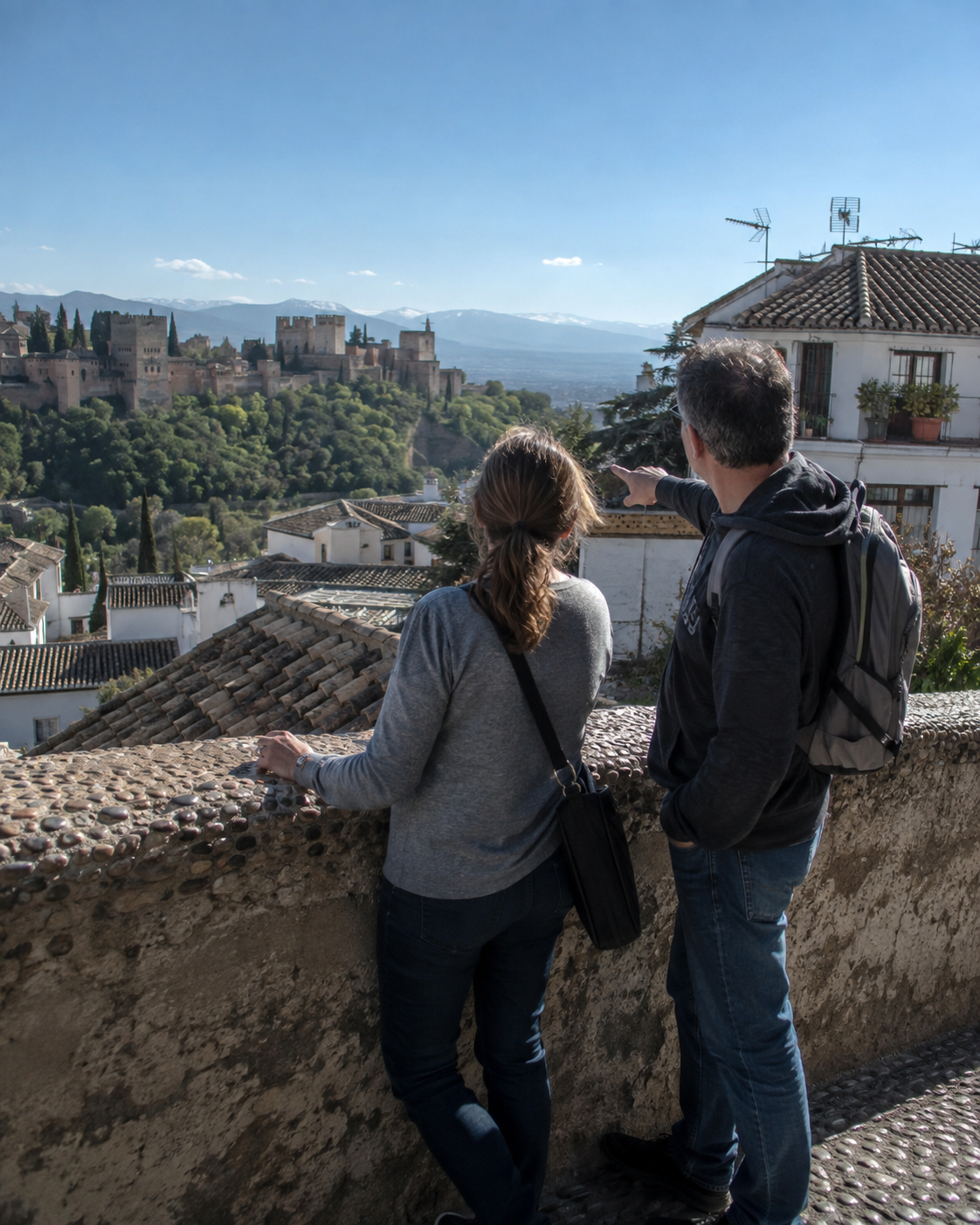
Few places make this encounter more dramatic than Granada.
Charles V visited the city in 1526 and decided to establish an imperial residence within the Alhambra complex. Construction of his palace began the following year under Pedro Machuca, an architect who had spent time in Italy.
The palace is strikingly geometric. A massive square building encloses a circular courtyard, with classical columns organizing the two levels around it. The architectural language is unmistakably Renaissance: circles, squares, symmetry, proportion, and controlled repetition.
Then you step outside and remember that the building stands inside the Alhambra.
The contrast with the surrounding Nasrid palaces is extraordinary. The intricate surfaces, intimate rooms, water, inscriptions, and geometric ornament of the Alhambra meet the monumental classical geometry of an imperial Renaissance palace almost wall to wall. You do not need specialist knowledge of architecture to notice that these buildings come from very different worlds.
The palace also has one of the stranger construction histories of the Spanish Renaissance. Machuca died before it was finished, work was repeatedly interrupted, and the building was effectively abandoned during the seventeenth century. For centuries it remained without a completed roof. The roof was finally completed in 1967, more than four hundred years after construction had begun.
It is a useful warning about architectural dates. A guidebook may describe a monument as sixteenth-century even though important parts of what you are looking at were repaired, altered, or finished hundreds of years later.
The Renaissance took another turn under Philip II.
He commissioned El Escorial outside Madrid, a vast complex begun in 1563 and largely completed by 1584. It combined a royal palace, monastery, basilica, royal burial place, library, college, and seminary on an extraordinary scale.
Under architect Juan de Herrera, the decorative richness found in earlier Plateresque architecture largely disappeared. Granite walls, strict proportions, repetitive windows, strong horizontal lines, and pyramidal slate roofs dominate the building. The style became known as Herrerian architecture and was also called estilo desornamentado, the "unornamented style."
Seeing El Escorial after the University of Salamanca makes the contrast particularly clear. Both belong broadly to sixteenth-century Spain, but they express authority in completely different ways. Salamanca's facade communicates richness through ornament. El Escorial relies on scale, geometry, repetition, and restraint.
The building also left a trace in everyday Spanish. La obra de El Escorial became an expression for a project that seems to take an exceptionally long time to finish, although the original complex was actually completed remarkably quickly considering its enormous scale.
Baroque Spain Brings Movement Back
By the seventeenth century, Spanish architecture had moved in another direction. Baroque architects favored movement, depth, theatrical presentation, dramatic entrances, and emotionally powerful religious spaces.
There was never one uniform Spanish Baroque. Galicia developed differently from Madrid, Salamanca, or Andalusia, and regional materials and traditions remained important. One pattern appears frequently, however: comparatively straightforward structural walls combined with areas of concentrated decoration, particularly facades, portals, staircases, and retablos, the elaborate altarpieces found inside Spanish churches.
This creates a curious connection with Plateresque architecture. Both traditions could treat the surface of a building as an opportunity for extraordinary ornament, but the visual effect is different. Plateresque detail often feels precise and jewel-like. Baroque architecture is generally more interested in depth, movement, shadow, and theatrical effect.
The Cathedral of Santiago de Compostela is one of the best places to see how Baroque architects worked with much older buildings.
The cathedral is fundamentally medieval, and its famous Pórtico de la Gloria belongs to the Romanesque period. Yet visitors arriving in the Plaza del Obradoiro encounter an enormous eighteenth-century Baroque facade designed by Fernando de Casas Novoa.
The new facade was not built simply because someone decided the medieval cathedral needed to look more fashionable. The older western stonework had been exposed to Galicia's wet climate for centuries and needed protection. The Baroque facade therefore served partly as a vast stone screen sheltering the medieval structure behind it.
A practical solution became one of Spain's great architectural spectacles. Towers, deep openings, columns, sculpture, and constantly changing surfaces create an impression of height and movement while the much older cathedral remains behind them.
Even the name Obradoiro preserves something of the construction process. It comes from a Galician word meaning "workshop," referring to the stonemasons' workshops established in the square during the long building campaign.
Walk around the cathedral rather than stopping at its famous western facade and the chronology becomes even easier to see. Different sides reveal interventions from different periods. The building makes much more sense as something that continued developing over centuries than as a monument belonging neatly to one architectural style.
Toward the end of the Baroque period, decoration in some areas of Spain became even more elaborate. The style commonly called Churrigueresque takes its name from the Churriguera family, influential architects and designers working around the late seventeenth and early eighteenth centuries.
Interestingly, the architecture later described as Churrigueresque often became much more extravagant in the hands of the family's followers than in the work of the Churriguera brothers themselves. Over time, their name became shorthand for a broader form of extremely elaborate Spanish Baroque.
At its most exuberant, the distinction between architecture and sculpture begins to blur. Broken pediments, carved figures, columns, scrolls, niches, foliage, and layers of ornament can cover so much of a facade or retablo that the structure behind them almost disappears.
Salamanca is particularly rewarding because the city allows you to compare this later Baroque world with the Plateresque architecture of the previous centuries. The richly carved university facade and the later Plaza Mayor associated with Alberto Churriguera are both highly decorative, yet they do not feel the same. Plateresque resembles extraordinarily intricate carving applied to a surface; Baroque decoration creates much more depth, movement, and theatricality.
The Islamic Tradition That Never Entirely Disappeared
A history of Spanish architecture organized only around Gothic, Renaissance, and Baroque styles leaves out one of the reasons Spanish buildings look different from those elsewhere in Europe: Mudéjar.
The term refers broadly to Islamic artistic and architectural traditions that continued within Christian-ruled areas of the Iberian Peninsula. Muslim craftsmen and Islamic decorative techniques remained influential for centuries after territories passed into Christian control.
Horseshoe and multilobed arches, geometric brickwork, glazed ceramic tiles, carved wood, decorative plaster, and elaborate artesonado wooden ceilings all appeared in Christian buildings alongside Gothic and Renaissance forms.
This heritage is particularly important when looking at the Spanish Renaissance. Classical ideas did not arrive from Italy and encounter an empty architectural landscape. They entered a visual culture that had already spent centuries absorbing and combining traditions from Christian Europe and Islamic Iberia.
A Renaissance facade might therefore cover a fundamentally Gothic building, while an artesonado ceiling based on Islamic geometry remained overhead. Those combinations are not exceptions to some supposedly pure Spanish style. They are one of its defining characteristics.
How to Recognize What You Are Looking At
You do not need an architectural history course to start distinguishing these periods while traveling in Spain. It is often easier to pay attention to the overall impression of a building before worrying about terminology.
Inside a Gothic cathedral, the structure itself usually attracts attention. Pointed arches lead into ribbed vaults, columns rise toward high ceilings, and large windows introduce colored light. Flying buttresses may be visible outside, carrying the weight of the stone vaults away from the walls.
If those Gothic forms are suddenly accompanied by abundant royal coats of arms, pomegranates, heraldic emblems, and elaborate late-medieval carving, you may have moved into the world of Isabelline Gothic.
Plateresque buildings tend to reward looking closely at the facade. From a distance, the architecture may appear relatively conventional; near the wall, the surface becomes a field of tiny medallions, scrolls, pilasters, shields, and figures.
Renaissance architecture often feels calmer. Classical columns, circular forms, pediments, symmetry, and carefully balanced proportions become easier to recognize once you know to look for them. El Escorial takes that restraint even further, removing so much ornament that bare stone and strict geometry become the dominant impression.
Baroque architecture announces itself differently. Rather than simply adding more decoration, it often uses deep shadows, projections, curves, sculpture, and changing surfaces to make a facade feel as though it is moving. In its most elaborate Churrigueresque forms, the decoration can become so dense that the architecture begins to resemble a gigantic carved altarpiece.
After you learn those broad differences, finding buildings that refuse to fit neatly into any of them becomes part of the fun.
Where to See Several Centuries in One Trip
Some Spanish cities make these changes particularly easy to see because several periods survive within a relatively small historic center.
Toledo brings together its great Gothic cathedral, the Isabelline monastery of San Juan de los Reyes, and important Mudéjar architecture. Granada offers perhaps the most dramatic contrast, placing the Renaissance Palace of Charles V directly beside the Nasrid palaces of the Alhambra, with Mudéjar churches elsewhere in the city.
Salamanca is particularly good for comparing Plateresque and Baroque architecture. Santiago de Compostela compresses Romanesque and Baroque history into one cathedral complex, while Seville offers the remarkable experience of a Gothic cathedral growing out of the site and surviving elements of an Almohad mosque.
These places also demonstrate why architecture is often easier to understand in person than in photographs. When you can walk around a building, enter it, notice changes in stonework, and compare a facade with the interior behind it, historical periods stop feeling like abstract dates.
Spanish Architecture Also Gives Language Learners Useful Clues
Architecture provides an enjoyable way to connect Spanish vocabulary with something tangible. A cathedral is una catedral, a facade is una fachada, a vault is una bóveda, and a cloister is un claustro. Gothic becomes gótico, Renaissance is renacimiento, and Baroque is barroco. Travelers will also encounter specifically Iberian architectural terms such as mudéjar and plateresco, along with retablo for the elaborate altarpieces found in many churches.
These words are much easier to remember once they are attached to real objects rather than a vocabulary list. They appear on museum labels, historical plaques, guided tours, and descriptions of monuments throughout Spain.
Even familiar place names can acquire another meaning. Granada is not only the name of the Andalusian city; granada also means "pomegranate" in Spanish, which helps explain the fruit's repeated appearance in royal decoration associated with Ferdinand and Isabella after the conquest of Granada.
For readers who would like to develop their Spanish while exploring more of Spain's culture and history, Polyglottist Language Academy offers Spanish classes for adults. Structured language study can make museums, historical sites, local tours, and even the plaques on old buildings considerably more accessible.
The more Spanish architecture you see, the harder it becomes to ask simply, "What style is this building?" A cathedral may have begun in the Middle Ages, acquired Renaissance decoration two centuries later, received a Baroque facade after that, and undergone another reconstruction in the nineteenth century.
A more revealing question is: which part of its history am I looking at now?