
Traditional Spanish Dances Beyond Flamenco: Sevillanas, Sardanas, and More
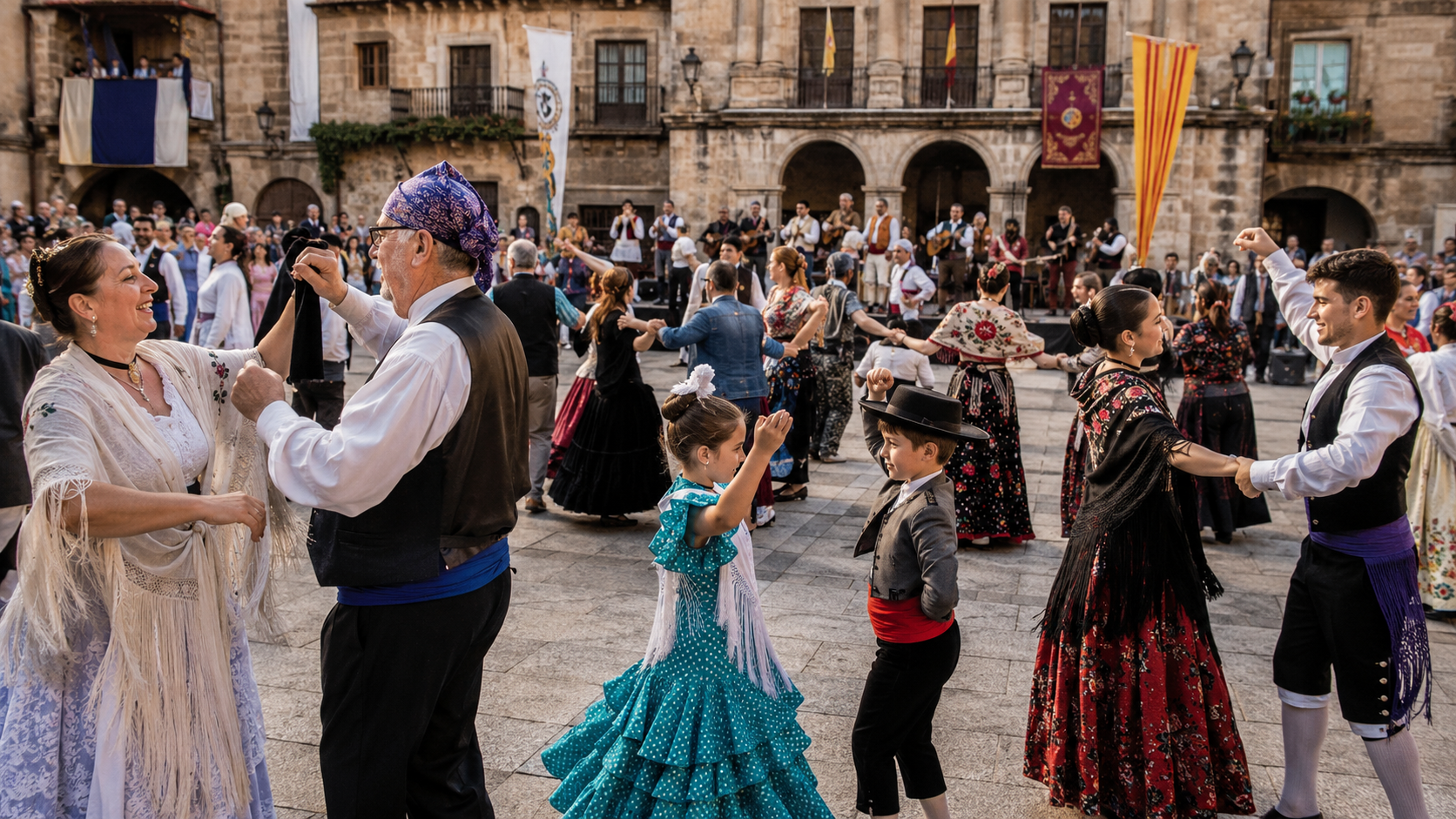
Imagine arriving in a Spanish plaza expecting flamenco.
Instead, you hear an unfamiliar wind instrument with a bright, almost reedy sound. A circle begins to form. People place their bags in the center, join hands, and start taking small, carefully counted steps. Some are experienced dancers; others watch the feet beside them and try to keep up.
You are not in Andalusia. You are in Catalonia, watching a sardana.
Travel farther west and the scene changes again. In Galicia, the music may be led by a bagpipe. In the Basque Country, a single dancer may perform an athletic dance of honor. In Madrid, a couple turns almost in place to the sound of an organillo. At a fair in Andalusia, friends and relatives dance sevillanas in pairs—not as a formal stage performance, but as part of the celebration itself.
Flamenco deserves its international fame. UNESCO recognizes it as Intangible Cultural Heritage and identifies Andalusia as its historic heartland. But using flamenco as shorthand for all Spanish dance is a little like using one regional accent to represent the entire Spanish-speaking world. Spain’s dance heritage also includes circle dances, courtship dances, ceremonial solos, stick dances, urban social dances, and regional traditions that may vary not only from one autonomous community to another, but sometimes from one town to the next.
To understand traditional Spanish dances, then, we need to stop looking for one national style. The more interesting question is this:
How does each region choose to move together?
Sevillanas: the dance people actually join
Sevillanas are among the dances most frequently confused with flamenco, and the confusion is understandable. They share Andalusian surroundings, expressive arm movements, handclaps, guitars, flowers, shawls, and dresses with ruffles. They may even appear in the same venues.
But sevillanas are not simply “easy flamenco.”
They are a structured Andalusian folk dance, closely associated with Seville and with social occasions such as local fairs, family celebrations, neighborhood festivals, and especially the Feria de Abril. Unlike a theatrical flamenco performance centered on individual artistry and improvisational dialogue among singer, guitarist, and dancer, sevillanas are commonly danced in pairs by ordinary participants.
That social purpose changes the feeling of the dance.
A sevillanas pair moves through a sequence of approaches, turns, separations, and changes of position. Eye contact matters. So does the awareness of where your partner is standing. The dance consists of four sections, traditionally called the four sevillanas. A popular interpretation presents them as stages of courtship, although it is better to understand that as a familiar cultural reading rather than a proven origin story.
For a traveler, the distinction becomes obvious at an Andalusian fair. A flamenco performance may invite admiration from an audience. Sevillanas often invite participation—or at least make participation appear temptingly possible.
That does not mean they are effortless. Experienced dancers coordinate their steps, hands, turns, and partner changes with elegant precision. But they belong to a social world in which people may learn the basic pattern because they expect to use it at real celebrations.
Adult Spanish learners often find this cultural distinction useful. The verb bailar means “to dance,” but the social meaning of dancing changes with the setting. Watching a professional artist and joining a familiar community dance are not the same cultural act, even when some of the visual vocabulary overlaps.
The sardana: a dance built as a circle
If sevillanas are about a pair negotiating space, the Catalan sardana is about creating a group.
Dancers stand in a circle, face inward, hold hands, and perform precisely counted sequences of short and long steps—curts and llargs. The structure now associated with the sardana developed largely during the nineteenth century, although it evolved from earlier forms rather than appearing fully formed at a single historical moment.
The circle is not merely decorative. It shapes the social meaning of the dance.
There is no obvious star at the center. The dancers must listen, count, and adjust collectively. In many public settings, people can join or leave the ring, although a newcomer should first observe how the particular event is organized. Bags and personal belongings are sometimes placed inside the circle, producing a wonderfully practical image: the group dances outward while its everyday possessions rest in the middle.
The accompanying ensemble is called a cobla. Traditionally, it consists of eleven musicians playing twelve instruments, including the flabiol, tamborí, tible, tenora, trumpets, trombone, fiscorns, and double bass. The tenora’s distinctive sound is one reason a sardana can be recognizable before you even see the dancers.
The sardana has also carried meanings connected with Catalan civic and cultural identity. Those meanings should be discussed carefully. It is too simple to describe the dance as permanently political or to repeat an uncomplicated story that it was uniformly prohibited everywhere throughout the Franco dictatorship. Its public role changed over time, and its symbolism became especially powerful in contexts where Catalan identity was constrained. Yet it also remains what it has long been: a social dance practiced at festivals, public gatherings, municipal events, and aplecs, or sardana meetings.
This is an important lesson for language students. A cultural tradition can become a political symbol without being reducible to politics. The sardana can communicate Catalan belonging, historical memory, musical skill, and the simple pleasure of dancing in a circle—all at once.
Jota is not one dance
Ask someone in Spain about the jota, and the next question may be: “Which jota?”
The jota aragonesa, associated with Aragón, is the most internationally familiar version. It is often energetic, with quick footwork, jumps, castanets, and lively interaction between partners. But jota is better understood as a broad family of regional dances than as one standardized choreography.
Versions appear in Aragón, Navarra, Valencia, Murcia, Galicia, La Rioja, Cantabria, parts of Castile, Catalonia, Andalusia, and elsewhere. Tempo, clothing, accompaniment, steps, and performance style can vary significantly.
This makes the jota particularly useful for understanding Spain. The same name can travel across regions and acquire different accents.
Language works in much the same way. A Spanish word may be understood nationally while carrying different associations, pronunciations, or everyday uses depending on where you hear it. Similarly, saying “the jota” without naming a region may leave out precisely what makes that version meaningful.
At a festival, you might see pairs dancing with raised arms and castanets. Elsewhere, the choreography may place greater emphasis on group formations, restrained movements, or local instruments. The variation is not evidence that one version is less authentic. Regional variation is the tradition.
Galicia moves to the sound of the gaita
The first surprise for many visitors encountering Galician folk music is the bagpipe.
The gaita galega gives the music of Galicia a sound that may feel more immediately connected to Ireland or Scotland than to an outsider’s idea of Spain. This is one reason discussions of Galicia often mention Celtic influences. That comparison can be illuminating, but it should not be turned into an overly neat claim of direct and uninterrupted Celtic ancestry.
Galicia’s identity developed through many historical layers. What matters for the listener is that its regional music really does sound different from the guitar-centered image of Spain familiar abroad.
The muñeira is one of Galicia’s best-known traditional dances. Its name is commonly connected with mills or millers, and its music is generally lively, often driven by gaita, drums, and tambourines. It may be performed by individuals, couples, or groups, with energetic steps suited to festivals and cultural gatherings.
For language learners, Galicia also offers a reminder that Spanish is not the only language they will encounter in Spain. Galician, or galego, is a Romance language with its own literature, media, music, and public life. The instrument may be called a gaita in both Galician and Spanish, but the songs, introductions, place names, and event announcements surrounding a performance may be in Galician.
You do not need to speak every regional language to appreciate this. Simply recognizing that Spain is multilingual changes the way you listen.
Aurresku: dancing as an act of honor
Not every dance is designed to make a crowd join in.
The aurresku is a Basque dance associated with ceremony, tribute, and respect. Today it is often performed as a solo by a dancer executing controlled turns, balances, high kicks, and precise movements, traditionally accompanied by the txistu, a three-holed Basque flute, and the tamboril, a small drum.
You may encounter an aurresku at a wedding, official event, memorial, public honor, or civic ceremony. In that setting, it is not simply entertainment. The dancer is offering recognition.
The modern solo performance developed from larger Basque social and ceremonial dance traditions, so it is important not to mistake the shortened ceremonial form for the entire historical tradition. It is also traditionally associated with male performers, although contemporary practice can vary.
The emotional effect of the aurresku comes partly from restraint. The movements may be physically demanding, but the atmosphere can remain solemn. Applause, photography, and audience behavior should therefore follow the tone of the occasion rather than assumptions about how spectators behave at a tourist performance.
This is one of the cultural skills that language learners develop over time: noticing not only what people are doing, but what the action means in that setting.
Madrid’s chotis: foreign roots, unmistakably local
Some traditions become regional symbols precisely because communities adapt them.
The chotis arrived in Spain from Central Europe, yet it became so closely associated with Madrid that it now appears inseparable from the city’s popular identity. It is especially connected with the festivities of San Isidro, when performers may wear the traditional clothing of the chulapos and chulapas.
The dance is performed by a couple rotating in a compact space. A popular description says that the male dancer should be able to turn within the area of a single floor tile while his partner circles around him.
The musical sound most associated with the Madrid chotis is the organillo, a small mechanical street organ. Together, the turning movement, local clothing, festival atmosphere, and organillo transformed an imported dance into something recognizably madrileño.
This is a useful antidote to the idea that an “authentic” tradition must be ancient, unchanged, and isolated from outside influence. Cultures borrow. Cities adapt. Communities take something foreign and make it local.
Madrid did not need to invent the chotis from nothing in order to make it its own.
Fandango: one name, many histories
The word fandango appears far beyond Spanish folk dance. It has entered classical music, international popular culture, and expressions in several languages. Yet within Spain, it does not refer to one fixed dance.
Historically, the fandango emerged as a lively couple dance and musical form, with written references dating back at least to the eighteenth century. Rhythmic footwork, courtship energy, clapping, and castanets often appear in descriptions, but the form developed many regional identities.
You can find fandango traditions in Andalusia, Asturias, Galicia, the Basque Country, the Balearic Islands, and elsewhere. In Andalusia, the name also appears within flamenco in forms such as fandangos de Huelva and related styles.
The safest way to speak about the fandango is therefore to ask what period, region, and musical context is intended. It is not one choreography frozen in time. It is a name that has traveled.
The other bolero
The word bolero creates a different kind of confusion.
Many people know bolero as the romantic song tradition associated with Cuba and Latin America. That bolero is real, important, and internationally influential—but it is not the same as the Spanish dance tradition that emerged in the late eighteenth century.
The Spanish bolero belongs to the history of social and theatrical dance. It contributed to the development of escuela bolera, a stylized form blending elements of Spanish folk dance with classical technique. Dancers use castanets, turns, jumps, elegant poses, and carefully controlled upper-body movements.
Escuela bolera played an important role in theatrical images of Spain and influenced the language of European stage dance.
So when someone mentions bolero, context matters. Are they discussing Spanish theatrical dance, Cuban song, ballroom choreography, or a classical composition inspired by Spanish rhythms? The shared word does not guarantee a shared tradition.
A wider dance map of Spain
Even these dances cover only part of the country’s cultural landscape.
In Asturias, the danza prima forms another communal circle tradition. In Catalonia and neighboring areas, the ball de bastons creates rhythm through the striking of wooden sticks. Basque ezpatadantza traditions incorporate swords into ceremonial and festival choreography.
The Canary Islands contribute dances such as the lively isa and the more measured folías, reminders that Spain’s cultural geography extends beyond the Iberian Peninsula. In Málaga province, verdiales bring together singing, guitar, violin, tambourines, and vivid rural festival traditions.
There are also seguidillas, paloteos, zortzikos, and regional versions of the pasodoble. The pasodoble is often reduced to bullfighting imagery, but that association represents only part of its musical and dance history.
A complete catalog would require far more than one article. The goal is not to memorize every name. It is to recognize the pattern: Spain’s traditional dances form a regional mosaic, and many names contain further local variations.
Words that help you understand the dance floor
Dance gives beginners a surprisingly practical set of Spanish words because many of them describe visible actions.
Bailar — to dance
¿Quieres bailar? means “Would you like to dance?”
Pareja — partner or couple
In dance instructions, por parejas means “in pairs.”
Dar una vuelta — to make a turn
A teacher might say, Da una vuelta, or “Turn around.”
Marcar el paso — to mark or keep the step
This refers to maintaining the rhythmic pattern.
Hacer palmas — to clap rhythmically
In Spanish music, palmas are not always casual applause. They may be part of the musical structure.
Castañuelas — castanets
These handheld percussion instruments appear in several Spanish dance traditions, although certainly not in all of them.
Corro or rueda — circle
Entrar en la rueda means “to enter the circle.”
Traje regional — regional dress
This is often a more respectful and accurate phrase than calling meaningful festive clothing a “costume.”
Feria — fair
A feria may include music, food, dancing, decorated public spaces, and social events.
Verbena — an outdoor neighborhood celebration, often with music and dancing
This is one of those words whose cultural meaning is richer than a simple dictionary translation.
Regional terms matter too: cobla in Catalonia, gaita in Galicia, txistu in the Basque Country, and chulapo or chulapa in Madrid. Dance makes Spain’s linguistic diversity visible as well as audible.
Watching respectfully—and knowing when to join
Community traditions are not automatically staged for visitors.
At a public festival, it is usually wise to observe before stepping into a dance. Notice whether newcomers are joining freely, whether someone is teaching the steps, and whether the event appears participatory or ceremonial.
A sardana circle at an open community event may welcome experienced participants. A public sevillanas lesson may explicitly invite beginners. An aurresku performed at a memorial or formal tribute is a different situation entirely.
Photography also requires judgment. Avoid blocking dancers, photographing children closely without permission, or treating regional clothing as an exotic prop. If the mood is solemn, follow the behavior of the local audience.
The most respectful question is not “Am I allowed to do this?” but “What kind of moment is this?”
That small shift—from consumption to attention—can change a traveler’s experience of culture.
Are these dances still alive?
Traditional dances are sometimes presented as if they survived only inside museums or tourist shows. In reality, many continue through cultural associations, dance schools, municipal programs, family traditions, competitions, local festivals, and folk ensembles.
Catalonia, for example, has an extensive network of sardana organizations and recurring public activities. Other regional traditions depend on similar local structures, including neighborhood groups, music schools, festival committees, and intergenerational teaching.
Of course, traditions change. Younger participants may discover dances through social media, perform them in contemporary clothing, or learn them in organized classes rather than from relatives. A dance may move between a village festival, a cultural association, a professional stage, and a video shared online.
Change does not automatically make a tradition inauthentic. Living traditions survive partly because communities keep deciding that they are worth practicing.
What these dances teach us about Spain
Flamenco remains one of Spain’s greatest artistic traditions. The problem begins only when it becomes the entire picture.
Sevillanas show how dance can organize social interaction between partners. Sardana creates community through a circle. Muñeira carries the sound of Galicia’s gaita. Aurresku turns movement into tribute. Chotis demonstrates how a city can transform an imported dance into a local emblem. Jota refuses to be reduced to a single version.
Together, these traditions reveal a Spain that is regional, multilingual, historically layered, and constantly negotiating what it means to preserve culture.
At Polyglottist Language Academy, we often encourage students to look beyond grammar exercises and vocabulary lists. Studying Spanish also means learning to recognize regional identities, understand the tone of a celebration, notice when another language is being spoken, and appreciate why a familiar word or custom may mean something different in Seville, Barcelona, Santiago de Compostela, Bilbao, or Madrid.
Our online Spanish classes help adult learners build the language skills needed for those deeper encounters—not only to order a meal or ask for directions, but to understand more of what is happening around them.
Explore Spanish Classes at Plyglottist Language Academy
Frequently Asked Questions
What is the most popular traditional dance in Spain besides flamenco?
There is no single national answer. Sevillanas are especially popular in Andalusia, while sardana is strongly associated with Catalonia, jota has many regional forms, and other communities maintain their own prominent traditions.
Are sevillanas a type of flamenco?
They are closely connected to Andalusian culture and may share some visual and musical features with flamenco, but they are distinct. Sevillanas have a fixed four-part structure and commonly function as a social pair dance.
Can tourists join a sardana circle?
Sometimes, especially at open public events, but it is best to observe first. The steps require careful counting, and joining without understanding the rhythm can disrupt the circle. A public lesson is an ideal place to begin.
Why does Galician music use bagpipes?
The gaita is deeply rooted in Galician musical tradition. Its presence reflects Galicia’s distinct regional history and musical culture. Comparisons with other Atlantic or Celtic-influenced traditions can be useful, but claims of direct ancestry should be made cautiously.
Is the aurresku always danced by a man?
It has traditionally been performed by male dancers in many ceremonial settings, although contemporary practice can vary. Its defining feature is its role as a formal dance of honor.
Is Spanish bolero the same as Cuban bolero?
No. Spanish bolero is an eighteenth-century dance tradition connected with theatrical dance and escuela bolera. Cuban bolero is a later romantic song tradition.
Where can travelers see traditional Spanish dances?
Look for annual fairs, municipal festivals, cultural associations, public-square events, regional celebrations, and professional folk performances. Seville’s fairs are closely associated with sevillanas, Catalonia hosts sardana gatherings, Madrid celebrates chotis during San Isidro, and many northern regions present local dances at community festivals.