
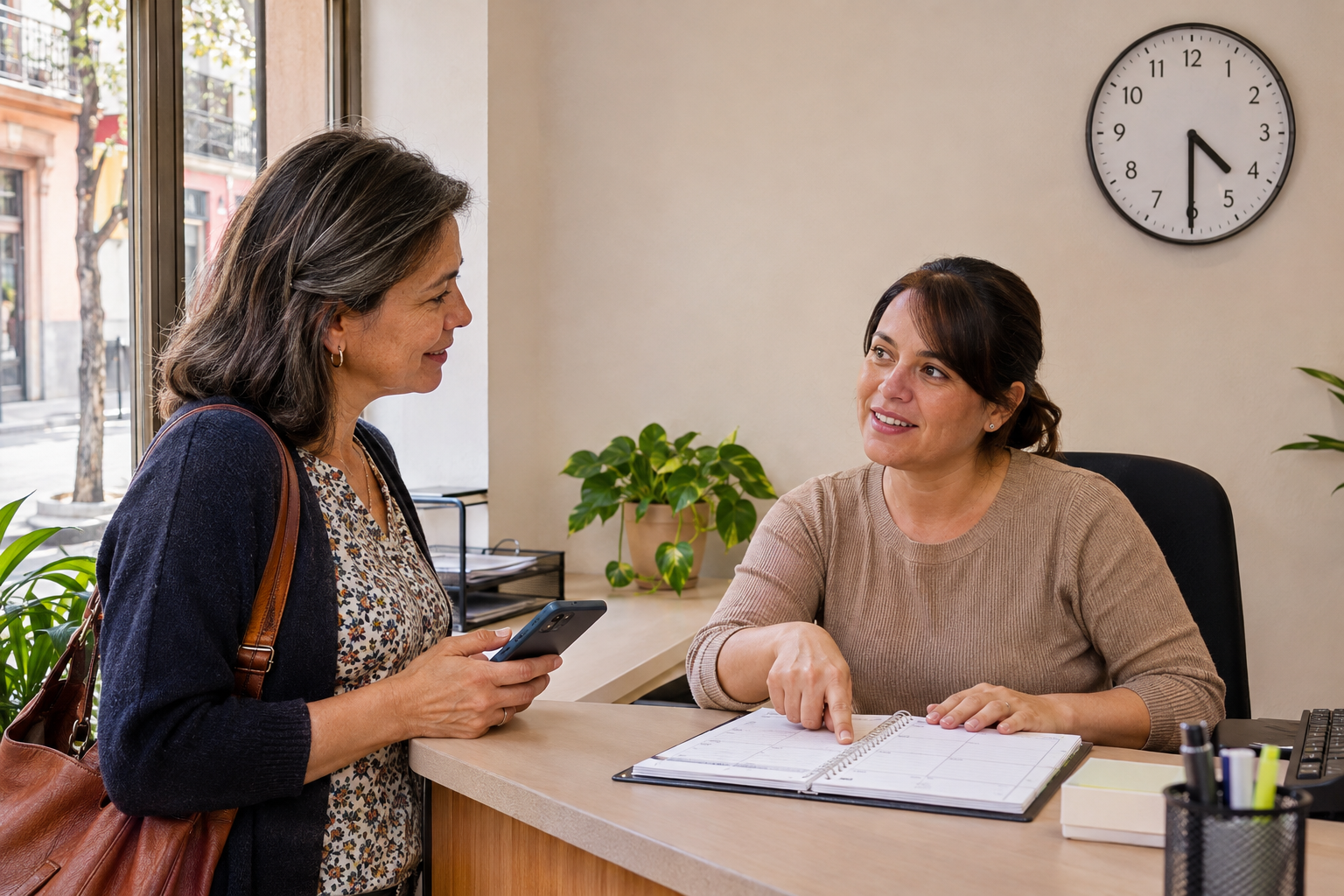
The receptionist says a las cuatro y media. The confirmation email says 16:30. A friend describes the same time as las cuatro y treinta de la tarde.
One appointment, three ways of expressing it. None is especially difficult on paper. On the phone, while looking for a calendar and trying to remember whether jueves is Thursday, the arithmetic can feel less cooperative.
Telling time in Spanish involves several related skills: reading a clock, asking when something happens, understanding a schedule, and making sure two people have agreed to the same plan. Learning them together is more useful than treating the clock as an isolated vocabulary exercise.
Start with a distinction that will do a great deal of work: ¿Qué hora es? asks what time it is now. ¿A qué hora…? asks at what time something happens.
“It’s three” and “at three” need different beginnings
To ask for the current time, say:
¿Qué hora es? — What time is it?
The basic answers use the verb ser:
Es la una. — It’s one o’clock.
Son las dos. — It’s two o’clock.
Son las tres. — It’s three o’clock.
One takes the singular form, es la. The other numbered hours take son las. The feminine articles la and las reflect the understood word hora, meaning “hour.” Learn the whole beginning as a phrase; there is little practical benefit in rebuilding it from the grammar every time someone asks.
When arranging something, change the beginning:
A la una. — At one.
A las tres. — At three.
That small a connects the time to an event:
¿A qué hora empieza la clase? — What time does the class start?
Empieza a las seis. — It starts at six.
A learner might also hear La clase es a las seis—“The class is at six.” The singular es belongs to la clase. It does not contradict Son las seis, which tells the current time. These sentences answer different questions.
Add minutes, then learn the quarter-hour shortcuts
For minutes after the hour, y means “and”:
Son las cinco y diez. — It’s five ten.
Es la una y veinte. — It’s one twenty.
Three expressions are particularly useful: y cuarto for a quarter past, y media for half past, and en punto for exactly on the hour.
Time Spanish English
1:00 Es la una. It’s one o’clock.
3:05 Son las tres y cinco. It’s three oh five.
4:15 Son las cuatro y cuarto. It’s quarter past four.
6:30 Son las seis y media. It’s half past six.
8:45 Son las nueve menos cuarto. It’s quarter to nine.
10:50. Son las once menos diez. It’s ten to eleven.
With menos, count back from the next hour: las nueve menos cuarto is fifteen minutes before nine. A common beginner error is to identify the current hour on the clock and then subtract from it. At 8:45, that would send the answer an hour in the wrong direction.
For appointments, keep the same clock expression and replace the opening: La cita es a las nueve menos cuarto means the appointment is at 8:45.
Saying en punto adds emphasis: a las nueve en punto means “at nine sharp.” An ordinary a las nueve already names a specific time; the extra phrase makes the insistence more audible.
Why “quarter to nine” may sound different in Mexico
The expression menos cuarto is especially familiar from teaching materials based on Spanish from Spain. In much of Spanish-speaking America, a speaker may instead say un cuarto para las nueve: a quarter of an hour until nine.
Likewise, veinte para las diez means twenty minutes to ten, or 9:40. The minutes come first, followed by para and the approaching hour. Both patterns belong to Spanish; their frequency varies by region and speaker.
A beginner does not need to produce every regional version immediately. It is sensible to use one clear pattern while learning to recognize alternatives heard at the destination or among conversation partners.
Practice hearing equivalent times together: las nueve menos cuarto and un cuarto para las nueve. The aim is to attach both expressions to 8:45, without translating each one laboriously into English first.
Specify the part of the day when it matters
“At eight” may be perfectly clear between friends discussing dinner. It is less helpful in a message about an unfamiliar work schedule.
With a specific clock time, use:
A las ocho de la mañana. — At eight in the morning.
A las cuatro de la tarde. — At four in the afternoon.
A las diez de la noche. — At ten at night.
Spanish also uses de la madrugada for the hours after midnight and before dawn: a las dos de la madrugada, for example. The boundary between tarde and noche does not map neatly onto a single English definition of “evening.” Context and local usage matter.
Without a clock time, a common pattern is por la mañana, por la tarde, or por la noche. In many Latin American varieties, en la mañana, en la tarde, and en la noche are also familiar. The Instituto Cervantes curriculum includes both patterns.
Compare Trabajo por la tarde—“I work in the afternoon”—with Empiezo a las tres de la tarde—“I start at three in the afternoon.”
For two easily confused points on the clock, the words themselves are useful: mediodía is noon; medianoche is midnight. Nos vemos al mediodía means “See you at noon.” El tren sale a medianoche means “The train leaves at midnight.”
Read 16:30 as comfortably as “four thirty”
Written schedules frequently use the 24-hour clock. This format identifies each hour of the day without needing to add “morning,” “afternoon,” or “night.”
The conversion is straightforward: for hours from 13 through 23, subtract twelve. Thus, 14:00 is 2 p.m., 16:30 is 4:30 p.m., and 21:15 is 9:15 p.m. Midnight at the beginning of a day is 00:00; noon is 12:00.
An appointment displayed as 16:30 can be confirmed conversationally as a las cuatro y media de la tarde. In more formal announcements, the twenty-four-hour numbers may be spoken directly.
Separators can vary too. A notice showing 16.30 may be using a period to separate hours and minutes; 16:30 uses a colon. For a learner writing a practical message, the colon gives a clear, compact result.
For online lessons or international calls, add another detail: whose local time? ¿A las seis, hora de California?—“At six, California time?”—can prevent a misunderstanding that perfect Spanish grammar would otherwise leave intact.
Opening hours contain more than two numbers
A shop notice might read:
Lunes a viernes: 09:00–14:00 y 17:00–20:00
Sábados: 10:00–14:00
Domingos: cerrado
This sample schedule means Monday through Friday, 9 a.m.–2 p.m. and 5–8 p.m.; Saturday, 10 a.m.–2 p.m.; closed on Sundays.
The gap matters. On weekdays, this business has two opening periods. Arriving at 15:00 would mean arriving during the closure between them. The sign supplies that information; guessing why the business closes is unnecessary.
The most useful questions distinguish the beginning from the end:
¿A qué hora abren? — What time do you open?
¿A qué hora cierran? — What time do you close?
¿Hasta qué hora están abiertos? — Until what time are you open?
These are direct questions to the people running a business. When asking about a particular institution, a singular subject works too: ¿A qué hora abre el museo?—“What time does the museum open?”
Several short phrases deserve attention on notices:
Spanish Meaning
De lunes a viernes Monday through Friday
Cerrado los lunes Closed on Mondays
Abierto hasta las ocho Open until eight
A partir de las diez From ten onward
Con cita previa By prior appointment
An opening time does not necessarily identify the last opportunity to enter or receive a service. At an attraction, ask ¿A qué hora es la última entrada?—“What time is the last admission?” At a restaurant, ¿Hasta qué hora sirven comida? asks until what time food is served.
The useful number depends on what someone is trying to do.
Make an appointment through a complete exchange
Cita is the everyday word for an appointment. It can also mean a romantic date; the surrounding conversation makes the meaning clear.
A short booking exchange might go like this:
Customer: Buenos días. Quisiera pedir una cita para el jueves.
Good morning. I’d like to make an appointment for Thursday.
Receptionist: ¿Por la mañana o por la tarde?
In the morning or the afternoon?
Customer: Por la tarde, si es posible.
In the afternoon, if possible.
Receptionist: Tenemos una cita a las cuatro y media.
We have an appointment at four thirty.
Customer: Perfecto. Entonces, el jueves a las cuatro y media de la tarde.
Perfect. So, Thursday at four thirty in the afternoon.
The final sentence repeats the agreement. It is useful precisely because hearing a time once and remembering it correctly are separate achievements.
For a change of plans, Necesito cambiar mi cita means “I need to reschedule my appointment.” Follow it with a specific question: ¿Sería posible a las cinco?—“Would five be possible?”
Some organizations ask clients to arrive before the appointment itself. If that is unclear, ask ¿A qué hora tengo que llegar?—“What time do I need to arrive?” The answer may differ from the time printed beside the booking.
A plan needs a day, a time, and a degree of certainty
The difference between el martes and los martes is small on the page and substantial in a calendar:
Tengo clase el martes a las seis. — I have class on Tuesday at six.
Tengo clase los martes a las seis. — I have class on Tuesdays at six.
One identifies a particular Tuesday; the other describes a recurring arrangement.
For informal plans, ¿Nos vemos a las siete? means “Shall we meet at seven?” An answer such as Sí, a las siete me viene bien means “Yes, seven works for me.”
Approximation should be explicit. Sobre las siete or alrededor de las siete means “around seven.” Neither names a universal window of acceptable lateness. If a meal, booking, or departure depends on the plan, ask ¿A las siete en punto o más o menos?—“At seven sharp, or approximately?”
It is tempting to explain every uncertain arrangement as a cultural difference about punctuality. Often the immediate problem is simpler: one person offered a rough suggestion, and another recorded a firm appointment. Clarifying the wording is more useful than making assumptions about a nationality.
“In half an hour” is different from “for half an hour”
Clock times identify a point. Durations and waiting times answer other questions.
Salimos dentro de media hora. — We’re leaving in half an hour.
La reunión dura media hora. — The meeting lasts half an hour.
The first sentence starts a countdown from now. The second measures the length of an event.
Two questions help keep them separate:
¿Cuánto falta? — How much longer?
¿Cuánto dura? — How long does it last?
At a station, Faltan diez minutos means there are ten minutes to go. In a description of a journey, Dura diez minutosmeans the journey takes ten minutes.
A familiar word changes function in another useful pair: mañana means “tomorrow,” while la mañana means “the morning.” Mañana por la mañana is therefore entirely ordinary Spanish for “tomorrow morning.”
Translate the expression as a whole. Trying to give every occurrence of mañana the same English equivalent creates a problem that the Spanish sentence does not have.
Practice with a calendar, then close it
A clock worksheet checks whether a learner can construct a time expression. A conversation checks whether that expression can survive being heard, remembered, and changed.
Try this with a teacher or study partner: one person offers three appointment times aloud. The other chooses one, checks the day, and repeats the complete booking. Then make one alteration. Perhaps Thursday is unavailable, or the appointment needs to move half an hour later.
For listening practice, write the times as digits first. This keeps the task focused on recognizing the time rather than simultaneously spelling every Spanish number. Once the numbers are clear, say the agreement aloud in a complete sentence.
Polyglottist Language Academy offers live language classes for adults, including online instruction and selected in-person classes in Berkeley, California. Its beginner Spanish curriculum includes numbers, dates, time, and simple everyday dialogues—material that becomes useful when students practice asking and answering each other. The Spanish classes page provides current levels and formats. Polyglottist Language Academy
The satisfying moment comes when the calendar can close. Someone has offered a time, someone else has suggested a change, and both know when to turn up. Entonces, el jueves a las cuatro y media. A small sentence, with an actual plan inside it.