
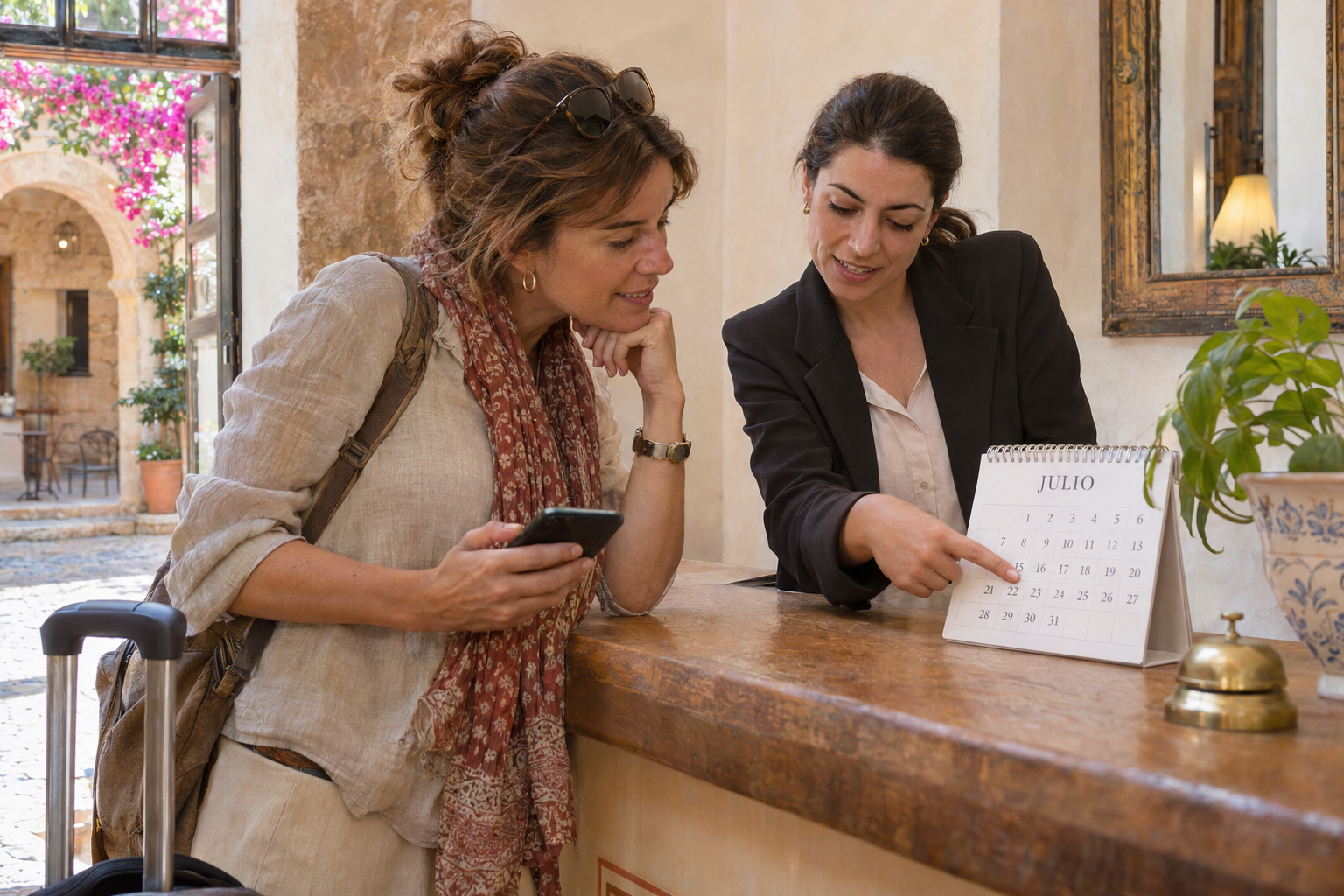
A hotel confirms a reservation for 06/07/2027. An American traveler reads June 7. The person at the hotel means July 6. Both dates are perfectly possible, which is precisely the problem: nothing in those numbers announces that something has gone wrong.
Knowing how to say dates in Spanish helps, but the most useful habit is even simpler: name the month when a misunderstanding would matter.
The usual Spanish order is day + month + year. July 6, 2027, becomes 6 de julio de 2027, spoken as seis de julio de dos mil veintisiete. In a sentence, it might be: Llegamos el seis de julio—“We arrive on July 6.”
That gives a beginner the basic pattern. The next step is learning how dates behave in actual conversations, where people omit information, suggest changes, and assume everyone is looking at the same calendar.
Start with the day, then name the month
The standard Spanish date structure is:
day + de + month + de + year
For example:
Written date Say it in Spanish English meaning
4 de marzo cuatro de marzo March 4
18 de agosto dieciocho de agosto August 18
23 de noviembre de 2027 veintitrés de noviembre de dos mil veintisiete
November 23, 2027
The two instances of de connect the parts. Keep them in the phrase rather than assembling the date by translating each English word.
Notice another difference: English may say “March fourth” or “the fourth of March.” Spanish normally uses the ordinary counting number: cuatro de marzo, not cuarto de marzo. The second is dos, the third is tres, and the twenty-second is veintidós.
The first day of the month has its own variation, which we will come to shortly.
For writing, the combination of numerals and a spelled-out month is useful: 18 de agosto de 2027. It is clear without being cumbersome. Spanish does not place a comma between the month and year in this format.
Why knowing the date format is only half the job
In ordinary Spanish usage, an all-numeric date generally follows day/month/year:
Numeric date Usual Spanish interpretation Written without ambiguity
05/09/2027 September 5, 2027 5 de septiembre de 2027
09/05/2027 May 9, 2027 9 de mayo de 2027
23/05/2027 May 23, 2027 23 de mayo de 2027
The last example is relatively easy for an American reader to recognize: 23 cannot be a month. Dates involving two numbers from 1 to 12 deserve more attention because both interpretations work.
However, a Spanish-language website is not a guarantee that every date field follows the same convention. International booking systems and software settings can introduce another format. Look for the label beside the field:
DD/MM/AAAA means day, month, four-digit year. A stands for año.
MM/DD/AAAA means month, day, four-digit year.
AAAA-MM-DD puts the year first; 2027-09-05 means September 5, 2027.
Year-first notation is useful in technical contexts and international data exchange. For an ordinary message to another person, naming the month makes the meaning immediately visible.
For a booking, a short confirmation can settle the matter:
Para confirmar: llegamos el seis de julio, ¿correcto?
Just to confirm: we arrive on July 6, correct?
Reading 06/07 aloud as “six, seven” preserves the uncertainty. Saying seis de julio resolves it.
The twelve months, without English capitalization
Most Spanish month names look familiar to English speakers. Familiarity helps with reading, although it can tempt learners to pronounce them as English words.
English Spanish
January enero
February febrero
March marzo
April abril
May mayo
June junio
July julio
August agosto
September septiembre
October octubre
November noviembre
December diciembre
Months and weekdays normally begin with lowercase letters in Spanish: marzo, lunes, viernes. The usual exceptions, such as the beginning of a sentence, still apply.
Give junio and julio some separate listening practice. Their spellings differ by one letter, and mistaking one for the other shifts a plan by a month. Ask a teacher or conversation partner to alternate them unpredictably; reciting the months in order makes the next answer too easy to guess.
When learning pronunciation, use a recording rather than relying entirely on an English approximation. A spelling such as “HOO-nee-oh” can suggest a starting point for junio, but it does not accurately represent every Spanish sound or regional pronunciation.
Is the first uno or primero?
Both el uno de mayo and el primero de mayo are valid ways to say May 1. Primero is more usual in Spanish-speaking America; uno is more usual in Spain.
An American learner may find primero intuitive because English also uses “first.” Keep that habit confined to the first day: May 2 is el dos de mayo, rather than el segundo de mayo.
For the twenty-first and thirty-first, use veintiuno and treinta y uno in these date expressions: el veintiuno de mayo, el treinta y uno de octubre.
“In June” and “on June 5” work differently
English uses “on” before a specific date. Spanish normally uses el, without translating “on” as a separate preposition:
La clase empieza el cinco de junio.
The class starts on June 5.
Mi cumpleaños es el dieciocho de agosto.
My birthday is on August 18.
With a month or a year on its own, use en:
Viajamos en junio.
We’re traveling in June.
Nací en mil novecientos ochenta y cuatro.
I was born in 1984.
The contrast is worth learning as a pair: en junio, but el cinco de junio. A phrase such as en el cinco de junio carries an English structure into a place where Spanish does not normally use it.
When arranging something for a date, para el is useful:
Quisiera una cita para el diez de abril.
I’d like an appointment for April 10.
And for a range, Spanish contracts de + el to del and a + el to al:
Estaremos allí del cinco al doce de junio.
We’ll be there from June 5 to June 12.
El curso va del veintiocho de abril al nueve de junio.
The course runs from April 28 to June 9.
In a hotel conversation, it can help to identify what each endpoint means: Llegamos el cinco de junio y salimos el doce—“We arrive on June 5 and leave on the 12th.” That specifies arrival and departure rather than leaving the listener to interpret a range.
Say the year as a whole number
English speakers often divide years into two parts: “nineteen eighty-four,” “twenty twenty-seven.” The standard Spanish pattern reads the complete number:
YearSpanish1984mil novecientos ochenta y cuatro1999mil novecientos noventa y nueve2000dos mil2008dos mil ocho2027dos mil veintisiete2031dos mil treinta y uno
There is no extra y after mil: dos mil veintisiete, rather than dos mil y veintisiete.
The year is often unnecessary when discussing next week’s appointment. A birth date or a reservation made far in advance needs it. Learn to supply the information the situation requires rather than treating every spoken date as a formal announcement.
On a form, fecha de nacimiento means “date of birth.” For example:
Mi fecha de nacimiento es el catorce de febrero de mil novecientos ochenta y cuatro.
My date of birth is February 14, 1984.
Ask for the date—or for the day of the week
¿Qué fecha es hoy? asks “What’s today’s date?” A straightforward answer is Hoy es cinco de junio—“Today is June 5.”
¿Qué día es hoy? can invite “Friday” or a calendar date, depending on the conversation. If the distinction matters, make the question more specific: ¿Qué día de la semana es? asks for the weekday.
The weekdays are lunes (Monday), martes (Tuesday), miércoles (Wednesday), jueves (Thursday), viernes (Friday), sábado (Saturday), and domingo (Sunday).
Adding the weekday can provide a useful cross-check:
La cita es el viernes, cuatro de junio de dos mil veintisiete.
The appointment is on Friday, June 4, 2027.
If a message instead says “Friday, June 5, 2027,” the details disagree: June 5 that year is a Saturday. Ask which one is intended rather than silently choosing whichever seems more likely.
¿El viernes cuatro o el sábado cinco?
Friday the 4th or Saturday the 5th?
This is a useful conversation skill at any level. Knowing enough Spanish to notice a mismatch is valuable; knowing how to question it finishes the job.
A booking conversation worth rehearsing
A short exchange can bring the pieces together without requiring much vocabulary.
Guest: Quisiera reservar una habitación del seis al nueve de julio.
I’d like to book a room from July 6 to July 9.
Receptionist: ¿Para cuántas personas?
For how many people?
Guest: Para dos. Llegamos el seis de julio y salimos el nueve.
For two. We arrive on July 6 and leave on the 9th.
Receptionist: Muy bien.
Very good.
Guest: ¿Puede enviarme la confirmación con el mes escrito en letras, por favor?
Could you send me the confirmation with the month written out, please?
The final request is useful when the written confirmation might otherwise return to ambiguous numbers. For something simpler, ¿Puede escribir la fecha, por favor? means “Could you write down the date, please?”
If the spoken number is unclear, offer the alternatives: ¿Ha dicho trece o treinta?—“Did you say thirteen or thirty?” This gives the other person a precise problem to solve.
Practice changing a plan
Choose three dates from a real calendar: a birthday, an appointment, and a trip. Say each one in a sentence. Then change one detail.
Llegamos el seis de julio becomes Llegamos el siete de julio. A June appointment moves to July. A class begins on the twenty-first rather than the twenty-second.
With a partner, take turns offering a date, declining it, and suggesting another. Write down the date heard before looking at the other person’s calendar. This reveals whether the difficulty lies in forming the phrase or recognizing it when someone else speaks.
Polyglottist Language Academy offers live language classes for adults, including online classes and selected in-person classes in Berkeley, California, with an emphasis on practical communication and how the language is used. The Spanish classes page lists current levels and formats for adults who would like guided speaking and listening practice.
A useful goal is to get comfortable enough to interrupt politely: Un momento: ¿el seis de julio? A few extra words can keep two people, two calendars, and one reservation in agreement.