
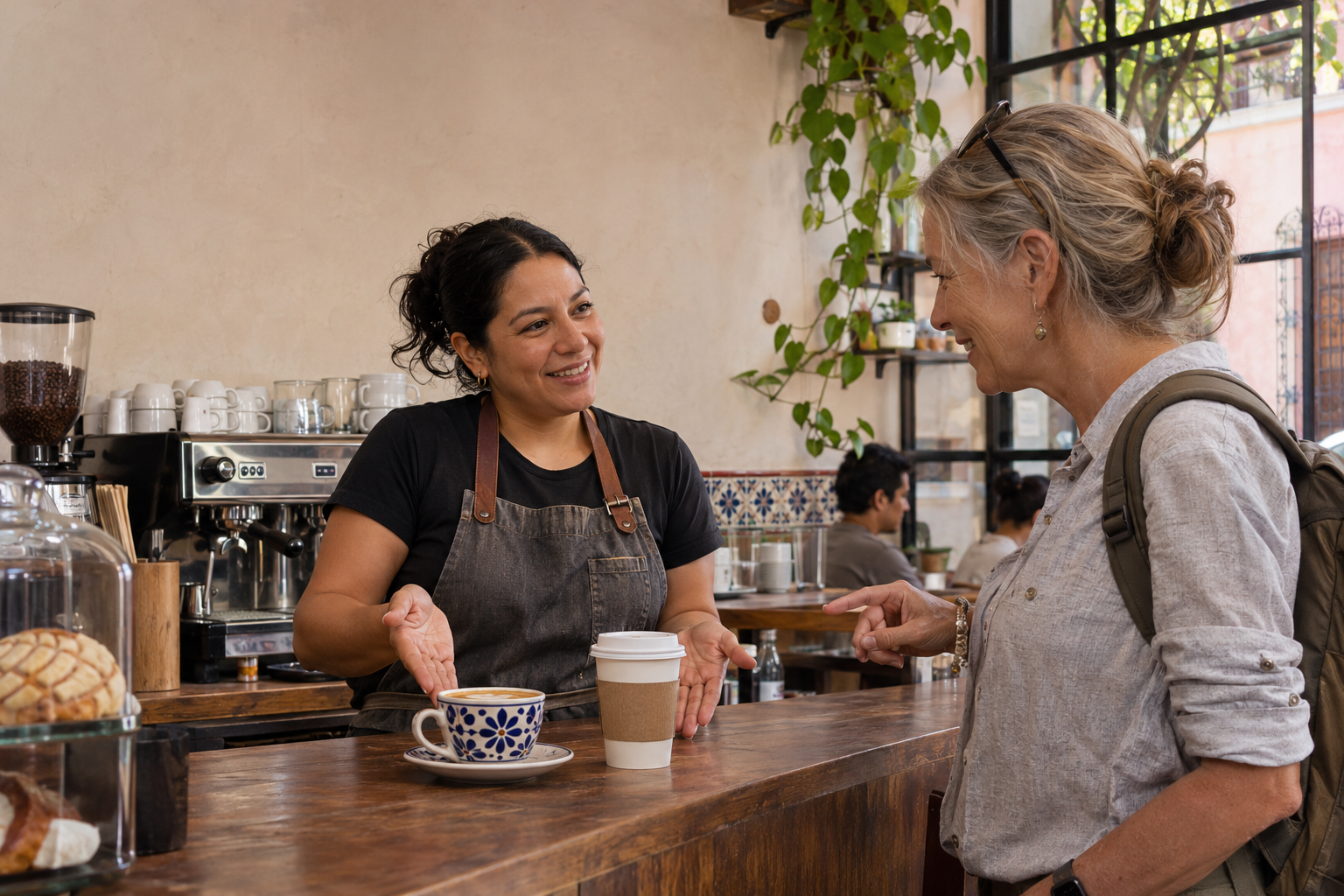
The first question is easy. The answer is where things get interesting.
An adult preparing for a first trip to Mexico might carefully practice Un café, por favor, then arrive at a café and hear ¿Para aquí o para llevar? The coffee order was perfectly understandable. The unexpected question—“For here or to go?”—is what brings the conversation to a halt.
That small exchange is a useful starting point for anyone looking for Spanish classes for Alameda adults before traveling to Mexico. A worthwhile course should help learners handle the next turn in a conversation, including the moments when they miss something.
The aim is manageable: greet someone, explain a need, understand enough of the reply, and ask for clarification. Those abilities can make an unfamiliar place feel considerably easier to navigate. They also make room for the small conversations that rarely appear on an itinerary.
Prepare for the trip that is actually booked
“Spanish for Mexico” is a large assignment. “Spanish for checking into a hotel in Oaxaca, ordering breakfast, and asking when a museum opens” gives a beginner something concrete to work toward.
Before choosing a class, write down five likely interactions from the actual trip. A beach stay with organized transfers creates different language needs from a visit involving intercity buses and independently booked rooms. Neither itinerary requires learning every word in a travel phrasebook.
For a first visit, useful priorities might be confirming a reservation, understanding prices and times, ordering food, asking where something is, and explaining a simple problem. Add personal details: traveling with children, seeking vegetarian meals, visiting relatives, or wanting to talk about art.
Bring that list to a prospective teacher. Ask what a beginner would practice and how the class handles listening. A specific answer—“We rehearse ordering, then change the available items and ask follow-up questions”—reveals more than a promise to build confidence.
A general beginner course can provide a sound foundation, even if it is not advertised as travel Spanish. The useful question is whether its speaking tasks connect basic grammar to situations a traveler will encounter.
The most useful sentence may be “Could you repeat that?”
Phrasebooks tend to organize language around successful transactions. Real conversations contain hesitations, interruptions, background noise, and unfamiliar voices.
Beginners need language for those moments early:
Spanish English When it helps
Estoy aprendiendo español. I’m learning Spanish. Giving someone a little context.
¿Puede repetir, por favor? Could you repeat that, please? Asking to hear something again.
Más despacio, por favor. More slowly, please. Slowing down an explanation.
No entendí la última parte. I didn’t understand the last part. Identifying what was missed.
¿Puede escribirlo, por favor? Could you write it down, please? Confirming a name, address, or number.
These expressions let a learner participate without understanding every word. They also give the other person a practical way to help.
Practice them as part of an exchange. A teacher might name a departure time, deliberately say it faster on the next attempt, and wait for the learner to request repetition. Then the student confirms: ¿A las nueve?—“At nine?”
That final confirmation matters. Nodding can end an uncomfortable moment while leaving the original uncertainty untouched. Repeating the essential detail gives both people a chance to catch a misunderstanding.
There is no prize for maintaining Spanish when communication would be easier in English. If someone switches languages, accept the help. A trip can include both successful Spanish conversations and efficient English ones.
Learn the reply alongside the question
A useful class teaches exchanges in pairs. After ¿Cuánto cuesta?—“How much does it cost?”—comes practice hearing prices. After ¿Dónde está el baño?—“Where is the bathroom?”—come words such as al fondo (“at the back”), a la derecha (“to the right”), and a la izquierda (“to the left”).
Numbers deserve particular attention. Reciting them in order is a different task from recognizing sesenta and setenta in a busy shop. Try hearing prices in random order, writing them as digits, and checking them aloud.
A restaurant exchange offers another good exercise:
Customer: Buenos días. Un café, por favor.
Good morning. A coffee, please.
Server: ¿Para aquí o para llevar?
For here or to go?
Customer: Para aquí. ¿Tiene leche?
For here. Do you have milk?
Server: Sí. ¿Algo más?
Yes. Anything else?
Customer: No, gracias. Eso es todo.
No, thank you. That’s everything.
The exchange is short, but it contains choices, a follow-up question, and a clear ending. Change the drink or remove an item from the imaginary menu, and the learner has to pay attention again.
This is a sensible test of a class: does the activity still work when the answer changes? Memorizing both halves of a fixed dialogue can feel reassuring. Handling a small variation shows what is becoming usable.
A greeting belongs before the request
An English-speaking traveler may mentally translate the necessary information and deliver it immediately: “Where is the entrance?” A slightly fuller opening often makes an interaction feel more considerate: Buenos días. Disculpe, ¿dónde está la entrada?
“Good morning. Excuse me, where is the entrance?” requires only a few extra words. It acknowledges the person being asked.
In shops, hotels, and other everyday encounters in Mexico, a greeting is a useful habit. The setting still matters: a crowded counter does not demand an elaborate introduction, and an urgent question should remain urgent. Courtesy does not require a performance.
The distinction between tú and usted also deserves explanation. Usted commonly signals formality or respectful distance; its use varies with relationships and circumstances. For a beginner addressing an unfamiliar adult, forms such as disculpeand ¿puede ayudarme? (“Can you help me?”) are useful starting points. They can be learned as complete expressions before the grammar feels familiar. RAE - ASALE
A teacher should make politeness understandable without turning every conversation into a social test. Most first-time visitors will occasionally choose an awkward expression. A clear request, patient tone, and willingness to listen usually offer a better starting point than worrying over every pronoun.
Mexican Spanish: learn what changes the interaction
There is no need to master a collection of slang before boarding the plane. A beginner benefits more from recognizing ordinary vocabulary and hearing speakers from the destination.
For a practical starting set, learn jugo for juice, boleto for a ticket, celular for a mobile phone, and para llevar for takeaway. Vocabulary varies within Mexico as well as across countries, so treat these as useful choices rather than the only possible words.
Two broader features are worth knowing. In everyday Mexican Spanish, ustedes is the usual plural “you,” used for both formal and informal situations. A course may introduce Spain’s vosotros, but a Mexico-bound beginner can prioritize ustedes. In pronunciation, z and c before e or i generally have an “s” sound, as in gracias. This pattern, called seseo, is standard throughout Spanish-speaking America. RAE - ASALE
Then there are words whose meaning depends heavily on the situation. Ahorita is a useful example. The Diccionario del español de México gives meanings ranging from the present moment to a short time later or when possible. Translating it automatically as “right now” can therefore create confusion. If timing matters, ask ¿Como en cuántos minutos?—“About how many minutes?” Diccionario del español de México
That is a language lesson, not evidence for a sweeping claim about how an entire country treats time. Context is doing work that an English translation may conceal.
Put pronunciation effort where it helps most
The rolled r can absorb a remarkable amount of a beginner’s attention. It deserves practice, but it should not monopolize preparation for a holiday.
Ask a teacher to check the pronunciation of the words that matter to this trip: the destination, accommodation name, nearby street, and frequently used requests. Hearing the correct syllable stress can be more useful immediately than attempting to eliminate an English accent.
Keep the written Spanish beside an audio example whenever possible. English-style spellings are rough approximations, and they can encourage habits that later need correcting.
A practical exercise is to record a short request, listen to a teacher’s version, and try again. Choose one change at a time. Can the listener identify the destination? Is the question clear? Are the key words distinct?
Clear, understandable speech is a reasonable goal for the first trip. A convincing imitation of a local accent can wait.
Choosing a class from Alameda
For an Alameda resident, the choice involves both teaching and logistics. An appealing class still needs to fit an ordinary week.
If considering an in-person course in Berkeley, check the journey from the actual starting point at the actual class time. Include parking or the final walk from transit. A convenient-looking location on a map may feel different after work.
For online instruction, ask how much time students spend speaking and how the teacher checks listening. Live teaching can provide useful interaction remotely, but “online” alone says little about the lesson itself.
Class level matters just as much. Someone who studied Spanish years ago may remember vocabulary while struggling to build a sentence aloud. A true beginner may recognize plenty of words from life in California without having studied the language systematically. Neither situation is unusual. Describe what can be done now, and ask for placement advice.
In a group, look for enough individual turns to practice, time to ask questions, and activities with changing answers. Individual lessons may suit a short preparation window or particular itinerary. A group can provide a steadier progression and practice listening to classmates as well as the instructor.
Ask one concrete question before enrolling: “What would I be able to practice in a typical lesson?” The answer should make the class easier to picture.
A manageable routine before departure
If several weeks remain, divide preparation into small, connected tasks. Begin with greetings, pronunciation, and requests for clarification. Add numbers and times, then work through the five situations chosen from the itinerary.
Between lessons, a brief routine can have three parts: listen to a short exchange, say something aloud, and change one detail. Order two coffees instead of one. Move the reservation from Thursday to Friday. Ask for the price without looking at the written number.
Keep a small personal phrase sheet on the phone, including the accommodation address and useful questions. Test any translation tool before relying on it during the trip. It is easier to learn an app’s controls at home than at a counter with someone waiting.
During the final week, rehearse a sequence rather than adding another hundred words. Arrive at the imaginary hotel, give a name, ask about breakfast, miss the time, request repetition, and confirm it. The exercise should include one small complication. That is what makes it preparation.
If departure is only days away, narrow the goal. Learn greetings, clarification phrases, essential personal information, and the words needed for a few likely encounters. A handful of lessons cannot promise fluency; they can help a traveler become more willing and better equipped to speak.
A class should leave room for the unscripted moment
Polyglottist Language Academy offers live language classes for adults, including online instruction and selected in-person classes in Berkeley, California. Spanish lessons emphasize practical communication alongside pronunciation, grammar, and cultural understanding.
For Alameda adults planning a first trip to Mexico, the current Spanish options distinguish between beginner groups in Berkeley, individual online lessons by arrangement, and an online advanced conversation group for experienced speakers. Someone starting from zero should look at Complete Beginner or ask about individual instruction suited to the trip. The Spanish classes page lists current formats, levels, dates, and tuition. Polyglottist Language Academy
The most satisfying preparation may show up in an ordinary exchange: a question answered, a time clarified, a recommendation understood well enough to follow. Perhaps the conversation lasts twenty seconds. Perhaps it continues because there is something else to ask.
Either way, the useful achievement is the same: being able to take another turn.